
Richard J. Condon Commissioner Division Of Criminal Justice Services
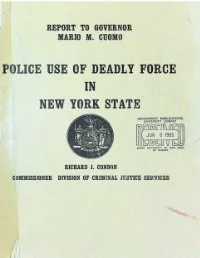
Police Use of Deadly Force in New York State: A Report to Governor Mario M. Cuomo (1985) offers one of the earliest systematic examinations of how and why lethal force was deployed by law enforcement across the state during a period of intense public scrutiny. Commissioned at a time when debates over police accountability, training standards, and civil rights were gaining national prominence, the report evaluates legal frameworks, departmental policies, and patterns of police–citizen encounters to assess the necessity and proportionality of deadly force incidents. Drawing on case reviews, agency surveys, and statistical analyses, it seeks to identify structural weaknesses and propose reforms aimed at reducing unnecessary violence and strengthening public trust.
Viewed from today’s perspective, the report stands as an important precursor to contemporary discussions about policing and the appropriate limits of state power. In the decades since its publication, nationwide movements such as Black Lives Matter, advances in data transparency, increased availability of video evidence, and evolving constitutional standards have intensified scrutiny of deadly force practices. Modern debates continue to revolve around issues the 1985 report identified early on: the need for clear and consistent use‑of‑force policies, robust training in de‑escalation, improved data collection, and stronger mechanisms of accountability. As current policymakers and communities grapple with how to balance public safety, civil liberties, and equitable treatment, this historical report offers valuable insight into the longstanding nature of these challenges and the enduring need for thoughtful, evidence‑based reform.
If you'd like, I can also turn this into a full foreword, integrate it into a larger document, or tailor the tone for academic, policy, or public audiences.
NY. Division Of Criminal Justice Services. 1985. p.273.
