Open Access Publisher and Free Library
CRIMINAL JUSTICE.jpeg

CRIMINAL JUSTICE

CRIMINAL JUSTICE-CRIMINAL LAW-PROCDEDURE-SENTENCING-COURTS

Law Enforcement Officers’ Perception of Rape and Rape Victims: A Multimethod Study

By Annelise Mennicke, MSW Delaney Anderson, MSW Karen Oehme, JD Stephanie Kennedy, MSW

Rape and sexual violence are alarmingly common in our society, demanding a focused and coordinated response among researchers, the justice system, and health and social service providers. According to the Rape, Abuse, and Incest National Network (RAINN; n.d.), a sexual assault occurs every two minutes in the United States, totaling to 207,754 victims of rape and sexual assault each year. Using these inci- dence rates, RAINN estimates that one out of every six women will be raped during her lifetime (RAINN, n.d.). Victims of rape commonly experience a wide range of physical and emotional effects, including posttraumatic stress disorder, substance abuse, depres- sion, anxiety, sleep disorders, eating disorders, and many other negative and long-lasting consequences (RAINN, n.d.).

Springer Publishing Company, 2014, 15p.

download
Applying Procedural Justice to Sexual Harassment Policies, Processes, and Practice: Issue Paper

By Umphress, E., and Thomas, J. M. (Eds.)

The 2018 National Academies report Sexual Harassment of Women: Climate, Culture, and Consequences in Academic Sciences, Engineering, and Medicine recommends the creation of institutional policies that can improve an institution's climate, culture, and reporting options while supporting those who have experienced sexual harassment.

This perspective paper addresses the 2018 report recommendations by exploring how a procedural justice framework could help guide improvements and revisions to policies, processes, and practices within higher education institutions with the potential to mitigate the negative experiences and outcomes of those affected by sexual harassment. Based on previous research, this paper applies a principles-based perspective to highlight ideals, rules, and standards that institutions can implement to achieve this goal.

Washington, DC: The National Academies Press. https://doi.org/10.17226/26563. 2022. 33p.

download
Mitigation Strategies for Deterring Transit Assaults

By Joan G. Hudson, et al.

This guidebook provides guidance for transit agencies seeking to address and mitigate assaults on passengers and transit workers. Developed through an extensive research effort—including a literature review, national assault data analysis, agency surveys, focus groups, and interviews with six transit agencies—this guidebook equips agencies with practical strategies and evidence-based recommendations to enhance safety and security in the transit environment.

Assaults on transit systems, while varying across time, location, and agency size, pose significant safety concerns for both passengers and transit workers. This guidebook begins by outlining the scope of the issue, including definitions, key facts, and the impact of the transit environment on perceived and actual security. The guidebook then presents national data trends and insights into the causes, risks, and consequences of transit-related assaults.

National Academy of Sciences.. 2025. 95p.

download
Identifying Gaps in Sexual Harassment Remediation Efforts in Higher Education:

By TERESA FRASCA et al.

Sexual harassment continues to be a persistent problem in institutions of higher education, despite the creation of new resources, policies, and programs aimed at combatting high rates on campuses (NASEM, 2018). Historically, these institutions have focused sexual harassment 1 prevention and response efforts on complying with the requirements of the law (NASEM, 2018). Specifically, institutions in the United States have focused on responding to formal reports of sexual harassment through complying with Title IX and Title VII2 —which prohibit discrimination against employees, students, staff, and/or faculty on the basis of sex—rather than identifying what harm has been caused by the sexual harassment, who has been harmed, and how that harm can be repaired. Even when institutions provide resources to repair the harm caused by sexual harassment, the harm might extend beyond the conclusions of the institutional response process and provision of the required remedial measures and sanctions (when applicable) (e.g., Grossi, 2017; Karp and Frank, 2016; McMahon et al., 2019; NASEM, 2018; Smith and Freyd, 2014). Put simply, there is a lack of attention to remediating (or repairing and limiting) the damage caused by sexual harassment across the timeline of the institutional response process (see Box 1 and Figure 1).

National Academies of Sciences. 2025. 76p.

download
Latin America and the Caribbean Economic Review, April 2025: Organized Crime and Violence in Latin America and the Caribbean.

By William Maloney, Raul Morales Lema, and Marcela Meléndez Arjona

The Latin America and Caribbean region faces a very different outlook from what was foreseen six months ago. Despite continued progress on reducing inflation, LAC continues to grow more slowly than any other region of the world and increasing its dynamism and job creation potential faces new and daunting challenges. First, higher and more persistent inflation than anticipated in the advanced countries has slowed global interest rate declines which constrains regional monetary authorities’ ability to loosen monetary policy. Second, higher interest payments on debt consume an increasing share of government revenue impeding progress on reducing deficits and creating fiscal space for necessary public investment. Third, rising tariffs have driven up uncertainty around the nature of the global trade order, threaten market access for exports, and call into question the nearshoring project. Fourth, increased return migration will, in some cases, stress local labor markets and dampen remittances. Fifth, organized crime, and the violence that accompanies it continues to expand, reducing the quality of life of citizens, dampening economic growth, and undermining the integrity of public institutions. Progress on the fiscal front, as well as continued productivity related reforms to make the region more able to negotiate a changing environment are needed.

Washington, DC: The International Bank for Reconstruction and Development / The World Bank, 2025. 92p.

download
Emotional Labour and Public Protection Policing: The experience and impact of emotional labour on Police Scotland public protection police officers

By Maureen Taylor and Lesley McMillan

There is a significant body of research that illustrates the emotional demands of policing and the physical and psychological toll this takes on officers and staff. However, the management of these demands, particularly in more specialist roles such as those in public protection policing where the demand may be higher, are less well understood. This research explores the experiences of public protection police officers in Police Scotland through a lens of emotional labour The aims of this research were to: • Critically review the literature around the emotional impacts of policing on officers and the role of emotional labour in policing; • Establish the experience of, and impact on, officers involved in the investigation of public protection cases; assess how police officers in roles where emotional labour may be heightened, manage their emotions and the strategies they develop to do so; and • Examine how emotions and emotion management are mediated by organisational, departmental and role values, demands and culture In doing so, the research sought to answer the following research questions: 1. What is the emotional experience of police officers in public protection roles and what impact does it have on them? 2. What emotional labour do officers undertake, and what strategies of emotion management do officers employ? 3. To what extent does the theory of emotional labour explain the experiences of public protection police officers? 4. What role does the prevailing organisational culture play in the emotion management strategies of public protection policing? This report presents the findings from this research and a potential framework for understanding the factors that contribute to resilience within the context of public protection policing

Edinburgh: Scottish Institut Institute for Policing Research, 2025. 32p.

download
Placebo Trials: A New Tool to Discourage Wrongful Convictions Caused by Jury Error

By Hayley Stillwell

Despite the foundational principle in the American criminal justice system that it is better to acquit the guilty than to convict the innocent, wrongful convictions remain a persistent issue. Wrongful convictions are sometimes caused by flawed evidence, such as eyewitness misidentifications and unreliable forensic techniques. Researchers and scholars have studied this problem of flawed evidence extensively, leading to many successful reform efforts to address this portion of the wrongful conviction problem. But there is another portion of the wrongful conviction problem that has yet to be the target of reform efforts—wrongful convictions caused by juror error. Implicit biases, forbidden assumptions, and strategic voting are jury errors that can lead to wrongful convictions, yet they are difficult problems to address given the black box of secrecy that surrounds jury deliberations. This Article proposes the use of “placebo trials” as a novel thought experiment that could transform into a real experimental method to identify and address jury error. Placebo trials simulate real trials in every way, but they are not real. As far as jurors know, however, they are sitting on a real trial. Another important characteristic of placebo trials is that the objectively correct verdict outcome is an acquittal. By inserting a variable into a placebo trial, the experiment can show with firsthand jury data whether the variable impacts acquittal rates. If a variable has such an effect, then it may lead to wrongful convictions and should be the focus of reform efforts.

56 Ariz. St. L.J. 1361 (2024 )

download
Times Crime and Justice Commission: A report into the state of the criminal justice system

By The Times of London

final report. Its 10 recommendations for change include a universal digital ID system, the roll out of live facial recognition, a licence to practise for the police, victim care hubs, restriction of social media for under 16s and raising the minimum age of criminal responsibility to 14.

London: Time of London, 3035. 57p

download
The Court of Appeal in Northern Ireland

By Conor McCormick and Brice Dickson

Available open access digitally under CC-BY-NC-ND licence. This compelling book underscores the significance of the Court of Appeal in Northern Ireland, making a significant contribution to the literature and proposing recommendations on how it could enhance both its efficiency and its reputation.

Bristol, UK: Bristol University Press, 2024.

download
Access to Social Justice: Effective Remedies for Social Rights

By Katie Boyle, Diana Camps, Kirstie Ken English, Jo Edson Ferrie, Aidan Flegg, and Gaurav Mukherjee

Available open access digitally under CC-BY-NC-ND licence. This book addresses the significant violations of social rights in the UK, as well as the gaps in access to justice to remedy them. This is a unique contribution to our understanding of human rights from the perspective of access to justice with key insights for policy and practice.

2025, 253p.

download
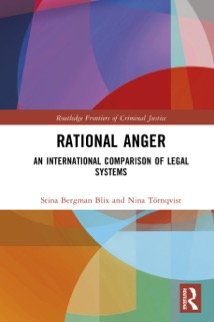
Rational Anger: An International Comparison of Legal Systems

By Stina Bergman Blix and Nina Törnqvist

Exploring the rationales behind legal anger, its logic and origins, this book builds on the perspectives of judges and prosecutors in Italy, Sweden, the United States, and Scotland. When do judges and prosecutors become angry in court, what do they become angry about, and which other emotions open up for anger? Anger brings people to court and is essential in evaluating wrongdoing and attributing blame, but at the same time, anger is seen as a threat to well-reasoned and just decision-making. Drawing on observations, interviews, and shadowing of legal professionals, the text demonstrates how anger is entangled with legal thought and comes into play in legal practices. By comparing the workings and displays of anger found in different legal systems and emotional cultures, the book elucidates assumptions about law, morality, truth, and emotions that we commonly take for granted. Rational Anger will be of great interest to students and scholars of criminology, criminal justice, sociology, law, social psychology, and organisation studies.

Oxford, UK; New York: Oxford University Press, 2025. 124p.

download
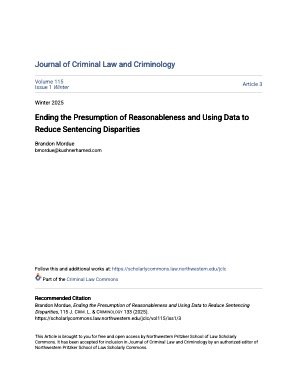
Ending the Presumption of Reasonableness and Using Data to Reduce Sentencing Disparities

By Brandon MordueFollow

The idea that one’s punishment should depend on the crime committed rather than which judge happens to do the sentencing strikes most as uncontroversial, if not a requirement for a fair sentencing regime. Forty years ago, the passage of the Sentencing Reform Act promised just that result. Increased data availability allows us to evaluate the project’s success. The results are not encouraging.

Federal defendants are sentenced using guidelines issued by the United States Sentencing Commission that sometimes bear little relation to the underlying wrongdoing. This has created a split among judges, with some following the guidelines and others rejecting them. The consequences are arbitrariness in sentencing and unwarranted disparities across offenders.

In 2007, the Supreme Court permitted appellate courts to presume the reasonableness of guideline sentences, largely insulating those sentences from judicial review. Much has changed since then, and it is time for the presumption to go. The findings of the original data analysis presented in this Article, as well as developments since the Court’s decision, show that the claims made in support of the presumption are unfounded. In fact, some of the related case law rests upon provably false empirical premises.

Today, most sentences are not within the range set by the guidelines. Favoring the minority of sentences that are within the range results in a sentencing regime incompatible with the overriding statutory aim of avoiding unwarranted sentencing disparities. Rather than presuming the reasonableness of within-guideline sentences, the courts can chart a course correction by prioritizing the data on actual sentences from the Sentencing Commission. Such a shift would achieve more consistent sentences across offenders convicted of similar crimes.

115 J. Crim. L. & Criminology 133 (2025), 73p.

download
Participatory Defense and Three Pillars of Criminal Injustice

By Isis Misdary

Three separate but closely related factors have together produced this nation’s epidemic of mass incarceration. First, the enforcement of criminal law has become wholly dominated by a caste of repeat players. The chasm between this grouping and outsiders has become far more important than the prosecution-defense duality ostensibly dominating the system. Second, the system’s design and policies have become dominated by central authorities sealed in a “tough-on-crime” echo chamber. This leaves local communities largely powerless to check the devastation being visited upon them. And third, the system has ruthlessly suppressed the individuality of those facing charges. They are rarely seen, almost never heard, ignored if they try to contextualize events giving rise to the charges, and punished severely if they attempt to assert their rights, much less their innocence. Robbed of all that makes them human, their fates arouse little sympathy. Devastated communities have mounted various responses to mass incarceration. None is more exciting than the participatory defense movement. This movement seeks to involve the person facing charges as well as that person’s family and community. Together, they meet with defense counsel, gather evidence for the case, and in mitigation, prepare videos or other testimonials to influence charging and plea-bargaining decisions and undertake other efforts to support the person facing charges. Through the movement’s work on individual cases, families and communities have spotted issues within the criminal systems and the criminal laws close to home that must change, that must end. Case by case, they have started to challenge, change, and end them. Yet, for all its promise, participatory defense may face considerable challenges going forward in these areas. As a relatively new movement, it must continue to resolve significant design challenges and overcome formidable institutional and attitudinal buttresses the current system has erected.

25 Nev. L.J. 325 (2025), 92p.

download
THE PRETRIAL FAIRNESS ACT: EQUITY, BUT AT WHAT COST?

By John Burns

This Note traces the evolution of bail from its origins to modern commercial bail, highlighting how the system has disproportionately affected low-income defendants. In 2023, Illinois became the first state to eliminate cash bail with the enactment of the Pretrial Fairness Act, which attempted to remedy longstanding inequities. The Note situates Illinois’s approach between New Jersey’s successful risk-based reform and California’s oversimplified and harmful “zero bail” experiment. While Illinois’s reform represents a meaningful step toward fairness, this Note argues that its reliance on a categorical approach and its limited use of pretrial assessments may unintentionally undermisne its effectiveness. The Note concludes that Illinois must go further by expanding judicial discretion and mandating the use of risk assessment tools.

Washington University Journal of Law & Policy [Vol. 78, 2025. 29p.

download
Judge-Scholar Collaboration and the Second Amendment

By Andrew Willinger and Eric Ruben

Legal scholarship is overly abstract and theoretical, making it unhelpful to judges and lawyers. That, at least, is the common critique from the bench. When it comes to the Second Amendment, however, a different pattern has emerged: judges consistently cite law review articles and look to the academy for guidance. Most recently, in United States v. Rahimi, some Justices went further, implicitly inviting more scholarly work to help the Court answer open questions raised by its novel methodological approach to the Second Amendment. This Article explores this aberrant trend.

We raise several explanations for the distinctive scholarly role in Second Amendment jurisprudence, including the Amendment's unique aspects as well as the role of legal movements in facilitating the Amendment's development. Faced with a lack of judicial precedent on both the right to keep and bear arms and originalism-in-practice, law review articles often can be more helpful than past opinions. Beyond scholarship's utility in a new area of law, we suggest that a related phenomenon-the gun rights and conservative legal movements' trifold success at facilitating the rise of the individual Second Amendment right, popularizing originalism as a methodology, and elevating originalist judges to the bench-is an important part of the story. For a half century, organizations focused on achieving both a robust right to bear arms and a conservative vision of the Constitution have become more prominent and have closely associated with both scholars and judges. If, in the usual telling, judges look askance at scholarship, this specific area of law might present an exception since it has been a joint project from the beginning.

The Article concludes that the judge-scholar collaboration that has characterized Second Amendment case law is likely to continue. Moreover, it could have ramifications far beyond the right to keep and bear arms, including for other rights that may be on the cusp of transformation and for other legal movements seeking to emulate the strategies that ushered in modern Second Amendment law.

78 SMU Law Review __ (forthcoming), Duke Law School Public Law & Legal Theory Series No. 2025-26, SMU Dedman School of Law Legal Studies Research Paper No. 696,


download
Antisemitism, Anti-Zionism, and Title VI: A Guide for the Perplexed

By Benjamin Eidelson, Deborah Hellman,

Universities are facing an unprecedented wave of claims that they have violated their obligations to Jewish students under Title VI of the 1964 Civil Rights Act. These charges center on an equally unprecedented wave of anti-Israel activity on college campuses, much of which is alleged to cross the line into antisemitism. This essay, forthcoming in the Harvard Law Review Forum, provides one of the first systematic analyses of these exceptionally high-stakes claims about Title VI.

Our analysis reveals that the Title VI claims face formidable hurdles, including some that have received surprisingly little attention thus far. Most fundamentally, Title VI’s omission of “religion” as a protected characteristic means that Jewishness is protected under the statute only insofar as it constitutes a “race” or (less likely) a “national origin.” Under existing law, however, discrimination based on the cultural practices or viewpoints that may be associated with such an immutable characteristic—as Zionism might be associated with Jewishness—is ordinarily not cognizable as discrimination based on the protected characteristic itself. Moreover, if “hostile environment” liability can be founded on offensive conduct that does not constitute covered disparate treatment in its own right, this is likely possible only pursuant to a disparate impact theory that the Trump Administration has denounced and that the Supreme Court has rejected for private suits. Any notion of harassment based on conduct’s “objective offensiveness” would also need to account for distinctive features of the university setting that likely preclude liability for much of the protest activity that has loomed large in recent public discussions of Jewish students’ experiences on campus.

Although specific facts matter and not all of the issues are clear-cut, we thus conclude that appeals to Title VI in this area are much weaker than has been widely appreciated. Of course, this does not mean that campus antisemitism is acceptable. But it does mean that, for the most part, universities have both the right and the responsibility to balance their competing commitments in this area—including commitments to both inclusion and freedom of expression—using their own considered judgment.

Harvard Public Law Working Paper 25-13

Forthcoming, Harvard Law Review Forum (June 2025)

download
Assembly-Line Public Defense

By David Abrams and Priyanka Goonetilleke

Each year, millions of Americans rely on public defenders to fulfill their Sixth Amendment right to counsel. Despite being the linchpin of the criminal justice system, public defense remains both underfunded and understudied. This article provides empirical analysis to contribute to a critical question: How should public defender systems be structured?

Criminal justice advocates, scholars, and the American Bar Association strongly favor vertical representation in public defense. Under this model, a single public defender represents a defendant throughout their case, from initial appearance through sentencing. The alternative approach—horizontal representation—operates like an assembly line: Different attorneys handle each stage of a case, from preliminary hearings to pretrial conferences to trials. The preference for vertical representation stems from the intuitive belief that continuity of representation improves outcomes for defendants. However, no prior empirical work has tested this assumption.

Using a natural experiment created by the Defender Association of Philadelphia’s transition from a fully horizontal representation system to a partially vertical one, we find no evidence that increasing attorney continuity improves defendant outcomes.

These findings have significant implications for how public defender offices should allocate their scarce resources. While vertical representation is considered by many as the ideal, our results cast doubt on whether the additional resources and logistical challenges relative to horizontal representation are justified given the current reality of underfunded public defense. As jurisdictions nationwide grapple with a chronic lack of resources for public defense, this article provides crucial empirical evidence to inform decisions about how best to uphold defendants’ Sixth Amendment right to counsel.

.100 New York University Law Review No. 5 (forthcoming), Northwestern Law & Econ Research Paper No. 25-05, Northwestern Public Law Research Paper No. 25-22, U of Penn, Inst for Law & Econ Research Paper No. 25-10,

download
JUDICIAR TRACELOGY AND ITS EXPERTISE

By Vitalie Jitariuc

The achievement of the tasks of the criminal process, which relate to the identification and punishment of persons who have committed criminal acts, is inextricably linked to the restoration of the truth in criminal cases. Only on the basis of comprehensive and thorough investigations of all aspects of socially dangerous acts can we determine the role of each person involved in the crime and establish with sufficient certainty the circumstances in which the crime was committed.

Reaserch Gate, 2024, 256p.

download
Managing Security in the Built Environment – A Review of Environmental Crime Prevention Strategies

By C. HANNAH,* S. TADEPALLI AND P. GOPALAKRISHNAN

The practice of urban planning and building design largely follow traditional methods while transforming the structure and quality of life in the built environment. The process of managing cities requires updates and integration of new technologies and research efforts. In this context, development of smart, sustainable, energy efficient, healthy, safe and secure built environment is a priority that is shaping modern cities all over the world. Though management of Indian cities tries to address these issues to a certain extent, it can be said that, as compared to many developed countries, aspects of safety and security have not been the top priority of our planners and designers. Research on Environmental Criminology and Environmental Psychology clearly indicates the important role and benefits of crime prevention through appropriate design of the built environment. In this context, this paper highlights the role of crime prevention strategies and the relevance of environmental criminology in current building practices for addressing security concerns in India.

Creative Space, Vol. 2, No. 2,, January 2015, pp. 141–156

download
Introduction to the Special Issue

By Joan E. Durrant, PhD

One of Britain’s colonial legacies is the common law defence available to adults who corporally punish children. Canada inherited this defence, which became codified in 1892 as Section 43 of the Criminal Code. The aim of this Special Issue is to examine Canada's law alongside those of other former members of the British Empire that have abolished their defences - Ireland, Scotland and Wales. The first three papers in this issue will place Canada's law within its global, historical and colonial contexts. The next three papers tell the stories of how Ireland, Scotland and Wales overcame the same challenges faced in Canada to ultimately provide equal protection for children.

Department of Community Health Sciences

Max Rady College of Medicine, 7p,

download