Open Access Publisher and Free Library
TERRORISM.jpeg

TERRORISM

Terrorism-Domestic-International-Radicalization-War-Weapons-Trafficking-Crime-Mass Shootings

Posts in Inclusion
On the Front Line: A Guide to Countering Far-Right Extremism

By Vidhya Ramalingam

Far-right extremism remains a worrying problem across Europe. The most visible cases are those that hit the headlines, such as the discovery of the National Socialist Underground in Germany or Anders Behring Breivik’s attacks in Norway. In the past decade, both Hungary and Sweden were hit by a string of serial murders of Roma and ethnic minorities. Though attacks of this magnitude and scale remain rare, they are not unheard of. In some cases, those personally touched by these violent attacks are still fighting for justice. While high-profile and high-impact events hit the headlines, the bulk of the threat posed by the far right is felt through smaller-scale localised harassment, bullying and hate crime by extremists targeting minority communities. These kinds of incidences often go undetected, and indeed they are hard to quantify. They manifest in the sectioning off of some local areas as no-go zones for ethnic minorities, graffiti of far-right symbols on mosques and synagogues, or threats received by individual members of the community. Those carrying out these actions – far-right extremists – are a broad group, ranging from less ideological youth street gangs to neo-Nazi terrorist cells, anti-Islam activists and registered political parties. Though they differ in their aims and methods, there are some defining features: racism, xenophobia, ultra-nationalism and authoritarianism.

London: Institute for Strategic Dialogue, 2014. 77p.
download
Networked Radicalization: A Counter-Strategy

By F. Cilluffo, G.B. Saathoff, et. al

Savvy use of the Internet has empowered terror networks to expand their reach beyond national borders by enabling wide distribution of a compelling message and social connectivity with new audiences. Use of computer-mediated communication (CMC) has made a range of terrorist operational activities cheaper, faster, and more secure, including communications, fundraising, planning and coordination, training, information gathering and data mining, propaganda and misinformation dissemination, and radicalization and recruitment. The list is long, and not even complete. Before the Internet, terrorists seeking to communicate with one another through electronic means used telephones or radios, which could be tapped. Terrorists seeking to offer training meant congregating trainers and trainees in a fixed training location, exposing the group to capture or worse. Terrorists or their supporters engaged in fundraising or recruitment often pursued these aims in public settings. And terrorists researching a potential target often did so at public libraries and bookstores, subjecting them to surveillance in these public spaces. Now, with the Internet, all of these same activities can be conducted in relative anonymity from safe locations across the globe.

Washington, DC: Homeland Security Policy Institute, The George Washington University; Charlottesville, VA: The Critical Incident Analysis Group (CIAG) University of Virginia School of Medicine, 2007. 34p.

download
Domestic Terrorism: An Overview

By Jerome P. Bjelopera

The emphasis of counterterrorism policy in the United States since Al Qaeda’s attacks of September 11, 2001 (9/11) has been on jihadist terrorism. However, in the last decade, domestic terrorists—people who commit crimes within the homeland and draw inspiration from U.S.-based extremist ideologies and movements—have killed American citizens and damaged property across the country. Not all of these criminals have been prosecuted under federal terrorism statutes, which does not imply that domestic terrorists are taken any less seriously than other terrorists. The Department of Justice (DOJ) and the Federal Bureau of Investigation (FBI) do not officially designate domestic terrorist organizations, but they have openly delineated domestic terrorist “threats.” These include individuals who commit crimes in the name of ideologies supporting animal rights, environmental rights, anarchism, white supremacy, anti-government ideals, black separatism, and beliefs about abortion

Washington, DC: Congressional Research Service, 2017. 62p.

download
Breaking Down the State: Protestors Engaged

Edited by Jan Willem Duyvendak and James M. Jasper.

In this important book, Jan Willem Duyvendak and James M. Jasper bring together an internationally acclaimed group of contributors to demonstrate the complexities of the social and political spheres in various areas of public policy. By breaking down the state into the players who really make decisions and pursue coherent strategies, these essays provide new perspectives on the interactions between political protestors and the many parts of the state—from courts, political parties, and legislators to police, armies, and intelligence services. By analyzing politics as the interplay of various players within structured arenas, <i>Breaking Down the State</i> provides an innovative look at law and order versus opposition movements in countries across the globe.

Amsterdam: Amsterdam University Press, 2015. 246p.

download
Veracruz: Fixing Mexico’s State of Terror

By International Crisis Group

Once regarded as a minor hub in Mexico’s criminal economy, Veracruz is now confronting the harrowing truths from over a decade of violence and grand corruption. At least 2,750 people are believed to have disappeared in a state whose former governor is wanted for embezzlement on numerous counts. The murders of seventeen journalists from 2010 onwards are the most notorious examples of a whirlwind of killings that targeted, among others, legal professionals, police officers, potential witnesses to crimes and any civilians who dared check the ambitions of a multitude of criminal organisations and their political accomplices. A new governor from the opposition National Action Party (PAN) has promised to clean out the state and prosecute wrongdoers, fostering hopes that peace can be restored. But as economic turbulence threatens the country, and bankruptcy looms over Veracruz, strong international support will be crucial to bolster initiatives aimed at finding the bodies of the disappeared, investigating past crimes, and transforming the state’s police force and prosecution service. Veracruz is emblematic of the challenges facing the country as a whole. Threats by the new U.S. administration to curb Mexican imports and fortify the border to keep out undocumented immigrants imperils its southern neighbour’s economic prospects. Similarly, President Trump’s predilection for armed force to combat cartels ignores the harm produced by the militarisation of public security as well as its proven ineffectiveness. But Mexican voices demanding a stronger national response are hamstrung by the extreme unpopularity of political leaders and public estrangement from government. Corruption and perceived criminal complicity have undermined the legitimacy of the Mexican government at all levels, especially at the tier of the country’s 31 regional states. Baptised “viceroys” as a result of the extraordinary powers granted them during Mexico’s transition from one-party regime to multiparty democracy, state governors have also become some of the country’s most disreputable public authorities. Since 2010, eleven state governors have come under investigation for corruption. In Veracruz, an alliance between criminal groups and the highest levels of local political power paved the way to an unbridled campaign of violence through the capture of local judicial and security institutions, guaranteeing impunity for both sides. Strengthening institutional probity and capacity in Veracruz, as in the rest of Mexico, will require federal and state levels to deliver on vows to work in partnership to staunch corruption, and on their willingness to abjure short-term political and electoral advantage. With the election of the new governor, Miguel Ángel Yunes Linares, the once hegemonic Institutional Revolutionary Party (PRI) lost power in the state for the first time in over 80 years. But the PRI remains in control at the federal level and has shown wavering commitment to Yunes’ reformist plans, not least because of the importance of securing votes from the region, the country’s third most populous, in the 2018 presidential election. The state’s budgetary crisis and the new governor’s two-year mandate make it highly unlikely that the state government could accomplish sweeping reform to Veracruz’s institutions without sustained federal backing.

Brussels: International Crisis Group, 2017. 41p.

download
A Dark and Constant Rage: 25 Years of Right-Wing Terrorism in the United States

By Anti-Defamation League

Right-wing extremists have been one of the largest and most consistent sources of domestic terror incidents in the United States for many years, a fact that has not gotten the attention it deserves. n The Anti-Defamation League’s Center on Extremism has compiled a list of 150 rightwing terrorist acts, attempted acts, and plots and conspiracies that took place in the United States during the past 25 years (1993-2017). These incidents were perpetrated by white supremacists, anti-government extremists, anti-abortion extremists and other types of right-wing extremists. n The vast majority of right-wing terror incidents have stemmed from white supremacists and anti-government extremists (such as militia groups and sovereign citizens), with the two broad extremist movements being responsible for almost the same number of incidents (64 related to white supremacists, 63 to anti-government extremists). n Most acts were committed by small number of extremists acting on their own rather than at the behest of organized extremist groups. About half of the 150 incidents were actually committed by lone wolf offenders. n Right-wing extremists have killed 255 people in these attacks and injured over 600 more. n Overwhelmingly, firearms and explosives were the most common weapons chosen: 55 of the incidents involved use or planned use of firearms; 55 involved use of explosives. Overall, incidents involving firearms were more likely to be deadly. n Right-wing terror incidents have involved a wide array of targets, with government, law enforcement, racial and religious targets the most common. n Right-wing terror incidents occur consistently because the movements from which they emanate are mature extremist movements with deep-seated roots. The Internet has made it easier for extremists to meet each other (and thus engage in plots), as well as to self-radicalize and become lone wolf offenders. n Right-wing terrorism is a subject under-covered by the media, in part perhaps because so many right-wing terror incidents take place far from major media centers and urban areas. One consequence of this relative lack of coverage has been an inadequate awareness among policy-makers and the public alike of the threat that violent right-wing extremists pose. n If the United States does not treat right-wing extremism as a real threat, the list of right-wing terror incidents can only grow.

New York: ADL, 2022. 28p.

download
White Crusade: How to Prevent Right-Wing Extremists from Exploiting the Internet

By Christina Schori Liang and Matthew John Cross

Right-wing extremists (RWEs) are using the current protests over police brutality in the United States as a cover to commit terroristic acts and to grow their numbers. They present a significant danger to public safety and security and are a growing threat in the West. Despite this, the rise of right-wing extremism (a homogenized term for white ethnonationalists, alt-rights, white supremacist groups, male supremacist groups, and rightwing anti-government extremists) has not been afforded the priority and attention it justly deserves. There are three reasons for this. First, the global narrative maintains that terrorism rests almost exclusively in the hands of a balaclava-clad Salafi-jihadist holding a Kalashnikov. Second, Western right-wing media has largely pushed back against covering the rise of right-wing extremism and the media as a whole has failed to contextualize the systematic threat RWEs present. Third, the global pandemic has forced governments to focus their attention on maintaining public health and socioeconomic order and have consequently failed to see how RWEs are subversively using the pandemic to support and expand their own agenda. RWEs have utilized the lawless and unmoderated internet to reach broader audiences, disseminate literature, and target vulnerable people. They have done so quietly, pushing an ideological campaign that manifests itself under the surface of popular internet discourse, rather than the aggressive proselytizing of Salafi-jihadist groups like the Islamic State. These efforts can be understood as a kind of subversive exposure, where memes and fake news dominate discourse. This paper will analyse the scope of the RWE threat, describe their latest modus operandi, and explore how the pandemic is being instrumentalized by such groups and how the internet has become their principal tool and battleground. The paper will then provide theory and evidence for how counter-narrative programs, especially through digital disruption, can help neutralise the threat.

Geneva: Geneva Centre for Security Policy, 2020. 27p.

download
The Rise of Far-Right Extremism in the United States

By Seth G. Jones

Right-wing extremism in the United States appears to be growing. The number of terrorist attacks by far-right perpetrators rose over the past decade, more than quadrupling between 2016 and 2017. The recent pipe bombs and the October 27, 2018, synagogue attack in Pittsburgh are symptomatic of this trend. U.S. federal and local agencies need to quickly double down to counter this threat. There has also been a rise in far-right attacks in Europe, jumping 43 percent between 2016 and 2017.

Washington, DC: Center for Strategic and International Studies (CSIS), 2019. 9p.

download
Right-Wing Extremism among the Youth in Spain: Current situation and Perspectives

By Lucía Miranda Leibe, Bettina Steible, Almudena Díaz Pagés and Natalia Sueiro Monje

Violent right-wing extremism has resurfaced as a worrying phenomenon in Europe, with terrorism being one of its most serious and visible forms. Old and new forms of right-wing based violence have emerged in recent years, as the Utøya attack showed in 2011. This massacre served as a wake-up call for European societies and security authorities, and highlighted the dangers of right-wing terrorism in Europe, particularly for the youth. Furthermore, terrorism is not the sole form of extreme-right and hate-based violence. Conversely, the range of extreme-right related violence also includes hate crime and hate speech, two phenomena that should not be overlooked. The former is especially relevant considering the impact it has on minority groups, on women, but also on the general population. As for the latter, the increasing use of the Internet and social media platforms has facilitated the exponential dissemination of hate speech. While two decades ago, much more effort was required by individuals to gain access to extremist right-wing ideology, nowadays these ideas are spread at a much higher speed and to a much broader audience. This is not a trivial matter. The spread of hate speech has an important impact on minority groups, as the primary victims, but also on society as a whole, as it affects social cohesion and the quality of democratic debate.

Madrid: Observatorio de la Juventud en España, 2020. 98p.

download
Extreme Right-Wing Terrorism

Chairman: The Rt Hon. Dr Julian Lewis MP

This report highlights the significant close working relationship between our security and intelligence agencies and counter-terrorism policing. It is through this regular collaborative approach that we can keep our citizens safe from all forms of terrorism. I would like to take this opportunity to thank our agencies and counter-terrorism policing for their excellent work to better understand and disrupt the threat from extreme right-wing terrorism.

London: Intelligence and Security Committee of Parliament, 2022. 137p.

download
Terrorism and Counterterrorism in Southeast Asia: Emerging Trends and Dynamics

By The Soufan Center

In the last three years, Indonesia and the southern Philippines have seen something new: women carrying out suicide bombings – some with their husbands, some with their children, and some avenging slain husbands – targeting churchgoers, police officers, and soldiers.1 In Malaysia, during the May 2018 general election, a 51-year-old housewife planned to use a car filled with gas canisters and explosives to mow down voters at a polling station, raising the spectre of women killing not only with their families, but also perpetrating “self-directed” or “lone wolf” terrorist acts themselves.2 More recently, the suicide bombing of a church in Makassar, Indonesia, and a shooting at a police headquarters in Jakarta have once again highlighted the potential of female terrorist operatives. Like suicide bombing, it was once assumed that women’s involvement as perpetrators of terrorist violence was culturally and ideologically anathema to terrorist groups in the region.

Washington, DC: The Soufan Center, 2021. 38p.

download
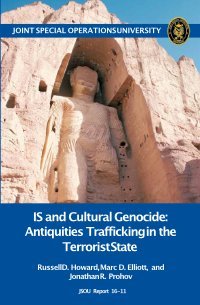
IS and Cultural Genocide: Antiquities Trafficking in the Terrorist State

By Russell D. Howard, Marc D. Elliott, and Jonathan R. Prohov

In this monograph, the authors offer compelling research that reminds government and military officials of the moral, legal, and ethical dimensions of protecting cultural antiquities from looting and illegal trafficking. Internationally, states generally agree on the importance of protecting antiquities, art, and cultural property not only for their historical and artistic importance, but also because such property holds economic, political, and social value for nations and their peoples. Protection is in the common interest because items or sites are linked to the common heritage of mankind. The authors make the point that a principle of international law asserts that cultural or natural elements of humanity’s common heritage should be protected from exploitation and held in trust for future generations. The conflicts in Afghanistan, and especially in Iraq and Syria, coupled with the rise of the Islamic State (IS), have brought renewed attention to the plight of cultural heritage in the Middle East and throughout the world.

MacDill Air Force Base, Florida: Joint Special Operations University Press, 2016. 112p.

download
Theoretical Perspectives of Terrorist Enemies as Networks

By Robert G. Spulak, Jr. and Jessica Glicekn Turnley

Social and physical networks have many similarities, and many differences. And while network analysis can be useful for defeating an adversary's physical networked infrastructure, such as power grids or transportation systems, it is only a piece of a larger toolkit when working with a human system. Indeed, human will and adaptability are critical aspects of a network that might otherwise be viewed as purely technical. We compare and contrast approaches from the physical and social sciences, using networks to highlight the advantages and disadvantages of using the same analytic perspective for significantly different targets. We conclude with a discussion of the networks suggested by the National Military Strategic Plan for the War on Terrorism.

Hurlburt Field, FL: Joint Special Operations University, 2005. 42p

download
Film Piracy, Organized Crime, and Terrorism

By Treverton, Gregory F. ,Matthies, Carl , Cunningham, Karla J.,Goulka, Jeremiah ,Ridgeway, Gregory , Wong, Anny

This report presents the findings of research into the involvement of organized crime and terrorist groups in counterfeiting products ranging from watches to automobile parts, from pharmaceuticals to computer software. It presents detailed case studies from around the globe in one area of counterfeiting, film piracy, to illustrate the broader problem of criminal--and perhaps terrorist--groups finding a new and not-much-discussed way of funding their activities. Piracy is high in payoff and low in risk, often taking place under the radar of law enforcement. The case studies provide compelling evidence of a broad, geographically dispersed, and continuing connection between film piracy and organized crime, as well as evidence that terrorist groups have used the proceeds of film piracy to finance their activities. Counterfeiting is a threat not only to the global information economy, but also to public safety and national security. Cooperation among law enforcement and governments around the world is needed in the battle against intellectual-property theft, and meaningful progress will require increased political will, strong legislation, consistent enforcement, deterrent sentencing, and innovative solutions. The report lays out an agenda of measures. Increased global intelligence-gathering and sharing is needed to further illuminate the scope and nature of the connections between piracy and organized crime, and policymakers and law enforcement worldwide should reexamine the common but erroneous assumption that counterfeiting is a victimless crime.

Santa Monica, CA: RAND, 2009. 183p.

download
Evaluating Afghanistan’s Past, Present and Future Engagement with Multilateral Drug Control

By John Collins and Ian Tennant

This paper charts the history of Afghanistan’s interaction with the international drug control system and the complex relationship between national–international policy formation. It tells the story of Afghanistan’s relationship with and impact on evolving global drug regulations from the birth of the League of Nations drug control system through the 1961 UN Single Convention on Narcotic Drugs and up to the present day. It draws on primary documentation from US and British archives and an extensive review of secondary literature, as well as a series of interviews conducted for the purposes of this paper. It argues for a more nuanced historical awareness of Afghanistan’s role within multilateral drug control as a way to understand its roles in the creation of the modern licit drug economy and its continued role in the modern illicit drug economy. Further, it argues that there is a need to engage broader society in discussions, to ensure more continuity is built into the system—as relationships built with the old regime in Afghanistan have collapsed. It calls for re-centring international capacity-building efforts on community-centred approaches, not simply law enforcement and traditional alternative development (AD) programmes. Moving away from the former enforcement focused activities also reduces the risks of human rights violations.

Birmingham, UK: University of Birmingham.. 2022. 34p.

download
Hot Lands: The Rise of Civilian Militias

By Adrian Arellano.

Why do civilians form militias? Militias emerge not when there is a lack of state security but instead when competing violence specialists behave as predatory actors. I argue that varying time horizons create the conditions for militias. I examine political reforms that have heterogeneous effects, lowering horizons for specialists and raising them for civilians. A high discount rate pushes violence specialists towards destructive violence. Having two options of violence, productive and destructive violence, specialists weigh the cost and benefits of each. The cost of productive violence is incurred up front while the cost of destructive violence occurs later, leading specialists to opt for destruction when they are experiencing a falling discount factor. However, discounting the future is self-defeating as it sets the conditions for militias. Some civilians will flee while others collaborate, but those with low discount factors will form protective militias. For civilian militias, political reforms lowers their discount rate and increases the extent to which they value the future relative to the present. Civilian militias with a low discount rate will have an interest in securing their future with arms. With the help of subnational and archival research, I show that militia onset is more likely in response to predatory actors. I test the theory using two case studies: the autodefensas in Mexico and the Deacons for Defense and Justice in the United States.

Ann Arbor: University of Michigan, 2019. 216p.

download
Crime, Violence, and the Crisis in Guatemala: A Case Study in the Erosion of the State

By Hal Brands.

Guatemala is currently experiencing a full-blown crisis of the democratic state. An unholy trinity of criminal elements—international drug traffickers, domestically based organized crime syndicates, and youth gangs—is effectively waging a form of irregular warfare against government institutions, with devastating consequences. The police, the judiciary, and entire local and departmental governments are rife with criminal infiltrators; murder statistics have surpassed civil-war levels in recent years; criminal operatives brazenly assassinate government officials and troublesome members of the political class; and broad swaths of territory are now effectively under the control of criminal groups. Guatemala’s weak institutions have been unable to contain this violence, leading to growing civic disillusion and causing a marked erosion in the authority and legitimacy of the government.

Carlisle, PA: U.S. Army War College Press, 2010. 71p.

download
Colombia's Paramilitaries: Criminals or Political Force?

By David Spencer

The intent of this monograph was to explore the multiple dimensions of Colombia's ongoing crisis and inform the public debate regarding the challenges faced by the statesmen, intellectuals, military strategists, and others who take on the responsibility to deal with that crisis. Hopefully, it will also generate serious reflection about the tough choices Colombian, U.S., and other global leaders face. The author points out, first, that the Colombian paramilitary self-defense forces represent some important sectors of society, and enjoy more popular support from Colombian society than the insurgents. Second, the paramilitaries have developed into a powerful irregular force that is proving itself capable of challenging Colombian guerrillas. Third, while they commit horrendous atrocities, they have been successful where the state has not. Therefore, the paramilitaries are seen by many as a viable solution to the conflict. Finally, he argues that, until the segments of the society represented by the paramilitaries are--somehow-- incorporated into the solution to the Colombian crisis, there will be no solution.

Carlisle, PA: U.S. Army War College Press, 2001. 32p.

download
Threat Posed by Mounting Vigilantism in Mexico

By George W. Grayson

Until the 1980s, Mexico enjoyed relative freedom from violence. Ruthless drug cartels existed, but they usually abided by informal rules of conduct hammered out between several capos and representatives of the dominant Institutional Revolutionary Party (PRI), which ruled the country until the 1990s. Relying on bribes, the desperados pursued their illicit activities with the connivance of authorities. In return for the legal authorities turning a blind eye, drug dealers behaved discretely, shunned high-tech weapons, deferred to public figures, spurned kidnapping, and even appeared with governors at their children’s weddings. Unlike their Colombian counterparts, Mexico’s barons did not seek elective office. In addition, they did not sell drugs within the country, corrupt children, target innocent people, engage in kidnapping, or invade the turf or product-line (marijuana, heroin, cocaine, etc.) of competitors. The situation was sufficiently fluid so that should a local police or military unit refuse to cooperate with a cartel, the latter would simply transfer its operations to a nearby municipality where they could clinch the desired arrangement. Three key events in the 1980s and 1990s changed the “live and let live” ethos that enveloped illegal activities. Mexico became the new avenue for Andean cocaine shipped to the United States after the U.S. military and law-enforcement authorities sharply reduced its flow into Florida and other South Atlantic states. The North American Free Trade Agreement, which took effect on January 1, 1994, greatly increased economic activities throughout the continent. Dealers often hid cocaine and other drugs among the merchandise that moved northward through Nuevo Laredo, El Paso, Tijuana, and other portals. The change in routes gave rise to Croesus-like profits for cocaine traffickers--a phenomenon that coincided with an upsurge of electoral victories. Largely unexamined amid this narco-mayhem are vigilante activities. With federal resources aimed at drug traffickers and local police more often a part of the problem than a part of the solution, vigilantes are stepping into the void. Suspected criminals who run afoul of these vigilantes endure the brunt of a skewed version of justice that enjoys a groundswell of support.

Carlisle, PA: U.S. Army War College Press, 2011. 76p.

download
An Illusion of Complicity: Terrorism and the Illegal Ivory Trade in East Africa

By Cathy Haenlein.

Organised crime groups, rather than terrorist groups, are profiting the most from the East African illegal wildlife trade. A number of myths and misperceptions have grown alongside the illegal ivory trade – none more troubling than the alleged participation of terrorist groups. In East Africa, the Somali terror group Al-Shabaab has supposedly received up to 40 per cent of its running costs through the illegal ivory trade alone. This is a powerful narrative, espoused by some politicians, policy-makers and practitioners. But it is largely wrong. Evidence for Al-Shabaab involvement in poaching and trafficking remains extremely limited and controversial. Briefings given to policy-makers on terrorism and the illegal ivory trade continue to refer to unverified sources. This is a cause for concern: such a narrative risks diverting attention from the trade’s main facilitators and, counter-intuitively, from Al-Shabaab’s known funding sources. To address these misconceptions, this report explores the complex ecosystems of terrorism, poaching and ivory trafficking in East Africa.

London: Royal United Services Institute (RUSI), 2015. 58p.

download