

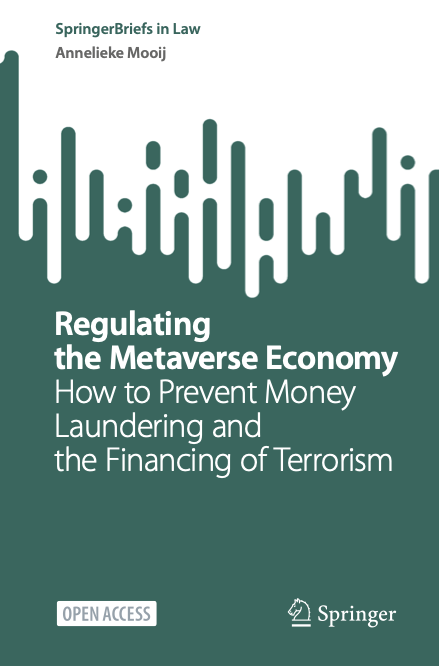
By Annelieke Mooij
This open access book examines regulating an environment that has no jurisdiction, is fully anonymous and infinitely vast? Welcome to the Metaverse, an online virtual reality that is expected to add billions to the global economy. The Metaverse offers a new type of virtual economy with practically endless business opportunities. The question is how to prevent these opportunities from being abused to commit money laundering and finance terrorism (MLFT).
This book explores the current European Union legislation designed to prevent MLFT in connection with the Metaverse. It analyses the legislation in relation to the three traditional stages of MLFT: placement, layering and integration. Furthermore, some additional risks specific to the Metaverse are discussed, such as Non-Fungible Tokens (NFTs) and the high level of anonymity. The book concludes that the current legislation is not suitable for facing the new challenges of the Metaverse.
In turn, the book puts forward a novel approach to regulating and enforcing MLFT legislation: using a system of smart assets equipped with AI to prevent and detect MLFT. In addition, it makes recommendations on how to improve the legal framework with regard to the new challenges arising from the Metaverse. Particular attention is given to creating a legal framework that incorporates the use of smart assets and the Internet of Things, in order to provide a safe environment for potential users and society.
By Noga Shanee, Amnon Keren, Evelyn D. Anca, Tamar Fredman, Omer Polansky & Yael Cohen Paran
There are certain biases that characterize the global efforts to tackle wildlife crime, restricting their effectiveness. Firstly, wildlife crime is considered mainly a problem of developing source countries, while the role of developed consumer countries is largely ignored. Secondly, illegal trafficking and legal wildlife trade are treated separately, while the first is considered harmful to the environment and the latter is often considered tolerable, and even a conservational tool. In this study, we use the case study of Israel, a small, developed country with a solid legal framework to control the illegal wildlife trade. For the period between 2021 and 2023 we reviewed national and international laws and regulations from different sectors relevant to wildlife law enforcement. We monitored social media, online commerce platforms and instant messaging groups in order to assess online trade, and interacted with the wildlife authorities to assess their responses. We found six overarching legal themes: (1) species permitted for trade and possession; (2) trade and possession permits; (3) health permits; (4) animal welfare laws and regulations; (5) wildlife shows; and (6) general commerce and money laundering laws. Our results demonstrate that although there is a regulatory infrastructure which allows legal wildlife trade, the vast majority of the trade violates at least some of the related laws and standards. We also found biases in the authorities’ readiness to tackle different types of wildlife crime. Therefore, this study challenges the false dichotomy between legal and illegal wildlife trade and calls for further research and improved enforcement and control of authorized wildlife trade in developed countries.
Journal of International Wildlife Law & Policy, Volume 28, 2025 - Issue 1
By Lauren R. Shapiro
This paper evaluated three cyber-enabled imposter scams against older adults using Lifestyle Routine Activity Theory. The frst section examined the motivated ofender’s tools for manipulating older adult targets (social engineering and persuasion) and explained how Artifcial Intelligence could increase exposure and susceptibility of imposter victims. The next section focused on the suitable victim by examining how heuristics and impaired cognitive, physical, and psychosocial abilities contributed to the older adult target’s susceptibility to imposter scam by interfering with the process of rational decision-making. The third section examined ways in which capable guardians, in the form of agencies and laws, protected and helped older adult targets from imposter scams. Recommendations regarding the creation of educational programs that teach older adults how to be safer online (i.e., less suitable victims) through evaluating risks, identifying potential imposter scams, and becoming efcient self-advocators were provided.
Security Journal (2025) 38:43
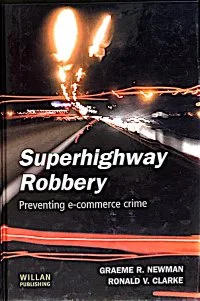
By Graeme R. Newman and Ronald V. Clarke
In Superhighway Robbery, Graeme Newman and Ronald Clarke provide a grounded, pragmatic analysis of how the digital revolution didn't necessarily create new types of criminals, but rather provided them with a much more efficient set of tools. They move away from the sensationalized "hacker" myths of the early 2000s to focus on the cold reality of Situational Crime Prevention. The book's central thesis is that the internet acts as a vast infrastructure—a superhighway—that significantly reduces the effort required to commit traditional crimes like theft, fraud, and piracy while increasing the potential rewards and lowering the risk of being caught.
By applying their famous CRAVED model to the digital world, the authors explain that data and software are the ultimate targets because they are easily concealable, removable, and available. They argue that the most effective way to stop cybercrime is not to wait for a change in human nature, but to change the digital environment itself. This involves "designing out" crime by making digital targets harder to reach and less profitable to exploit. Ultimately, Newman and Clarke strip away the mystery of the "Information Age" to reveal that cybercrime is essentially a matter of opportunity, and by closing those digital windows of opportunity, we can make the superhighway a significantly safer place.
In the digital realm, the CRAVED model explains why certain data or media becomes a prime target for "superhighway robbery." Concealability is at an all-time high because digital files take up no physical space and can be hidden in encrypted folders or behind innocuous filenames, making them easy to possess without detection. These files are incredibly Removable because they can be copied or moved across the globe in milliseconds, allowing a thief to "steal" an item while the original remains in place. The Availability of these targets is virtually limitless; once a movie or piece of software is uploaded to a server, it is accessible to anyone with a connection, twenty-four hours a day.
The Value of digital goods remains high because they often represent thousands of hours of professional labor or sensitive personal information that can be sold on the dark web. These items are also highly Enjoyable, as they often consist of popular entertainment, games, or high-end tools that people naturally want to use. Finally, they are perfectly Disposablebecause there is a massive, ready-made market of willing buyers or downloaders, ensuring that a criminal can quickly offload their "loot" for profit or social capital without the logistical headaches of physical fencing.
Cullompton, Devon. UK. Willan. 2003.

By Megan M. McNally and Graeme R. Newman
From the cover: There has been a glaring lack of scholarly attention to the crime of identity theft, according to the editors. The chapters in this volume attempt to fill some of this gap by exploring theory and research on identity theft, as well as situational measures to prevent its occurrence.
The editors' introduction outlines several key issues related to the definition, extent and commission of identity theft. The chapter by Graeme Newman applies the opportunity perspective to the study of identity theft. Megan
McNally uses the "script" approach to examine the meaning and mechanics of identity theft in all of its forms. Henry Pontell, Gregory Brown and Anastasia Tosouni present new findings on how identity theft affects victims, based on data collected by the Identity Theft Resource Center. Heith Copes and Lynne Vieraitis describe how a sample of identity theft offenders viewed their crimes. Michael Levi recounts the evolution of identity fraud and its control in the U.K. Russell Smith presents a framework for evaluating preventive measures, particularly document-based systems, biometric technologies and identity cards. Sara Berg considers how information technology can be used within a situational crime prevention framework to fight identity theft. Robert Willison examines the use of situational crime prevention to protect sensitive personal information in the context of information systems security.
Crime Prevention Studies, volume 23. Willan Publishing. Culmcott House, Uffculme, Cullompton Devon EX 15 3AT, U.K. 2008. 195p.

Edited by Mihails Potapovs and Kate E. Kanasta
Drawing on expertise from professionals, government officials, and academics, this book uncovers the proactive measures taken by Latvia to build resilient cybersecurity capabilities. The work offers a comprehensive exploration of Latvia’s cyber domain, structured around three overarching themes: the ecosystem, its processes, and future perspectives. In doing so, it takes readers through the intricacies of Latvia’s cybersecurity landscape and provides a nuanced understanding of its strengths, challenges, strategic considerations, and broader implications. One of the key contributions of the work lies in its exploration of Latvia’s cybersecurity strategies and resilience. By delving into the nation’s policies, collaborations, and technological advancements, this book uncovers how Latvia has proactively addressed cyber threats, emphasising the importance of tailored approaches for smaller countries in building robust cybersecurity defences. Highlighting the importance of studying cybersecurity in smaller nations, this book stresses Latvia’s contributions to global cybersecurity efforts as an EU and NATO member. The volume advocates for innovation and collaboration, emphasising their crucial role in securing a digital future for nations worldwide. This book will be of much interest to student of cybersecurity, Baltic politics, EU politics, global governance, and International Relations. The Open Access version of this book, available at http://www.taylorfrancis.com, has been made available under a Creative Commons Attribution-Non Commercial-Share Alike (CC-BY-NC-SA) 4.0 license.
London; New York: Routledge, 2025. 305p.