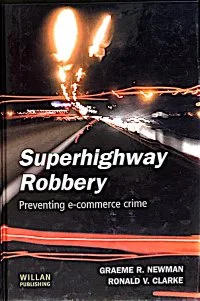
By Graeme R. Newman and Ronald V. Clarke
In Superhighway Robbery, Graeme Newman and Ronald Clarke provide a grounded, pragmatic analysis of how the digital revolution didn't necessarily create new types of criminals, but rather provided them with a much more efficient set of tools. They move away from the sensationalized "hacker" myths of the early 2000s to focus on the cold reality of Situational Crime Prevention. The book's central thesis is that the internet acts as a vast infrastructure—a superhighway—that significantly reduces the effort required to commit traditional crimes like theft, fraud, and piracy while increasing the potential rewards and lowering the risk of being caught.
By applying their famous CRAVED model to the digital world, the authors explain that data and software are the ultimate targets because they are easily concealable, removable, and available. They argue that the most effective way to stop cybercrime is not to wait for a change in human nature, but to change the digital environment itself. This involves "designing out" crime by making digital targets harder to reach and less profitable to exploit. Ultimately, Newman and Clarke strip away the mystery of the "Information Age" to reveal that cybercrime is essentially a matter of opportunity, and by closing those digital windows of opportunity, we can make the superhighway a significantly safer place.
In the digital realm, the CRAVED model explains why certain data or media becomes a prime target for "superhighway robbery." Concealability is at an all-time high because digital files take up no physical space and can be hidden in encrypted folders or behind innocuous filenames, making them easy to possess without detection. These files are incredibly Removable because they can be copied or moved across the globe in milliseconds, allowing a thief to "steal" an item while the original remains in place. The Availability of these targets is virtually limitless; once a movie or piece of software is uploaded to a server, it is accessible to anyone with a connection, twenty-four hours a day.
The Value of digital goods remains high because they often represent thousands of hours of professional labor or sensitive personal information that can be sold on the dark web. These items are also highly Enjoyable, as they often consist of popular entertainment, games, or high-end tools that people naturally want to use. Finally, they are perfectly Disposablebecause there is a massive, ready-made market of willing buyers or downloaders, ensuring that a criminal can quickly offload their "loot" for profit or social capital without the logistical headaches of physical fencing.
Cullompton, Devon. UK. Willan. 2003.