Open Access Free Library
CRIME+CRIMINOLOGY.jpeg

CRIME

Violent-Non-Violent-Cyber-Global-Organized-Environmental-Policing-Crime Prevention-Victimization

Posts in Forensic
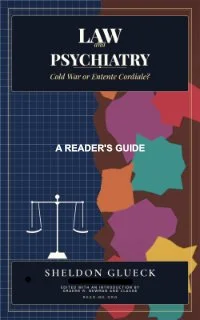
LAW AND PSYCHIATRY: Cold War or Entente Cordiale?: An abridged Glueck Classic

by Graeme Newman (Author), Sheldon Glueck (Author)

In 1962, a Harvard criminologist stood before an audience of lawyers and psychiatrists and asked whether their two professions were fighting a cold war — or could finally reach an entente cordiale.

Sheldon Glueck had spent nearly four decades studying what happens when the law and the mind collide. When the American Psychiatric Association awarded him its Isaac Ray Award in 1962, he used the honor to revisit a question he'd first raised in 1925: can a courtroom ever fairly judge a defendant whose mind wasn't entirely his own?

Law and Psychiatry: Cold War or Entente Cordiale? is Glueck's answer — four lectures that trace the law's century-long struggle to define legal insanity, from the rigid "right-and-wrong" test born in the trial of a Victorian assassin, through the sweeping 1954 Durham rule that tried to replace it, to Glueck's own proposal for resolving the deadlock. Along the way, he tackles the oldest dilemma in criminal justice — does anyone really choose freely, or are we all, to some degree, prisoners of forces we don't control? — with the wit and clarity of a scholar who has spent a career refusing easy answers.

This Read-Me.Org Mini-Classic edition condenses and lightly modernizes Glueck's original lectures for today's reader, and adds a new closing chapter, "Law and Psychiatry Today," tracing what actually happened next: the rise and fall of the Durham rule, the Hinckley verdict that reshaped the insanity defense overnight, the states that abolished it outright, and the neuroscience now reopening questions Glueck could only pose in the language of his own era.

What's inside:

  • An editor's introduction placing Glueck and the Isaac Ray Lectures in context

  • A biographical sketch of Sheldon and Eleanor Glueck and their landmark criminology research

  • All four of Glueck's original 1962 lectures, condensed and modernized

  • A new chapter tracing the insanity defense from 1962 to the present day

  • Review questions for classroom or book-group discussion

  • A further reading list for readers who want to go deeper

Whether you're a law or psychology student, a true-crime reader curious where the insanity defense actually came from, or simply someone who has ever wondered where blame ends and illness begins, this short, sharp classic still has something to say — six decades on, the cold war Glueck diagnosed has never entirely thawed.

A Read-Me.Org Mini-Classic — condensed, modernized editions of significant but hard-to-find works of criminology, law, and social science.

Direct quotation from the original is limited to brief, fair-use excerpts. Read-Me.Org discloses the use of AI assistance in preparing this edition.

Read-Me.Org Inc. New York-Philadelphia-Australia. 2026. p.43.

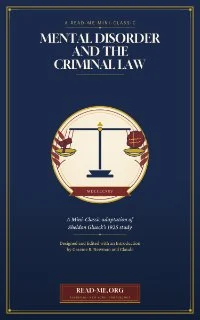
Mental Disorder And The Criminal Law: A Mini-Classic adaptation of Sheldon Glueck’s 1925 study

by Graeme Newman (Author), Sheldon Glueck (Author)

In 1925, a thirty-year-old Harvard instructor wrote a book that quietly reshaped how American law would treat defendants whose minds were diseased. Sheldon Glueck's Mental Disorder and the Criminal Law took direct aim at the M'Naghten "right-and-wrong" rule — the eighty-year-old English test still governing most American insanity trials — and showed, case by case and state by state, why it no longer matched what psychiatry actually knew about the human mind.

A century later, the debate Glueck defined is still very much alive. The M'Naghten rule remains the law in a majority of U.S. states. The Hinckley trial, the 1984 Insanity Defense Reform Act, and the more recent abolition of the insanity defense in several states are all chapters in an argument Glueck saw coming.

This Mini-Classic distills Glueck's dense, five-hundred-page original — footnoted case law, medical literature, and a state-by-state statutory appendix — into a single accessible guide:

  • A biography of Glueck and the Harvard reform circle (Roscoe Pound, Felix Frankfurter, William Healy) that shaped his thinking

  • The historical moment: M'Naghten's Case, the Leopold and Loeb trial, and the rise of modern psychiatry

  • A chapter-by-chapter walk through Glueck's argument — from the "wild beast" test of 1724 through the clinical psychoses of the 1920s to his own proposed reforms

  • A concluding chapter connecting Glueck's 1925 arguments to Hinckley, neurolaw, and today's insanity-defense debates

  • Sixteen review questions for students and reading groups

Ideal for students of criminal law, criminology, and the history of psychiatry — and for anyone curious how the insanity defense got the shape it has today.

Direct quotation from the original is limited to brief, fair-use excerpts. Read-Me.Org discloses the use of AI assistance in preparing this edition.

Read-Me.Org Inc. New York-Philadelphia-Australia. 2026. p.69.

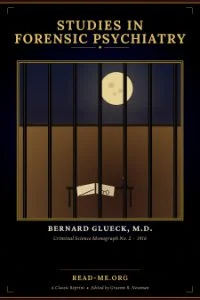
Studies in Forensic Psychiatry

By Bernard Glueck. Designed and Edited with an Introduction by Graeme R. Newman and Claude.

In 1916, psychiatrist Bernard Glueck made a case that was still radical for its time: that prisons and asylums needed trained psychiatrists on staff, not as outside consultants, but as clinicians embedded in the institution itself. Writing from the criminal department of the Government Hospital for the Insane in Washington, D.C., Glueck laid out five detailed case studies that argued, one patient at a time, for a new way of understanding the criminal mind.

Inside, you'll find:

  • A clinical study of psychogenic psychosis in prisoners — the theory that mental breakdown behind bars is often a meaningful reaction to arrest, trial, and confinement, not simply organic illness

  • An extended case-by-case analysis of malingering, and the difficult problem of separating feigned symptoms from genuine mental illness

  • A study of "litigious paranoia" — the compulsive, self-representing plaintiff who turns the courtroom into an extension of his delusion

  • A landmark early psychoanalytic case history of kleptomania

Glueck went on to found the first psychiatric clinic ever established inside an American prison, at Sing Sing, and later served as a psychiatric expert in the Leopold and Loeb trial. He was also the elder brother of criminologist Sheldon Glueck — making this book a companion volume to Read-Me.Org's editions of War Criminals and Probation and Criminal Justice.

This new edition includes a substantial original introduction by Graeme R. Newman, assessing Glueck's century-old argument against the present day: what holds up in modern correctional psychiatry, what doesn't, and a hard look at whether American prisons have actually delivered on the promise Glueck was making in 1916 — including current data on the ongoing shortage of psychiatric staffing across U.S. correctional systems.

A Read-Me.Org Classic Reprint. This is a corrected and reformatted edition of the 1916 first edition (Little, Brown, and Company), prepared from a public domain source text under a Creative Commons Attribution 4.0 International License. AI-assisted tools were used in the production of this edition, as disclosed on our website.

Read-Me.Org Inc. New York-Philadelphia-Australia. 2026. p.165.

Contraband tobacco: Systematic profiling of cigarette packs for forensic intelligence

By: Laurie Caron, Frank Crispino, Cyril Muehlethaler 

Tobacco smuggling remains a widespread illegal activity in Canada, associated with important social and economic impacts, and often linked to organized crime. This study explores the application of forensic profiling as an intelligence tool to support the analysis of contraband cigarette production and distribution. Physical and chemical manufacturing characteristics of seized contraband cigarette packs, provided by police forces, were observed and coded using macroscopic, microscopic, and spectroscopic techniques. Multivariate statistical analyses were then conducted to compare manufacturing characteristics between packs and identify potential links. The analyses highlighted links between cigarette packs and seizures based on shared manufacturing characteristics. The results and the identified groups were also compared with seizure data provided by our collaborator. The results demonstrate the relevance of forensic profiling to formulate hypotheses regarding shared production processes or supply networks. These hypotheses provide information that contributes to understanding tobacco smuggling and aim to examine how forensic intelligence can support law enforcement and measures to prevent and disrupt this criminal activity. A preliminary optimal procedure for applying forensic profiling in operational contexts targeting contraband tobacco was finally proposed. Despite limitations in the dataset creation that were beyond our control, this study represents a starting point for applying this scientific approach to tobacco smuggling.