Open Access Publisher and Free Library
CRIME+CRIMINOLOGY.jpeg

CRIME

Violent-Non-Violent-Cyber-Global-Organized-Environmental-Policing-Crime Prevention-Victimization

Posts in Inclusion
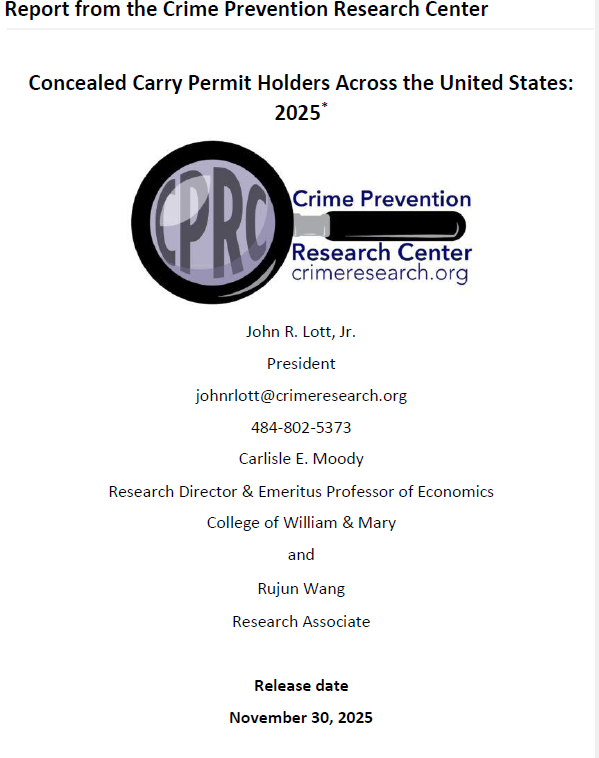
Report from the Crime Prevention Research Center.  Concealed Carry Permit Holders Across the United States: 2025

By John R. Lott, et al.

After peaking in 2022, the number of Concealed Carry Permit holders across the United States has declined for the third year in a row. The total now sits at 20.88 million, representing a 2.7% drop from last year. A major factor behind this ongoing decrease is the widespread adoption of Constitutional Carry laws. Following Louisiana’s implementation of permitless carry on July 4, 2024, 29 states now allow residents to carry without a permit. As a result, 46.8% of Americans (157.6 million) now live in Constitutional Carry States, with 67.7% of the land in the country (2.57 million square miles). Although no additional states enacted such laws this year, the broader trend remains unchanged. Unlike gun ownership surveys that may be affected by people’s unwillingness to answer personal questions, concealed handgun permit data is the only really “hard data” that we have, but it becomes a less accurate measure as more states become Constitutional Carry states.

Salt Lake City UK: Crime Prevention Research Center, 2025

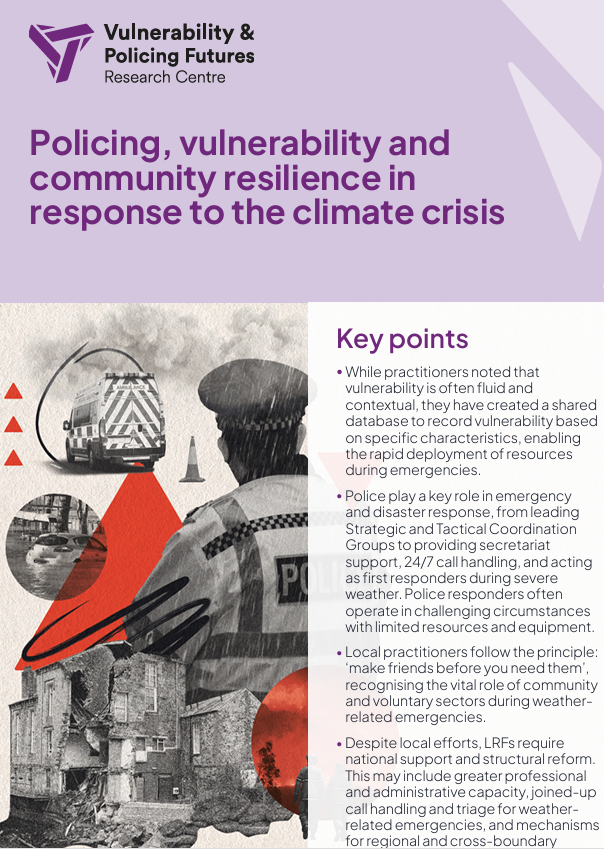
Policing, vulnerability and community resilience in response to the climate crisis

By Ali Malik

The increasing frequency and severity of extreme weather events in the UK, such as storms, flooding, heatwaves, and severe cold spells, recognised as consequences of the climate crisis, have placed significant operational and organisational pressures on police, emergency responders and local authorities. This research adopts an in-depth qualitative case study design and a temporal analogues approach, which draws on past experiences and events to develop an understanding of the present and inform future learning. Doing this provides insights into the role of the police and Local Resilience Forums (LRFs) in preparing for and responding to extreme weather eventsThe findings highlight that LRFs are essential for locally led emergency planning. However, due to resource constraints, these partnerships often rely on relational capital, negotiated agreement and goodwill. Decisive leadership, situational awareness, experience from past events and routine work were also described as key factors for effective emergency response. LRFs cannot mitigate the impacts of the climate crisis without national support. Local preparedness depends on safe homes, green spaces, reliable transport networks and affordable clean energy. The research also points to the need for greater professional, analytical, and specialist support for LRFs, along with targeted funding to resource localised efforts for preparedness, recovery, and long-term climate adaptation.


AI in Policing: international lessons and domestic solutions

By Justice

1. Artificial intelligence (“AI”) is rapidly reshaping public services, and policing is no exception. The pace of innovation, the scale of private sector investment, and the UK Government’s explicit ambition to “mainline AI into the veins of the nation” mean that AI deployment in policing is not a distant prospect but an accelerating reality. This brings significant opportunities: enhanced investigative capability, faster processing of digital evidence, improved risk assessment, and the potential to intervene earlier to prevent harm. Yet it also carries profound risks for human rights, the rule of law, and public trust. The police occupy a uniquely powerful position in our democratic society; integrating AI into that environment without the right safeguards risks entrenching discrimination, undermining lawful decision making, and eroding communities’ confidence in policing2. This report asks a central question: what must be in place for AI in policing to be trustworthy, value for money, effective in achieving policing goals, and compliant with human rights and the fair administration of justice? To answer this, JUSTICE carried out international research, examined domestic developments, and convened stakeholders across policing, government, civil society, regulators, academia, and industry. Across this work, five lessons emerged, each of which signals not only what must be done, but the urgency of acting now while the UK remains at a crossroads.

London: Justice, 2025. 62p.

What Do We Know About How Processes of Desistance Vary by Ethnicity?

By Stephen Farrall, Jason Warr, Abigail Shaw, Kanupriya Sharma


This paper reviews what is known about ethnic identity and the processes by which people cease offending. Whilst the past 30 years have seen dramatic growth in what is known about desistance, in many jurisdictions, there is a paucity of research which examines this in terms of ethnicity or ethnic variations. We therefore review what is empirically known about ethnicity and desistance. Whilst this review draws from the global literature, our focus is on what this literature tells us about ethnicity and desistance from a British perspective. We find that the majority of these have been undertaken in the United States (although there are some European and Australasian studies). Few studies, however, have fully unpacked the role of racism (in terms of institutional processes or overt prejudice and hostility) and that there have been very few studies of the roles played by ethnicity in processes of desistance.

The Howard Journal of Crime and JusticeVolume 64, Issue 3Sep 2025