
Open Access Publisher and Free Library
CRIME+CRIMINOLOGY.jpeg

CRIME

Violent-Non-Violent-Cyber-Global-Organized-Environmental-Policing-Crime Prevention-Victimization

Posts tagged drug detection
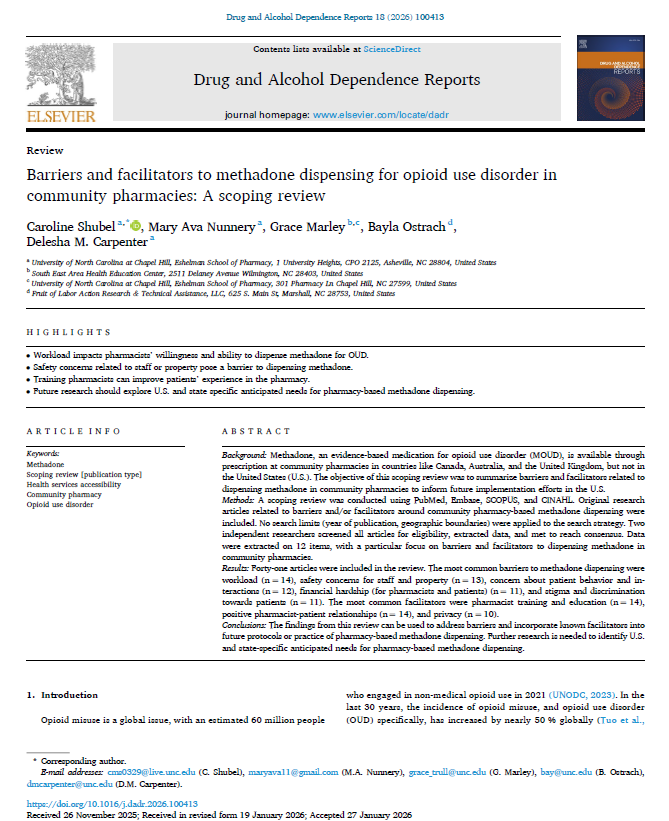
Barriers and facilitators to methadone dispensing for opioid use disorder in community pharmacies: A scoping review

By Caroline Shubel , Mary Ava Nunnery , Grace Marley, Bayla Ostrach , Delesha M. Carpenter

Background: Methadone, an evidence-based medication for opioid use disorder (MOUD), is available through prescription at community pharmacies in countries like Canada, Australia, and the United Kingdom, but not in the United States (U.S.). The objective of this scoping review was to summarize barriers and facilitators related to dispensing methadone in community pharmacies to inform future implementation efforts in the U.S. Methods: A scoping review was conducted using PubMed, Embase, SCOPUS, and CINAHL. Original research articles related to barriers and/or facilitators around community pharmacy-based methadone dispensing were included. No search limits (year of publication, geographic boundaries) were applied to the search strategy. Two independent researchers screened all articles for eligibility, extracted data, and met to reach consensus. Data were extracted on 12 items, with a particular focus on barriers and facilitators to dispensing methadone in community pharmacies. Results: Forty-one articles were included in the review. The most common barriers to methadone dispensing were workload (n = 14), safety concerns for staff and property (n = 13), concern about patient behavior and interactions (n = 12), financial hardship (for pharmacists and patients) (n = 11), and stigma and discrimination towards patients (n = 11). The most common facilitators were pharmacist training and education (n = 14), positive pharmacist-patient relationships (n = 14), and privacy (n = 10). Conclusions: The findings from this review can be used to address barriers and incorporate known facilitators into future protocols or practice of pharmacy-based methadone dispensing. Further research is needed to identify U.S. and state-specific anticipated needs for pharmacy-based methadone dispensing

:Drug Alcohol Depend Rep. 2026 Jan 29;18:100413. doi: 10.1016/j.dadr.2026.100413. PMID: 41695144; PMCID: PMC12906019
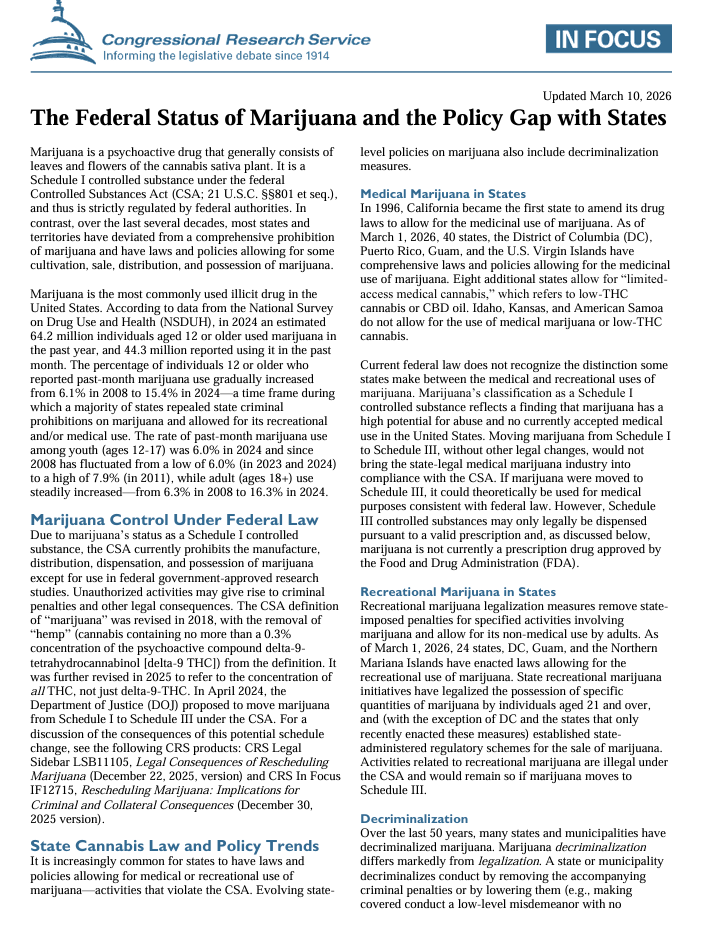
The Federal Status of Marijuana and the Policy Gap with States

By Lisa N. Sacco, Joanna R. Lampe, Hassan Z. Sheikh

Marijuana is a psychoactive drug that generally consists of leaves and flowers of the cannabis sativa plant. It is a Schedule I controlled substance under the federal Controlled Substances Act (CSA; 21 U.S.C. §§801 et seq.), and thus is strictly regulated by federal authorities. In contrast, over the last several decades, most states and territories have deviated from a comprehensive prohibition of marijuana and have laws and policies allowing for some cultivation, sale, distribution, and possession of marijuana.


Marijuana is the most commonly used illicit drug in the United States. According to data from the National Survey on Drug Use and Health (NSDUH), in 2024 an estimated 64.2 million individuals aged 12 or older used marijuana in the past year, and 44.3 million reported using it in the past month. The percentage of individuals 12 or older who reported past-month marijuana use gradually increased from 6.1% in 2008 to 15.4% in 2024—a time frame during which a majority of states repealed state criminal prohibitions on marijuana and allowed for its recreational and/or medical use. The rate of past-month marijuana use among youth (ages 12-17) was 6.0% in 2024 and since 2008 has fluctuated from a low of 6.0% (in 2023 and 2024) to a high of 7.9% (in 2011), while adult (ages 18+) use steadily increased—from 6.3% in 2008 to 16.3% in 2024.


Washington, DC: Congressional Research Service; March 10, 2026.

Detection of Illegally Manufactured Fentanyls and Carfentanil in Drug Overdose Deaths — United States, 2021–2024

By Lauren J. Tanz; Andrea Stewart, R. Matt Gladden,; Jean Y. Ko, Lauren Owens, Julie O’Donnell

During 2023, approximately 72,000, or nearly seven in 10, drug overdose deaths in the United States were estimated to involve illegally manufactured fentanyls (IMFs). Carfentanil, a fentanyl analog 100 times more potent than fentanyl, has reemerged in the U.S. drug supply. Using CDC’s State Unintentional Drug Overdose Reporting System data, this report describes trends in overdose deaths during January 2021– June 2024, overall and with IMFs detected, by U.S. Census Bureau region, and in deaths with carfentanil detected, in 45 states and the District of Columbia (DC). Numbers of deaths with carfentanil detected by state during January 2023–June 2024 in 49 states and DC are also reported. The number of overdose deaths with IMFs detected declined from 2022 to 2023 in the Northeast (3.2% decline), Midwest (7.8%), and South (2.8%) regions; deaths in the West increased 33.9%. The percentage of deaths with IMFs detected was steady at approximately 70%–80% in the Northeast, Midwest, and South. In contrast, the percentage of deaths with IMFs detected in the West increased from 48.5% during January–March 2021 to 66.5% during April–June 2024. Overdose deaths with carfentanil detected increased approximately sevenfold, from 29 during January–June 2023 to 238 during January–June 2024; during January 2023–June 2024, overdose deaths with carfentanil detected were reported in 37 states. Overdose prevention efforts that address the widespread presence of IMFs, including carfentanil, and can rapidly adapt to other potent opioids in the drug supply might result in lasting reductions in overdose deaths across the entire United States

MMWR | December 5, 2024 | Vol. 73 | No. 48, 7p.