Open Access Publisher and Free Library
CRIME+CRIMINOLOGY.jpeg

CRIME

Violent-Non-Violent-Cyber-Global-Organized-Environmental-Policing-Crime Prevention-Victimization

Posts in Diversion
Gang Phantasmagoria: How Racialized Gang Allegations Haunt Immigration Legal Work

By Ana Muñiz

Through an analysis of interviews with Southern California attorneys, supplemented by archival materials, this article contributes to the literature on gangs, critical criminology, and Gothic tropes by examining how the ambiguous nature of gang profiling allows state actors to target racialized others in various legal and administrative venues with little evidence and few procedural protections. I conceptualize gang phantasmagoria as the constant, amorphous, unpredictable, and haunting threat of racialized gang allegations and argue that the dynamic shapes the work of legal practitioners and constitutes a state mechanism of racial terror. Specifically, first I argue that government officials deploy the specter of gangs to both portray asylum seekers as monstrous threats and justify restrictions in asylum eligibility. I then illustrate how the potential for gang phantasmagoria to upend asylum applications and trigger the deportation of their clients elicits constant low-grade anxiety for attorneys. Consequently, attorneys are forced to adopt more cautious approaches to legal work in a way that indirectly facilitates the social control of young Latinx immigrants.


Critical Criminology, olume 30, pages 159–175, (2022
The Federal Status of Marijuana and the Policy Gap with States

By Lisa N. Sacco, Joanna R. Lampe, Hassan Z. Sheikh

Marijuana is a psychoactive drug that generally consists of leaves and flowers of the cannabis sativa plant. It is a Schedule I controlled substance under the federal Controlled Substances Act (CSA; 21 U.S.C. §§801 et seq.), and thus is strictly regulated by federal authorities. In contrast, over the last several decades, most states and territories have deviated from a comprehensive prohibition of marijuana and have laws and policies allowing for some cultivation, sale, distribution, and possession of marijuana.


Marijuana is the most commonly used illicit drug in the United States. According to data from the National Survey on Drug Use and Health (NSDUH), in 2024 an estimated 64.2 million individuals aged 12 or older used marijuana in the past year, and 44.3 million reported using it in the past month. The percentage of individuals 12 or older who reported past-month marijuana use gradually increased from 6.1% in 2008 to 15.4% in 2024—a time frame during which a majority of states repealed state criminal prohibitions on marijuana and allowed for its recreational and/or medical use. The rate of past-month marijuana use among youth (ages 12-17) was 6.0% in 2024 and since 2008 has fluctuated from a low of 6.0% (in 2023 and 2024) to a high of 7.9% (in 2011), while adult (ages 18+) use steadily increased—from 6.3% in 2008 to 16.3% in 2024.


Washington, DC: Congressional Research Service; March 10, 2026.

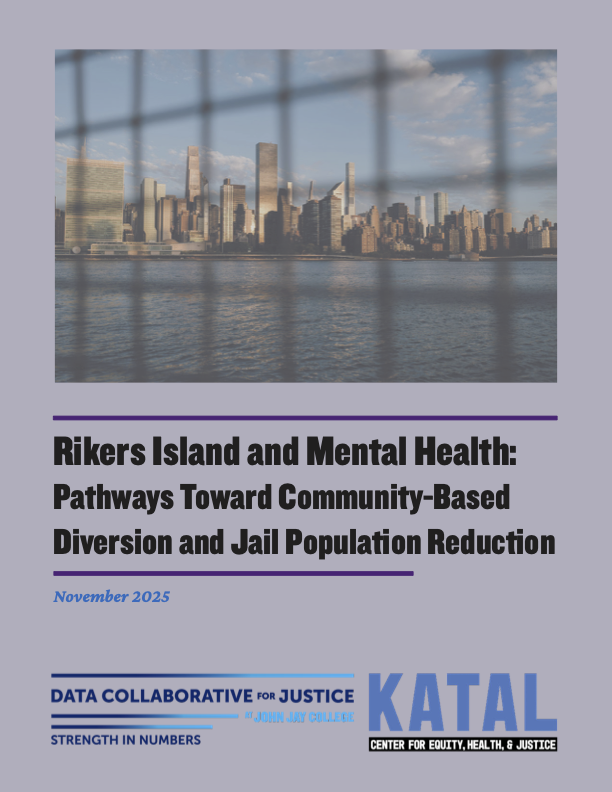
Rikers Island and Mental Health: Pathways Toward Community-Based Diversion and Jail Population Reduction

By Michael Rempel, Krystal Rodriguez, and Kellyann Bock

As New York City works toward its mandate to close Rikers Island, addressing the mental health needs of people detained in the jail system remains a central challenge—and a defining opportunity for reform. Developed by the Data Collaborative for Justice at John Jay College and the Katal Center for Equity, Health, & Justice, this report brings together the latest mental health data for people held at Rikers, lived-experience insights from directly impacted people, and a 15-point plan to create a more effective and humane path forward.

Grounded in evidence, the report aims to:

  1. Present updated data on the nature and scale of mental health needs among people held in the NYC jails.

  2. Give a voice to the people behind the numbers through select first-person accounts that highlight systemic gaps and unmet needs.

  3. Identify a continuum of safe and effective jail diversion strategies that can reduce the jail population while strengthening care, stability, and long-term public safety.

Taken together, this report offers a roadmap to reduce the number of people with serious mental health needs detained at Rikers and to strengthen NYC’s continuum of care.