
Open Access Free Library
CRIME+CRIMINOLOGY.jpeg

CRIME

Violent-Non-Violent-Cyber-Global-Organized-Environmental-Policing-Crime Prevention-Victimization

Posts tagged program evaluation
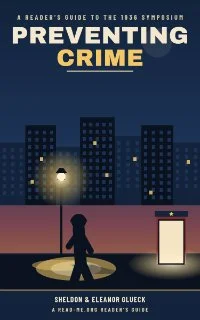
Preventing Crime: A Reader's Guide

by Graeme R. Newman with the assistance of Claude.

Can you stop crime before it starts, without fully knowing what causes it? A reader's guide to the 1936 symposium that gathered twenty-four programs trying to find out.

Preventing Crime: A Symposium, edited by Sheldon and Eleanor Glueck, brought together the directors of coordinated community councils, school bureaus, police prevention units, residential homes, child guidance clinics, a parent school, and boys' clubs, and asked each the same questions: what evidence shows the need for your program, how does it work, and how do you know whether it succeeds? The editors were candid from the start. Their title, they admitted in the preface, was optimistic, and a more accurate one would have been "Promising Efforts to Prevent Delinquency and Criminality." Only time and real evaluation, they wrote, could say whether these programs actually prevented anything.

The book is a portrait of what serious people believed about crime prevention in the depths of the Depression, and a case study in the gap between good intentions and good evidence. This Reader's Guide makes it accessible without replacing it. It explains what each program did, sets out the twelve principles the Gluecks drew from the contributions, and shows exactly what counted as proof of success in 1936, and how little of it would count today.

INSIDE THIS GUIDE

  • A reading plan and a chapter-by-chapter map of the original, with all twenty-five contributors

  • The Gluecks' opening argument: can crime be prevented without knowing its causes?

  • Twelve principles distilled from the programs, from starting early to using trained personnel

  • Community councils, school programs, police prevention bureaus, residential homes, clinics, and boys' clubs, program by program

  • A close look at "the audit problem": what each contributor offered as evidence, and what it actually showed

  • A worked example that tests one program's before-and-after numbers against six hard questions

  • What has changed since 1936, including the Cambridge-Somerville Youth Study's sobering results and decades of research on what works, what doesn't, and what's promising

  • Five common misreadings, a primer of evaluation terms, a glossary, an annotated reading list, an FAQ, 26 discussion questions and classroom activities

WHO IT'S FOR: Students of criminology, social work, education, public policy and program evaluation; practitioners designing youth programs; teachers and reading groups; and general readers curious about where crime prevention came from and why proving it works is so hard.

PLEASE NOTE: This is an independent guide, not an abridgment or edition of the original symposium. It does not reproduce the original's text and is not endorsed by the editors', or contributors', heirs. It is meant to be read alongside the original, which is in the public domain in the United States.

Written by Graeme R. Newman with the assistance of Claude, an AI model made by Anthropic. The AI-generated content is disclosed in accordance with Read-Me.Org policy.

Download the original book here.

Read-Me.Org Inc. New York-Philadelphia-Australia. 2026. p.54p.

Evaluability Assessment and Evaluation Options for an Elder Abuse Shelter Model

By Sierra Smucker, Jirka Taylor, Ivy Todd, Emily Hoch, Monique Martineau, Deven Clark, Meagan E. Cahill, Esther M. Friedman

s the number of older adults in the United States increases, there will be a corresponding increase in the need for services to prevent elder abuse and intervene in cases where it has already occurred. However, there are a limited number of evidence-based interventions to support victims of elder abuse. To encourage the rigorous evaluation of one intervention—Elder Abuse Shelters (EASs)—RAND researchers developed three research designs and assessed the preparedness of the well-established Weinberg Center's EAS in New York to undertake them. Researchers found that the Weinberg Center's EAS is well established, and the program model was organizationally and programmatically ready to be evaluated, though data collection practices should be strengthened before implementing the suggested evaluation designs. These evaluation designs could be generalized and implemented at EASs across the country as the number of shelters continues to grow.

Key Findings

The Weinberg Center's client numbers have fluctuated over time but are typically between 16 and 34 per year. Clients mostly identify as women, are ethnically and racially diverse, and are from the New York City area. Many clients have cognitive impairment and limited financial resources.

The COVID-19 pandemic corresponded with a decrease in the number of clients by decreasing potential clients' desire to stay in long-term care facilities and increasing turnover in referring agencies.

The Weinberg Center has a clear program logic model that connects inputs and outputs with measurable short- and long-term outcomes.

Organizationally and programmatically, the Center is ready to embark on an evaluation, with scores of 77 and 84 percent, respectively, in those areas of the evaluability assessment.

However, a low score for evaluation readiness of 43 percent, driven largely by currently insufficient data collection processes, indicates that the Center would need to strengthen its data collection capacity to complete a rigorous evaluation.

Three evaluation designs could help the Weinberg Center's EAS and other EAS models rigorously evaluate its impact: (1) a quasi-experimental design using non-random self-selection into the program, (2) a propensity score matching design that pairs clients with Adult Protective Services, and (3) a robust pre- and post-evaluation design.

When conducting an evaluation of an EAS, researchers must consider equity, data safety, and consent. The experience of elder abuse and the tools needed to help someone heal will differ across individuals depending on their background and cultural expectations.

Recommendation

Because the Weinberg Center is largely ready to embark on an evaluation, its leadership should review the proposed designs and consult with partners and potential evaluation teams as needed to decide how to proceed. Federal and state partners interested in protecting victims of elder abuse should consider funding one of these evaluation designs to determine whether EASs should be supported and encouraged to proliferate as the population ages.

Santa Monica, CA: RAND, 2023, 77p.