Open Access Publisher and Free Library
CRIME+CRIMINOLOGY.jpeg

CRIME

Violent-Non-Violent-Cyber-Global-Organized-Environmental-Policing-Crime Prevention-Victimization

Posts in Social Sciences
Reducing Drug Use, Reducing Reoffending Are programmes for problem drug-using offenders in the UK supported by the evidence?

By The UK Drug Policy Commission

Over the past ten years, UK drug strategies have increasingly focused on providing treatment and support services for drug-dependent offenders – who commit a disproportionate number of acquisitive crimes (e.g. shoplifting and burglary) – as a way of reducing overall crime levels. This criminal justice focus has been reinforced in the recent 2008 UK drug strategy (new Welsh and Scottish drug strategies are also being developed). The UK Drug Policy Commission (UKDPC) has analysed the evidence for the effectiveness of these initiatives for reducing drug use and reoffending and of the wider impact of this more prominent criminal justice approach. To inform our analysis we commissioned an independent review of the published evidence from leading researchers at the Institute for Criminal Policy Research (ICPR), King’s College London. We also listened to policy experts, local commissioners, drug workers and current and ex-drug users.

London: The UK Drug Policy Commission (UKDPC), 2008. 80p.

download
Organized Crime in Central America: The Northern Triangle

Edited by Cynthia J. Arnson and Eric L. Olson

In early May 2011, dozens of gunmen entered a farm in Guatemala’s Petén region, murdering and decapitating 27 people. Guatemalan authorities as well as speculation in the press have blamed the Zetas, a violent Mexican drug trafficking cartel increasingly active in Guatemala and other parts of Central America . Whether a vengeance killing following the murder of a presumed drug lord, or a struggle amongst the Zetas and Mexico’s Sinaloa cartel for the control of territory and smuggling routes, the massacre underscores the vulnerability of the civilian population in unsecured border areas between Mexico and Guatemala, where narcotics and human trafficking flourish. In response, the government of President Álvaro Colom declared a state of siege similar to the one declared from December 2010-February 2011 in the department of Alta Verapaz. This incident and others like it underscore the serious threat to democratic governance, human rights, and the rule of law posed by organized crime in Central America. The international community has begun to address the burgeoning crisis and commit significant resources to the fight against crime and violence; indeed, not since the Central American wars of the 1980s-1980s has the region commanded so much attention in the international arena. To better understand the nature, origins, and evolution of organized crime in Central America, and thereby contribute to the efforts of policymakers and civil society to address it, the Latin American Program commissioned a series of case studies that looked at the countries of the so-called Northern Triangle—El Salvador, Guatemala, and Honduras— and at the broader regional context affecting national dynamics. Our interest was to understand more fully how organized crime has evolved in Central America, and to examine the links between organized crime and traffickers in Central America, Mexico and Colombia. What role does Central America play in the supply chain for illegal goods between the Andes and the United States, and how have trafficking organizations from these areas related to one another over time? The growing presence and activities of organized crime groups in Central America has worsened an already alarming crisis of citizen security. In mid- 2010, the Inter-American Commission on Human Rights reported that Latin America had the highest levels of youth violence in the world . UN figures indicate that the rate of youth homicide in Latin America is more than double that of Africa, and 36 times the rate of developed countries . An oft-referenced study by the United Nations Development Program (UNDP) noted in 2009 that the seven countries of Central America—Belize, Costa Rica, El Salvador, Guatemala, Honduras, Nicaragua, and Panama—register the highest levels of non-political violence in the world; this observation has been echoed in statements by the U.S. Department of Defense . The situation is most acute in the countries of the Northern Triangle6 . In El Salvador alone, sixty-eight percent of homicide victims are between the ages of fifteen and thirty-four, and nine out of ten victims are male7 . Countries such as Costa Rica, Nicaragua, and Belize are also witnessing rising rates of insecurity associated with the increased presence of organized crime.

Washington, DC: Woodrow Wilson International Center for Scholars, Latin American Program, 2011. 254p.

download
Combating Wildlife Crime in Nigeria: An analysis of the Criminal Justice Legislative Framework

By Shamini Jayanathan

This report, commissioned by the Environmental Investigation Agency UK (EIA) in partnership with Africa Nature Investors Foundation (ANI) and supported by the U.S. Department of State, Bureau of International Narcotics and Law Enforcement Affairs (INL), is the first of its kind to undertake an in-depth legislative analysis of the federal wildlife-related laws of Nigeria alongside those of six states identified as key for addressing wildlife crime in Nigeria, namely Adamawa, Kano, Lagos, Rivers, Cross River and Taraba States. It builds on recommendations made by the EIA in its report of 2018 regarding Nigeria’s progress on its National Ivory Action Plan (NIAP) which included the need to conduct an assessment under the auspices of the International Consortium for Combatting Wildlife Crime (ICCWC). This report’s focus on legislation will complement such an effort that will in due course be undertaken by the UN Office on Drugs and Crime (UNODC).

Nigeria: Africa Nature Investors Foundation; London:Environmental Investigation Agency (UK), 2021. 36p.

download
Taking Off: Wildlife Trafficking in the Latin America and Caribbean Region

By Bridget Connelly and Henry Peyronnin

Wildlife trafficking in the air sector in Latin America and the Caribbean (also known as the LAC region) is a serious and significant problem. As in other regions, the confluence of habitat destruction, economic polarization, and convenient availability of international travel has facilitated wildlife trafficking at a national, regional, and international level. The consequences for wildlife populations have been dire – against the backdrop of a 94% drop in regional animal population sizes between 1970 and 2020, the C4ADS Air Seizure Database shows that seizures of animal products along air routes increased steadily until 2019.

The LAC region poses particular concern for two reasons. First, it is one of the principal remaining repositories of biological and species diversity in the world. Increasing wildlife trafficking will continue to degrade this essential environment. Second, the LAC region is the home to many of the world’s most capable and violent trafficking organizations, which raises the risk that wildlife trafficking will empower organizations seeking to impose more direct harms on humans.

Washington, DC: USAID Reducing Opportunities for Unlawful Transport of Endangered Species (ROUTES). 2021. 16p.

download
Organized Crime and Illegally Mined Gold in Latin America

By Livia Wagner

Throughout history, man has venerated gold. Gold was the first of the three gifts of the Magi to Jesus. For much of the 19th and 20th centuries, the values of world currencies were fixed in terms of gold (the Gold Standard). Olympic athletes vie for gold medals and the best footballer in the world is awarded the Ballon d’Or. An extremely well behaved child is ‘as good as gold’ and a generous person has ‘a heart of gold’.

It is only natural to think positively about gold, just as it is equally natural to think negatively about drugs. But, as the Global Initiative proves in its latest research report: “Organised Crime and Illegally Mined Gold in Latin America”, illegally mined gold is now more important to organized crime in some countries of Latin America than narcotics:

In Peru and Colombia – the largest cocaine producers in the world – the value of illegal gold exports now exceeds the value of cocaine exports.

Illegal mining is the easiest and most profitable way to launder money in the history of Colombian drug trafficking.

Geneva, SWIT: Global Initiative against Transnational Organized Crime, 2016. 100p.

download
Corruption, Informality, and Power: Explaining the limits to institutional approaches for tackling illegal logging in Peru

By Camila Gianella, Maritza Paredes and Lorena Figueroa

Policies and strategies implemented to combat illegal logging in Peru appear to have had limited success. Addressing corruption in the forest sector requires an understanding of the role of political and informal power arrangements that shape individual and collective behaviours. Forest governance outcomes can only be strengthened by considering the networks, actors, powers, and interests that interact with wider conditions.

Bergen, Norway: Chr. Michelsen Institute, 2021. 25p.

download
Vietnam's Footprint in Africa: An analysis of the role of Vietnamese criminal groups in wildlife trafficking

By The Environmental Investigation Agency (EIA)

For a decade, Vietnam has been repeatedly highlighted for its role in the international illegal wildlife trade, so it is encouraging to see the recent efforts taken by the Government to address its involvement; it is to be congratulated for the measures it has taken and the successes it has had domestically. Yet despite these efforts to tackle illegal wildlife trade in country, Vietnam’s reputation is tarnished by the fact that it is the primary destination for illegal wildlife products sourced from across Africa and shipped by criminal networks directly or indirectly to meet the demand in Vietnam and beyond. These networks are accelerating the decline of Africa’s biodiversity and are exacerbating corruption and weak rule of law in many source and transit countries in the continent.

London; Washington, DC: EIA, 2021. 32p.

download
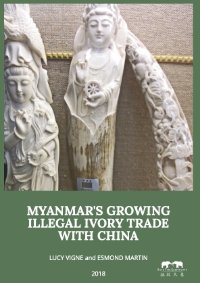
Myanmar's Growing Illegal Ivory Trade with China

By Lucy Vigne and Esmond Martin

The report ‘Myanmar’s Growing Illegal Ivory Trade with China’ released today (subs: October 2, 2018) shows that one town in particular, Mong La - a frontier town in the notorious Golden Triangle on the border of China - has experienced a ‘prolific growth’ in ivory trading. The number of new ivory items seen for sale in the town grew by 63% in three years, and now accounts for over a third of the ivory seen in the country.

The report by ivory trade specialists Lucy Vigne and Esmond Martin recounts how Chinese visitors smuggle worked ivory from Mong La back home with little concern about getting caught. This ivory has often come up the Mekong River into the lawless eastern periphery of Myanmar where it is for sale in both retail and bulk. The wholesale price for African raw ivory in late 2017 in the Golden Triangle region has remained stable at about USD 770 to USD 800 per kg since late 2015.

Myanmar has the largest captive, or ‘domestic’, elephant population in the world with over 5,000 individuals. Traders there say that the internal ivory trade is legal for trimmed domestic elephant tusk tips and from licensed animals that have died, and operate accordingly. (Trading in the tusks of the remaining wild elephants in Myanmar – numbering perhaps 2,000 – is acknowledged to be illegal). The ivory from captive elephants is used for local carving and retail sale especially in Mandalay and Yangon. Their tusks are also sold wholesale in Mandalay to Chinese traders, who smuggle them across the China border in contravention of the existing international ivory trade ban.

Traders reported that 90% of buyers were Chinese wishing to smuggle the ivory home, as also found by the same authors in market surveys in Hong Kong (2015) and Laos (2017). In Vietnam (2016) this was estimated to be 75%.

Nairobi, Kenya: Save the Elephants, 2018. 92p.

download
Runway to Extinction: Wildlife Trafficking in the Air Transport Sector

By Mary Utermohlen

"This report highlights the widespread, pervasive nature of wildlife trafficking by air, with each major world region impacted. Our analysis shows that traffickers of all types exploit the same vulnerabilities within airports, often using the same trafficking methods to circumvent law enforcement and airport authorities. Furthermore, seizure data shows that many wildlife trafficking networks rely on the same smuggling methods over time, suggesting that a thorough understanding of airport-specific or country-specific trafficking patterns could be instrumental in reducing the air transport system's vulnerability to trafficking," said the report’s author Mary Utermohlen, Program Director at C4ADS.

In addition to contributing to the extinction of endangered species, threatening local livelihoods, and undermining regional and global security, illegal wildlife trade is a risk factor for the spread of zoonotic diseases. According to the Center for Disease Control, three out of every four new or emerging infectious diseases originate in animals. Many of the species seized in air transport—including live birds, live reptiles and mammals—are high-risk carriers of zoonotic diseases and may end up in illegal or unregulated markets around the world.

Godalming, UK: Traffic, 2022. 12p.

download
The Roots of Environmental Crime in the Peruvian Amazon

By InSight Crime

Peru’s 70 million hectares of Amazon forest are being razed at an alarming rate. This investigation reveals the range of culprits behind the devastation: from illegal gold miners who leave behind pools of poisonous mercury, to poor locals coopted into harvesting valuable trees, to a complex web of front companies, agribusiness subsidiaries, corrupt officials and criminal groups that prosper from the Amazon’s destruction.

Conducted with the Igarapé Institute – a Brazil-based think tank devoted to development, security and climate issues – the six-part series also unravels the crucial links in the chain of specific environmental crimes contributing to forest loss, including illegal logging, illicit gold mining, coca cultivation, wildlife trafficking and the usurping of lands for cattle farms and booming agricultural industries.

Peru’s Amazon, which covers nearly half of the Andean country, is rich in biodiversity and critical to the capture of carbon, which mitigates global warming. Political instability and corruption, however, have made protecting it much more difficult. Meanwhile, demand from international markets for wood, gold and other forest products increases the threat to Indigenous communities, animal habitats and protected reserves.

Washington, DC: InSight Crime; IGARAPÉ INSTITUTE , 2022. 61p.

download
Trends in the Implementation of Ethical Supply Chains: A 2020 Snapshot of the Cocoa Sector

By Philip Rothrock, Laura Weatherer, Kate Ellis, Leah Samberg, Stephen Donofrio, Ciro Calderon

Over the past few decades, cocoa production has emerged as a driver of land use change, particularly in West Africa. In addition to its significant contributions to deforestation, cocoa production has also faced intense public scrutiny due to human rights violations, especially the use of child labor.

In Trends in the Implementation of Ethical Supply Chains: A 2020 Snapshot of the Cocoa Sector, Forest Trends’ Supply Change Initiative joined the Accountability Framework Initiative (AFi) to shed light on current trends in implementing best practice for achieving ethical supply chains across the cocoa sector. For this analysis, Supply Change researched and analyzed company sustainability commitments, production and procurement policies, and progress reporting against the common approaches for pursuing ethical supply chains outlined in the Accountability Framework.

Washington, DC: Forest-Trends, 2021. 22p.

download
High Flying: Insight Into Wildlife Trafficking Through India's Airports

By Saket Badolaand and Astha Gautam

TRAFFIC’s “HIGH FLYING: Insight into wildlife trafficking through India's airports” analysis found the trafficking of over 70,000 native and exotic wild animals, including their body parts or derivatives (weighing around 4000kg) in 140 wildlife seizure incidents at 18 Indian airports between 2011-2020. Many of the seized species are categorised as threatened on the IUCN Red List and listed in the Convention on International Trade in Endangered Species of Wild Fauna and Flora (CITES) Appendices, regulating its trade to protect the species from decline.

One example, the Indian Star Tortoise, is listed as Vulnerable on the IUCN Red List. However, traffickers clearly disregard the threatened status and international CITES rules in Appendix I prohibiting its trade as the Indian Star Tortoise was the highest number of native species seized between 2011-2020. Among the species groups seized (including both Indian and exotic species), reptiles were the most encountered group during the study period (46%), followed by mammals (18%), timber (13%), and species from the marine environment (10%).

The highest number of native species seized included the Indian Star Tortoise, followed by the Black Pond Turtle Geoclemys hamiltonii.

The highest number of non-native species seized, Red-Eared Slider Turtle, followed by the Chinese Pond Turtle Mauremys reevesii.

Chennai International Airport, Tamil Nadu, recorded the highest number of wildlife seizure incidents, followed by Chhatrapati Shivaji International Airport, Mumbai and Indira Gandhi Airport New Delhi. The study's findings reflect the ongoing trafficking and not an actual representation as most of the illegal wildlife trade goes unchecked and unreported.

Godalming, UK: Traffic, 2022. 12p.

download
Measuring Impact - Measuring Efforts to Combat Wildlife Crime: A Toolkit for Improving Action and Accountability

By Environmental Incentives, LLC, Foundations of Success, and ICF International

Killing protected or managed species and the illegal trade in wildlife and their related parts and products (hereafter called “wildlife crime”) are among the most severe threats to global biodiversity. Hundreds of millions of individual animals belonging to hundreds of species are the targets of illegal harvesting and trade. Wildlife crime not only threatens the survival of focal species, but may also significantly alter ecosystem function and stability when one or more species are substantially depleted or even made locally extinct. High-value wildlife products are often trafficked by organized criminal syndicates and are known to finance violent non-state actors including terrorist groups. Armed conflict can exacerbate wildlife killing and trafficking, and trafficking is frequently associated with other crimes such as money laundering (Loucks et al. 2008, UNODC 2012). Wildlife criminals create insecurity in rural communities and kill park rangers, hurting morale and recruitment of park staff and reducing tourism and associated revenue needed for conservation and community development. For developing countries, loss of revenue from trade, taxes, and/or tourism can be significant and particularly damaging (Rosen & Smith 2010). The illegal trade in wildlife can also introduce and/or spread pathogens (Gómez & Aguirre 2008), posing major risks to human and livestock health, with implications for food security, commerce, and labor productivity (i.e., Ebola virus outbreak). Despite focused efforts often lasting several decades, wildlife crime remains a global threat (Broad & Damania 2010, Sharma et al. 2014). The importance of wildlife crime as a threat to conservation and development has attracted the attention of governments, non-governmental organizations (NGOs), research institutions, and multilateral organizations globally. Strategies to combat wildlife crime depend on accurate and reliable knowledge,

Washington, DC: United States Agency for International Development, 2017. 76p.

download
Nature Crime: Understanding and Tackling a Key Threat to the Climate and Land Use Agenda

By Charles Victor Barber, Karen Winfield, and Rachael Petersen

The Climate and Land Use Alliance (CLUA), with the support of Meridian Institute, is exploring the integration of climate and land use with justice, equity, health, and economic recovery through Climate and Forests 2030: Resources for Funders. This focus is intended to inspire innovation and investment in integrated work on forests, rights, and sustainable land use and will inform a new strategic plan for CLUA for the period 2021 to 2030. To inform the thinking, CLUA commissioned a series of “thought pieces” to provide diverse inputs into developing a more integrated approach for forests and land use. These are meant to stimulate discussion and debate

Nature crime occurs when individuals or criminal networks illegally exploit natural ecosystems to extract natural resources. Nature crimes include illegal logging, illegal mining, illegal fishing, illegal wildlife trade, and the illegal conversion of forests and wetlands for agriculture or other uses. These crimes are often associated with financial crime of various types, as well as labor and human violations and official corruption. The prevalence of nature crime and associated corruption and criminal behavior constitutes a serious barrier to progress in tackling climate change, slowing biodiversity loss, reducing the risk of future zoonotic pandemics, and achieving sustainable, peaceful, and equitable human development. The scale of the nature crime economy is immense. It is variably estimated to be the third- or fourth-largest illicit economy in the world (after drug trafficking and trade in counterfeit goods) with an annual value of as much as $281 billion, but this figure underestimates its indirect impacts: governments are deprived annually of some $7-12 billion in timber and fisheries revenues, while the indirect costs of undermining ecosystem services may be as high as $1-2 trillion per year,

San Francisco?:Climate and Forests 2030, 2021. 30p.

download
Green Carbon, Black Trade: Illegal Logging, Tax Fraud and Laundering in the World's Tropical Forests

Edited by Christian Nellemann

This report Green Carbon, Black Trade by UNEP and INTERPOL focuses on illegal logging and its impacts on the lives and livelihoods of often some of the poorest people in the world set aside the environmental damage. It underlines how criminals are combining old fashioned methods such as bribes with high tech methods such as computer hacking of government web sites to obtain transportation and other permits. The report spotlights the increasingly sophisticated tactics being deployed to launder illegal logs through a web of palm oil plantations, road networks and saw mills.

Nairobi, Kenya: Arendal, Norway: United Nations Environment Program, GRID-Arendal.; 2012. 72p.

download
Timber Trafficking: Illegal Logging in Indonesia, South East Asia and International Consumption of Illegally Sourced Timber

By Dave Currey, Faith Doherty, Sam Lawson, Julian Newman, and A. Ruwindrijarto

A report into illegal logging in Indonesia and South-East Asia, and the international consumption of illegally sourced timber. For the past two decades, the international community has been aware of rampant logging of tropical forests and vanishing biodiversity. Yet even if you could track an illegally cut tree to a port in a timber consuming country, and supply conclusive evidence that it was illegally cut, none of them have legislation in place that would allow their enforcement authorities to seize the shipment.

London; Washington, Environment Protection Agency; Bogor, Indonesia: Telapak, 2001. 36p.

download
Money Laundering from Environmental Crime

By The Financial Action Task Force (FATF)

Environmental crime covers a wide range of activities, from illegal extraction and trade of forestry and minerals to illegal land clearance and waste trafficking. Actors involved in these crimes vary from large organized crime groups to multinational companies and individuals. Perpetrators of environmental crime rely on both the financial and non-financial sector to launder their proceeds. The ‘low risk, high reward’ nature of environmental crime makes for a lucrative and safe source of revenue for criminals. This is partly due to a regulatory and legal environment that is not always consistent globally and does not fully address the financial aspects and money laundering (ML) risks of these crimes. The FATF conducted this study to strengthen awareness of the scale and nature of criminal gains and laundering techniques for environmental crimes. This study builds on the FATF’s 2020 report on financial flows from the illegal wildlife trade. It brings together expertise from across the FATF’s Global Network to identify good practices that governments and the private sector can take to disrupt the profitability of environmental crimes. The findings for this report are based on case studies and good practices provided by over 40 countries, alongside expertise from civil society and the private sector.

Paris: FATF, 2021. 70p.

download
Parenting, Scarcity and Violence: Theory and Evidence for Colombia

By Jorge Cuartas, Arturo Harker, and Andrés Moya

During early childhood, children develop cognitive and socioemotional skills that predict success in multiple socioeconomic dimensions. A large part of the development of these skills depends on the child’s context during the first years of life and, in particular, on the quality of parental care. Grounded on recent literature in psychology and behavioral economics, we discuss a theoretical framework for understanding why some children receive adequate care, while others do not. Within this framework, we identify a determinant of the quality of parenting that has not yet been explored in-depth: the availability of parents’ mental resources, which are depleted by the subjective feeling of scarcity and the stress generated by adversities. Using cross-sectional data from a household survey in Colombia and administrative data on crime and violence, we find that a greater subjective feeling of scarcity (β=0.45, IC95%:[0.082, 0.979]) and greater exposure to violence (β =0.09, IC90%:[0.004, 0.182]) are associated with a lower likelihood that parents engage in stimulating activities with their children. At the same time, the results show that receiving information on childrearing is correlated with better parental practices (β =-0.48, IC95%:[-0.822, -0.136]).

Bogotá, Colombia: Universidad de los Andes–Facultad de Economía–CEDE , 2016. 35p.

download
International Law and Sexual Violence in Armed Conflicts

By Chile Eboe-Osuji

Sexual violence is a particular brand of evil that women have endured—more than men—during armed conflicts, through the ages. It is a menace that has continued to challenge the conscience of humanity—especially in our times. At the international level, basic laws aimed at preventing it are not in short supply. What is needed is a more conscious determination to enforce existing laws. This book explores ways of doing just that; thereby shoring up international legal protection of women from sexual violence in armed conflicts.

Leiden; Boston: Brill, 2012. 374p.

download
The Illegal Logging Crisis in Honduras: How U.S. and E.U. imports of illegal Honduran wood increase poverty, fuel corruption and devastate forests and communities

By Environmental Investigation Agency

One of the poorest countries in Latin America, Honduras is losing up to $18 million a year in lost stumpage fees and other forest-based revenue. Yet this is only the tip of the iceberg of a massive, nationwide, resource rip-off by major timber and wood product producers and their high level political backers. An estimated 80% of mahogany and up to 50% of pine — Honduras’ main timber export — is produced in violation of government regulations.

Washington, DC: Environmental Investigation Agency, 2005. 48p.

download