By Philip Berge Benny.
According to the Talmud.
London, Smith Elder (1880) 156 pages.

By Philip Berge Benny.
According to the Talmud.
London, Smith Elder (1880) 156 pages.
By George S. Dougherty.
George S. Dougherty, former deputy commissioner and chief of detectives New YorkPolice department. “It began with the discovery that I am a human being and regard the criminal as human.”
Appleton. (1924) 294 pages.
By August Drahms.
His personnel and environment. Introduction by Cesare Lombroso. All you need to know and more, of the born criminal and the criminal classes.
Macmillan Co. (1900) 419 pages.
By pages
The Mystery of the Unborn, by pages. “Dr. Wilson believed that criminals are born unfinished. The die is cast at birth. The lack of finish at birth explains the incompetent, the born tired, the unemployed. Then what is the use? Why not painless extinction of those who commit great crimes, and the sterilization of the feebleminded….” Albert Wilson.
John Bale et al., (1928) 477.
By Prince Emmanuel of Jerusalem.
“ History shows that hanging did not prevent petit larceny. So we have abandoned the policy of frightfulness in punishment and cannot revert to it even though it still has some few supporters. And yet we feel that the theory of punishment being deterrent is philosophically sound. …The first news from the Laboratory revealed the prevalence of feeble-mindedness among delinquents. “
Rosburgh Publishing (1921) 247 pages.
By V. M. Masten.
If a thief will have it no other way than to be a thief, then control of him, and not his social rehabilitation, must be the desideratum.”
Boston Gorham Press (ca. 1922) 238 pages.
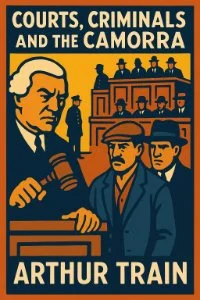
By Arthur Train.
by Arthur Train (Author), Colin Heston (Introduction) Format: Kindle Edition
Arthur Train’s Courts, Criminals and the Camorra (1912) arrives from a moment when the American courtroom was transforming from a dusty forum of local justice into a national spectacle. Crime reporting surged, public fascination with underworld societies ripened, and the newly consolidated profession of the district attorney—Train’s own calling—stood at the intersection of drama and civic responsibility. Few chroniclers were better positioned to capture this world than Train himself: lawyer, storyteller, and one of the most influential interpreters of everyday justice in the early twentieth century.
This book offers a vivid, almost cinematic tour through the people and pressures that shaped the criminal courts of Train’s New York. With a wit sharpened by long service in the district attorney’s office, Train narrates cases, misadventures, and courtroom characters with the briskness of a magazine correspondent and the subtle insight of someone who has lived the system from the inside. He makes the courthouse feel less like a bureaucratic maze and more like a bustling social laboratory—part theater, part battleground, part human comedy.
The title’s reference to the Camorra, the Neapolitan criminal society that briefly dominated headlines in the years preceding publication, allows Train to broaden his canvas. The Camorra trials in Europe—particularly the sensational proceedings in Viterbo (1911–12)—were international news, and Americans consumed tales of conspiracy, vendetta, and secret brotherhoods with a mixture of horror and fascination. Train uses these stories not merely to thrill, but to show how crime everywhere reflects its environment: local culture shapes criminal enterprise just as surely as it shapes courts, policing, and political life.
What makes this volume enduring is Train’s tone—bright, conversational, humane. His criminals are rarely monsters; they are people caught in pressures of poverty, opportunity, folly, or ambition. His courts, for all their flaws, are animated by men and women doing their best under imperfect circumstances. The result is a portrait of justice as a living organism, not an abstract ideal.
More than a century later, these essays feel surprisingly fresh. They remind us that the tensions surrounding criminal justice—media sensationalism, public fear, the allure of organized crime, the frustrations of overburdened courts—are not uniquely modern. The debates that animate today’s legal and political discussions echo those Arthur Train captured with humor and clarity in 1912.
To read Courts, Criminals and the Camorra now is to eavesdrop on the origins of our contemporary legal culture. It is also simply to enjoy a gifted storyteller at work, illuminating the world he knew best with charm, color, and a sharp eye for the human quirks that make justice both necessary and endlessly fascinating.
New York Scribner’s (1912) 256 pages. Read-Me.Org Inc. 2025. 173p.
By Filson Young.
With notes and introduction by Filson Young. “Most of the interest and part of the terror of great crime are due not to what is abnormal, but to what is normal in it; what we have in common with the criminal, rather than that subtle insanity which differentiates him from us, is what makes us view with so lively an interest a fellow-being who has wandered into these tragic and fatal fields.”
William Hodge (1910) 266 pages.
By Horace M. Kallen.
A Manual for Judges, Practitioners, and Students, by Hans Gross. Translated from the 4th German edition . Introduction By Joseph Jastrow,. “ In short, the individualization of disease, in cause and in treatment, is the dominant truth of modern medical science. The same truth is now known about crime…” Published under the Auspices of The American institute of criminal law and criminologyBoston,
Little Brown and Co. (1911) 567 pages.
Translated by Gina Lombroso.
This is the classic work of the “father of criminology” Cesare Lombroso translated from the Italian by his daughter Gina Lombroso. Here was the idea of the “born criminal” and a detailed classification system according to body types and other physiological and physical features. The major work was “L’Uomo delinquente” that emphasized the atavistic origins of criminality.
NY. Harrow and Heston Classic Reprint. (1876) 251 pages.
By Raffaele Garofalo.
Garofalo, a student of Lombroso, attempted to formulate a sociological definition of crime that would designate those acts which can be repressed by punishment. These constituted "Natural Crime" and were considered offenses violating the two basic altruistic sentiments common to all people, namely, probity and piety.
A Read-Me.org Classic Reprint. 1885. 510 pages.
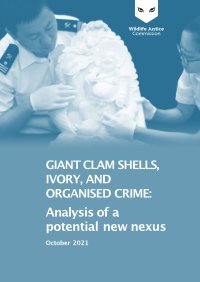
By Jenny Feltham and Luciana Capdepon
Giant clams are a traditional source of subsistence protein for coastal communities across Asia and Pacific regions. In recent decades, however, giant clams have been subject to poaching and commercial harvesting. Now viewed as high-value luxury food item, giant clams are also in demand in the international aquarium trade, and their shells are sought after for the ornamental carving industry. The Wildlife Justice Commission is concerned that giant clam shells are being used as a substitute for elephant ivory. Since China’s 2017 ban on the domestic elephant ivory trade, giant clam shells are an increasingly popular ivory alternative. These factors are likely to have contributed to the overexploitation and rapid decline of giant clam populations throughout many of their natural habitats. This not only puts increased pressure on the vulnerable giant clam, but also perpetuates demand for “premium” ivory products, sustaining the threat to elephant populations in the wild. Giant clams may not be as immediately charismatic as, say, elephants or rhinos, but they play a valuable role in maintaining healthy coral and oceans. Preventing biodiversity loss and preserving ocean eco-systems are crucial in the fight against catastrophic climate change.
The Hague: Wildlife Justice Commission, 2021. 41p.
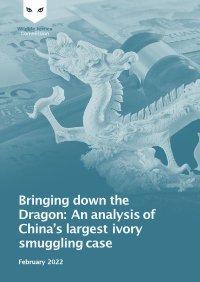
By Jenny Feltham and Hendelene Prinsloo.
Bringing down the Dragon: An analysis of China’s largest ivory smuggling case, provides an in-depth case study of the inner workings of a wildlife crime syndicate and how Chinese authorities took it down by targeting the key facilitators and following the money. It also highlights how complex trafficking is and offers useful insights for law enforcement. The Chen organised crime group was a successful organised crime network, the kingpins, the untouchables. For several years they trafficked huge quantities of ivory by flying under the radar and eluding authorities through their corrupt connections. That all changed in late 2018 when Chen Chenzong, son of the Big Boss Chen Jiancheng, was arrested whilst dining out at a restaurant in China. Chinese authorities caught onto the network and the key players. They targeted the corrupt facilitators, in this instance a corrupt Customs Officer. Then followed the money, eventually seizing the assets of the Chen organised crime group. By December 2020, 17 members of the group had been convicted for their roles in trafficking 20.22 tonnes of ivory – equivalent to approximately 2000 elephants – from Nigeria to China. This case is a blueprint for law enforcement agencies investigating transnational organised wildlife crime.
The Hague: Wildlife Justice Commission, 2022. 56p.
By Jenny Feltham.
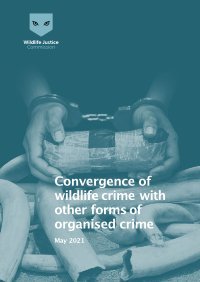
Through its own investigations and intelligence analysis, the Wildlife Justice Commission has also collected evidence of criminal networks that are dealing in wildlife alongside other illicit commodities. This report aims to present some of these examples, along with information collected from open sources, to contribute to the knowledge base on this issue. It sets out 12 case studies that illustrate a range of converging crime types and typologies that have transpired in different regions of the world to increase the understanding of how these intersections can occur on the ground. The case studies include six cases involving the trafficking of terrestrial wild animals, three cases involving fisheries crimes, and three cases involving timber crimes (although they are collectively referred to as wildlife crime throughout the report). The cases demonstrate that criminal groups may have a range of motivations to diversify their activities and engage in wildlife or other types of crime Convergence can occur opportunistically on an adhoc basis, as a complete “career shift” in response to changing conditions, or as part of a diversification strategy to increase profits across a range of illicit commodities. It can also occur transactionally when criminal groups in different markets exchange goods or services with each other or could be embedded to such an extent that the crimes are inextricably linked.
The Hague: Wildlife Justice Commission, 2021. 53p.
By Tanya Wyatt and Anh Ngoc Cao .
Wildlife trafficking is a growing global concern. It takes place in all regions of the world with those nations with high biodiversity being the source and the consumers of the wildlife as well as transit areas and hubs for smuggled wildlife. It is a significant contributor to biodiversity loss and species extinction. Many if not most developing nations are rich in biodiversity and therefore must contend with wildlife trafficking. It is a critical concern for these nations’ environment and economies. It has been documented that corruption is an essential component in the facilitation and perpetration of the illegal wildlife trade, but a comprehensive study into the scale, scope and structure has yet to be undertaken. This U4 Issue paper conducts a meta-study regarding corruption’s role in wildlife trafficking from the available literature, interviews with experts and a case study of Vietnam in an attempt to highlight concerns for bilateral donors in regards to conservation, environment and law enforcement programmes.
Bergen, Norway: U4 Anti-Corruption Resource Centre – Chr. Michelsen Institute, 2015. 54p.
Edited by Gian Ege, Andreas Schloenhardt, and Christian Schwarzenegger.
"Wildlife trafficking threatens the existence of many plant and animal species and accelerates the destruction of wildlife, forests, and other natural resources. It contributes to environmental degradation, destroys unique natural habitats, and deprives many countries and their populations of scarce renewable resources. Nevertheless, preventing and supressing the illegal trade in wildlife, animal parts, and plants is presently not a priority in many countries and it remains overlooked and poorly researched. The chapters included in this volume address causes, characteristics, and actors of wildlife trafficking, analyse detection methods, and explore different international and national legal frameworks."
Berlin: Carl Grossmann Verlag, 2020. 405p.
By S.K. Witting.
With access to and usage of it increasing dramatically over the past 20 years, the Internet has become an emerging realm for human interaction. With children constituting one-third of Internet users worldwide, this realm offers endless opportunities to learn, connect, and interact. At the same time, the Internet facilitates child sexual abuse on a large scale – through the production, dissemination, and accessing of child sexual abuse material.This study aims to critically analyse emerging aspects of the international and national regulation, investigation and prosecution of online child sexual abuse material from a child-rights and rule-of-law-based approach. It investigates emerging aspects of substantive and procedural law which have been little explored in the past, zooming in on complex constitutional aspects by applying a comparative legal analysis approach with a strong focus on the Global South as well as interdisciplinary legal research.In order to solve these complex legal issues, the answer lies in the identification and subsequent navigation of a variety of dichotomies that govern the discourse on online child sexual abuse material. The international and national regulation, investigation and prosecution of emerging aspects of online child sexual abuse material hence require constant identification, reflection and calibration of competing discourses, with a view to developing a cyber-specific yet victim-sensitive response that upholds the rule of law and takes a child-centred approach.
Leiden: Leiden University, 2020. 158p.
By Amanda Cabrejo le Roux, Jacob Duer, Brenda Koekkoek, Arnold Kreilhuber, Elizabeth Mrema, and Andrew Raine of the United Nations Environment Programme (UNEP).
Chemicals provide important benefits to society and play a vital role in the global economy, but they also carry risks for the environment and human health, with greater risks to vulnerable social groups. Chemicals can contaminate soil, air and water and can damage biodiversity, and human exposure to chemicals is implicated in a range of acute and chronic health effects. As industries have grown in recent decades, so too have environmental and health concerns, and now a range of multilateral environmental agreements together with initiatives, non-binding legal instruments, national legislation and policy frameworks regulate the trade in chemicals
Arendal: UNEP and GRID-Arendal , 2020 86p.
By Louisa Musing, Lindsey Harris, Aled Williams, Rob Parry-Jones, Daan van Uhm, and Tanya Wyatt.
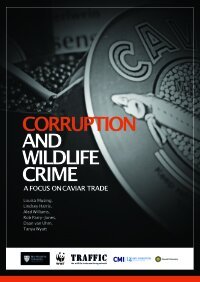
While conservation practitioner anecdotes and existing empirical research all point to corruption as a main facilitator enabling wildlife crime, there is still limited knowledge about what can change this situation and help reverse the pernicious impact of corruption on conservation outcomes in practice. Corruption has a negative impact on conservation by reducing the effectiveness of conservation programmes, reducing law enforcement and political support, as well as establishing incentives for the overexploitation of resources. It undermines the effectiveness and legitimacy of laws and regulations and can be an indicator of the presence of organised crime groups. Corruption needs to be addressed as a central part of the approach to tackling wildlife crime.
Cambridge, UK: A TRAFFIC, WWF, U4 ACRC, Utrecht University, and Northumbria University, 2019. 42p.
By Thiess Büttner, and Hannes Spengler.
The paper revisits the local determinants of crime using a spatial model distinguishing between resident and non-resident offenders. Employing data for German municipalities, the model is estimated by means of a spatial GMM approach. Focusing on resident offenders legal earnings opportunities and the expected gain from offenses are found to be important determinants of crime. Also the socio-economic background in terms of unemployment, poverty, and inequality proves significant for both property and violent crime. Whereas local inequality only shows an effect on crime committed by resident offenders, crime committed by non-resident offenders is shown to be significantly related to the characteristics in adjacent municipalities such as unemployment and income.
Mannheim: ZEW – Leibniz Centre for European Economic Research, 2003. 30p.