Open Access Publisher and Free Library
CRIME+CRIMINOLOGY.jpeg

CRIME

Violent-Non-Violent-Cyber-Global-Organized-Environmental-Policing-Crime Prevention-Victimization

Posts in justice
A Walk in the Park

By Robin Clarke.

Join Robin Clarke, world class naturalist, on his dramatic venture in Bolivia, to establish the Amboró national park along with his friend and Bolivian zoologist Noel Kempff Mercado, who was eventually murdered by a drug cartel. Clarke battled for decades to save the beautiful rain forests, terminate the trafficking in endangered species, and grappled with the Californian mafia’s drug cartel. And he risked his life to save hikers lost in the wilds of the Bolivian mountains. Though this book is essentially a very personal memoir, it reads like a suspense story.

New York. Harrow and Heston, A Read-Me.Org Imprint. 2022. 391p.

download
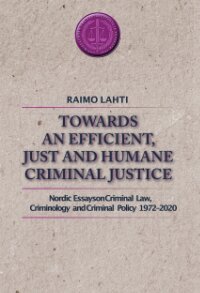
Towards an Efficient, Just and Humane Criminal Justice: Nordic Essays on Criminal Law, Criminology and Criminal Policy 1972-2020

By Raimo Lahti.

This collection of essays on criminal law, criminology and criminal policy includes a selection of my articles from the year of 1972 to the year of 2020, i.e., from a period of 49 years. The writings – in all 32 – chosen for the compilation are written in English and 30 of them have been published earlier. The main aim with this anthology is to crucially widen the access of my writings for comparative purposes. The articles are divided into seven chapters. Chapters I–VI cover a large spectrum of criminal sciences, and they are – in particular, in Chapters IV–VI – written rather from a Nordic (Scandinavian) than from a narrower Finnish perspective. The title of the anthology expresses its main message: towards an efficient, just and humane criminal justice. Chapter VII includes five articles related to bio-ethics and (criminal) law. The reason for that chapter’s attachment is to present some of my contributions to the new discipline entitled ‘Medical law and biolaw’.

The intensified internationalization and Europeanization of criminal law and justice have changed the role of comparative law and criminal sciences in general. There is much more need for comparison of legal orders due to the emergence of European criminal law and international criminal law and due to the increased interaction between European and global legal regulations and the national legal orders. We also need more evidence-based criminological research to be utilized in criminal-policy planning and as a foundation for rational policy decisions.

Helsinki: Suomalainen lakimiesyhdistys, 2021. 554p.

download
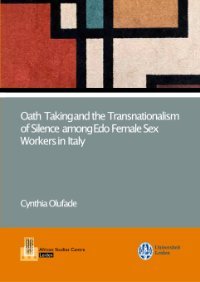
Oath taking and the transnationalism of silence among Edo female sex workers in Italy

By Cynthia A. Olufade.

This book is based on Cynthia A. Olufade’s Master’s thesis ‘Oath taking and the transnationalism of silence among Edo female sex workers in Italy’, winner of the African Studies Centre, Leiden’s 2018 Africa Thesis Award. This annual award for Master’s students encourages student research and writing on Africa and promotes the study of African cultures and societies. This study aimed to interrogate the oath taking phenomena among Edo female sex workers in Italy. In a bid to understand how the oaths taken in Edo State, translates into an intangible aspect of the trafficking process. To achieve the aims of the study, the research utilised the qualitative method of data collection, it involved the use of in-depth interviews and observations. The study reveals that the transnational silence exhibited by different categories of actors in the Edo sex work network sustains the industry. The research also highlights that the oaths form only a part, albeit important of the construction of debt and bondage in the context of Edo transnational sex work. In light of its findings, the study concludes that the idea of transnationalism of silence is as effective as the oaths taken.

Leiden: Leiden University, 2020. 118p.

download
Three Criminal Law Reformers: Beccaria, Bentham, Romilly

By Coleman Phillipson.

THE following three essays are not intended to be considered as separate, independent studies; they are meant to be taken together as supplementing each other, and as constituting one whole. With this intention in view, the author has been able to avoid a good deal of overlapping and repetition, which would otherwise have been inevitable. Though three men and their works are here discussed, we are concerned with but one epoch, one movement, one phase in legal evolution, which represents in many respects a turning-point in European history, and is of the utmost importance in the development of our modern civilisation. Beccaria, Bentham and Romilly are among the greatest law reformers of modern times. In their assault on the folly, injustice and cruelty of the then existing criminal jurisprudence, in their trenchant criticism of outworn codes, obscurantist traditions, blind superstitions, dogmatic technicalities, oppressive fictions, and useless relics of the past, in their proposal of rational substitutes, in their pointing the way to the light, they were intimately united. Their resemblances, like their differences, are as striking in their work as they are in their personal characteristics. In the case of Beccaria—a diffident Italian youth, shrinking from the struggles _ of men, whose small work was almost forcibly extracted from . him by his friends, and whose guarded oracular utterances soon arrested the attention of the world—we shall see vital conceptions and principles of penology in the process of germination and crystallisation; we shall see them in their triumphant conflict with the prevailing régime of sanguinary laws and barbarous methods of procedure. In the case of Bentham—that myriad-minded man, the dauntless explorer of institutions, the arch-legislator ever ready, in his jealously guarded “‘hermitage,”’ to make laws for all the nations of the earth—we shall see a prodigious multitude of ideas, schemes and systems, lavishly given to the world from a rich mine that could, surely, never be exhausted; we shall see this prolific progenitor scattering them broadcast, infusing new life into many barren places…

London: J.M. Dent, 1923. 344p.

download
Passion and Criminality in France

By Louis Proal.

A Legal and Literary Study. Translated by Alfred Richard Allinson. From the preface: “…How comes it that affection may turn to hate, and lovers become the bitterest of foes — that the transition is so easy from love to loathing, from the transports of the most exalted tenderness to frenzies of the most savage anger? How is it foun so fond a feeling may grow so cruel and lead to commission of so many barbarous murders…?”

Paris. Carrington (1901) 707 pages.

download
Challenge Of Crime In A Free Society

By the President’s Commission of Law Enforcement and Administration of Justice.

“This report is about crime in America — about those who commit it, about those who are its victims, and about what can be done to reduce it….The existence of crime, the talk about crime, the reports of crime, and the fear of crime have eroded the basic quality of life of many Americans.” From the Summary.

Harrow and Heston Classic reprint. (1967) 342 pages.

download
The Positive School of Criminology

By Enrico Ferri.

The positive school of criminology was b born of the three lectures Ferri gave at the University of Naples in 1901. In these essays he makes the case for the importance, possibly supremacy, of social and economics causes of crime, in contrast to the then dominant theories of biological determinism, the idea of the “born criminal.” In much of his professional life he was driven by one cause that strikes a bell today in the 21st century: the cause of social justice.

Harrow and Heston Classic Reprint. 1902.

download
Criminal Sociology

By Enrico Ferri.

In this great Italian classic in criminology, its famed author Enrico Ferri describes it as “a work of propaganda and an elementary guide for anyone who intends to dedicate himself to the scientific study of offenders and of the means of prevention and social defense against them.” Published in 1892 and in English in 1896. The book emphasizes the link between crime causation and social justice, setting him apart from his criminal anthropologist forebears.

Harrow and Heston Classic Reprint. 1896.

download
Criminals of Chicago

By Prince Emmanuel of Jerusalem.

“ History shows that hanging did not prevent petit larceny. So we have abandoned the policy of frightfulness in punishment and cannot revert to it even though it still has some few supporters. And yet we feel that the theory of punishment being deterrent is philosophically sound. …The first news from the Laboratory revealed the prevalence of feeble-mindedness among delinquents. “

Rosburgh Publishing (1921) 247 pages.

download
The Criminal Classes

By D. R. Miller.

“A law demanding only a refrain from violence or abstinence from all that may injure others contains but the negative, while it is lacking in the more important, the positive elements. If men, by closing their eyes to the existence of evil, could thereby banish it, then might it be best for all to close their eyes….it is quite certain that we can never hope to discover, through ignorance, what are the various types of criminal abnormality, nor know the many causes or cures for such estrangements. An intelligent and thorough study of the criminal problem will eliminate from our creed that fatalistic formula which asserts that ‘Evil is good not understood’…”

United Brethren Publishing House (1903) 224 pages.

download
Criminal Intelligence

By Carl Murchison.

“This material is offered for the special consideration of lawyers, psychologists, siociologists, social workers, and all those who have to do with the formulation of criminal law, the treatment of criminals, and the molding of public opinion concerning the enemies of organized society…”

A Read-Me.Org Classic Reprint (1926) 483 pages.

download
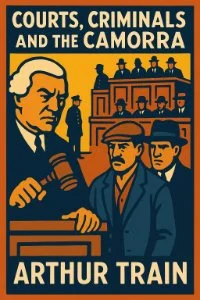
Courts, Criminals And The Camorra

By Arthur Train.

by Arthur Train (Author), Colin Heston (Introduction) Format: Kindle Edition

Arthur Train’s Courts, Criminals and the Camorra (1912) arrives from a moment when the American courtroom was transforming from a dusty forum of local justice into a national spectacle. Crime reporting surged, public fascination with underworld societies ripened, and the newly consolidated profession of the district attorney—Train’s own calling—stood at the intersection of drama and civic responsibility. Few chroniclers were better positioned to capture this world than Train himself: lawyer, storyteller, and one of the most influential interpreters of everyday justice in the early twentieth century.
This book offers a vivid, almost cinematic tour through the people and pressures that shaped the criminal courts of Train’s New York. With a wit sharpened by long service in the district attorney’s office, Train narrates cases, misadventures, and courtroom characters with the briskness of a magazine correspondent and the subtle insight of someone who has lived the system from the inside. He makes the courthouse feel less like a bureaucratic maze and more like a bustling social laboratory—part theater, part battleground, part human comedy.
The title’s reference to the Camorra, the Neapolitan criminal society that briefly dominated headlines in the years preceding publication, allows Train to broaden his canvas. The Camorra trials in Europe—particularly the sensational proceedings in Viterbo (1911–12)—were international news, and Americans consumed tales of conspiracy, vendetta, and secret brotherhoods with a mixture of horror and fascination. Train uses these stories not merely to thrill, but to show how crime everywhere reflects its environment: local culture shapes criminal enterprise just as surely as it shapes courts, policing, and political life.
What makes this volume enduring is Train’s tone—bright, conversational, humane. His criminals are rarely monsters; they are people caught in pressures of poverty, opportunity, folly, or ambition. His courts, for all their flaws, are animated by men and women doing their best under imperfect circumstances. The result is a portrait of justice as a living organism, not an abstract ideal.
More than a century later, these essays feel surprisingly fresh. They remind us that the tensions surrounding criminal justice—media sensationalism, public fear, the allure of organized crime, the frustrations of overburdened courts—are not uniquely modern. The debates that animate today’s legal and political discussions echo those Arthur Train captured with humor and clarity in 1912.
To read Courts, Criminals and the Camorra now is to eavesdrop on the origins of our contemporary legal culture. It is also simply to enjoy a gifted storyteller at work, illuminating the world he knew best with charm, color, and a sharp eye for the human quirks that make justice both necessary and endlessly fascinating.

New York Scribner’s (1912) 256 pages. Read-Me.Org Inc. 2025. 173p.

download free
kindle $2.99 -- PAPERBACK $9.99
The Trial of Hawley Harvey Crippen

By Filson Young.

With notes and introduction by Filson Young. “Most of the interest and part of the terror of great crime are due not to what is abnormal, but to what is normal in it; what we have in common with the criminal, rather than that subtle insanity which differentiates him from us, is what makes us view with so lively an interest a fellow-being who has wandered into these tragic and fatal fields.”

William Hodge (1910) 266 pages.

download part 1
download part 2
Crime: It’s Causes and Treatment

By Clarence Darrow.

“The physical origin of such abnormalities of the mind as are called ‘criminal’ is a comparatively new idea….It has not been long since insanity was treated as a moral defect….”My main effort is to show that the laws that control human behavior are as fixed and certain as those that control the physical world…”

Thomas Crowell Pubs. (1922) 225 pages.

download