Open Access Free Library
CRIME+CRIMINOLOGY.jpeg

CRIME

Violent-Non-Violent-Cyber-Global-Organized-Environmental-Policing-Crime Prevention-Victimization

Posts in social sciences
Concealing for Freedom: The Making of Encryption, Secure Messaging and Digital Liberties

By: Ksenia Ermoshina and Francesca Musiani

Concealing for Freedom: The Making of Encryption, Secure Messaging and Digital Liberties sets out to explore one of the core battlegrounds of Internet governance: the encryption of online communications. Current debates around encryption have fundamental implications for our individual liberties and collective presence on the Internet. Encryption of communications at scale and in increasingly usable ways has become a matter of public concern, especially since Edward Snowden’s 2013 revelations. A new cryptographic imaginary is taking hold, which sees encryption as a necessary precondition for the formation of networked publics. At the same time, there have been major evolutions and accelerations in the field of secure communications, prompted in part by the cryptography community’s renewed efforts to create next-generation secure messaging protocols and applications. It is vital that we unveil the very recent, and sometimes less recent history of these protocols and their key applications. The book takes on this task, in order to show how the opportunities and constraints they provide to Internet users came about, and how both developer communities and institutions are working towards making them available for the largest possible audience. It explores how efforts towards this goal are built upon interwoven stories about technical development and architectural choices, about community-building – and about Internet governance and politics. In doing so, the book focuses on the experience of encryption in a wide variety of contemporary secure messaging protocols and tools, and looks at the implications of these endeavors for the “making of” digital liberties on the Internet. Concealing for Freedom provides two key empirical and theoretical contributions. Firstly, it enriches a social sciences-informed understanding of encryption. It does so by examining how different solutions of cryptography for secure communications are created, developed, enacted, and governed, and what this diverse experience of encryption, operating across many different sites, means for online civil liberties. Secondly, it contributes to understanding the social and political implications of particular design choices when it comes to the technical architecture of digital networks, in particular their degree of (de-)centralization. The book explores developers’ actions and their interactions with other stakeholders, for instance users, security trainers, standardising bodies, and funding organizations. It also examines their interactions with the technical artifacts they develop, in which a core common objective is to create tools that “conceal for freedom” even as how this objective is met differs according to technical architectures, the user publics being targeted and the tools’ underlying values and business models.

Manchester, UK: Mattering Press, 2022. 274p.

Non-Fatal Shooting Crosswalk Study: FINAL REPORT

By Alaina De Biasi Edmund F. McGarrell Scott E. Wolfe

Historically, crime in the United States has been measured by the Uniform Crime Reporting (UCR) system administered by the Federal Bureau of Investigation (FBI). In this system, local, county, state, Tribal and federal law enforcement agencies submit summary crime data on incidents and arrests to the UCR system. Crime patterns and trends can then be analyzed and tracked at local, state, and national levels. 

United States, Michigan Justice Statistics Center, School of Criminal Justice, Michigan State University. 2023. 33pg

Racial Isolation, School Police, and the “School-To-Prison Pipeline”: An Empirical Perspective on the Enduring Salience of “Tipping Points”

By Michael Heise

Two broad trends inform public K-12 education’s current trajectory. One involves persisting (and recently increasing) school racial isolation which helps account for an array of costs borne by students, schools, and communities. A second trend, involving a dramatically increasing police presence in schools, is evidenced by a rising school resource officer (“SRO/police”) presence in schools. Increases in the magnitude of a school’s SRO/police presence correspond with increases in the school’s propensity to engage law enforcement agencies in student disciplinary matters which, in turn, help fuel a growing school-to-prison pipeline problem. While these two broad trends propel two distinct research literatures, these research literatures do not meaningfully engage with one another. Empirical research is largely silent on the degree to which, if at all, variation in a school’s racial isolation level influences how its SRO/police presence interacts with the school’s propensity to report student discipline issues to law enforcement agencies. This Article examines whether variation in school racial isolation levels informs whether a school’s SRO/police presence influences the school’s law enforcement reporting rates. Results from this study imply that any such influence is confined to schools where non-white student enrollment ranges from 11% to 50%. The research literature on tipping points provides one helpful interpretative lens to better understand why this specific school racial isolation band systematically differs from others when it comes to SRO/police presence’s influence on a school’s propensity to report student discipline matters to law enforcement agencies.

Buffalo Law Review Vol. 71, No. 2 (2023)

Global Risks Report 2024

By World Economic Forum

The Global Risks Report explores some of the most severe risks we may face over the next decade, against a backdrop of rapid technological change, economic uncertainty, a warming planet and conflict. As cooperation comes under pressure, weakened economies and societies may only require the smallest shock to edge past the tipping point of resilience.

Geneva, SWIT: World Economic Forum, 2024. 124p

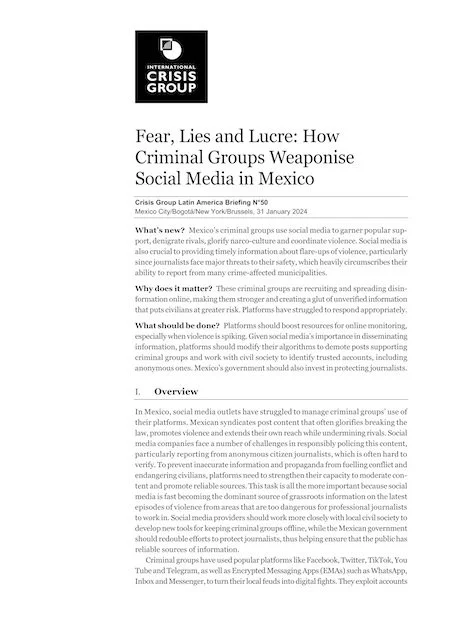
Fear, Lies and Lucre: How Criminal Groups Weaponise Social Media in Mexico

By International Crisis Group

What’s new? Mexico’s criminal groups use social media to garner popular support, denigrate rivals, glorify narco-culture and coordinate violence. Social media is also crucial for providing timely information about flare-ups of violence, particularly since journalists face major threats to their safety, which heavily circumscribes their ability to report from many crime-affected municipalities.

Why does it matter? These criminal groups are recruiting and spreading disinformation online, making them stronger and creating a glut of unverified information that puts civilians at greater risk. Platforms have struggled to respond appropriately.

What should be done? Platforms should boost resources for online monitoring, especially when violence is spiking. Given social media’s importance in disseminating information, platforms should modify their algorithms to demote posts supporting criminal groups and work with civil society to identify trusted accounts, including anonymous ones. Mexico’s government should also invest in protecting journalists.

Brussels: Crisis Group, 2024

Sheltering Injustice: A Call for Georgia to Stop Criminalizing People Experiencing Homelessness ref

By Southern Poverty Law Center

Access to safe, stable housing is a human right. In the United States, however, the deprivation of this right leads to inequitable housing access. As a result, in addition to people with disabilities and members of the LGBTQ+ community, people of color — especially Black people — are more likely to experience homelessness or be at risk of homelessness. Compounding this issue, people of color and people with disabilities are also overrepresented in the criminal legal system because of mass incarceration. This intersection of housing inaccessibility and criminalization has resulted in the pernicious practice of the criminalization of people experiencing homelessness, a pressing issue across the country — including in the Deep South. In 2023, for example, Georgia enacted a law that forces cities and other localities to enforce bans on public camping, putting thousands of Georgians living unsheltered at risk of arrest for performing basic survival activities like rest, eating and asking for help.

Montgomery, AL Southern Poverty Law Center, 2024

Homelessness, Offending, Victimization, and Criminal Legal System Contact   

By Bill McCarthy and John Hagan

There is now a sizable literature on connections between homelessness, crime, and criminal legal system contact. We review studies on these relationships, focusing mostly on links between the adversity that often characterizes homelessness—the need for shelter, food, and income—and offending, victimization, and involvement with the criminal legal system. We concentrate on multivariate studies from the United States and Canada and consider research on youth and adults. We begin with a short discussion of some of the challenges of studying these relationships. We follow our review of research on homeless conditions with a summary of research that has used data from homeless samples to advance a broad array of explanations of crime; a collection that includes strain, routine activities and lifestyle exposure, differential association, social control, rational choice, life course, and criminal capital theories.

Annual Review of Criminology, Volume 7, Page 257 - 281

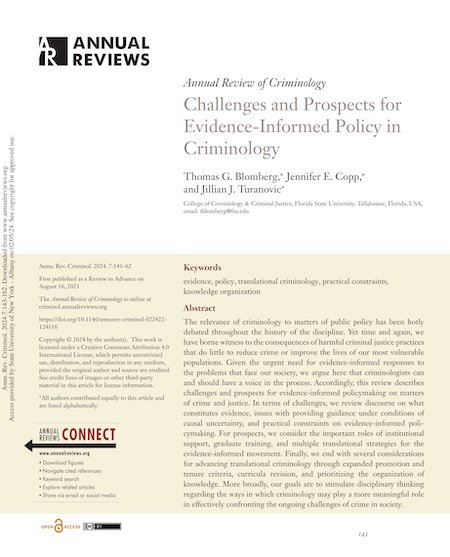
Challenges and Prospects for Evidence-Informed Policy in Criminology

By Thomas G. Blomberg, Jennifer E. Copp, and Jillian J. Turanovic

The relevance of criminology to matters of public policy has been hotly debated throughout the history of the discipline. Yet time and again, we have borne witness to the consequences of harmful criminal justice practices that do little to reduce crime or improve the lives of our most vulnerable populations. Given the urgent need for evidence-informed responses to the problems that face our society, we argue here that criminologists can and should have a voice in the process. Accordingly, this review describes challenges and prospects for evidence-informed policymaking on matters of crime and justice. In terms of challenges, we review discourse on what constitutes evidence, issues with providing guidance under conditions of causal uncertainty, and practical constraints on evidence-informed policymaking. For prospects, we consider the important roles of institutional support, graduate training, and multiple translational strategies for the evidence-informed movement. Finally, we end with several considerations for advancing translational criminology through expanded promotion and tenure criteria, curricula revision, and prioritizing the organization of knowledge. More broadly, our goals are to stimulate disciplinary thinking regarding the ways in which criminology may play a more meaningful role in effectively confronting the ongoing challenges of crime in society.

Annual Review of Criminology, Volume 7, Page 143 - 162

 Hybrid Interpersonal Violence in Latin America: Patterns and Causes   

By Abigail Weitzman, Mónica Caudillo, and Eldad J. Levy

In this review, we argue that to understand patterns and causes of violence in contemporary Latin America, we must explicitly consider when violence takes on interpersonal qualities. We begin by reviewing prominent definitions and measurements of interpersonal violence. We then detail the proliferation of interlocking sources of regional insecurity, including gender-based violence, gangs, narcotrafficking, vigilantism, and political corruption. Throughout this description, we highlight when and how each source of insecurity can become interpersonal. Next, we outline mutually reinforcing macro and micro conditions underlying interpersonal violence in its many hybrid forms. To conclude, we call for more multifaceted conceptualizations of interpersonal violence that embrace the complexities of Latin American security situations and discuss the opportunities and challenges that lie ahead in this area.

Annual Review of Criminology, Volume 7, Page 163 - 186

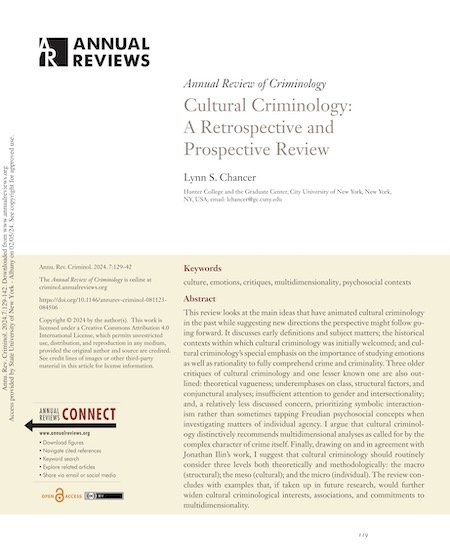
Cultural Criminology: A Retrospective and Prospective Review

By Lynn S. Chancer

This review looks at the main ideas that have animated cultural criminology in the past while suggesting new directions the perspective might follow going forward. It discusses early definitions and subject matters; the historical contexts within which cultural criminology was initially welcomed; and cultural criminology's special emphasis on the importance of studying emotions as well as rationality to fully comprehend crime and criminality. Three older critiques of cultural criminology and one lesser known one are also outlined: theoretical vagueness; under-emphases on class, structural factors, and conjunctural analyses; insufficient attention to gender and intersectionality; and, a relatively less discussed concern, prioritizing symbolic interactionism rather than sometimes tapping Freudian psychosocial concepts when investigating matters of individual agency. I argue that cultural criminology distinctively recommends multidimensional analyses as called for by the complex character of crime itself. Finally, drawing on and in agreement with Jonathan Ilin's work, I suggest that cultural criminology should routinely consider three levels both theoretically and methodologically: the macro (structural); the meso (cultural); and the micro (individual). The review concludes with examples that, if taken up in future research, would further widen cultural criminological interests, associations, and commitments to multidimensionality.

Annual Review of Criminology, Volume 7, Page 129 - 142

Code of the Street 25 Years Later: Lasting Legacies, Empirical Status, and Future Directions

By Jamie J. Fader and Kenneth Sebastian León

This review, published on the twenty-fifth anniversary of the publication of Code of the Street (1999), considers the legacies of Elijah Anderson's groundbreaking analysis of the interactional rules for negotiating street violence within the context of racism and structural disadvantage in Philadelphia. Empirical testing has yielded substantial support for Code of the Street’s key arguments. In the process of assessing its generalizability, such scholarship has inadvertently flattened and decontextualized the theory by, for example, reducing it to attitudinal scales. We identify a more politically conscious analysis in the original text than it is generally credited with, which we use to argue that “code of the street” has outgrown its reductive categorization as a subcultural theory. We conclude that the pressing issue of urban gun violence makes now an ideal time to refresh the theory by resituating it within the contemporary structural and cultural landscape of urban violence, analyzing the social-ecological features that shape the normative underpinnings of interpersonal violence, and studying the prosocial and adaptive features of the code.

Annual Review of Criminology, Volume 7, Page 19 - 38

Bentham and the Arts

Edited by Anthony Julius, Malcolm Quinn, and Philip Schofield

Bentham and the Arts considers the sceptical challenge presented by Bentham’s hedonistic utilitarianism to the existence of the aesthetic, as represented in the oft-quoted statement that, ‘Prejudice apart, the game of push-pin is of equal value with the arts and sciences of music and poetry. If the game of push-pin furnish more pleasure, it is more valuable than either.’ This statement is one part of a complex set of arguments on culture, taste, and utility that Bentham pursued over his lifetime, in which sensations of pleasure and pain were opposed to aesthetic sensibility. Leading scholars from a variety of disciplines reflect on the implications of Bentham’s radical utilitarian approach for our understanding of the history and contemporary nature of art, literature, and aesthetics more generally.

Each contributor takes into account, from the perspective of their own discipline and expertise, the implications for their research area of the views contained in Bentham’s Of Sexual Irregularities, and other writings on Sexual Morality (published in the authoritative edition of The Collected Works of Jeremy Bentham in 2014) and ‘Not Paul, but Jesus: Volume III’ (published online by the Bentham Project in 2014). In these essays, Bentham puts forward the first philosophical defence of sexual liberty. In doing so, he questions the meaning of ‘taste’ and hence the received understanding of aesthetics more generally.

The contributors, moreover, challenge two of the major commonplaces in literary and historical studies of the nineteenth century: first that literature and utilitarianism represented alternative and incompatible views of the world; and second that Bentham’s utilitarianism was somehow emaciated in comparison with that of John Stuart Mill. The volume also includes new reflections on the auto-icon and the panopticon, the latter showing the utilitarian genealogy of a collaborative art and architecture project on the site of the Millbank Penitentiary.

The title ‘Bentham and the Arts’ itself challenges the commonly held notion that Bentham had nothing relevant to say on the subject of the Arts – the essays in this volume show that Bentham remains extraordinarily relevant, both in historical and philosophical terms.

London: UCL Press, 2020

Selective Bribery: When Do Citizens Engage in Corruption?

By  Aaron Erlich, Jordan Gans-Morse, and Simeon Nichter

  Corruption often persists not only because public officials take bribes, but also because many citizens are willing to pay them. Yet even in countries with endemic corruption, few people always pay bribes. Why do citizens bribe in some situations but not in others? Integrating insights from both principal-agent and collective action approaches to the study of corruption, the authors develop an analytical framework for understanding selective bribery. Their framework reveals how citizens’ motivations, costs, and risks influence their willingness to engage in corruption. A conjoint experiment conducted in Ukraine in 2020 provides substantial corroboration for 10 of 11 pre-registered predictions. By shedding light on conditions that dampen citizens’ readiness to pay bribes, the researchers’ findings offer insights into the types of institutional reforms that may reduce corruption. 

Evanston, IL: Northwestern University, Institute for Policy Research, Working Paper-22-28, 2022. 55p

The changing culture of outlaw motorcycle gangs in Australia

By Christopher Dowling, Dominic Boland, Anthony Morgan, Julianne Webster, Yi-Ning Chiu and Roger Lowe 

This study explores changes to the internal culture of a sample of Australian outlaw motorcycle gangs (OMCGs). We analysed data from 39 in-depth interviews with former OMCG members in Queensland to discern changes in recruitment practices, hierarchies and governance processes, as well as values, norms and relationships experienced and observed while members of an OMCG. Structurally, clubs changed little, although participants described how members were increasingly using the structures and systems of clubs for their own benefit. Changes were noted in recruitment practices, which were seen as increasingly geared towards enlisting violent, criminally-inclined men. There was also a perceived erosion of loyalty and camaraderie within OMCGs, with a shift towards younger, newer members who were seen as self-interested and financially motivated. These changes were contributing factors in decisions of many former members to disengage from OMCGs. 

Australia, Australia Institute of Criminology. Trends & issues in crime and criminal justice no. 615. February 2021. 16pg

Family and Me (FAM): A New Model of Foster Care for Youth Impacted by Commercial Sexual Exploitation in San Francisco

By Julie Freccero, Audrey Taylor, Sarah Chynoweth, Justine DeSilva

Children and youth experiencing commercial sexual exploitation (CSE) often have some form of engagement with the child welfare system. Safe and stable housing is vital to minimize vulnerability to CSE, help survivors recover, and reduce revictimization. Yet housing and shelter are among the top service gaps reported by agencies serving trafficking survivors in San Francisco, a high density area for CSE. To address this disparity, in 2019, a coalition of agencies developed Family And Me (FAM), a new model of foster care designed to meet the needs of youth who have experienced or are at risk of CSE in the San Francisco Bay Area. The goal was to establish an evidence-based, youth-centered model of care that could be scaled throughout the State of California and beyond. The 3.5-year FAM pilot aimed to improve the health, safety, and well-being of youth affected by CSE and to increase the knowledge, capacity, and retention rates of the caregivers who support them by offering a range of enhanced support services for both youth and their caregivers. However, due to numerous challenges, such as COVID-19 restrictions and recruitment barriers, the FAM collaborative was only able to implement a portion of the original FAM model.

Berkeley, CA: Human Rights Center at UC Berkeley School of Law, 2022. 40p.

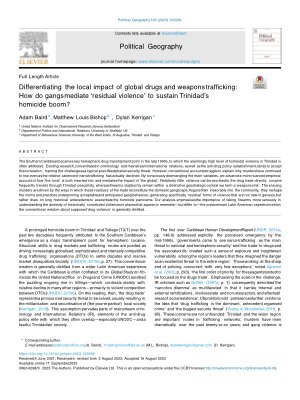
Differentiating the local impact of global drugs and weapons trafficking: How do gangs mediate ‘residual violence’ to sustain Trinidad’s homicide boom?

By Adam Baird , Matthew Louis Bishop , Dylan Kerrigan

The Southern Caribbean became a key hemispheric drug transhipment point in the late 1990s, to which the alarmingly high level of homicidal violence in Trinidad is often attributed. Existing research, concentrated in criminology and mainstream international relations, as well as the anti-drug policy establishment, tends to accept this correlation, framing the challenge as a typical post-Westphalian security threat. However, conventional accounts struggle to explain why murders have continued to rise even as the relative salience of narcotrafficking has actually declined. By consciously disentangling the main variables, we advance a more nuanced empirical account of how ‘the local’ is both inserted into and mediates the impact of ‘the global’. Relatively little violence can be ascribed to the drug trade directly: cocaine frequently transits through Trinidad peacefully, whereas firearms stubbornly remain within a distinctive geostrategic context we term a ‘weapons sink’. The ensuing murders are driven by the ways in which these ‘residues’ of the trade reconstitute the domestic gangscape. As guns filter inexorably into the community, they reshape the norms and practices underpinning acceptable and anticipated gang behaviour, generating specifically ‘residual’ forms of violence that are not new in genesis, but rather draw on long historical antecedents to exacerbate the homicide panorama. Our analysis emphasises the importance of taking firearms more seriously in understanding the diversity of historically constituted violences in places that appear to resemble—but differ to—the predominant Latin American cases from which the conventional wisdom about supposed ‘drug violence’ is generally distilled.

Political Geography. Volume 106, October 2023, 102966

Yucatán as an Exceptionto Rising Criminal Violencein México

By Shannan Mattiace1and Sandra Ley

ucatán state’s homicide level has remained low and steady for decades and criminalviolence activity is low, even while crime rates in much of the rest of the country have increased since 2006. In this research note, we examine five main theoretical expla-nations for Yucatán’s relative containment of violence: criminal competition, protection networks and party alternation, vertical partisan fragmentation, interagency coordin-ation, and social cohesion among the Indigenous population. Wefind that in Yucatán,interagency coordination is a key explanatory variable, along with cooperation aroundsecurity between Partido Revolucionario Institucional and Partido Acción Nacionalgovernments and among federal and state authorities

journal of Politics in Latin America2022, Vol. 14(1) 103–119© The Author(s) 2022Article reuse guidelines:sagepub.com/journals-permissionsDOI: 10.1177/1866802X221079636journals.sagepub.com/home/pla

Anatomy of a Homicide Project An exploratory review of the homicides committed in Leon County between 2015-2020

By Sara Bourdeau,

At the direction of Sheriff Walt McNeil, the Leon County Sheriff’s Office (LCSO) began a review of data related to the 141 homicides recorded in Leon County from 2015-2020.A The purpose of this exploratory project was to gain a better understanding of the commonalities between the people, conditions, and circumstances contributing to the incidents. The Anatomy of a Homicide Project goals included: 1. Examining commonalities of homicide victims and offenders. 2. Identifying underlying issues, such as adverse childhood experiences (ACE), which may have contributed to or resulted in the homicides. 3. Understanding the various behavioral, social, environmental, economic, or situational factors experienced by both victims and offenders and how these factors may be correlated to the homicides. 4. Identifying commonalities in location, time, and methods by which homicides are committed. 5. Understanding motivational factors contributing to the homicides. 6. Identifying intelligence and investigative gaps and methods to better collect this data in the future. 7. Developing recommendations for targeted actions to mitigate contributing factors and prevent future homicides. The social, emotional, and financial costs of homicide for victims and offenders, the criminal justice system, the health care system, and society in general, far exceed those of other crimes. One study estimated the cost of one (1) murder to be 38 times higher than rape, 51 times higher than an armed robbery, and 119 times higher than an aggravated assault.1 Prevention of homicides is a top priority for the Leon County Sheriff’s Office. Additional research is needed to fully diagnose the problem and move forward with a series of people, place, and behavior-based strategies. When treated as a public health problem, using a scientific epidemiological approach, homicides can be prevented.2 It will take an ALLin community working together with focus, fairness, and a balanced approach of prevention and enforcement. The Leon County Sheriff’s Office dedicates this report to the victims of the homicides which occurred in Leon County from 2015-2020 and the families, friends, and neighborhoods impacted by these tragedies. While we will never fully understand the circumstances of these events, we will build on what we have learned by advocating for additional research, improved data collection and analysis, increased collaboration and information sharing between agencies, providers, and the community, and solutions which are both evidence-based and community informed.

2021 94p.

The Enduring Neighborhood Effect, Everyday Urban Mobility, and Violence in Chicago

By Robert J. Sampson† and Brian L. Levy

A longstanding tradition of research linking neighborhood disadvantage to higher rates of violence is based on the characteristics of where people reside. This Essay argues that we need to look beyond residential neighborhoods to consider flows of movement throughout the wider metropolis. Our basic premise is that a neighborhood’s well-being depends not only on its own socioeconomic conditions but also on the conditions of neighborhoods that its residents visit and are visited by—connections that form through networks of everyday urban mobility. Based on the analysis of large-scale urban-mobility data, we find that while residents of both advantaged and disadvantaged neighborhoods in Chicago travel far and wide, their relative isolation by race and class persists. Among large U.S. cities, Chicago’s level of racially segregated mobility is the second highest. Consistent with our major premise, we further show that mobility-based socioeconomic disadvantage predicts rates of violence in Chicago’s neighborhoods beyond their residence-based disadvantage and other neighborhood characteristics, including during recent years that witnessed surges in violence and other broad social changes. Racial disparities in mobility-based disadvantage are pronounced—more so than residential neighborhood disadvantage. We discuss implications of these findings for theories of neighborhood effects on crime and criminal justice contact, collective efficacy, and racial inequality

University of Chicago Law Review, U Chi L Rev > Vol. 89 (2022) > Iss. 2

Study to Identify an Approach to Measure the Illicit Market for Tobacco Products: Final Report

By Jirka Taylor, Shann Corbett, Fook Nederveen, Stijn Hoorens, Hana Ross, Emma Disley

The illicit tobacco trade is a global phenomenon with significant negative health, social and economic consequences. This study is intended to support efforts to better understand the scope and scale of the illicit tobacco market. The primary objective was to develop a reliable, robust, replicable and independent methodology to measure the illicit market that can be applied by the EU and its Member States. The key requirements were that the methodology would capture the total volume of the illicit trade and distinguish between the legal and illegal market, ideally distinguishing between types of tobacco products, and types of illicit trade. Based on in-depth literature reviews and interviews with key informants, we constructed a longlist of 11 methodologies that have been or could be used to measure the illicit tobacco market and assessed them against a standardised set of criteria. This resulted in a shortlist of five preferred methods (i.e. discarded pack survey, comparison of sales/tax paid and self-reported consumption, consumer survey with and without pack inspection/surrender, econometric modelling). As individual approaches, these shortlisted methods were not sufficient to meet the minimum criteria. Accordingly, these shortlisted methods were then used to formulate options for combination of methodologies corresponding to various levels of resource intensity.

Brussels: Publications Office of the European Union, 2021. 197p.