Open Access Publisher and Free Library
CRIME+CRIMINOLOGY.jpeg

CRIME

Violent-Non-Violent-Cyber-Global-Organized-Environmental-Policing-Crime Prevention-Victimization

Sexual States: Governance and the Struggle over the Antisodomy Law in India

By Jyoti Puri

In Sexual States Jyoti Puri uses the example of the efforts to decriminalize homosexuality in India to show how the regulation of sexuality is fundamentally tied to the creation and enduring existence of the state. Between 2001 and 2013 activists attempted to rewrite section 377 of the Indian Penal Code, which outlaws homosexual behavior. Having interviewed activists and NGO workers throughout five metropolitan centers, investigated crime statistics at the National Crime Records Bureau, visited various state institutions, and met with the police, Puri found that section 377 is but one element of the large and complex systems of laws, practices, policies, and discourses that regulate Indian sexuality. Intended to mitigate sexuality's threat to the social order, this regulation works to preserve the views of the state as inevitable, legitimate, and indispensable. By highlighting the various means through which the regulation of sexuality constitutes India's heterogeneous and fragmented.

Durham, NC: Duke University Press, 233p;.

download
California Police Sexual Misconduct Arrest Cases, 2005-2011

By Philip M Stinson, Zachary J. Calogeras, Natalie L. DiChiro, and Ryan K. Hunter

This report was prepared at the request of the California Research Bureau. The data are from a larger study on police crime in the United States. Police crimes are those crimes committed by sworn law enforcement officers given the general powers of arrest at the time the offense was committed and/or at the time when the officer was arrested. These crimes can occur while the officer is on- or off-duty and include offenses committed by state, county, municipal, tribal, or special law enforcement agencies. Police crimes damage the occupational integrity of police officers, the organizational legitimacy of the employing law enforcement agency, and the overall authority and legitimacy of the law enforcement community. According to Stinson’s (2009) typology of police crime, nearly all crime committed by sworn law enforcement officers is alcohol-related, drug-related, sex-related, violence-related, and/or profit-motivated. This report focuses on the sex-related police crime arrests of sworn law enforcement officers in the State of California during the years 2005-2011.

Bowling Green, OH: Bowling Green State University, 2015. 25p.

download
Environmental Crime in the Amazon Basin: a Typology for Research, Policy and Action

By Adriana Abdenur, Brodie Ferguson, Ilona Szabo de Carvalho, Melina Risso and Robert Muggah

According to the world’s top scientific experts, deforestation and degradation are up 25 percent in the first six months compared to last year. More forests are being cleared in 2020 than at any point in the past 15 years.

Although spectacular levels of illegal burning have occupied global headlines, a host of other less visible but equally significant environmental crimes are being committed throughout the Amazon basin every day. Such crimes not only impact biodiversity and the global climate, but are virtually always associated with social ills ranging from corruption to slavery and violence.

A new paper from the Igarape Institute – Environmental Crime in the Amazon Basin: a Typology for Research, Policy and Action – introduces a typology to help better understand the scope and scale of the problem and its extensive social and environmental impacts. To date, one of the principal barriers to better policing of the Amazon is the confusion and ambiguity of what is, and is not, a crime. Different countries apply different interpretations which can frustrate investigations and the enforcement of existing laws. The new paper is designed to provide greater clarity to policy makers, law enforcement agencies, civil society actors, and companies committed to curbing environmental crime.

Rio de Janeiro - RJ - Brasil, Igarapé Institute, 2020. 29p.

download
Climate Change and Crime in Cities

By Robert Muggah

Climate change is already disrupting cities around the world. Continued greenhouse gas emissions and warming are intensifying heat islands, contributing to water shortages, rising seas, increasing flood-related risks and worsening pollution. With over two thirds of the population expected to live in cities by 2030, the effects are consequential. Large and fast-growing cities in Asia, Africa and the Americas are likely to be hit hardest by more frequent and intense disasters. Coastal cities across North America and Western Europe are likewise on the front-line.

Climate change is influencing all aspects of city life, from labor markets and food security to migration patterns and economic productivity. One critical, if under-examined, way climate change is affecting cities is in relation to crime and victimization. To be sure, the debate about the relationships between climate and security – and in particular the influence of global warming on conflict onset, duration and intensity – has heated-up over the past decade, there is less attention devoted to how climate change stands to influence criminal violence in cities around the world.

Evidence suggests that dramatic climate change will generate a substantial increase in crime in many cities – and especially more vulnerable neighborhoods. In this paper, Robert Muggah, Igarapé Institute co-founder and Research and Innovation Director analyses studies and theories about the link climate-crime and present strategies and preventive measures to avoid violence while protecting the most vulnerable.

Rio de Janeiro - RJ - Brasil, Igarapé Institute, 2021. 13p.

download
Guidance Note on Combating Environmental Crime: Lessons from fighting illegal gold mining in the Amazon Basin

By The Igarapé Institute and INTERPOL

The Igarapé Institute, in a partnership with INTERPOL, releases the “Guidance note on combating environmental crime: lessons from fighting illegal gold mining in the Amazon Basin”. The publication offers practical guidance for law enforcement, criminal justice and environmental protection authorities to better understand the scope and scale of the challenge. It is designed for national and subnational environmental investigators, police officers and public prosecutors at the forefront of efforts to dismantle environmental crimes in the Amazon.

The guidance note reviews policy and operational strategies meant to prevent, control and reduce illegal small-scale gold mining in the Amazon – with a focus on Brazil, Colombia and Peru. The note offers a catalogue of 12 measures already in place in the three countries that can be valuable for law enforcement, criminal justice and environmental protection authorities to learn from each other, cooperate and coordinate activities within and across countries.

Rio de Janeiro - RJ - Brasil, Igarapé Institute, 2021. 41p.

download
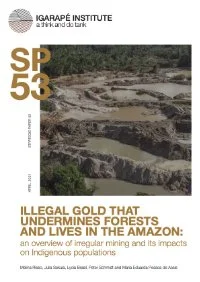
Illegal Gold that Undermines Forests and Lives in the Amazon: an overview of irregular mining and its impacts on Indigenous populations

By Melina Risso, Julia Sekula, Lycia Brasil, Peter Schmidt and Maria Eduarda Pessoa de Assis

In the past 20 years, the price of gold has increased from US$400 to US$1861.50 per ounce, driven by rising demand in China and India. Gold is time and capital-intensive to produce, which is why this rise in demand has driven an attendant demand for illegal gold mining — an industry that is estimated to yield globally between US$12 and US$28 billion annually.2 The Brazilian Amazon is rife with illegal gold mining operations, with 321 identified points of illegal, active and inactive mines arranged in the 9 states that comprise the Brazilian Amazon Basin.3 This has had a direct impact on deforestation rates and health hazards of local indigenous populations. Deforestation across the Amazon grew 25% in the first half of 2020 according to INPE (Brazil’s National Institute for Space Research). The contribution of mining activity to deforestation rates as a whole has increased from 4% in 2017 to 23% in indigenous territories in data recorded up to June 10, 2020.4 Deforestation has been concentrated in indigenous territories where, between 2018 and 2019, environmental degradation by mining increased 107%. This devastation has a price — according to Brazil’s Federal Public Prosecutors Office, 1kg of gold represents roughly R$1.7m in environmental damages, culminating in an environmental cost roughly 10 times greater than the current price of gold.

Rio de Janeiro - RJ - Brasil, Igarapé Institute, 2021. 50p.

download
The Ecosystem of Environmental Crime in the Amazon: an analysis of illicit rainforest economies in Brazil

By Laura Trajber Waisbich, Melina Risso, Terine Husek and Lycia Brasil

Researchers analyzed data from 369 the Federal Police (PF) operations carried out between 2016 and 2021

Environmental crimes are rarely committed isolated from other offenses. Amazon deforestation is not only largely illegal but also driven by a diverse array of offenders through markets contaminated with crimes that despoil the environment, such as illegal logging, illegal mining (especially gold), land grabbing and unsustainable farming. There are a wide array of violations, from environmental, to tax evasion and interpersonal violence from assault to homicide.

The document provides an overview of this biome of Amazon crimes drawn from a detailed analysis of 369 Brazilian Federal Police operations carried out between 2016 and 2021. The police operations found that organized crime was behind half of environmental crimes they investigated, while illegal possession of firearms, ammunition and explosives turned up in almost one in five police operations

The analysis also highlights another strategic failing: lack of data, institutional weaknesses and insufficient political will. All are vital to holding violators accountable for their actions, most critically when the crimes include stealing public lands for illegal farming and ranching – an important driver of illegal deforestation.

Rio de Janeiro - RJ - Brasil, Igarapé Institute, 2022. 41p.

download
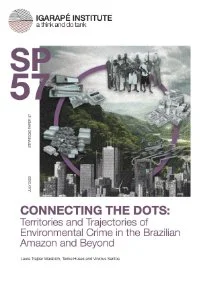
Connecting the Dots: Territories and Trajectories of Environmental Crime in the Brazilian Amazon and Beyond

By Laura Trajber Waisbich, Terine Husek and Vinicius Santos

The ecosystem of environmental crime in the Amazon is largely to blame for the current levels of deforestation and degradation of the biggest tropical forest on the planet. Several illegal economic activities, representing the main drivers of destruction in the river basin, take a heavy toll on the forest and its inhabitants. Based on an analysis of the spatial distribution of the Federal Police operations to fight environmental crime in the Legal Amazon between 2016 and 2021, this study highlights the hotspots for a range of illicit forest-based economic activities in the region, while also showing how other locations within and outside the Brazilian Amazon form part of a broader nexus of environmental crime. The study reviewed more than 300 Federal Police operations and identified 846 territories that make up the ecosystem of environmental crime in the Amazon. These territories are located in 262 municipalities, both in the Legal Amazon and beyond its borders. Of the cities mapped, 75% are located in the Legal Amazon, 22% are in other regions of Brazil and 3% are in neighboring countries. These territories are where environmental and associated crimes converge to fuel illegal deforestation, illegal logging, public land grabbing (known as grilagem, in Portuguese), agriculture and livestock rife with environmental illegalities and illegal mining.

Rio de Janeiro, Brazil: Igarape, 2022. 58p.

download
Exploring Drug Supply, Associated Violence and Exploitation of Vulnerable Groups in Denmark

By Thomas Friis Søgaard Marie Højlund Bræmer Michael Mulbjerg Pedersen

This report provides an analysis of current drug supply models and the related violence and exploitation of vulnerable groups in Denmark. Recent years have seen a growth in criminals’ exploitation of vulnerable groups for drug-related crimes. This development appears to be driven by several structural factors, including increased drug market competition and a proliferation of more labour-intensive supply models. Based on the findings of this study, we identify some priorities for future research to understand the impact of digital developments in retail-level drug distribution on vulnerable individuals and to inform responses to reduce criminal exploitation.

Lisbon: European Monitoring Centre for Drugs and Drug Addiction (EMCDDA), 2021. 55p.

download
European Drug Report 2022: Trends and Developments

By European Monitoring Centre on Drugs and Drug Addiction (EMCDDA)

Our overall assessment is that drug availability and use remain at high levels across the European Union, although considerable differences exist between countries. Approximately 83.4 million or 29 % of adults (aged 15–64) in the European Union are estimated to have ever used an illicit drug, with more males (50.5 million) than females (33.0 million) reporting use. Cannabis remains the most widely consumed substance, with over 22 million European adults reporting its use in the last year. Stimulants are the second most commonly reported category. It is estimated that in the last year 3.5 million adults consumed cocaine, 2.6 million MDMA and 2 million amphetamines.

Lisbon: EMCDDA: 2022. 60p.

download
A Shallow Flood: The Diffusion of Heroin in Eastern and Southern Africa

By Jason Eligh

The flow of heroin from Asian production points to the coastal shores of eastern and southern Africa is not new. Whereas the first heroin transit routes in the region in the 1970s relied heavily on maritime transport to enter the continent, a number of transport modes and urban centres of the interior have increasingly become important features in the current movement of heroin in this region. Interior transit hubs and networks have developed around air transport nodes that use regular regional and international connections to ship heroin. As regional air routes proliferated and became more efficient, their utility and value for the heroin trade increased as well. Heroin is also consolidated and shipped over a frequently shifting network of overland routes, moving it deeper into the African interior in a south-westerly direction across the continent.

Consequently, a shallow flood of heroin has gradually seeped across the region, and this has had a significant impact on the many secondary towns found along the continent’s transcontinental road networks. These places, in turn, have spawned their own small local heroin markets, and become waypoints in rendering sustainable the now chronic, metered progression of heroin’s resolute geographic diffusion across the region.

Geneva: Global Initiative Against Transnational Organized Crime, 2020. 100p.

download
From the Maskani to the Mayor: The political economy of heroin markets in East and Southern Africa

By Simone Haysom

The heroin economy has shaped the growth of coastal villages, border towns and megacities across East and Southern Africa.

The trafficking of heroin is a crucial component of urban politics and development in East and Southern Africa. The heroin economy has shaped the growth of small coastal villages, border towns and megacities along the Southern Route – a network moving Afghan drugs south across the Indian Ocean and onward through Tanzania, Kenya and Mozambique to South Africa. Rapid and dysfunctional urbanisation, the migration of low-skilled youth throughout the region, unemployment and the inability of local governments to cope with service delivery needs have contributed to the spread of the drug, building fortunes for a few ‘big fish’ and promoting corruption among police and politicians.

ENACT (Africa) 2020. 60p..

download
Hiding in Plain Sight: Heroin's Stealthy Takeover of South Africa

By Simone Haysom

The heroin route that crosses South Africa has created a regional heroin economy, with severe social and political repercussions. Heroin use has developed in both major cities and small towns – an important shift in local drug markets that is taking a toll on thousands of people. This policy brief sheds light on the domestic heroin economy, analyses its implications and proposes responses to its drivers and consequences. An effective response will need to consider political factors and must be regionally coordinated. Market dynamics and harm-reduction approaches should also be included. The most sustainable strategies address root causes, disrupt markets and tackle corruption.

ENACT (Africa) 2019. 12p.

download
The Heroin Coast: A political economy along the estern African seaboard

By Simone Haysom, Peter Gastrow and Mark Shaw

This report examines the characteristics of the heroin trade off the East African coast and highlights the criminal governance systems that facilitate drug trafficking along these routes.

In recent years, the volume of heroin shipped from Afghanistan along a network of maritime routes in East and southern Africa appears to have increased considerably. Most of this heroin is destined for Western markets, but there is a spin-off trade for local consumption. An integrated regional criminal market has developed, both shaping and shaped by political developments in the region. Africa is now experiencing the sharpest increase in heroin use worldwide and a spectrum of criminal networks and political elites in East and southern Africa are substantially enmeshed in the trade. This report focuses on the characteristics of the heroin trade in the region and how it has become embedded in the societies along this route. It also highlights the features of the criminal governance systems that facilitate drug trafficking along this coastal route.

ENACT (Africa), 2018. 54p.

download
Fending off Fentanyl and Hunting Down Heroin: Controlling opioid supply from Mexico

By Vanda Felbab-Brown

This paper explores policy options for responding to the supply of heroin and synthetic opioids from Mexico to the United States. Forced eradication of opium poppy has been the dominant response to illicit crop cultivation in Mexico for decades. Forced eradication appears to deliver fast results in suppressing poppy cultivation, but the suppression is not sustainable even in the short term. Farmers find a variety of ways to adapt and replant after eradication. Moreover, eradication undermines public safety and rule of law efforts in Mexico, both of high interest to the United States….Unless security and rule of law in Mexico significantly improve, the licensing of opium poppy in Mexico for medical purposes is unlikely to reduce the supply of heroin to the United States. Mexico faces multiple feasibility obstacles for getting international approval for licensing its poppy cultivation for medical purposes, including, currently, the inability to prevent opium diversion to illegal supply and lack of existing demand for its medical opioids. In seeking to establish such demand, Mexico should avoid setting off its own version of medical opioid addiction.

Washington, DC: The Brookings Institution,2020. 28p.

download
Fentanyl and Geopolitics: Controlling opioid supply from China

By Vanda Felbab-Brown

Since 2013, China has been the principal source of the fentanyl flooding the U.S. illicit drug market — or of the precursor agents from which fentanyl is produced, often in Mexico — fueling the deadliest drug epidemic in U.S. history.

This policy paper draws on lessons from several sets of regulatory domains in China to identify the conditions under which China enforces its regulations. The explored regulatory domains include illicit methamphetamine production in China and its anti-trafficking collaboration with Australia; wildlife trade and the enforcement of anti-wildlife trafficking regulations since the early 1990s, including in the wake of the Severe Acute Respiratory Syndrome (SARS) and COVID-19 epidemics; and the evolution of the tobacco industry.

Washington, DC: The Brookings Institution, 2020. 39p.

download
Read-Me.Org
The Opioid Crisis in America: Domestic and International Dimensions

By Vanda Felbab-Brown, Jonathan P. Caulkins, Carol Graham, Keith Humphreys, Rosalie Liccardo Pacula, Bryce Pardo, Peter Reuter, Bradley D. Stein, and Paul H. Wise

This Brookings opioid project, “The Opioid Crisis in America: Domestic and International Dimensions,” has analyzed policy options for reducing demand, providing treatment, designing regulatory frameworks, and implementing domestic law enforcement and international supply control measures. It has explored local impacts on communities as well as state and federal level responses and international actions. It has paid special attention to vulnerable communities, such as politically and economically disenfranchised Americans, women and children, and military veterans.

Washington DC: The Brookings Institution, 2020. 15p.

download
Neighborhood Crime and Travel Behavior: An Investigation of the Influence of Neighborhood Crime Rates on Mode Choice – Phase II

By Christopher E. Ferrell, Shishir Mathur, Justin Meek and Matthew Piven

There are considerable environmental and public health benefits if people choose to walk, bicycle, or ride transit, instead of drive. However, little work has been done on the effects of neighborhood crimes on mode choice. Instinctively, we understand that the threats posed by possible criminal activity in one’s neighborhood can play a major role in the decision to drive, take transit, walk or ride a bicycle, but so far little empirical evidence supports this notion, let alone guides public infrastructure investments, land use planning, or the allocation of police services. This report--describing Phase 2 of a research study conducted for the Mineta Transportation Institute on crime and travel behavior--finds that high crime neighborhoods tend to discourage residents from walking or riding a bicycle. When comparing a high crime to a lower crime neighborhood the odds of walking over choosing auto decrease by 17.25 percent for work trips and 61 percent for non-work trips. For transit access to work trips, the odds of choosing walk/bike to a transit station over auto decrease by 48.1 percent. Transit trips, on the other hand, are affected by neighborhood crime levels in a similar way to auto trips, wherein high crime neighborhoods appear to encourage transit mode choice.

San Jose, CA: Mineta Transportation Institute, 2012. 104p.

download
Knife crime England Wales

By Grahame Allen and Megan Harding

“Knife” crime, a crime involving an object with a blade or sharp instrument, is a persistent concern and disproportionately impacts the young and disadvantaged. Various remedies have been tried over the years. The Library Briefing Paper Knives and Offensive Weapons (SN00330) discusses the legislation which governs the carrying (possession) and sale of knives and other offensive weapons.

London: House of Commons Library, 2021. 37p.

download
Violence Against Women and Ethnicity: Commonalities and Differences Across Europe

Edited by Ravi K. Thiara, Stephanie A. Condon, and Monika Schröttle

This book draws together both: theory and practice on minority/migrant women and gendered violence. The interplay of gender, ethnicity, religion, class, generation and sexuality in shaping the lives, experiences and choices of minority/migrant women affected by violence has not always been adequately theorised within much of the existing writing on violence against women. Feminist theory, especially the insights provided by the concept of intersectionality, are central to the editors’ conceptual frameworks.

Leverkusen-Opladen: Verlag Barbara Budrich , 2011. 426p.

download