
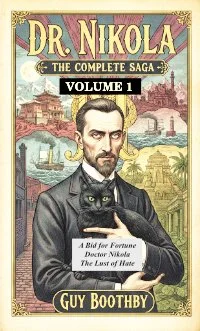
by Guy Boothby (Author), Graeme Newman (Editor), Colin Heston (Introduction)
When the enigmatic Dr. Nikola first stepped onto the literary stage in 1895, clutching his sinister black cat Apollyon and weaving schemes that stretched from the back alleys of Shanghai to the hidden monasteries of Tibet, he didn't just capture the Victorian imagination—illegally or otherwise, he colonized it. Behind this towering figure of Gothic villainy was a prolific, whirlwind talent from the edge of the British Empire: the South Australian-born Guy Boothby.
These two volumes bring together, for the first time in a single definitive collection, the complete saga of Dr. Nikola: A Bid for Fortune, Dr. Nikola, The Lust of Hate, Dr. Nikola’s Experiment, and Farewell, Nikola. To read them in succession is to witness the birth of the modern "super-villain" and to appreciate the unique, rugged perspective Boothby brought to the crowded field of late-Victorian sensation fiction.
Born in Adelaide in 1867, Guy Newell Boothby was the son of a prominent South Australian parliamentarian. While he eventually found fame in the drawing rooms of London, his formative years were spent in the wide-open, often unforgiving landscapes of the Australian colonies. Unlike many of his contemporaries—who wrote of "The Orient" or the "South Seas" from the comfort of an English study—Boothby had the red dust of the Flinders Ranges and the salt of the Southern Ocean in his blood. In 1891, he and his brother famously crossed Australia from north to south, an arduous journey that informed the visceral, kinetic energy of his prose. This "Australian-ness" manifests in the Nikola series through a distinct lack of Victorian stuffiness; his heroes and villains alike are defined by their competence, their physical endurance, and a certain democratic grit that felt fresh to a British audience.
Guy Boothby died tragically young at the age of 37, leaving behind a staggering 53 novels written in just over a decade. For years, his work languished in the shadows of more "academic" Victorian literature. However, as these works have entered the public domain, a new generation of readers—and editors—has rediscovered the sheer, unadulterated joy of his storytelling. Boothby’s Dr. Nikola remains a vital link in the evolution of popular fiction. Without Nikola, would we have Sax Rohmer’s Fu Manchu? Would we have the sophisticated antagonists of James Bond? Probably not. By centering this edition on Boothby’s Australian roots, we acknowledge that the "King of Sensation" wasn't just a product of London’s Fleet Street, but a traveler of the world who brought the wild energy of the Antipodes to the heart of the Empire.
This collection published in two volumes aims to preserve the thrill of the original serialization while providing the context necessary for a modern reader. As you follow the Doctor through the mist-shrouded streets of London and the sun-bleached ports of the Pacific, remember that you are in the hands of a master who knew those ports firsthand.
Welcome to the world of Dr. Nikola. Tread carefully—Apollyon is watching!
Read-Me.Org Inc. New York-Philadelphia-Australia. 2026. 471p.