
Open Access Publisher and Free Library
Fiction+Mediajpg.jpg

FICTION and MEDIA

CRIME AND MEDIA — TWO PEAS IN A POD

Posts tagged Victorian fiction
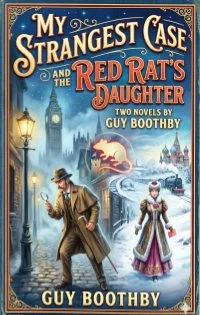
My Strangest Case & The Red Rat's Daughter


by Guy Boothby (Author), Colin Heston (Introduction)

To step into the world of Guy Boothby is to step into a whirlwind. At the turn of the 20th century, few authors could match Boothby's sheer velocity. A man who famously dictated his novels into a phonograph to keep pace with his imagination, Boothby was the architect of the "sensation novel," bridging the gap between the gothic mysteries of the past and the fast-paced thrillers of the future. This volume brings together two of his most gripping works: My Strangest Case and The Red Rat's Daughter. While different in setting, they share the quintessential Boothby hallmarks—exotic locales, high-stakes intrigue, and the relentless pursuit of justice (or survival).

The George Fairfax Mystery: My Strangest Case
In My Strangest Case, we are introduced to George Fairfax, a detective who stands in the long shadow of Sherlock Holmes but operates with a flair all his own. Originally published at the dawn of the 1900s, this story takes the reader from the high society of London to the rugged landscapes of the East. It is more than a simple whodunit; it is a globe-trotting adventure that explores the consequences of a long-hidden secret. Boothby’s talent for atmosphere ensures that the mystery feels as much a part of the environment as the characters themselves.

Intrigue in the East: The Red Rat's Daughter
The Red Rat's Daughter showcases Boothby’s obsession with the "Far East" and the political tensions of the era. Set against the backdrop of imperial Russia and the vast Siberian frontier, it is a tale of romance entangled with international conspiracy. The title itself—alluding to the mysterious "Red Rat"—promises a level of melodrama that Boothby delivers in spades. It captures a specific moment in literary history when the world felt both dangerously large and increasingly interconnected.
Why Boothby Matters Today
Reading Guy Boothby in the 21st century offers more than just nostalgia. It provides a window into the Victorian psyche:

  • The Pace: Boothby’s narrative drive is modern; he rarely lets a chapter end without a hook.

  • The Scope: He was an early pioneer of the "international thriller," refusing to keep his protagonists tethered to English soil.

  • The Style: His prose is unapologetically bold, designed to entertain the masses of the Edwardian era.

Whether you are a devotee of classic detective fiction or a newcomer to the "sensation" genre, these two novels represent a master storyteller at the height of his powers. Turn the page and prepare for a journey that spans continents and decades.

Read-Me.Org Inc. New York-Philadelphia-Australia. 2026. 350p.

Dr. NIKOLA - The Complete Saga: Volume 2


by Guy Boothby (Author), Graeme Newman (Editor), Colin Heston (Introduction)

. When the enigmatic Dr. Nikola first stepped onto the literary stage in 1895, clutching his sinister black cat Apollyon and weaving schemes that stretched from the back alleys of Shanghai to the hidden monasteries of Tibet, he didn't just capture the Victorian imagination—illegally or otherwise, he colonized it.
These volumes bring together, for the first time in a single definitive collection, the complete saga of Dr. Nikola: A Bid for Fortune, Dr. Nikola, The Lust of Hate, Dr. Nikola’s Experiment, and Farewell, Nikola. To read them in succession is to witness the birth of the modern "super-villain" and to appreciate the unique, rugged perspective Boothby brought to the crowded field of late-Victorian sensation fiction.
Born in Adelaide in 1867, Guy Newell Boothby was the son of a prominent South Australian parliamentarian. While he eventually found fame in the drawing rooms of London, his formative years were spent in the wide-open, often unforgiving landscapes of the Australian colonies.
In the 1890s, the literary world was reeling from "Sherlock-mania." While Sir Arthur Conan Doyle gave the world the ultimate champion of logic, Boothby gave it the ultimate agent of chaos. Dr. Nikola is not merely a criminal; he is a polymath, an occultist, and a man of immense physical and intellectual magnetism.
Across these five novels, we see Nikola evolve:
Volume 1:
A Bid for Fortune (1895): We are introduced to the Doctor through the eyes of Richard Hattasall. Here, Nikola is a vengeful shadow, a man whose "vendetta" drives a globe-trotting chase.
Dr. Nikola (1896): Arguably the centerpiece of the series, Boothby takes us into the forbidden heart of Tibet. It remains one of the finest examples of the "Lost World" genre, enriched by Stanley L. Wood’s iconic illustrations.
The Lust of Hate (1898): A darker, more psychological turn where Nikola manipulates a broken man’s desire for revenge.
Volume 2
Dr. Nikola’s Experiment (1899): Here, Boothby touches on the "mad scientist" tropes that would later define 20th-century sci-fi, as Nikola attempts to conquer death itself.
Farewell, Nikola (1901): The swan song of the character, providing a sense of closure to a man who lived his life in the liminal space between genius and madness.
Guy Boothby died tragically young at the age of 37, leaving behind a staggering 53 novels written in just over a decade. For years, his work languished in the shadows of more "academic" Victorian literature. However, as these works have entered the public domain, a new generation of readers—and editors—has rediscovered the sheer, unadulterated joy of his storytelling.
Boothby’s Dr. Nikola remains a vital link in the evolution of popular fiction. Without Nikola, would we have Sax Rohmer’s Fu Manchu? Would we have the sophisticated antagonists of James Bond? Probably not. By centering this edition on Boothby’s Australian roots, we acknowledge that the "King of Sensation" wasn't just a product of London’s Fleet Street, but a traveler of the world who brought the wild energy of the Antipodes to the heart of the Empire. This collection aims to preserve the thrill of the original serialization while providing the context necessary for a modern reader. As you follow the Doctor through the mist-shrouded streets of London and the sun-bleached ports of the Pacific, remember that you are in the hands of a master who knew those ports firsthand.
Welcome to the world of Dr. Nikola. Tread carefully—Apollyon is watching!

Read-Me.Org Inc. New York-Philadelphia-Australia. 2026. 292p.

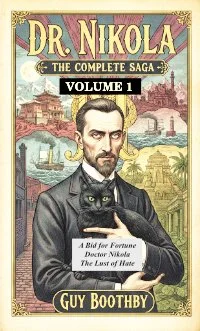
Dr. NIKOLA: The Complete Saga: Volume 1

by Guy Boothby (Author), Graeme Newman (Editor), Colin Heston (Introduction)

When the enigmatic Dr. Nikola first stepped onto the literary stage in 1895, clutching his sinister black cat Apollyon and weaving schemes that stretched from the back alleys of Shanghai to the hidden monasteries of Tibet, he didn't just capture the Victorian imagination—illegally or otherwise, he colonized it. Behind this towering figure of Gothic villainy was a prolific, whirlwind talent from the edge of the British Empire: the South Australian-born Guy Boothby.

These two volumes bring together, for the first time in a single definitive collection, the complete saga of Dr. Nikola: A Bid for Fortune, Dr. Nikola, The Lust of Hate, Dr. Nikola’s Experiment, and Farewell, Nikola. To read them in succession is to witness the birth of the modern "super-villain" and to appreciate the unique, rugged perspective Boothby brought to the crowded field of late-Victorian sensation fiction.

Born in Adelaide in 1867, Guy Newell Boothby was the son of a prominent South Australian parliamentarian. While he eventually found fame in the drawing rooms of London, his formative years were spent in the wide-open, often unforgiving landscapes of the Australian colonies. Unlike many of his contemporaries—who wrote of "The Orient" or the "South Seas" from the comfort of an English study—Boothby had the red dust of the Flinders Ranges and the salt of the Southern Ocean in his blood. In 1891, he and his brother famously crossed Australia from north to south, an arduous journey that informed the visceral, kinetic energy of his prose. This "Australian-ness" manifests in the Nikola series through a distinct lack of Victorian stuffiness; his heroes and villains alike are defined by their competence, their physical endurance, and a certain democratic grit that felt fresh to a British audience.

Guy Boothby died tragically young at the age of 37, leaving behind a staggering 53 novels written in just over a decade. For years, his work languished in the shadows of more "academic" Victorian literature. However, as these works have entered the public domain, a new generation of readers—and editors—has rediscovered the sheer, unadulterated joy of his storytelling. Boothby’s Dr. Nikola remains a vital link in the evolution of popular fiction. Without Nikola, would we have Sax Rohmer’s Fu Manchu? Would we have the sophisticated antagonists of James Bond? Probably not. By centering this edition on Boothby’s Australian roots, we acknowledge that the "King of Sensation" wasn't just a product of London’s Fleet Street, but a traveler of the world who brought the wild energy of the Antipodes to the heart of the Empire.

This collection published in two volumes aims to preserve the thrill of the original serialization while providing the context necessary for a modern reader. As you follow the Doctor through the mist-shrouded streets of London and the sun-bleached ports of the Pacific, remember that you are in the hands of a master who knew those ports firsthand.
Welcome to the world of Dr. Nikola. Tread carefully—Apollyon is watching!

Read-Me.Org Inc. New York-Philadelphia-Australia. 2026. 471p.

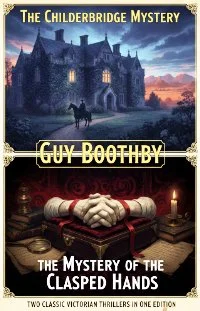
The Mystery of the Clasped Hands & The Childerbridge Mystery: Two Novels

by Guuy Boothby (Author), Colin Heston (Introduction)

In this combined edition, readers are presented with two quintessential examples of the late Victorian "shocker" from the pen of Guy Boothby, a writer who defined the era’s taste for fast-paced, sensational mystery. The first novel in this volume, The Mystery of the Clasped Hands, originally published in 1901 by F.V. White & Co., serves as a dark exploration of the macabre and the forensic. The story begins with a truly visceral hook: a wedding gift that contains the severed, preserved hands of a woman. It is a classic example of the Victorian obsession with reputation and the legal system, as the protagonist, Godfrey Tring, finds himself trapped in a web of circumstantial evidence. Boothby expertly depicts how quickly a gentleman’s life can be dismantled by a single accusation, making the legal system itself a source of mounting dread. This work highlights Boothby's skill in using sensational artifacts to drive a plot that forces the reader to question whether innocence alone is enough to survive a vengeful conspiracy.
Published just a year later in 1902, The Childerbridge Mystery shifts the focus toward the "sins of the father" trope and the intersection of colonial wealth and domestic stability. When wealthy Australian squatter William Standerton returns to England to establish himself at Childerbridge Manor, he brings with him a fortune that carries the shadow of his past. The mystery is not merely a puzzle of logic but a psychological examination of how the "New World" of the colonies—often viewed by Victorians as a place of lawless opportunity—inevitably catches up with the refined "Old World" of the English gentry. Boothby uses the tranquil setting of a country estate to highlight the tension between a man’s desire for a respectable future and the inescapable reach of his history.
Bound together, these two novels illustrate the common threads of Boothby’s literary legacy: the fragility of social identity, the weight of previous associations, and a relentless narrative pace that bridges the gap between 19th-century Gothic horror and the structured detective fiction of the 20th century. Whether dealing with a grisly forensic artifact or a haunted family legacy, Boothby provided his audience with a perfect blend of the familiar and the shocking. This edition serves as a testament to a writer who, though often overlooked today, once stood as a master of the mystery genre, capturing the collective anxieties of a world on the brink of change.

Sandra Belloni

By George Meredith. Designed and Edited with an Introduction by Colin Heston.

Sandra Belloni, first published in 1864 under the title Emilia in England, occupies a distinctive place in the literary corpus of George Meredith. It represents one of his earliest extended efforts to merge the comic novel with a more pointed social critique, a technique that would become a hallmark of his mature style. This novel, rich in subtle irony and psychological insight, grapples with the tensions between individuality and conformity, art and social convention, and the constraints of class and gender in Victorian England. At its heart, it is a narrative about a young woman of Italian descent, Emilia Belloni, whose musical gifts and unorthodox spirit clash with the expectations of the rigid English society into which she is thrust.

Meredith uses Emilia’s character not merely as a protagonist but as a symbolic figure—an embodiment of passionate sincerity, artistic freedom, and the disruptive power of the outsider. Emilia’s foreignness is not just ethnic; it is deeply cultural and emotional. Her instincts are governed by feeling and a commitment to truth, which repeatedly brings her into conflict with the carefully cultivated hypocrisies and social facades of the English middle and upper classes. Through her, Meredith examines the ways in which English society suppresses emotional authenticity in favor of propriety and self-interest.

In reading Sandra Belloni today, one encounters not only a portrait of Victorian society in all its contradictions but also an enduring exploration of the universal struggle between the self and society, between the voice that seeks to sing freely and the forces that would silence it. It is a novel that resonates beyond its historical moment, inviting readers to reflect on the costs and necessities of remaining true to oneself in the face of overwhelming pressure to conform.

Read-Me.Org Inc. New York-Philadelphia-Australia. 2025. 318p.