Open Access Publisher and Free Library
HUMAN RIGHTS.jpeg

HUMAN RIGHTS

Human Rights-Migration-Trafficking-Slavery-History-Memoirs-Philosophy

Posts in Abuse
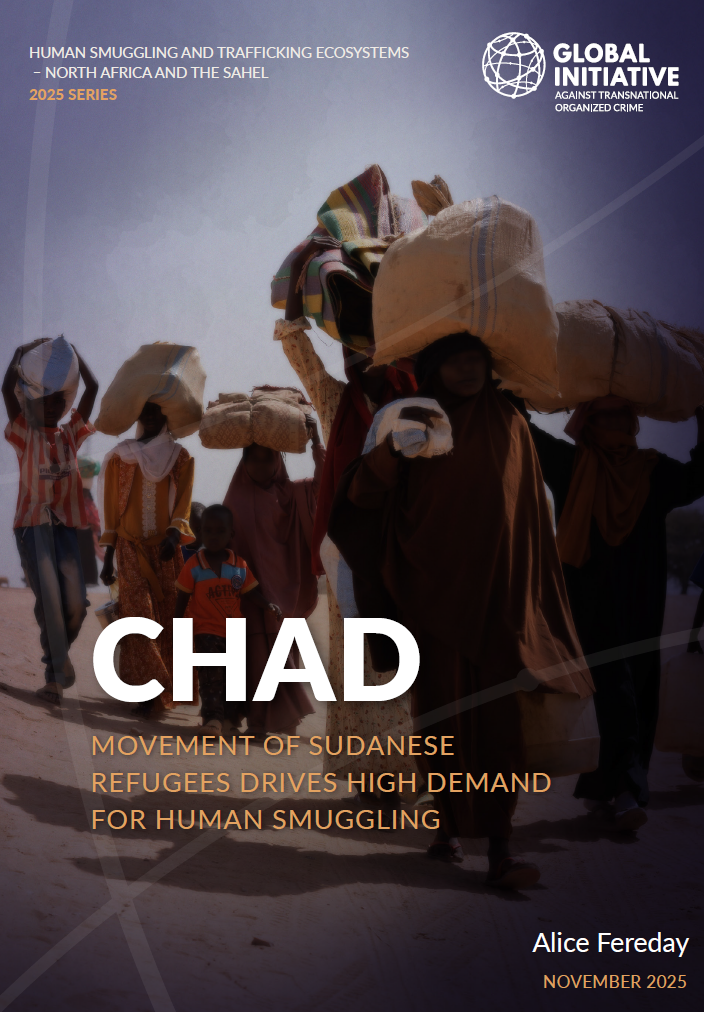
Chad: MOVEMENT OF SUDANESE REFUGEES DRIVES HIGH DEMAND FOR HUMAN SMUGGLING

By Alice Fereday

Chad’s role as a departure and transit country for northbound migration to North Africa and Europe is often overlooked, particularly in comparison to neighbouring Niger and Sudan. However, the country’s position at the crossroads of routes connecting central and eastern Africa to Libya and Niger makes it a significant transit corridor for regional migration, and its role as a bastion of relative stability in an increasingly volatile region has further increased its importance in recent years. Since 2023, the conflict in Sudan and a major influx of refugees into Chad have further shaped these mobility dynamics, making the country a major destination and transit point for Sudanese refugee displacement in the region. At the same time, Chad is navigating a fractious and contested political transition. Political violence escalated in 2024 and remains an important source of tension and political instability. The combination of these complex internal and regional dynamics, and their impact on human smuggling dynamics, make Chad a key country to monitor. A major component of human smuggling dynamics in Chad is internal movements to the country’s northern goldfields. These mobility patterns have typically been shaped by internal factors, including political instability, rebel activity and gold mining.1 This changed in 2023 with the outbreak of the conflict in Sudan and the massive influx of refugees and returnees into eastern Chad. Though northbound movements were temporarily hindered by this shift, which resulted in a relative decrease in demand for northbound travel from eastern Chad in the early months of the conflict, by the end of 2023 human smuggling had picked up again as many Sudanese began leaving refugee camps with the intention of travelling to northern Chad, Libya, Niger and Tunisia, often with the help of smugglers.2 In 2024, these movements escalated further and human smuggling between eastern and northern Chad saw significant growth, due in large part to increasing demand among Sudanese refugees for travel to northern Chad and Libya. However, the movement of Sudanese refugees through Chad also involved travel to Niger via N’Djamena or northern Chad. Northbound movements in Chad were also driven by increasing demand for travel to the Kouri Bougoudi goldfield. The flow of prospective gold miners, which began after the goldfield reopened at the end of 2022, was also facilitated by decreased restrictions on northbound travel as risks of rebel incursions in northern Chad remained contained in 2024. This encouraged the activities of passeurs, who catered to increasing demand for northbound travel, particularly from eastern Chad.Overall, Chad recorded progressively increasing movement levels in 2024 compared to previous years, presaging its emergence as an important space to watch for migrant and refugee movement, and associated protection risks. This is the latest GI-TOC monitoring report on human smuggling in Chad. It builds on a series of annual reports – issued since 2019 – which track the evolution of human smuggling in Chad and the political, security and economic dynamics that influence it
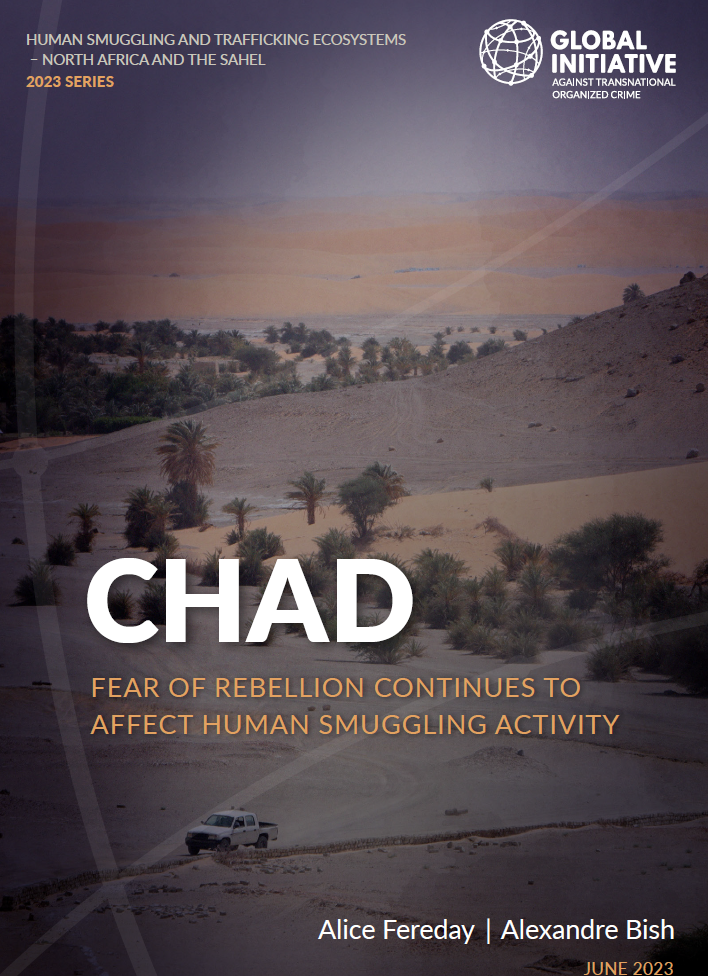
CHAD. FEAR OF REBELLION CONTINUES TO AFFECT HUMAN SMUGGLING ACTIVITY

By Alice Fereday ̵and Alexandre Bish

Human smuggling in Chad mostly involves northbound movements linking southern and eastern areas of the country to the north, in particular the gold mining areas in the Tibesti mountains, and to Libya. As a result, these dynamics are often connected to and impacted by the situation in northern Chad, where decades of political unrest, successive rebellions, intercommunity conflict, and deeply entrenched illicit economies and transnational organized crime dynamics are key factors of instability. Chadian authorities have long responded to these risks through securitization, including, in recent years, tight control over key routes and hubs, and a ban on travel to the north, further increasing demand for smuggling services among Chadians travelling to the goldfields or further afield to Libya, and in some cases, Europe. In 2022, human smuggling activity in Chad continued to be heavily affected by the political and security developments that followed the incursion led by the Front pour l’Alternance et la Concorde au Tchad (Front for change and concord in Chad – FACT) and ensuing death of President Idriss Déby, the country’s long-time leader, in April 2021. This upheaval interrupted what had been a broader rise of human smuggling from and through Chad, which, despite being illegal, had increased since 2016. This rise was in part due to the displacement of smuggling routes from Niger and Sudan, following anti-smuggling interventions in those two countries, which led to the use of Chad as a transit hub for human smuggling networks. Despite the displacement of routes, the number of migrants transiting the country still paled in comparison to the numbers that continued transiting Sudan and Niger. The most significant human smuggling itinerary in Chad remains the transport of migrants, both Chadian and foreign, to the gold mining economy along the country’s northern border with Libya. Since their discovery in 2012 and 2013, goldfields in the north have developed into major economic hubs attracting mostly poor migrants from across the region. The COVID-19 pandemic and linked travel restrictions in 2020 had little impact on movement to the goldfields. Rather, following the October 2020 ceasefire in Libya, the arrival of former mercenaries previously engaged in Libya to Kouri Bougoudi resulted in an uptick in gold mining, which in turn fuelled demand for workers. This development caused a surge in the movement of Sudanese and Chadian miners towards the goldfield since mid-2020.


A "wicked problem" - Seeking human rights-based solutions to trafficking into cyber-scam operations in South-East Asia

By the United Nations.  High Commissioner for Human Rights

UN Human Rights is calling urgent attention to the continuing and critical need for a human rights solution to a particularly “wicked problem” - the complex crisis of trafficking in persons, slavery and other serious human rights violations and abuses that are taking place in South-East Asia in the context of extensive criminal operations set up to perpetrate cyber-enabled fraud. This report centers the lived experience of victims subjected to abuses within these scam operations and who in many cases continue to suffer human rights harms after their release. Through a behavioural science and systems analysis lens, the report also seeks to understand the barriers and enablers that lead victims into these operations through fraudulent recruitment pathways. The report concludes with key messages which call on States, and where relevant other stakeholders, to ensure a human rights-based response to this multidimensional issue, placing the rights, dignity, safety, and well-being of victims of trafficking at its core including through ensuring full respect of the non-punishment principle.

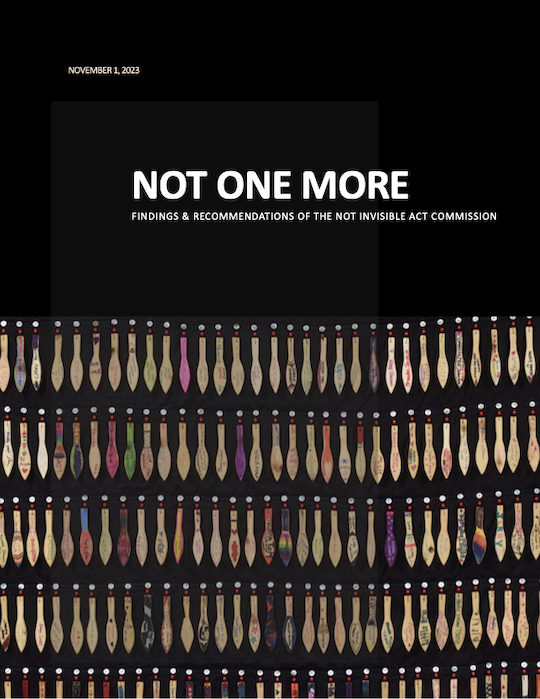
Not One More: Findings and Recommendations of the Not Invisible Act Commission

By The Not Invisible Act Commission

There is a crisis in Tribal communities. A crisis of violence, a crisis of abuse, and a crisis of abject neglect affecting Indian Women & Men, Indian Children, and Indian Elders. The federal government must act now; not tomorrow; not next week; not next month; and not next year. Once and for all, the federal government must end its systematic failure to address this crisis and react, redress, and resolve this. We call on the federal government to declare a Decade of Action & Healing to address the crisis of missing, murdered, and trafficked Indian people. -- The Not Invisible Act Commissioners _____________________________________________________________________________ With each passing day, more and more American Indian and Alaska Native (AI/AN) persons are victimized due to inadequate prevention and response to the MMIP and HT crisis. Our recommendations encompass actions that must be undertaken without delay to provide AI/AN people and communities with the same sense of safety and security that other communities in the United States take for granted. The United States government’s failure to fulfill its trust responsibilities to Tribal nations, coupled with historic policies that sought to disconnect AI/AN people from their land, language, and culture, have given rise to a public health, public safety, and justice crisis in Tribal communities. The crisis is most notably reflected in the federal government’s failure to effectively prevent and respond to the violence against AI/AN people, particularly in the context of missing, murdered, and trafficked AI/AN people. Despite the best efforts of many individuals across law enforcement (LE), the judiciary, and social services, long-standing institutional failures must be acknowledged and addressed. Calls for action and funding to address these issues have been made repeatedly.1 Although there has been a growing awareness of the high rates of missing, murdered, and trafficked AI/AN people in recent years, and several federal initiatives have been launched,2 addressing the needs in Tribal communities continues to generally be underprioritized by the federal government. Until this changes, violence against AI/AN individuals and on Indian and Alaska Village lands will persist. The Commission believes that the circumstances that have created the crisis of MMIP and HT are not intractable. In fact, to see them so is to continue the unjust past. With resolve and an appropriate investment of resources, these issues can, and must, be effectively addressed. While it is imperative that the federal government take immediate and concerted action, thescale and severity of this issue, and the need for long-term healing and justice, also demand a comprehensive and sustained response. Therefore, we call upon the federal government to declare a Decade of Action and Healing dedicated to addressing this crisis effectively for future generations. Such a declaration would underscore the urgency of the matter and signify a long-term commitment to combatting the deeply rooted issues that perpetuate continued violence against AI/AN individuals and supporting individuals and communities in their healing as they seek justice. This Decade of Action and Healing must involve partnership with Tribal communities, Tribal governments, and relevant organizations, focusing on improving safety, prevention, justice, support services, and healing for AI/AN communities through increased funding, policy reform, action-oriented programs, and training and technical assistance.

Washington, DC: U.S. Department of the Interior and the Department of Justice, 2025. 212p.

Child Streetism in Ghana: Safeguarding Human Rights and Ensuring Child Welfare Amidst Urban Challenges

By Emmanuel Arthur - Ewusie

Ghana's child street crime is a complicated issue that calls for striking a careful balance between protecting national security, respecting human rights, and applying the law. The term "streetism" describes the situation where children live and labor on the streets, frequently without access to basic supplies and at risk from different sources. To address the underlying causes of streetism, safeguard vulnerable children, and maintain social well-being, it is imperative to strike a balance between these objectives. The basic idea of human rights is at the center of the problem. Every child is entitled to education, a secure and supportive home, and defense against abuse and exploitation. But these rights are frequently violated by child streetism in Ghana, where children are put at risk of exploitation, abuse, and neglect. As a result, the protection and realization of children's rights must be given top priority in any strategy to combat streetism, and this strategy should be informed by both Ghanaian law and international human rights norms. Regarding child streetism, criminal law is also very important. It's important to distinguish between criminal behavior and the circumstances that lead to streetism, even though some youngsters may participate in criminal activity while living on the streets. Penalties by themselves may worsen the cycle of poverty and vulnerability and are insufficient to address the root causes of streetism. Instead, social initiatives that deal with family dissolution, poverty, and limited access to healthcare and education should be used in conjunction with criminal law enforcement. In addition, when tackling child streetism, national security implications are considered. Streetism has the potential to worsen social unrest and jeopardize public safety, especially in cities where a high proportion of youngsters live on the streets. Thus, combating streetism involves preserving community stability and security in addition to upholding individual rights. But rather than using punitive tactics, security measures must be put into place in a way that upholds human rights and encourages long-term solutions. This essay aims to present a thorough examination of youth street crime in Ghana, looking at its effects on national security, criminal law enforcement, and human rights. It attempts to contribute to a fuller knowledge of the complex issues faced by child streetism and to inform evidence-based methods for addressing this important issue in Ghana by examining legal frameworks, policy responses, and grassroot activities. In Ghana, the issue of children living and working on the streets creates difficult problems where criminal law, national security, and human rights intersect. This study looks at the causes, prevalence, and effects of child street behavior, considering how it affects children's rights and welfare, the application of the law, and maintaining national security. The research investigates legislative frameworks, policy responses, and grassroots activities targeted at resolving child streetism in Ghana using a multidisciplinary analysis. Additionally, it assesses the efficacy of the current strategies and makes recommendations for a fair and rights-based strategy that puts the child's best interests first while maintaining public safety and security.

Unpublished Paper 2024. 19p.