
Crime, Insanity And Affliction: Three Studies in Social Pathology
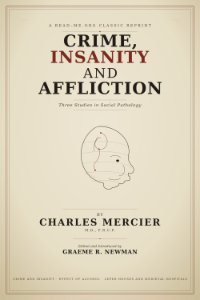
by Graeme Newman (Editor), Charles Mercier (Author)
Why do people commit crime? When does mental illness diminish responsibility? Should punishment always follow wrongdoing?
More than a century before modern debates about criminal responsibility, forensic psychiatry, and the treatment of mentally ill offenders, the distinguished British physician Charles Mercier confronted these enduring questions with remarkable clarity and originality.
In Crime, Insanity and Affliction, Mercier explores the complex relationship between criminal behaviour, mental disorder, and human suffering. Rejecting simplistic explanations, he argues that crime cannot be understood apart from the biological, psychological, and social forces that shape human conduct. His examination ranges from drunkenness, epilepsy, intellectual disability, and mental illness to questions of moral responsibility, punishment, and the proper role of the criminal law.
Although written in the early twentieth century, many of Mercier's observations anticipate debates that continue today. His discussion of diminished responsibility, the treatment of mentally ill offenders, addiction, and the limits of punishment remains surprisingly relevant in an era still struggling to balance justice, compassion, and public safety.
This new Read-Me edition presents Mercier's influential work with a new editorial introduction that places his ideas within the development of modern criminology, forensic psychiatry, and criminal justice. It also examines where Mercier's conclusions have been confirmed, where later research has challenged them, and why his work continues to deserve the attention of students, scholars, and general readers alike.
More than a historical curiosity, Crime, Insanity and Affliction is a thoughtful exploration of one of society's oldest and most difficult questions: how should we judge those whose minds, circumstances, or afflictions place them beyond the ordinary boundaries of responsibility?
Read-Me.Org Inc. New York-Philadelphia-Australia. 2026. 182p.