Open Access Free Library
CRIME+CRIMINOLOGY.jpeg

CRIME

Violent-Non-Violent-Cyber-Global-Organized-Environmental-Policing-Crime Prevention-Victimization

Posts in Law
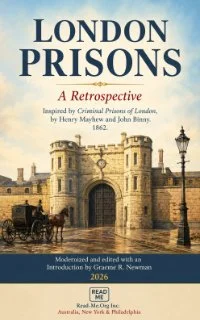
London Prisons: A Retrospective

by Graeme R. Newman

In 1862, Henry Mayhew and John Binny walked into eleven of London's most notorious institutions — Newgate, Millbank, Pentonville, Brixton, the prison hulks at Woolwich, Coldbath Fields, Tothill Fields, Wandsworth, Holloway, the House of Detention at Clerkenwell, and Horsemonger Lane — and wrote down exactly what they saw: the governors, the warders, the chaplains, and the prisoners themselves, in their own words.

This edition brings that record back to life. Each chapter has been fully rewritten in modern prose while preserving every fact, every interview, and every argument the original authors made — from their case against purposeless hard labour to their unflinching accounts of the convict nursery, the condemned cell, and the boy discharged from prison with no one waiting at the gate.

A new introduction and retrospective, written for this edition, follows these institutions into the present: which ones were demolished, which became galleries, cathedrals, and post offices — and which are still open today, cited in current inspection reports for the very same overcrowding and neglect that Victorian reformers were fighting a century and a half ago.

What you'll find inside: • Eleven Victorian prisons, reconstructed room by room, cell by cell • Real testimony from governors, chaplains, and prisoners — first offenders and lifelong professionals alike • A frank, often moving record of Victorian London's poorest and most desperate • A new historical retrospective connecting each institution to its fate today

Part social history, part true crime, part uncomfortable mirror — London Prisons: A Retrospective is a door-by-door tour of a city's conscience, then and now.

Read-Me.Org Inc. New York-Philadelphia-Australia. 2026. p.339.
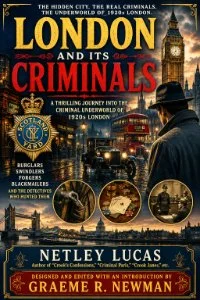
London and Its Criminals: A Portrait of London's Underworld in the 1920s

by Nettly Lucas (Author), Graeme Newman (Introduction)

Step into the hidden London of the 1920s—a city of fashionable hotels and crowded streets, respectable suburbs and shadowy back rooms, Scotland Yard detectives and professional criminals who made deception, burglary, fraud and blackmail their trade.

First published in 1926, London and Its Criminals is Netley Lucas’s remarkable journey through the criminal underworld of interwar London. Rather than simply recounting celebrated crimes, Lucas sets out to describe criminals themselves: how they lived, where they gathered, the methods they used, the slang they spoke, and the elaborate machinery of policing that pursued them.

The result is an extraordinary period portrait of crime and criminal justice.

Lucas takes his readers inside Scotland Yard and its Criminal Record Office, explaining the growing importance of fingerprints, criminal records and systematic detection. From there he ventures into a very different London—the world of professional burglars, pickpockets, confidence tricksters, jewel thieves, forgers, blackmailers and criminal gangs. He introduces his readers to figures he describes as the “Kings” and “Queens” of the Underworld: men and women who move between cheap public houses, prosperous suburban homes, exclusive restaurants and fashionable hotels while living secret criminal lives.

Among the book’s most striking chapters are Lucas’s accounts of “master criminals” and “crooked women.” His characters include expert burglars, ingenious forgers, sophisticated jewel thieves and accomplished confidence tricksters. Some are frightening, some ingenious, some surprisingly ordinary. Again and again Lucas emphasizes the unsettling proximity of the criminal world to respectable society.

Yet London and Its Criminals is more than a gallery of rogues. Lucas was writing at a moment when attitudes toward crime and punishment were beginning to change. He opens the book by discussing the emerging scientific study of crime, criminal psychology, rehabilitation and the limitations of imprisonment—questions that remain central to debates about criminal justice a century later.

Lucas is also an unusually provocative guide. He claims familiarity with criminals themselves and repeatedly describes conversations, meals and encounters with people operating on the wrong side of the law. His London is consequently not the London of official police reports alone. It is a city observed from its restaurants, streets, clubs, pubs, courtrooms and criminal meeting places.

Modern readers should approach some of Lucas’s language, assumptions and sweeping judgments as products of their time. That is also part of the historical importance of the book. It provides a vivid primary-source window into how crime, policing, punishment, class and the urban underworld were represented during the 1920s.

This new Read-Me.Org Classic Reprint presents Lucas’s fascinating account to a new generation of readers, accompanied by a detailed new Introduction by Graeme Newman that places the work in its historical and criminological context.

For readers interested in true crime, criminology, Scotland Yard, policing, criminal history, London history, organized crime and the social history of the 1920s, London and Its Criminals offers a fascinating journey into a vanished—but sometimes surprisingly familiar—criminal world

Read-Me.Org Inc. New York-Philadelphia-Australia. 2026. p.194.

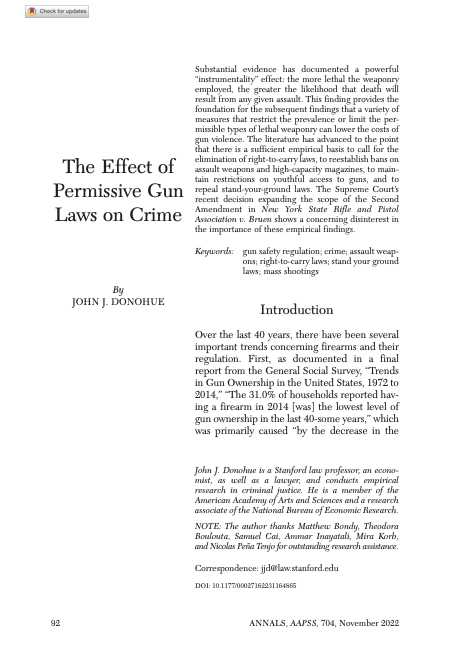
The Effect of Permissive Gun Laws on Crime

By John J. Donohue

Substantial evidence has documented a powerful “instrumentality†effect: the more lethal the weaponry employed, the greater the likelihood that death will result from any given assault. This finding provides the foundation for the subsequent findings that a variety of measures that restrict the prevalence or limit the permissible types of lethal weaponry can lower the costs of gun violence. The literature has advanced to the point that there is a sufficient empirical basis to call for the elimination of right-to-carry laws, to reestablish bans on assault weapons and high-capacity magazines, to maintain restrictions on youthful access to guns, and to repeal stand-your-ground laws. The Supreme Court’s recent decision expanding the scope of the Second Amendment in New York State Rifle and Pistol Association v. Bruen shows a concerning disinterest in the importance of these empirical findings.

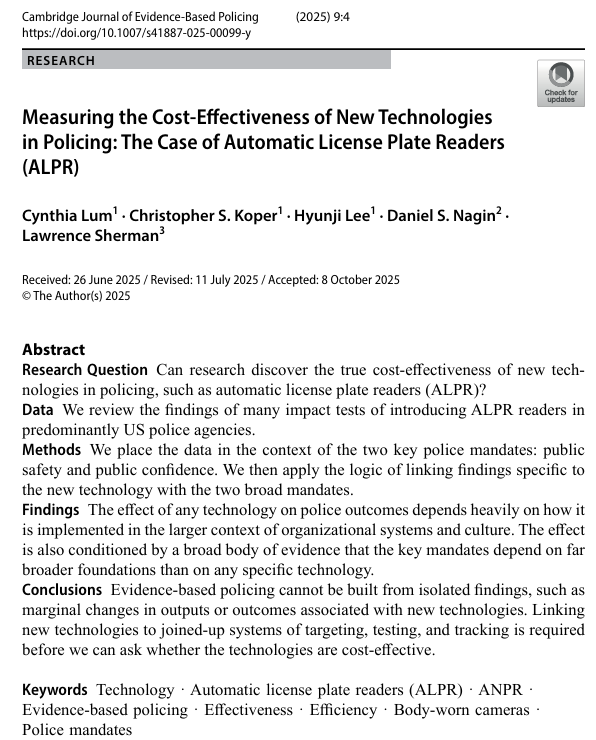
Measuring the Cost-Effectiveness of New Technologies in Policing: The Case of Automatic License Plate Readers (ALPR)

By Cynthia Lum, Christopher S. Koper, Hyunji Lee, Daniel S. Nagin, Lawrence Sherman

Research Question Can research discover the true cost-effectiveness of new technologies in policing, such as automatic license plate readers (ALPR)? Data We review the findings of many impact tests of introducing ALPR readers in predominantly US police agencies. Methods We place the data in the context of the two key police mandates: public safety and public confidence. We then apply the logic of linking findings specific to the new technology with the two broad mandates. Findings The effect of any technology on police outcomes depends heavily on how it is implemented in the larger context of organizational systems and culture. The effect is also conditioned by a broad body of evidence that the key mandates depend on far broader foundations than on any specific technology. Conclusions Evidence-based policing cannot be built from isolated findings, such as marginal changes in outputs or outcomes associated with new technologies. Linking new technologies to joined-up systems of targeting, testing, and tracking is required before we can ask whether the technologies are cost-effective.

Cambridge Journal of Evidence-Based Policing (2025)