
Open Access Free Library
CRIME+CRIMINOLOGY.jpeg

CRIME

Violent-Non-Violent-Cyber-Global-Organized-Environmental-Policing-Crime Prevention-Victimization

Posts in Research Report
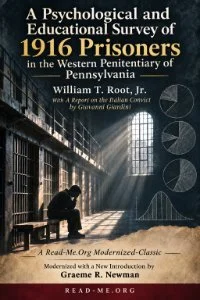
A Psychological and Educational Survey of 1916 Prisoners in the Western Penitentiary of Pennsylvania (Copy)

By William T. Root, Jr.. With A Report on the Italian Convict, by Giovanni Giardini. . Modernized with a new Introduction by Graeme R. Newman.

Originally published in 1927, this pioneering study offers a remarkable examination of the psychological, educational, and social characteristics of 1,916 prisoners in Pennsylvania's Western Penitentiary. Based on extensive individual interviews, intelligence testing, psychiatric assessments, and institutional records collected between 1924 and 1926, William T. Root, Jr. investigates the complex relationship between criminal behavior, intelligence, education, poverty, family circumstances, and social environment.

Challenging the prevailing emphasis on punishment and vengeance, Root argues that criminal conduct must be understood through its underlying causes. His findings raise enduring questions about personal responsibility, social inequality, rehabilitation, and the capacity of prisons to reform rather than merely confine offenders.

The volume also includes Giovanni Giardini's revealing investigation of Italian immigrant prisoners, examining the influence of cultural background, immigration, and changing social conditions on patterns of offending.

Although rooted in the psychological theories and classifications of the 1920s, some now discredited, this work remains an important historical contribution to criminology, correctional psychology, and the development of evidence-based prison reform.

This Read-Me.Org Modernized-Classic edition presents a carefully condensed and modernized text, replacing extensive statistical tables with accessible summaries while retaining selected original graphs. A new Introduction by Graeme R. Newman places the study in its historical and intellectual context, critically examines its assumptions, and explains its continuing relevance. Review and discussion questions make the volume particularly useful for students, researchers, and readers interested in the history of criminal justice.

A compelling historical document that asks a question as urgent today as it was a century ago: Should society seek to understand and reform those who commit crimes, or simply punish them?

Read-Me.Org Inc. New York-Philadelphia-Australia. 2026. p.105.

Multidimensional Latent Classification of ‘Street Robbery’ Offences

Alasdair M. Goodwill, Skye Stephens , Sandra Oziel , Jamie Yapp And Nicola Bowes.

In a recent study of personal robbery, commissioned by the Home Of fi ce in the UK, a qualitative typology of robbery offences was proposed based on the approach used by the offender to commit the crime, consisting of four approach types: Blitz, Confrontation, Con, and Snatch. Conceptual inspection of the typology reveals that these proposed types may be hypothetically demarcated as the product of two latent dimensions: interaction (between the offender and the victim) and violence (used to threaten/harm the victim). The current paper utilises crime scene information from 72 incarcerated male offenders convicted of ‘street’ robbery to test this hypothesis. Convergent statistical analysis was utilised to test the structure of Smith’s typology fi rst using multidimensional scaling (MDS) and then principal component analysis (PCA). MDS and PCA analyses provided convergent support for the existence of the four robbery styles and the latent dimensions of interaction and violence. Implications of Smith’s typological structure and latent behavioural dimensions on the conceptualisation and classi fi cation of robbery offences are discussed within the existing literature on ‘street’ robbery. Copyright © 2012 John Wiley & Sons, Ltd.

J. Investig. Psych. Offender Pro fi l. 9: 93–109 (2012)

A Psychological and Educational Survey of 1916 Prisoners in the Western Penitentiary of Pennsylvania

By William T. Root, Jr.. With A Report on the Italian Convict, by Giovanni Giardini. . Modernized with a new Introduction by Graeme R. Newman.

Originally published in 1927, this pioneering study offers a remarkable examination of the psychological, educational, and social characteristics of 1,916 prisoners in Pennsylvania's Western Penitentiary. Based on extensive individual interviews, intelligence testing, psychiatric assessments, and institutional records collected between 1924 and 1926, William T. Root, Jr. investigates the complex relationship between criminal behavior, intelligence, education, poverty, family circumstances, and social environment.

Challenging the prevailing emphasis on punishment and vengeance, Root argues that criminal conduct must be understood through its underlying causes. His findings raise enduring questions about personal responsibility, social inequality, rehabilitation, and the capacity of prisons to reform rather than merely confine offenders.

The volume also includes Giovanni Giardini's revealing investigation of Italian immigrant prisoners, examining the influence of cultural background, immigration, and changing social conditions on patterns of offending.

Although rooted in the psychological theories and classifications of the 1920s, some now discredited, this work remains an important historical contribution to criminology, correctional psychology, and the development of evidence-based prison reform.

This Read-Me.Org Modernized-Classic edition presents a carefully condensed and modernized text, replacing extensive statistical tables with accessible summaries while retaining selected original graphs. A new Introduction by Graeme R. Newman places the study in its historical and intellectual context, critically examines its assumptions, and explains its continuing relevance. Review and discussion questions make the volume particularly useful for students, researchers, and readers interested in the history of criminal justice.

A compelling historical document that asks a question as urgent today as it was a century ago: Should society seek to understand and reform those who commit crimes, or simply punish them?

Read-Me.Org Inc. New York-Philadelphia-Australia. 2026. p.105.
Perceived risk of victimisation by artificial intelligence enabled crimes

By Alexandra Voce, Isabella Voce, Anthony Morgan

In the past 10 years, there has been a rapid proliferation of publicly available tools and applications (apps) using artificial intelligence (AI). While these tools have the potential to significantly benefit daily life, studies find there are growing concerns about the potential for AI technologies to be misused for criminal, nefarious or antisocial purposes. Little to no research has examined whether Australians believe they or their families will be personally impacted by crimes involving AI technology in the imminent future, and which specific AI technologies are perceived as posing the greatest risk of harm to individuals and their families.

This report examined data from the Australian Cybercrime Survey to measure the perceived frequency of AI-enabled crimes and which specific technologies pose the greatest perceived risk of victimisation. The findings highlight priority areas for industry safeguards and public education.