Open Access Publisher and Free Library
CRIME+CRIMINOLOGY.jpeg

CRIME

Violent-Non-Violent-Cyber-Global-Organized-Environmental-Policing-Crime Prevention-Victimization

Posts in Crime
Male Powerlessness: Men and Intimate Partner Violence

By Emmanuel Rowlands

Male Powerlessness investigates black African men’s lived encounters with intimate partner violence (IPV) and the ways in which these men make sense of, and struggle to overcome, their unprecedented experiences of abuse at a time when research on women’s experiences of gender-based violence is expanding. In the transnational and dynamic gender environment of the City of Johannesburg, men (local and immigrant) engage in short- and long-term relationships that are typically marked by contestation and conflict. This book examines how men may become abused in heterosexual relationships, a topic that has received little attention in South African literature. The book examines the impact of IPV on black African men’s masculine identities and helps us understand the many masculine constructs that abused men may articulate. The book explores male powerlessness and its implications for men’s experiences of IPV and masculine well-being. The book makes an invaluable contribution from an empirical, methodological, and theoretical viewpoint to the corpus of gender-based violence literature that will interest students of sociology, criminology, social work, sexual politics, feminism, and critical men’s studies, among others. Emmanuel Rowlands is a Doctor of Philosophy in Sociology at the University of Johannesburg and the author of “She is trying to control me”: African Men’s Lived Experiences of Intimate Partner Violence in Johannesburg (2021), and Hegemonic Masculinity and Male Powerlessness: A Reflection on African Men’s Experiences of Intimate Partner Violence (2021), and Autoethnography, Reflexivity, and Insider Researcher Dynamics: Reflections on Investigating Violence against Men in Intimate Relationships 2022), and Constructing Victimisation as Masculine Honour: Men and Intimate Partner Violence in Johannesburg (2022).

Johannesburg, UJ Press, 2023. 288p.
download
Community Health Practitioners and Child Sexual Abuse in the Family, 1970s-2010s

By Ruth Beecher

This open access book is an innovative history of community health practitioners’ responses to the seemingly intractable problem of men (and on rare occasions, women) sexually abusing children within the private family home. It is situated within a social history of the development of British community-based health professions in the last decades of the twentieth century. Drawing on archival research and newly gathered in-depth oral history interviews, the monograph argues that expectations placed upon community-based doctors, nurses and mental health staff since the 1980s in relation to predicting and preventing the sexual abuse of children by men they know are incongruous. Beneath a surface acquiescence to the need to protect children from such abuse or to intervene early lie cultural, social and structural barriers that prevent its fulfilment. The book is a first in specifically interrogating the recent history of the role of community health practitioners within the modern 'child protection workforce', and contributes to growing scholarship on the history of emotions in the medical professions.

Cham: Palgrave Macmillan, 2025. 294p.

download
Child Sexual Abuse in Amish, Mennonite, Anabaptist, and Other Religious Groups

By  Mary Bylera , Tara L Mitchellb , Rhoda Witmerc , and Jasper Hoffmand

Background: Anabaptists are often stereotyped as quaint, conscientious objectors, peaceful, and gentle and are upheld as models for forgiveness, yet little is known about potential violence and abuse within their communities. Investigative reports, such as Espenshade and Alexander (2004) and Price (1992), though, suggest that sexual and physical violence may be common.

Objective: We sought participants for a study on their experiences of child sexual abuse (CSA). Because existing research on CSA has largely excluded Anabaptists or promoted the voices of their powerful over the marginalized voices of survivors, we intentionally sought current and non-practicing Anabaptist participants.

Methods: Participants (N = 384) responded to an online survey. Survey questions addressed participant demographics, religious affiliations, CSA experiences, and childhood teachings about CSA, as well as how CSA affected them.

Results: Of the 384 participants, 310 were born or joined in Anabaptist. Chi-square analyses showed that approximately half of participants experienced CSA, almost all participants were impacted by CSA, and CSA was related to changes in religious affiliation. Importantly, though, qualitative analysis revealed Anabaptist-background participants described CSA in ways that differed notably from participants not raised Anabaptist.

Conclusion: CSA occurs within conservative religious groups, including Anabaptist churches. Accurate information and language regarding bodies, abuse, consent, and resources could help conservative Anabaptist communities prevent CSA and provide culturally competent care for CSA survivors.

2024. 34p. 

download
Gendered Exploitation: Content Examination and Analysis of Selected Poverty Porn Vloggers in the Philippines

By Jerski Jarzen Duria

This study explores the gendered dynamics of poverty porn vlogging in the Philippines, focusing on how male and female vloggers portray poverty and interact with impoverished subjects. "Poverty porn" refers to content that exploits the suffering of impoverished individuals for emotional or financial gain, often by framing the content creators as charitable figures. The research examines six vloggers-ForeignGerms, Raffy Tulfo, King Lucks, Ivana Alawi, Rosemarie Tan Pamulaklakin, and Alex Gonzaga-whose content frequently centers around poverty in the Philippines. Through a qualitative content analysis approach, this study identifies recurring patterns, themes, and narrative structures within their vlogs. Drawing on Gender Role Theory, the research explores how societal expectations shape the behavior of male and female vloggers. Power and Exploitation Theory further explains the power dynamics between vloggers and their vulnerable subjects. Key themes include the emotional exploitation and the commodification of gendered vulnerability, reinforcement of gendered power dynamics and the savior complex, the gendered gaze and performative charity. Male vloggers tend to adopt dominant roles, positioning themselves as rescuers, while female vloggers often emphasize emotional labor and caregiving. This gendered framing perpetuates stereotypes of men as saviors and women as dependent and vulnerable. This study highlights the ethical concerns of such content, where vloggers profit from the suffering of impoverished individuals, particularly women and children. By analyzing these gendered portrayals, the research contributes to the discourse on the ethics of poverty porn in the digital age, shedding light on how social media creators exploit poverty for profit.

Unpublished paper, 2024.

Download
The global migration network of sex‑workers

By Luis E C Rocha1  · Petter Holme  · Claudio D G Linhares  

Differences in the social and economic environment across countries encourage humans to migrate in search of better living conditions, including job opportunities, higher salaries, security and welfare. Quantifying global migration is, however, challenging because of poor recording, privacy issues and residence status. This is particularly critical for some classes of migrants involved in stigmatised, unregulated or illegal activities. Escorting services or high-end prostitution are well-paid activities that attract workers all around the world. In this paper, we study international migration patterns of sex-workers by using network methods. Using an extensive international online advertisement directory of escorting services and information about individual escorts, we reconstruct a migrant fow network where nodes represent either origin or destination countries. The links represent the direct routes between two countries. The migration network of sex-workers shows diferent structural patterns than the migration of the general population. The network contains a strong core where mutual migration is often observed between a group of high-income European countries, yet Europe is split into diferent network communities with specifc ties to non-European countries. We find non-reciprocal relations between countries, with some of them mostly ofering while others attract workers. The Gross Domestic Product per capita (GDPc) is a good indicator of country attractiveness for incoming workers and service rates but is unrelated to the probability of emigration. The median fnancial gain of migrating, in comparison to working at the home country, is 15.9%. Only sex-workers coming from 77% of the countries have financial gains with migration and average gains decrease with the GDPc of the country of origin. Our results suggest that high-end sex-worker migration is regulated by economic, geographic and cultural aspects. 

 Journal of Computational Social Science (2022) 5:969–985


download
The prevalence of intimate partner violence in Australia: a national survey

By Ben Mathews, Kelsey L Hegarty, Harriet L MacMillan, Monica Madzoska, Holly E Erskine, Rosana Pacella, James G Scott, Hannah Thomas, Franziska Meinck, Daryl Higginss

Objectives: To estimate the prevalence in Australia of intimate partner violence, each intimate partner violence type, and multitype intimate partner violence, overall and by gender, age group, and sexual orientation.

Study design: National survey; Composite Abuse Scale (Revised)—Short Form administered in mobile telephone interviews, as a component of the Australian Child Maltreatment Study.

Setting: Australia, 9 April – 11 October 2021. Participants 8503 people aged 16 years or older: 3500 aged 16–24 years and about 1000 each aged 25–34, 35–44, 45–54, 55–64, or 65 years or older.

Main outcome measures: Proportions of participants who had ever been in an intimate partner relationship since the age of 16 years (overall, and by gender, age group, and sexual orientation) who reported ever experiencing intimate partner physical, sexual, or psychological violence.

Results: Survey data were available for 8503 eligible participants (14% of eligible persons contacted), of whom 7022 had been in intimate relationships. The prevalence of experiencing any intimate partner violence was 44.8% (95% confidence interval [CI], 43.3–46.2%); physical violence was reported by 29.1% (95% CI, 27.7–30.4%) of participants, sexual violence by 11.7% (95% CI, 10.8–12.7%), and psychological violence by 41.2% (95% CI, 39.8–42.6%). The prevalence of experiencing intimate partner violence was significantly higher among women (48.4%; 95% CI, 46.3–50.4%) than men (40.4%; 95% CI, 38.3–42.5%); the prevalence of physical, sexual, and psychological violence were also higher for women. The proportion of participants of diverse genders who reported experiencing intimate partner violence was high (62 of 88 participants; 69%; 95% CI, 55–83%). The proportion of non-heterosexual participants who reported experiencing intimate partner violence (70.2%; 95% CI, 65.7–74.7%) was larger than for those of heterosexual orientation (43.1%; 95% CI, 41.6–44.6%). More women (33.7%; 95% CI, 31.7–35.6%) than men (22.7%; 95% CI, 20.9–24.5%) reported multitype intimate partner violence. Larger proportions of participants aged 25–44 years (51.4%; 95% CI, 48.9–53.9%) or 16–24 years (48.4%, 95% CI, 46.1–50.6%) reported experiencing intimate partner violence than of participants aged 45 years or older (39.9%; 95% CI, 37.9–41.9%).

Conclusions: Intimate partner violence is widespread in Australia. Women are significantly more likely than men to experience any intimate partner violence, each type of violence, and multitype intimate partner violence. A comprehensive national prevention policy is needed, and clinicians should be helped with recognising and responding to intimate partner violence.

Medical Journal of AustraliaVolume 222, Issue 9, May 2025, Pages, 423-480

download
Fraud against the Commonwealth 2023–24 

This Statistical Bulletin presents the results from the 2023–24 Fraud Against the Commonwealth census. A similar number of internal fraud investigations were finalised compared with the previous financial year. Fewer external fraud investigations were finalised. Automatic processes were the primary method of detecting internal and external fraud allegations in 2023–24. Program information and program payments were the principal targets of substantiated internal and external fraud allegations respectively. Internal and external fraud losses were lower than the losses reported in 2022–23. Australian Government entities reported greater internal fraud and lower external fraud recoveries in 2023–24 than in the previous financial year

Statistical Bulletin 47

Canberra: Australian Institute of Criminology, 2025. 16p.

download
A Content Analysis of Illicit Tobacco-Related Crimes Reported in Australian Media

Introduction

Australian survey and seizure data suggest a growing illicit tobacco market. As an illicit product, accurately tracking trends in illicit tobacco growing, manufacture, and sales is challenging. We examined trends in Australian illicit tobacco-related crimes using a content analysis of news articles.

Aims and Methods

We analyzed Australian news articles identified in the Factiva database and government press releases describing Australian illicit tobacco-related crimes reported between January 2000 and December 2023. Sources were coded for crime type, location, product type, dollar value of seized products, methods of distribution or storage, agencies involved, and other crimes involved.

Results

We identified 447 crimes reported in 389 sources. The number of illicit tobacco-related crimes reported increased between 2000 and 2023. The most common crimes were possession of illicit tobacco (n = 196/43.7%) and smuggling (n = 187/41.8%), and the most common product type was “illicit cigarettes” (n = 197/44.1%). The most common distribution/storage method reported was via residential premises (n = 98/21.9%). One-hundred and twenty incidents involved other crimes such as financial crimes involving money laundering (n = 59/13.2%). Across all included news articles, the quantity of seized products totaled 827 529 307 cigarette sticks, 76 185 cartons, 668 687 packs, 239 hectares (of land growing tobacco plants), and 2 149 000 plants of illicit tobacco between 2000 and 2023. The median value (worth; AUD) of each seizure was $1 500 000 (range $43 to $67 000 000).

Conclusions

Australian media reporting on illicit tobacco-related crimes increased over the past two decades, particularly since 2018. These findings highlight a need for improved border detection measures, investment in enforcement, and other deterrent activities.

Implications

This media analysis complements trends identified in national survey data that indicate a growing illicit tobacco market in Australia since 2013 with a marked increase since 2018. While survey data suggests that the Australian tobacco tax policy, which has included regular large tax increases since 2010, has decreased consumer demand for tobacco overall, it may have also incentivized criminal networks to supply illicit tobacco products due to it being a “low risk” and “high reward” activity. Controlling the Australian illicit tobacco market should be a policy priority.

Nicotine & Tobacco Research, Volume 27, Issue 6, June 2025, Pages 980–987,

download
The Information Age: Transnational Organized Crime, Networks, and Illicit Markets

By John P. Sullivan

In his landmark trilogy, The Information Age: Economy, Society and Culture, sociologist Manuel Castells argued that networks, information technology, and global economic flows were altering the nature of politics, power, and states. This article examines the network dynamics Castells wrote about in relation to transnational crime and illicit economic markets. The article further explores Castells’s influence on the study of transnational organized crime, illicit networks, and the global illicit economy 

Journal of Strategic Security 16, no. 1 (2023) : 51-71

download
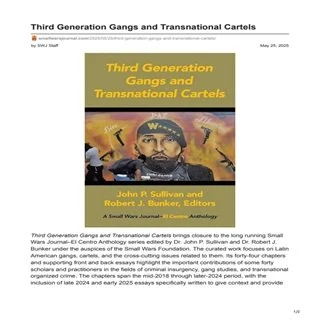
Third Generation Gangs and Transnational Cartels

 Written and edited by Sullivan and Robert J. Bunker

Third Generation Gangs and Transnational Cartels brings closure to the long running Small Wars Journal–El Centro Anthology series edited by Dr. John P. Sullivan and Dr. Robert J. Bunker under the auspices of the Small Wars Foundation. The curated work focuses on Latin American gangs, cartels, and the cross-cutting issues related to them. Its forty-four chapters and supporting front and back essays highlight the important contributions of some forty scholars and practitioners in the fields of criminal insurgency, gang studies, and transnational organized crime. The chapters span the mid-2018 through later-2024 period, with the inclusion of late 2024 and early 2025 essays specifically written to give context and provide analysis related to this work. The anthology benefits from a Foreword provided by Dr. Rashmi Singh, an Afterword offered by Dr. Alexandra Phelan, and a Postscript written by Dr. Mahmut Cengiz.

(A Small Wars Journal–El Centro Anthology). Bloomington: Xlibris, 2025 [ISBN: 979-8369442999, Paperback, 782 Pages]

Download
Changes in Online Illegal Drug Buying during COVID‑19: Assessing Effects due to a Changing Market or Changes in Strain using a Longitudinal Sample Design 

By James Hawdon· Katalin Parti  Thomas Dearden

This research uses longitudinal data to investigate if illegal online drug purchases changed over time during the COVID-19 pandemic, and if these changes were primarily driven by users adjusting to market conditions or by a heightened level of pandemic-induced strain that could drive a greater demand for drugs. Data were collected across four waves between fall 2019 and fall 2021 using an online survey. Data showed an increase in reported online drug purchases across the waves, but the online drug purchases remained consistent for the frst year of the pandemic, but increased by approximately 44% between the fall 2020 and fall 2021 when over 13 percent of the sample admitted to buying illegal drugs online. Strain was also related to buying illegal drugs online as those respondents who made illegal online purchased had an average of 5.2 strain events in the past 12 months compared to only 2.4 events among those who did not report purchasing illegal drugs online. However, the infuence of strain on online purchases remained consistent across time. These results suggest that the increase in online drug purchases was primarily driven by users adapting to changing market conditions rather than the cumulative strains associated with the pandemic producing a greater effect on purchases. Policy implications are also discussed.

  American Journal of Criminal Justice (2022) 47:712–734  

download
Victims'/Survivors' Perceptions of South Australia Police Responses to Rape

By Katherine J McLachlan

Women who have been raped rarely report their assaults to police. Researchers have attributed this to a range of reasons, both personal and systemic, including the influence of stereotypes and myths about rape on victims’/survivors’ decision- making. Rape myths often reflect community attitudes, social norms and police responses. For example, victims/survivors may blame themselves and also expect police will blame or disbelieve them. Such expectations (or subsequent experiences) of negative police responses undermine victims’/survivors’ faith in police. Poor or uncertain expectations held by victims/survivors are often borne out in reality, for police responses to rape are typically inconsistent and unpredictable. The potential diversity of responses is reflected in the mixed experiences reported by victims/survivors in my study.

Faculty of Education, Humanities, Law and Theology,, March 2007, 256p.

download
THE CRIME Volume 3.

BY Richard Grelling.. Translated By Alexander Gray. Introduction by Colin Heston.

Richard Grelling’s The Crime (Das Verbrechen), translated into English by Alexander Gray and published in London and New York between 1917 and 1919, is conceived as both a moral successor and completion to his earlier pacifist landmark, J’Accuse!, written between August 1915 and November 1916. In creating this extended work, Grelling sought to underscore the causes of World War I and dissect the self-justifying rhetoric that sustained the conflict long after its outbreak. Volumes I and II lay foundational groundwork, tracing the immediate antecedents of the war: imperialist tendencies within Germany and, on the part of the opposing Entente powers, ostensibly defensive motives followed by trait protectionism.

Never before in the annals of humankind has a crime of such sweeping magnitude been committed—and seldom has its perpetration been met with denial so unashamed. Within the very citadels of reason and culture, a proud civilization unleashed catastrophe under the guise of necessity—only to scramble afterward in self-exculpation. It is in this spirit of moral defiance—standing firm against voices of dissent, even from one’s own kin—that The Crime is offered to you. In the trilogy’s third volume, Grelling moves beyond the origins of war into the heart of wartime rationalization, exposing the “war-aims” that enabled aggression to persist under the cloak of purpose. May this work cast a clear light upon the structures of self-deception that allowed the world’s descent, and may it stir an unyielding clarity in us to recognize—and reject—such patterns again.

Read-Me.Org Inc. New York-Philadelphia-Australia. 2025. 261p.

download
kindle $2.99 -- paperback $9.99
First Taskforce Report: PPPs and Fighting Financial Crime in Ukraine

By Ian Mynot and Oksana Ihnatenko

This report summarises the main findings of the first meeting of the Taskforce on Public–Private Partnership in Fighting Financial Crime in Ukraine

Overview

On 15 November 2024, RUSI’s Centre for Finance and Security and the Center for Financial Integrity (CFI)1 launched a Taskforce on Public–Private Partnership in Fighting Financial Crime in Ukraine. An in-person meeting in Warsaw, held on a non-attributable basis, convened 40 representatives, including those from the public and private sectors in Ukraine, and international experts.

The discussion included two sessions focused on the current state of public–private partnerships (PPPs) in Ukraine and on international experience and recommendations. This report summarises the main findings of each of these sessions.

London: The Royal United Services Institute for Defence and Security Studies. (RUSI) 2025. 15p.

download
Economic Crime Academic Forum Report

By Rusi - Royal United Services Institute for Defence and Security Studies

Economic crime poses a significant threat to the UK, undermining its financial stability and security. To address this threat, in March 2023, the UK government launched the Economic Crime Plan 2,1 outlining a series of coordinated actions that should be undertaken across multiple government departments. Among these measures, the National Economic Crime Centre (NECC) was tasked with developing a people strategy to strengthen expertise and cross-sector collaboration, considering partnerships with industry and other stakeholders such as academia.2 Although there is a growing body of research on economic crime in the UK, there is scope for academia to play a more important role as a valuable resource in combatting economic crime. In October 2024, the NECC and the Home Office convened the first Economic Crime Academic Forum, hosted by RUSI’s Centre for Finance and Security. The forum aimed to bridge the gap between academic research and policymaking by fostering dialogue and identifying actionable solutions to issues including money laundering, fraud, kleptocracy and corruption. Academic participants came from a range of related disciplines and included both more established and early career academics, bringing a range of perspectives. Government attendees came from multiple government departments and law enforcement. The discussions focused on three aspects of research on economic crime: economic crime threats; the response to economic crime in terms of policy, enforcement and evaluation; and research methods and associated challenges. Due to the breadth and fluidity of the discussion, this report does not provide a linear summary of the matters raised. Instead, it details ways in which academics conduct research on economic crime, identifies gaps and challenges in research and academic engagement with government initiatives, and explores potential solutions. The forum was conducted on a non-attributable basis.

London: Royal United Services Institute for Defence and Security Studies (RUSI), 2025. 11p

download
European Drug Report 2025: Trends and Developments

By European Union Drugs Agency (EUDA)

The European Drug Report 2025: Trends and Developments presents the EUDA’s latest analysis of the drug situation in Europe. Focusing on illicit drug use, related harms and drug supply, the report provides a comprehensive set of national data across these themes, as well as on specialist drug treatment and key harm reduction interventions

This report is based on information provided to the EUDA by the EU Member States, the candidate country Türkiye, and Norway, in an annual reporting process. The purpose of the current report is to provide an overview and summary of the European drug situation up to the end of 2024. All grouping, aggregates and labels therefore reflect the situation based on the available data in 2024 in respect to the composition of the European Union and the countries participating in the EUDA’s reporting exercises. However, not all data will cover the full period. Due to the time needed to compile and submit data, many of the annual national data sets included here are from the reference year January to December 2023. Analysis of trends is based only on those countries providing sufficient data to describe changes over the period specified. The reader should also be aware that monitoring patterns and trends in a hidden and stigmatised behaviour such as drug use is both practically and methodologically challenging. For this reason, multiple sources of data are used for the purposes of analysis in this report. Although considerable improvements can be noted, both nationally and in respect to what is possible to achieve in a European-level analysis, the methodological difficulties in this area must be acknowledged. Caution is therefore required in interpretation, in particular when countries are compared on any single measure. Caveats relating to the data are to be found in the online Statistical Bulletin 2025 , which contains detailed information on methodology, qualifications on analysis and comments on the limitations in the information set available. Information is also available there on the methods and data used for European-level estimates, where interpolation may be used :

PortugalEuropean Union Drugs Agency (EUDA); 2025 355p

download
Weaker the Gang, Harder the Exit

By Megan Kang

This study draws on 95 interviews and observations with gang-affiliated individuals in Chicago to examine how gang structures shape disengagement and desistance from crime. Over the last two decades, the city’s gangs have experienced a decline in group closure, or their capacity to regulate membership and member behavior, and a blurring of boundaries between those active in a gang from all others. In the past, Chicago’s gangs maintained closure and bright boundaries that made gang affiliations, norms, and territories clearly defined. Leaving these gangs required costly exit rituals that signaled an unambiguous departure while facilitating desistance. Today, with weaker gang structures and blurry boundaries, leaving a gang is no longer a distinct event. However, the ease of gang disengagement makes desistance harder, as inactive members struggle to knife off past ties and access turning points. In this uncertain landscape, desistance tactics can backfire, sending blurred signals—behaviors intended to create distance from former affiliates and rivals but appear as wavering commitment to supporters—that trap individuals in a liminal space between social worlds. Contrary to leading desistance theories that emphasize individual readiness, opportunity, and pro-social bonds, this study underscores how group structures critically shape pathways out of crime

Unpublished paper 2025, 55p.

download
Compound Crime: Cyber Scam Operations in Southeast Asia

By Kristina Amerhauser and Audrey Thill with support from Martin Thorley, Louise Taylor and Matt Herbert

Cyber scam operations have surged across Southeast Asia since the onset of the COVID-19 pandemic, evolving into a transnational organized crime crisis of staggering proportions. In this report, we expose the inner workings of scam compounds and the sophisticated criminal ecosystem sustaining them.

Repurposed hotels, casinos, and private compounds across Cambodia, Laos, Myanmar and the Philippines have become centres of global fraud. These compounds are operated by organized criminal networks that exploit hundreds of thousands of people, many of whom are trafficked and forced to perpetrate online scams. Victims include not only those defrauded online but also the scam workers themselves, subjected to threats, violence, sexual exploitation and extreme working conditions.

The report details how cyber scams —including ‘pig-butchering’ romance-investment scams, crypto fraud, impersonation and sextortion— now generate tens of billions of dollars annually.

These illicit operations thrive due to weak rule of law, widespread corruption, and complicity from powerful figures who operate as ‘role shifters’ —individuals who blur the lines between government, business and crime. Scam compounds often enjoy protection from local elites and security forces, and rely on global money laundering networks, including cryptocurrencies and high-risk financial services providers.

This in-depth analysis, based on extensive fieldwork and case studies, highlights the devastating economic, human rights and security implications of cyber scam operations.

The report calls for urgent, coordinated responses, including better victim identification systems, crackdowns on enablers, and reforms to protect vulnerable communities.

Geneva, SWIT: 5 Global Initiative Against Transnational Organized Crime, 2025. 68p.

download
Urban greenspace and neighborhood crime

By James C. Wo, Ethan M. Rogers

Urban greenspace (UGS) has been recently linked to public safety. Criminologists, however, have been largely absent from the discussion about this association, despite having important theoretical tools and empirical findings to contribute. In the current study, we review the prominent criminological perspectives that may be used to explain the association between UGS and crime. Furthermore, we draw from prior work to extend beyond the question of whether UGS affects crime to the more crucial question of when it does. Using a sample of block groups in Washington, D.C., we examine the association between two measures of UGS—tree canopy coverage and noncanopy vegetation coverage—and violent and property crime. We also assess the moderating effects of antecedents to social disorganization (poverty and homeownership) on the association between UGS and crime. Our results suggest that both types of UGS are associated with fewer crimes, even while controlling for a range of criminogenic factors. The effects of tree canopy coverage appear to be crime general, while the effects of noncanopy vegetation coverage only apply to violent crime. The effects of tree canopy, however, are weaker in communities characterized by high levels of poverty and low levels of homeownership.

Criminology, Volume62, Issue 2, May 2024, Pages 236-275

download
Welfare Programs and Crime Spillovers

By David Jinkins, Elira Kuka, Claudio Labanca

Research on the social safety net examines its effects on recipients and their families. We show that these effects extend beyond recipients’ families. Using a regression discontinuity design and administrative data, we study a Danish policy that cut welfare benefits for refugees, increasing crime among affected individuals. Linking refugees to neighbors, we find increased crime among non-Danish neighbors, with spillovers persisting even after direct effects stabilize. Accounting for these spillovers raises the marginal value of public funds by 20%. We explore several mechanisms and find evidence consistent with peer effects among young individuals from the same country of origin.

IZA DP No. 17958

Bonn: IZA – Institute of Labor Economics , 2025. 85p.

download