Open Access Free Library
CRIME+CRIMINOLOGY.jpeg

CRIME

Violent-Non-Violent-Cyber-Global-Organized-Environmental-Policing-Crime Prevention-Victimization

Posts in Public Policy
Get a Job: Labor Markets, Economic Opportunity, and Crime

By Robert D. Crutchfield 

Are the unemployed more likely to commit crimes? Does having a job make one less likely to commit a crime? Criminologists have found that individuals who are marginalized from the labor market are more likely to commit crimes, and communities with more members who are marginal to the labor market have higher rates of crime. Yet, as Robert Crutchfield explains, contrary to popular expectations, unemployment has been found to be an inconsistent predictor of either individual criminality or collective crime rates. In Get a Job, Crutchfield offers a carefully nuanced understanding of the links among work, unemployment, and crime.

Crutchfield explains how people’s positioning in the labor market affects their participation in all kinds of crimes, from violent acts to profit-motivated offenses such as theft and drug trafficking. Crutchfield also draws on his first-hand knowledge of growing up in a poor, black neighborhood in Pittsburgh and later working on the streets as a parole officer, enabling him to develop a more complete understanding of how work and crime are related and both contribute to, and are a result of, social inequalities and disadvantage. Well-researched and informative, Get a Job tells a powerful story of one of the most troubling side effects of economic disparities in America.

New York; London: NYU Press, 2014. 303p.

After the War on Crime: Race, Democracy, and a New Reconstruction

By Mary Louise Frampton, Ian Haney Lopez, and Jonathan Simon

Since the 1970s, Americans have witnessed a pyrrhic war on crime, with sobering numbers at once chilling and cautionary. Our imprisoned population has increased five-fold, with a commensurate spike in fiscal costs that many now see as unsupportable into the future. As American society confronts a multitude of new challenges ranging from terrorism to the disappearance of middle-class jobs to global warming, the war on crime may be up for reconsideration for the first time in a generation or more. Relatively low crime rates indicate that the public mood may be swinging toward declaring victory and moving on.
However, to declare that the war is over is dangerous and inaccurate, and After the War on Crime reveals that the impact of this war reaches far beyond statistics; simply moving on is impossible. The war has been most devastating to those affected by increased rates and longer terms of incarceration, but its reach has also reshaped a sweeping range of social institutions, including law enforcement, politics, schooling, healthcare, and social welfare. The war has also profoundly altered conceptions of race and community.
It is time to consider the tasks reconstruction must tackle. To do so requires first a critical assessment of how this war has remade our society, and then creative thinking about how government, foundations, communities, and activists should respond. After the War on Crime accelerates this reassessment with original essays by a diverse, interdisciplinary group of scholars as well as policy professionals and community activists. The volume's immediate goal is to spark a fresh conversation about the war on crime and its consequences; its long-term aspiration is to develop a clear understanding of how we got here and of where we should go.

New York; London: NYU Press, 2008.256p

The Impact of Felony Larceny Thresholds on Crime in New England

by Osborne Jackson and Riley Sullivan

Criminal justice reform has been a high-priority policy area in New England and the nation in recent years. States are generally seeking legislation that would help reintegrate ex-offenders into society while still prioritizing the welfare of all members of the public and the achievement of fiscal goals. The research findings presented in this report indicate that raising felony larceny thresholds—that is, increasing the dollar value of stolen property at or above which a larceny offense may be charged in court as a felony rather than a misdemeanor, a policy adopted by three New England states over the last decade—seems to balance these objectives. Policymakers interested in criminal justice reform should consider incorporating felony larceny threshold increases into the suite of policy changes implementing such reform.

When assessing larceny incidents as a whole, this report concludes that enacting higher felony larceny thresholds does not lead to an escalation of crime in the short run. Even upon considering the subset of larceny incidents where escalation is most likely to occur and where analysis is potentially not affected by other concurrent changes in larceny penalties, this report finds only a small, 2 percent short-run increase in the intensity of larceny crime (value of stolen property) and still no increase in the amount of larceny crime (rate of occurrence).

New England Public Policy Center,  Federal Reserve Bank of Boston. 2020, 29pg

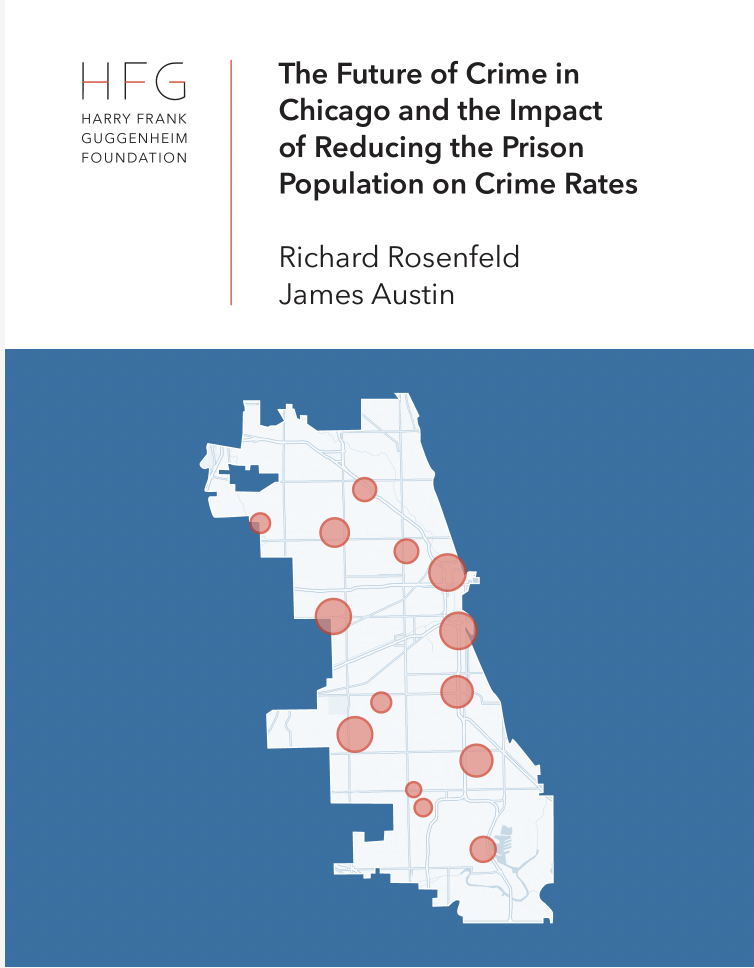
The Future of Crime in Chicago and the Impact of Reducing the Prison Population on Crime Rates

By Richard Rosenfeld, James Austin

This report examines the effects of a small set of factors on violent and property crime rates in Chicago. The authors find that a statistical model based on the Illinois imprisonment rate and a measure of the cost of living explained past variation in crime rates with minimal error.  The authors then used the model to forecast crime rates through 2025. Both violent and property crime are forecast to drop through 2025. In addition, the report finds that were Illinois to reduce its imprisonment rate by 25%, the effect on Chicago’s rate of violent crime would be negligible. No association was found between imprisonment rates and property crime. 

New York: Harry Frank Guggenheim Foundation. 2023, 20pg

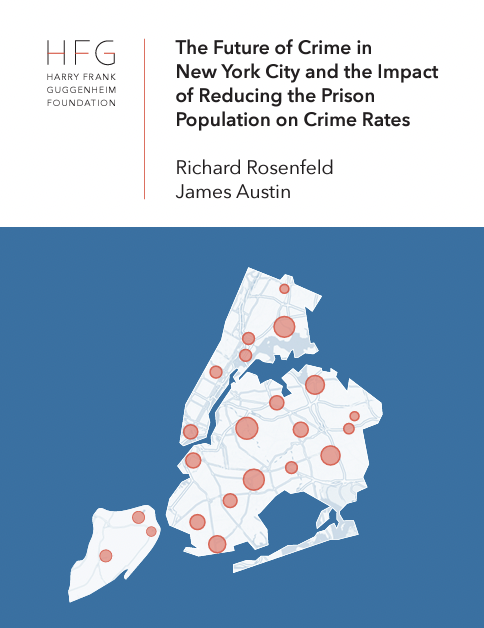
The Future of Crime in New York City and the Impact of Reducing the Prison Population on Crime Rates

By Richard Rosenfeld, James Austin

Employing a small number of predictive variables, the authors of this report created statistical models to forecast violent and property crime rates in New York City. The models estimated yearly changes in New York City’s crime rates from the early 1960s through 2021, estimates that corresponded very closely to the actual rates. The authors then used these models to forecast annual changes in crime rates through 2026. The forecast for violent crime is a slight decrease each year through 2026, while the forecast for property crime shows slight yearly increases. Finally, the projected impact on New York City’s violent crime rate of reducing the state imprisonment rate by 25% would be minimal. No association was found between imprisonment rates and property crime.

New York: Harry Frank Guggenheim Foundation. 2023, 18pg

The Future of Crime in Los Angeles and the Impact of Reducing the Prison Population on Crime Rates

By Richard Rosenfeld, James Austin

In this report, the authors devised statistical models to “predict” past yearly changes in Los Angeles’s rates of violent and property crime from the early 1960s through 2021, employing a very small set of predictive variables known to be associated with levels of crime. The yearly changes projected for those years corresponded quite closely to the actual changes. The authors then used the models to forecast crime trends through 2026. Violent crime is forecast to decline through 2026, while property crime is expected to rise modestly in the same period. The analysis also finds that if California imprisonment rates were reduced by 20%, the effect on crime in Los Angeles would be minimal.

New York: Harry Frank Guggenheim Foundation. 2023, 21pg

Perceptions of Data Analysis Across Ohio Law Enforcement Agencies

By Peter Leasure and Hunter M. Boehme

Efforts such as evidence-based policing and data-driven policing have argued for the use of research and data analysis in the decision-making process for law enforcement agencies. The current study sought to examine the importance of data collection and data analysis across Ohio law enforcement agencies and whether Ohio law enforcement agencies are interested in improving their data collection and data analysis procedures. The results showed that the majority of respondents strongly agreed or somewhat agreed that data collection and data analysis are key components of their decision-making process, and that their agency could benefit from improved data collection and data analysis procedures. However, a nontrivial number of respondents strongly disagreed or somewhat disagreed that data collection and data analysis are key components of their decision-making process, and that their agency could benefit from improved data collection and data analysis procedures. Recommendations informed by these results are discussed in detail.

Drug Enforcement and Policy Center. July 2023, 8pg

Future Crime: Assessing twenty first century crime prediction

By Katherine Aguirre, Emile Badran and Robert Muggah

  Cities are where the future happens first. They are hubs of innovation, productivity and experimentation. But many cities also are sites of crime and violence. More than ever, municipal authorities, private firms and civic groups are experimenting with new ways to improve real and perceived safety in cities. In some cities, new technologies are improving the situational awareness of public authorities and citizens. In others, all encompassing surveillance and monitoring systems are challenging fundamental norms of privacy. In most developed cities, high-frequency time series information on insecurity is increasingly available. Literally thousands of gigabytes of raw data are available representing the dynamics and characteristics of crime. New high-power computer analysis is giving rise to a next generation of smart, agile and evidence-informed policing strategies. Predictive platforms in particular can enhance police operations, identifying priority targets for police intervention, and enabling more effective allocation of police resources.  

Brazil: Igarape Institute. 2019, 23pg