Open Access Publisher and Free Library
CRIME+CRIMINOLOGY.jpeg

CRIME

Violent-Non-Violent-Cyber-Global-Organized-Environmental-Policing-Crime Prevention-Victimization

Posts in Violence & Oppression
A Pound of Flesh: The Criminalization of Private Debt

By Jennifer Turner

In the first-ever report on the extent and impact of cooperation between courts and the private debt collection industry nationwide, the American Civil Liberties Union found courts in 26 states and Puerto Rico in which judges issued arrest warrants for alleged debtors at the request of private debt collectors.

This practice violates the many state and federal laws as well as international human rights standards that prohibit the jailing of debtors. It worsens their financial struggles by subjecting them to court appearances, arrest warrants that appear on background checks, and jail time that interfere with their wages, their jobs, their ability to find housing, and more.

An estimated one in three adults in the United States has a debt that has been turned over to a private collection company, according to the Urban Institute. More than 6,000 of these companies operate in the U.S. At the bidding of the private debt collection industry, courts issue tens of thousands of arrest warrants every year when people don’t appear in court to deal with unpaid civil debt judgments.

New York: The American Civil Liberties Union (ACLU), 2018. 97p.

Histories Of Transnational Crime

Edited by Gerben Bruinsma

In the past two decades, the study of transnational crime has developed from a subset of the study of organized crime to its own recognized field of study, covering distinct societal threats and requiring a particular approach. This volume provides examples of transnational crime, and places them in a broad historical context, which has so far been missing from this field of study. The contributions to this comprehensive volume explore the causes and historical precursors of six main types of transnational crime: piracy, human smuggling, arms trafficking, drug trafficking, art and antique trafficking and corporate crime. The historical contributions demonstrate that transnational crime is not a novel phenomenon of recent globalization and that, beyond organized crime groups, powerful individuals, governments and business corporations have been heavily involved.

New York: Springer, 2015. 201p.

Confronting Child Sexual Abuse: Knowledge to Action

By Anne M. Nurse

Most people get information about child sexual abuse from media coverage, social movements, or conversations with family and friends. Confronting Child Sexual Abuse describes how these forces shape our views of victims and offenders, while also providing an in-depth look at prevention efforts and current research. Sociologist Anne Nurse has synthesized studies spanning the fields of psychology, sociology, communications, criminology, and political science to produce this nuanced, accessible, and up-to-date account. Topics include the prevalence of abuse, the impact of abuse on victims and families, offender characteristics, abuse in institutions, and the efficacy of treatments. Written for people who care for kids, for students considering careers in criminal justice or human services, and for anyone seeking information about this devastating issue, Nurse’s book offers new public policy ideas as well as practical suggestions on how to engage in prevention work. Interactive links to studies, videos, and podcasts connect readers to further resources.

Ann Arbor, MI: Lever Press, 2020. 319p.

Drugs Politics: Managing Disorder in the Islamic Republic of Iran

By Maziyar Ghiabi

Iran has one of the world’s highest rates of drug addiction, estimated to be between two and seven per cent of the entire population. This makes the questions this book asks all the more salient: what is the place of illegal substances in the politics of modern Iran? How have drugs affected the formation of the Iranian state and its power dynamics? And how have governmental attempts at controlling and regulating illicit drugs affected drug consumption and addiction? By answering these questions, Maziyar Ghiabi suggests that the Islamic Republic’s image as an inherently conservative state is not only misplaced and inaccurate, but in part a myth. In order to dispel this myth, he skilfully combines ethnographic narratives from drug users, vivid field observations from ‘under the bridge’, with archival material from the pre- and post-revolutionary era, statistics on drug arrests and interviews with public officials

Cambridge, UK: Cambridge University Press, 2019. 236p.

Drug Policies and Development: Conflict and Coexistence

Edited by Julia Buxton Mary Chinery-Hesse Khalid Tinasti

The 12th volume of International Development Policy explores the relationship between international drug policy and development goals, both current and within a historical per-spective. Contributions address the drugs and development nexus from a range of critical viewpoints, highlighting gaps and contradictions, as well as exploring strategies and opportunities for enhanced linkages between drug control and development programming. Crim-inalisation and coercive law enforcement-based responses in international and national level drug control are shown to undermine peace, security and development objectives. Readership: Academic scholars and researchers, policymakers and development practitioners interested in international development policy, drug policies and their effects on development, global economic and political trends, and local development issues.

Leiden; Boston: Brill, 2020. 335p.

Organized Crime Groups: A systematic review of individual-level risk factors related to recruitment

Francesco Calderoni,Tommaso Comunale,Gian Maria Campedelli,Martina Marchesi,Deborah Manzi and Niccolò Frualdo

There is relatively strong evidence that being male and having committed prior criminal activity and violence are associated with future organised crime recruitment. There is weak evidence that prior sanctions, social relations with organised crime-involved subjects and a troubled family environment are associated with recruitment. This systematic review examines what individual-level risk factors are associated with recruitment into organised crime. Despite the increase of policies addressing organised crime activities, little is known about recruitment. Existing knowledge is fragmented and comprises different types of organised criminal groups.Recruitment refers to the different processes leading individuals to stable involvement in organised criminal groups, including mafia, drug trafficking organisations, adult gangs and outlawed motorcycle gangs. This systematic review excludes youth (street) gangs, prison gangs and terrorist groups.

Oslo, Norway: Campbell Collaborative, 2022. 68p.

Gothic Incest: Gender, Sexuality and Transgression

By Jenny DiPlacidi

This book demonstrates that incest was representative of a range of interests crucial to writers of the Gothic, often women or homosexual men who adopted a critical stance in relation to the heteronormative patriarchal world. In repositioning the Gothic, representations of incest are revealed as synonymous with the Gothic as a whole. The book argues that extending the traditional endpoint of the Gothic makes it possible to understand the full range of familial, legal, marital, sexual and class implications associated with the genre's deployment of incest. Gothic authors deploy the generic convention of incest to reveal as inadequate heteronormative ideologies of sexuality and desire in the patriarchal social structure that render its laws and requirements arbitrary. The book examines the various familial ties and incestuous relationships in the Gothic to show how they depict and disrupt contemporary definitions of gender, family and desire. Many of the methodologies adopted in Gothic scholarship and analyses of incest reveal ongoing continuities between their assumptions and those of the very ideologies Gothic authors strove to disrupt through their use of the incest trope. Methodologies such as Freudian psychoanalysis, as Botting argues, can be positioned as a product of Gothic monster-making, showing the effect of Gothic conventions on psychoanalytic theories that are still in wide use today.

Manchester, UK: Manchester University Press, 2018. 314p.

The Enemy Within: Homicide and Control in Eastern Finland in the Final Years of Swedish Rule 1748-1808

By Anu Koskivirta

"This work explores the quantitative and qualitative development of homicide in eastern Finland in the second half of the eighteenth century and the early years of the nineteenth. The area studied comprised northern Savo and northern Karelia in eastern Finland. At that time, these were completely agricultural regions on the periphery of the kingdom of Sweden. Indeed the majority of the population still got their living from burn-beating agriculture. The analysis of homicide there reveals characteristics that were exceptional by Western European standards: the large proportion of premeditated homicides (murders) and those within the family is more reminiscent of modern cities in the West than of a pre-modern rural society. However, there also existed some archaic forms of Western crime there. Most of the homicides within the family were killings of brothers or brothers-in law, connected with the family structure (the extended family) that prevailed in the region. This study uses case analysis to explore the causes for the increase in both familial homicide and murder in the area. One of the explanatory factors that is dealt with is the interaction between the faltering penal practice that then existed and the increase in certain types of homicide.

Helsinki: Finnish Literature Society / SKS, 2003. 217p.

Torture, Humiliate, Kill: Inside the Bosnian Serb Camp System

By Hikmet Karčić

Half a century after the Holocaust, on European soil, Bosnian Serbs orchestrated a system of concentration camps where they subjected their Bosniak Muslim and Bosnian Croat neighbors to torture, abuse, and killing. Foreign journalists exposed the horrors of the camps in the summer of 1992, sparking worldwide outrage. This exposure, however, did not stop the mass atrocities. Hikmet Karčić shows that the use of camps and detention facilities has been a ubiquitous practice in countless wars and genocides in order to achieve the wartime objectives of perpetrators. Although camps have been used for different strategic purposes, their essential functions are always the same: to inflict torture and lasting trauma on the victims. Torture, Humiliate, Kill develops the author’s collective traumatization theory, which contends that the concentration camps set up by the Bosnian Serb authorities had the primary purpose of inflicting collective trauma on the non-Serb population of Bosnia and Herzegovina. This collective traumatization consisted of excessive use of torture, sexual abuse, humiliation, and killing. The physical and psychological suffering imposed by these methods were seen as a quick and efficient means to establish the Serb “living space.” Karčić argues that this trauma was deliberately intended to deter non-Serbs from ever returning to their pre-war homes. The book centers on multiple examples of experiences at concentration camps in four towns operated by Bosnian Serbs during the war: Prijedor, Bijeljina, Višegrad, and Bileća. Chosen according to their political and geographical position, Karčić demonstrates that these camps were used as tools for the ethno-religious genocidal campaign against non-Serbs. Torture, Humiliate, Kill is a thorough and definitive resource for understanding the function and operation of camps during the Bosnian genocide.

Ann Arbor: University of Michigan Press, 277p.

Sexual States: Governance and the Struggle over the Antisodomy Law in India

By Jyoti Puri

In Sexual States Jyoti Puri uses the example of the efforts to decriminalize homosexuality in India to show how the regulation of sexuality is fundamentally tied to the creation and enduring existence of the state. Between 2001 and 2013 activists attempted to rewrite section 377 of the Indian Penal Code, which outlaws homosexual behavior. Having interviewed activists and NGO workers throughout five metropolitan centers, investigated crime statistics at the National Crime Records Bureau, visited various state institutions, and met with the police, Puri found that section 377 is but one element of the large and complex systems of laws, practices, policies, and discourses that regulate Indian sexuality. Intended to mitigate sexuality's threat to the social order, this regulation works to preserve the views of the state as inevitable, legitimate, and indispensable. By highlighting the various means through which the regulation of sexuality constitutes India's heterogeneous and fragmented.

Durham, NC: Duke University Press, 233p;.

California Police Sexual Misconduct Arrest Cases, 2005-2011

By Philip M Stinson, Zachary J. Calogeras, Natalie L. DiChiro, and Ryan K. Hunter

This report was prepared at the request of the California Research Bureau. The data are from a larger study on police crime in the United States. Police crimes are those crimes committed by sworn law enforcement officers given the general powers of arrest at the time the offense was committed and/or at the time when the officer was arrested. These crimes can occur while the officer is on- or off-duty and include offenses committed by state, county, municipal, tribal, or special law enforcement agencies. Police crimes damage the occupational integrity of police officers, the organizational legitimacy of the employing law enforcement agency, and the overall authority and legitimacy of the law enforcement community. According to Stinson’s (2009) typology of police crime, nearly all crime committed by sworn law enforcement officers is alcohol-related, drug-related, sex-related, violence-related, and/or profit-motivated. This report focuses on the sex-related police crime arrests of sworn law enforcement officers in the State of California during the years 2005-2011.

Bowling Green, OH: Bowling Green State University, 2015. 25p.

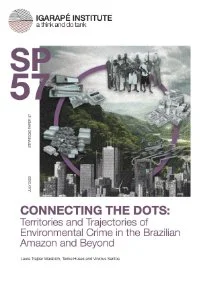
Connecting the Dots: Territories and Trajectories of Environmental Crime in the Brazilian Amazon and Beyond

By Laura Trajber Waisbich, Terine Husek and Vinicius Santos

The ecosystem of environmental crime in the Amazon is largely to blame for the current levels of deforestation and degradation of the biggest tropical forest on the planet. Several illegal economic activities, representing the main drivers of destruction in the river basin, take a heavy toll on the forest and its inhabitants. Based on an analysis of the spatial distribution of the Federal Police operations to fight environmental crime in the Legal Amazon between 2016 and 2021, this study highlights the hotspots for a range of illicit forest-based economic activities in the region, while also showing how other locations within and outside the Brazilian Amazon form part of a broader nexus of environmental crime. The study reviewed more than 300 Federal Police operations and identified 846 territories that make up the ecosystem of environmental crime in the Amazon. These territories are located in 262 municipalities, both in the Legal Amazon and beyond its borders. Of the cities mapped, 75% are located in the Legal Amazon, 22% are in other regions of Brazil and 3% are in neighboring countries. These territories are where environmental and associated crimes converge to fuel illegal deforestation, illegal logging, public land grabbing (known as grilagem, in Portuguese), agriculture and livestock rife with environmental illegalities and illegal mining.

Rio de Janeiro, Brazil: Igarape, 2022. 58p.

Exploring Drug Supply, Associated Violence and Exploitation of Vulnerable Groups in Denmark

By Thomas Friis Søgaard Marie Højlund Bræmer Michael Mulbjerg Pedersen

This report provides an analysis of current drug supply models and the related violence and exploitation of vulnerable groups in Denmark. Recent years have seen a growth in criminals’ exploitation of vulnerable groups for drug-related crimes. This development appears to be driven by several structural factors, including increased drug market competition and a proliferation of more labour-intensive supply models. Based on the findings of this study, we identify some priorities for future research to understand the impact of digital developments in retail-level drug distribution on vulnerable individuals and to inform responses to reduce criminal exploitation.

Lisbon: European Monitoring Centre for Drugs and Drug Addiction (EMCDDA), 2021. 55p.

The Heroin Coast: A political economy along the estern African seaboard

By Simone Haysom, Peter Gastrow and Mark Shaw

This report examines the characteristics of the heroin trade off the East African coast and highlights the criminal governance systems that facilitate drug trafficking along these routes.

In recent years, the volume of heroin shipped from Afghanistan along a network of maritime routes in East and southern Africa appears to have increased considerably. Most of this heroin is destined for Western markets, but there is a spin-off trade for local consumption. An integrated regional criminal market has developed, both shaping and shaped by political developments in the region. Africa is now experiencing the sharpest increase in heroin use worldwide and a spectrum of criminal networks and political elites in East and southern Africa are substantially enmeshed in the trade. This report focuses on the characteristics of the heroin trade in the region and how it has become embedded in the societies along this route. It also highlights the features of the criminal governance systems that facilitate drug trafficking along this coastal route.

ENACT (Africa), 2018. 54p.

Fending off Fentanyl and Hunting Down Heroin: Controlling opioid supply from Mexico

By Vanda Felbab-Brown

This paper explores policy options for responding to the supply of heroin and synthetic opioids from Mexico to the United States. Forced eradication of opium poppy has been the dominant response to illicit crop cultivation in Mexico for decades. Forced eradication appears to deliver fast results in suppressing poppy cultivation, but the suppression is not sustainable even in the short term. Farmers find a variety of ways to adapt and replant after eradication. Moreover, eradication undermines public safety and rule of law efforts in Mexico, both of high interest to the United States….Unless security and rule of law in Mexico significantly improve, the licensing of opium poppy in Mexico for medical purposes is unlikely to reduce the supply of heroin to the United States. Mexico faces multiple feasibility obstacles for getting international approval for licensing its poppy cultivation for medical purposes, including, currently, the inability to prevent opium diversion to illegal supply and lack of existing demand for its medical opioids. In seeking to establish such demand, Mexico should avoid setting off its own version of medical opioid addiction.

Washington, DC: The Brookings Institution,2020. 28p.

Neighborhood Crime and Travel Behavior: An Investigation of the Influence of Neighborhood Crime Rates on Mode Choice – Phase II

By Christopher E. Ferrell, Shishir Mathur, Justin Meek and Matthew Piven

There are considerable environmental and public health benefits if people choose to walk, bicycle, or ride transit, instead of drive. However, little work has been done on the effects of neighborhood crimes on mode choice. Instinctively, we understand that the threats posed by possible criminal activity in one’s neighborhood can play a major role in the decision to drive, take transit, walk or ride a bicycle, but so far little empirical evidence supports this notion, let alone guides public infrastructure investments, land use planning, or the allocation of police services. This report--describing Phase 2 of a research study conducted for the Mineta Transportation Institute on crime and travel behavior--finds that high crime neighborhoods tend to discourage residents from walking or riding a bicycle. When comparing a high crime to a lower crime neighborhood the odds of walking over choosing auto decrease by 17.25 percent for work trips and 61 percent for non-work trips. For transit access to work trips, the odds of choosing walk/bike to a transit station over auto decrease by 48.1 percent. Transit trips, on the other hand, are affected by neighborhood crime levels in a similar way to auto trips, wherein high crime neighborhoods appear to encourage transit mode choice.

San Jose, CA: Mineta Transportation Institute, 2012. 104p.

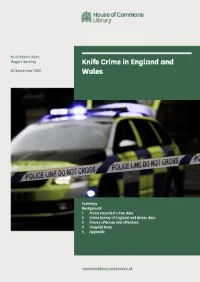
Knife crime England Wales

By Grahame Allen and Megan Harding

“Knife” crime, a crime involving an object with a blade or sharp instrument, is a persistent concern and disproportionately impacts the young and disadvantaged. Various remedies have been tried over the years. The Library Briefing Paper Knives and Offensive Weapons (SN00330) discusses the legislation which governs the carrying (possession) and sale of knives and other offensive weapons.

London: House of Commons Library, 2021. 37p.

Violence Against Women and Ethnicity: Commonalities and Differences Across Europe

Edited by Ravi K. Thiara, Stephanie A. Condon, and Monika Schröttle

This book draws together both: theory and practice on minority/migrant women and gendered violence. The interplay of gender, ethnicity, religion, class, generation and sexuality in shaping the lives, experiences and choices of minority/migrant women affected by violence has not always been adequately theorised within much of the existing writing on violence against women. Feminist theory, especially the insights provided by the concept of intersectionality, are central to the editors’ conceptual frameworks.

Leverkusen-Opladen: Verlag Barbara Budrich , 2011. 426p.

The Ecology of Football-related Crime and Disorder

By Justin Kurland

Numerous studies have been conducted on football ‘hooliganism’ with the majority of this work ignoring the immediate, environmental conditions that facilitate opportunities for crime in the football match day context. Consequently, the existing theoretical framework for explaining why crime emerges during football matches remains incomplete. This thesis aims to fill this gap for understanding modern football-related crime and disorder. The thesis uses a predominantly environmental criminology framework to explore whether crime opportunity theories can make sense of crime patterns observed around previously unexplored English domestic football stadia. It is crime event-oriented, focussing on how variation in the ecology of the area around stadia on match days and a set of counterfactual days when the stadium is not used facilitates different criminal opportunities. This is achieved primarily through the analysis of police-recorded crime data for three kilometre areas surrounding a sample of five stadia for the period 2005- 2010. The thesis focuses on three components of crime events - where they occur, when they occur, and why a disproportionate amount of it clusters in some neighbourhoods and not others. Despite the contrasting physical environment around the five stadia, the findings suggest very similar spatial and temporal crime patterns in the area surrounding stadia when they are used relative to when they are not and thus lend support to environmental theories of crime in the football context. The findings also help draw attention to where and when crime is elevated on football match days. The implications of the research for reducing the unintended and unwanted side-effect of football that is desired for the positive utilities it brings, in particular the practicality of employing situational crime prevention in the context of English domestic football are discussed.

London: University College London, 2014.

Sexual Abuse and Therapeutic Services for Children and Young People: The Gap Between Provision and Need

By Debra Allnock with Lisa Bunting, Avril Price, Natalie Morgan-Klein, Jane Ellis, Lorraine Radford and Anne Stafford

Worldwide it has been estimated that 160 million girls and 73 million boys under 18 years of age have experienced forced sexual intercourse or other forms of sexual violence involving physical contact (Pinheiro, 2006, p12). In the UK the true prevalence of sexual violence against children and young people is not known, but a recent review published in The Lancet estimated that between 5 and 10 per cent of girls and 5 per cent of boys have experienced penetrative sexual abuse and up to three times this number have been exposed to other forms of sexual violence (Gilbert et al, 2008). …This research, generously funded by the Private Equity Foundation and the Children’s Charity, aimed to address a gap in our knowledge by mapping the availability of therapeutic services to support children and young people who have experienced sexual abuse across the United Kingdom.

London: NSPCC, 2009. 171p.