Open Access Free Library
CRIME+CRIMINOLOGY.jpeg

CRIME

Violent-Non-Violent-Cyber-Global-Organized-Environmental-Policing-Crime Prevention-Victimization

Posts in Violent Crime
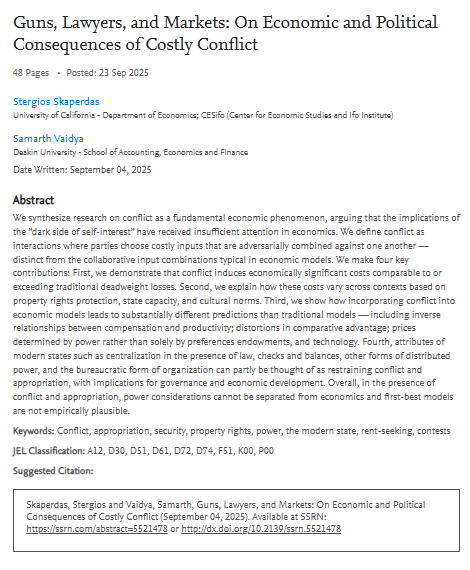
Guns, Lawyers, and Markets: On Economic and Political Consequences of Costly Conflict

By Stergios Skaperdas and Samarth Vaidya

We synthesize research on conflict as a fundamental economic phenomenon, arguing that the implications of the ”dark side of self-interest” have received insufficient attention in economics. We define conflict as interactions where parties choose costly inputs that are adversarially combined against one another — distinct from the collaborative input combinations typical in economic models. We make four key contributions: First, we demonstrate that conflict induces economically significant costs comparable to or exceeding traditional deadweight losses. Second, we explain how these costs vary across contexts based on property rights protection, state capacity, and cultural norms. Third, we show how incorporating conflict into economic models leads to substantially different predictions than traditional models — including inverse relationships between compensation and productivity; distortions in comparative advantage; prices determined by power rather than solely by preferences endowments, and technology. Fourth, attributes of modern states such as centralization in the presence of law, checks and balances, other forms of distributed power, and the bureaucratic form of organization can partly be thought of as restraining conflict and appropriation, with implications for governance and economic development. Overall, in the presence of conflict and appropriation, power considerations cannot be separated from economics and first-best models are not empirically plausible.

 CESifo Working Paper No. 12135, 2025
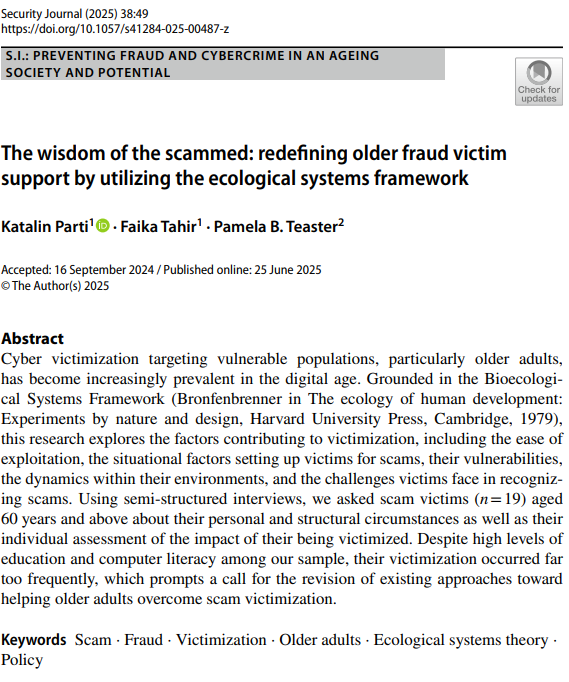
The wisdom of the scammed: redefning older fraud victim support by utilizing the ecological systems framework

By Katalin Parti  · Faika Tahir  · Pamela B. Teaster 

Cyber victimization targeting vulnerable populations, particularly older adults, has become increasingly prevalent in the digital age. Grounded in the Bioecological Systems Framework (Bronfenbrenner in The ecology of human development: Experiments by nature and design, Harvard University Press, Cambridge, 1979), this research explores the factors contributing to victimization, including the ease of exploitation, the situational factors setting up victims for scams, their vulnerabilities, the dynamics within their environments, and the challenges victims face in recognizing scams. Using semi-structured interviews, we asked scam victims (n=19) aged 60 years and above about their personal and structural circumstances as well as their individual assessment of the impact of their being victimized. Despite high levels of education and computer literacy among our sample, their victimization occurred far too frequently, which prompts a call for the revision of existing approaches toward helping older adults overcome scam victimization.  

  Security Journal (2025) 38:49

Safeguarding Singapore: Addressing the Impact of Transnational Scamming Operations in Southeast Asia

By Yen Zhi Yi
SYNOPSIS
In recent months, heightened media scrutiny has drawn attention to the proliferation of scam centres along Myanmar’s border towns and the subsequent crackdowns on them. Concurrently, Singapore has also witnessed a significant increase in scam-related incidents, with the government urging vigilance and taking precautionary measures to safeguard its citizens. Against this backdrop, it is imperative for ASEAN countries to work collaboratively to tackle this growing cross-border scourge. Doing so calls for stepped-up action at home to enhance awareness and enforcement collaboration abroad among regional partners to check this transnational security challenge.
 
S. Rajaratnam School of International Studies, NTU Singapore, 2025. 6p.

Homicide Victims and Perpetrators.

Socio-economic status, demographic background and criminal history.

By Lisa Westfelt

This study focuses on aspects that have not yet been examined in Swedish research: the socio-economic status and demographic background of victims and perpetrators at the time homicides are committed, as well as the victims and perpetrators’ criminal histories.

English summary of Brå report 2025:5 Stockholm: The Swedish National Council for Crime Prevention (Brå), 2025. 14p.

Homicide in Sweden since 1990. 

Scope, trends and characteristics.

By Klara Hradilova-Selin

This study is the fourth in a series of Brå’s research reports on homicide in Sweden, based on material from the criminal justice system. The analyses build on audited data from police preliminary investigations and, in cases that have been cleared, judgments obtained from both district courts and appeal courts. The aim has been to outline trends in and characteristics of homicide cases since 1990, with a particular focus on the most recent period for which data have been collected, 2018–2021. Some analyses also include data from Brå’s statistics on confirmed cases of lethal violence for 2022 and 2023. 


Report 2024:6