Open Access Publisher and Free Library
CRIME+CRIMINOLOGY.jpeg

CRIME

Violent-Non-Violent-Cyber-Global-Organized-Environmental-Policing-Crime Prevention-Victimization

Posts in social sciences
A Primer in the Psychology of Crime

By S.
 Giora
 Shoham and Mark
 Seis.

First published back in the 1980s, there's still nothing like this book anywhere. Provides a balanced, innovative account of the psychology of crime, drawing on current and past scientific research and philosophies. CONTENTS: 1. Perspectives, Defining Crime, and Theoretical Evaluation. 2. Psychoanalytic Theory. 3.Trait Perspectives. 4. Behavioral, Situational And Social Learning Perspectives. 5. Cognitive Learning Perspectives. 6. Existential and Phenomenological Perspectives. 7. References. RECOMMENDED: Excellent text for upper division undergraduate classes, or beginning graduate classes. Strongly recommended as a substitute for those expensive, superficial introductory textbooks! As we noted above, there is NO text that covers as carefully as this one does, the psychology of crime literature. It's as relevant today as it was a couple of decades ago.

NY. Harrow and Heston Publishers. 2012.

download
Who Pays? Casino Gambling and Organized Crime

By Craig A. Zendzian.

Written by a former NYPD cop, this book gives a behind the scenes look at the hidden interests that lie behind casino gambling from Nevada to New Jersey. Provides a concise analysis of how politics, organized crime and special interests created one of the greatest gambling empires in the United States. CONTENTS: 1. Introduction, 2.Nevada and Earlier Gambling Movements in America, 3. The Bahamas and Casino Gambling, 4. Gambling Comes to New Jersey, 5. Let's Do Business: The Corporate Way That is, 6. Who Investigates Racketeers?, 7. Where Does It End?

NY. Harrow and Heston Publishers. 2012.

download
A Primer in the Sociology of Crime

By S. Giora Shoham and John Hoffman.

With depth, clarity and erudition, this primer covers all the classic theory and research on the sociology of crime. CONTENTS: 1. Criminology and Social Deviance. 2. Theoretical and Methodological Issues in Criminology. 3. Ecological Theories of Crime and Delinquency. 4. Anomie and Social Deviance: Strain Theories. 5. Differential Association and its Progeny. 6. Control Theories of Crime and Delinquency. 7. Social Reaction to Crime: Stigma and Interaction. 8. Conflict and Radical Perspectives on Crime. 9. Recent Developments in the Sociology of Crime. References. RECOMMENDED: Excellent text for upper division undergraduate classes, or beginning graduate classes. Strongly recommended as a substitute for those expensive, superficial introductory textbooks!

NY. Harrow and Heston Publishers. 2012.

download
Corporate Crime Corporate Violence, 3rd edition

By Michael J. Lynch.

A revised and extended edition of the popular Crimes Against Health and Safety, this classic dissects the popular myths promoted by traditional criminology, uncovers who the real criminals are, and the extent of their dreadful crimes. The authors have written a new Introduction specially for this Kindle edition. CONTENTS: 1.Quiet Violence. 2.Corporate Crime: Definition and History. 3.Calling a Crime a Crime. 4.Conventional Laws for Unconventional Crimes. 5.Regulating Health and Safety. 6.Green Criminology: Corporate Violence and the Environment. 7.Explaining Corporate Violence. 9.Restructuring Risk Decision-making.References.

RECOMMENDED: If you're fed up with white collar crime, corporate arrogance and greed, then this book is for you. Makes a provocative text for upper division undergraduate courses on the Nature of Crime and its Control. Never fails to stimulate animated discussion in graduate classes.

NY. Harrow and Heston Publishers. 2014. 212p.

download
Discovering Criminology

Edited by Graeme R. Newman, Michael J. Lynch and David H. Galaty.

From W. Byron Groves. This rare book brings together the writings of Casey Byron Groves, possibly the most brilliant criminologist in America during the 1990s. Casey's approach was unique, unorthodox for the 1990s, and quite frankly, 'in your face." From "organizational perversion" to "punishing the privileged", the topics he covered were diverse, and the scholars on whose shoulders he stood were equally diverse, from Habermas and Hegel to van den Haag and Herrnstein. Only 200 copies of this book were ever printed.

Harrow and Heston Publishers. NY. 1993, 2012. 320p.

download
Explaining Criminal Careers

By John F. Macleod, Peter G. Grove and David P. Farrington

Implications for Justice Policy. Explaining Criminal Careers presents a simple quantitative theory of crime, conviction and reconviction, the assumptions of the theory are derived directly from a detailed analysis of cohort samples drawn from the “UK Home Office” Offenders Index .

Clarendon Press (2012) 273 pages.

download
Not Just in Transit: Drugs, the State and Society in West Africa

By West Africa Commission on Drugs.

After looking at the evidence, consulting experts from the region and around the world, and visiting some of the most affected countries and communities in West Africa, the Commissioners of the West Africa Commission on Drugs detail their conclusions in this report about how the problems of drug trafficking and consumption in the region should be tackled.

Geneva: WACD, 2014. 64p.

download
Money and Violence: financial self-help groups in a South African township

By E.. Bähre.

From the eighties onward, when apartheid was crumbling, more and more Africans migrated to Cape Town, South Africa. They did not leave their homes in the Eastern Cape because they liked the city like the many tourists who, not unlike the Dutch East India Company of the colonial past, enjoy its revitalising qualities. To the Xhosa migrants Cape Town was, and still is, a hostile city. People fear murder, rape, and theft. They do not know their neighbours and friends are scarce. They have no family there, either living or dead, and racist attitudes are ever present. The Xhosa migrants have only one motivation for plunging themselves into the unknown and hostile squatter camps of Cape Town and that is money. This ethnography concerns the way in which Xhosa migrants in the townships of Cape Town collectively manage their money in financial self-help groups, also known as financial mutuals.1 The migrants organise a myriad of groups in which the participants collectively save, borrow, lend, or use their hard-earned money to form insurances. Some mutuals consisted of only a few neighbours who met each month at a member’s home, with each giving about R200 to the host member until all members had had a turn. Other mutuals were complex arrangements where members saved money together, mostly for Christmas, but also issued loans to each other. There were also many insurance arrangements involving up to a couple of hundred members that made sure that money was available to attend the funeral of a relative back home, or to prevent a burial in Cape Town itself. One could join a group voluntarily and the social constraint of fellow members would make sure that not all the money would be spent but would be used for the contribution to the financial mutual.

Leiden/Boston: Brill Academic Publisher, 2007. 205p.

download
Man of Genius

By Cesare Lombroso.

From the Preface: “Just as giants pay a heavy ransom for their stature in sterility and relative muscular and mental weakness, so the giants of thought expiate their intellectual force in degeneration and psychoses. It is thus that the signs of degeneration are found more frequently in men of genius than even in the insane.”

NY. Harrow and Heston Classic Reprint. (1891) 403 pages.

download
Violence and Trolling on Social Media

Edited by Sara Polak and Daniel Trottier

.History, Affect, and Effects of Online Vitriol. “Trolls for Trump', virtual rape, fake news - social media discourse, including forms of virtual and real violence, has become a formidable, yet elusive, political force. What characterizes online vitriol? How do we understand the narratives generated, and also address their real-world - even life-and-death - impact? How can hatred, bullying, and dehumanization on social media platforms be addressed and countered in a post-truth world? This book unpicks discourses, metaphors, media dynamics, and framing on social media, to begin to answer these questions. Written for and by cultural and media studies scholars, journalists, political philosophers, digital communication professionals, activists and advocates, this book makes the connections between theoretical approaches from cultural and media studies and practical challenges and experiences 'from the field', providing insight into a rough media landscape.”

Amsterdam: Amsterdam University Press, 2020. 267p.

download
Below the Surface: How Illegal, Unreported and Unregulated Fishing Threatens our Security

By Cathy Haenlein.

This paper argues that large-scale illegal, unreported and unregulated (IUU) fishing takes place on an organised, systematic scale across multiple jurisdictions, and must therefore be recognised as transnational organised crime. Such IUU fishing endangers food security, threatens livelihoods, undermines the rule of law and deprives states of revenues. It also intersects with other crimes, further amplifying the threat to security. Illegal, unreported and unregulated (IUU) fishing is conventionally treated by governments worldwide as the result of technical regulatory infringements. As such, it is often deemed a matter for industry regulators and dismissed as a trivial issue insofar as it relates to national security. This diagnosis is flawed. Certainly, IUU fishing is often small in scale and conducted by artisanal fishers out of ignorance of laws, or opportunism. Yet there is also evidence that much of today’s IUU fishing activity takes place on an organised, systematic scale across multiple jurisdictions. Testament to this are the volumes involved. Although numerous difficulties affect such calculations, global losses to IUU fishing have been estimated at some $10–23.5 billion annually – equivalent to 11–26 million tonnes of fish per year. The result is the plunder of the world’s oceans, threatening not only marine ecosystems, but also the security of human populations. Large-scale IUU fishing endangers food security, threatens livelihoods, undermines the rule of law and deprives states of revenues. It also intersects with other crimes, further amplifying the threat to security. Yet research on these security dimensions is limited and fragmented; our understanding of their dynamics remains partial. Policy and practical responses, meanwhile, remain ill-suited, failing to keep pace with the complexity of the threat posed.

London: Royal United Services Institute (RUSI), 2019. 56p.

download
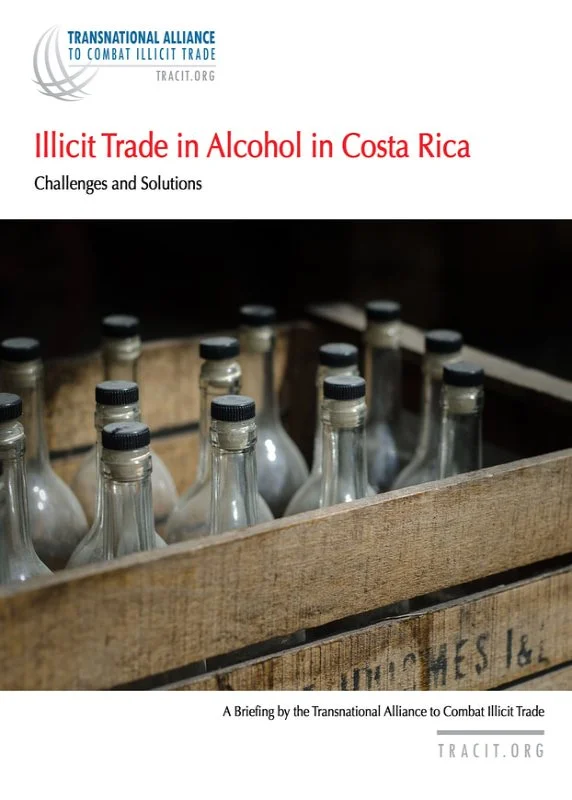
lllicit Trade in Alcohol in Costa Rica: Challenges and Solutions

By Transnational Alliance to Combat Illicit Trade (TRACIT).

Illicit trade in alcohol is widespread, representing significant percentages of alcohol consumption worldwide and stripping governments of billions of dollars in tax revenues. In almost all cases, illicit trade in alcohol results in serious health risks to consumers, revenue loss, and brand degradation for legitimate manufacturers, as well as reduced tax revenue for governments. This publication explores the situation in Costa Rica and highlights a number of regulatory and legal mechanisms that the government can implement to better control and combat illicit alcohol.

NY: TRACIT(September 2019) 14p.

download
lllicit Trade in Alcohol in India: Challenges and Solutions

By The Transnational Alliance to Combat Illicit Trade (TRACIT)

Illicit trade in alcohol is widespread, representing significant percentages of alcohol consumption worldwide and stripping governments of billions of dollars in tax revenues. In almost all cases, illicit trade in alcohol results in serious health risks to consumers, revenue loss, and brand degradation for legitimate manufacturers, as well as reduced tax revenue for governments. This publication explores the situation in India and the causes for the flourishing trade in illicit alcohol. The problem in India is exacerbated by the massive size of the country, the federal structure, diverse drinking patterns, the varied regulatory structure and regional nuances and traditions that characterize the alcohol market. Notably, the report highlights a number of regulatory and legal mechanisms that the government can implement to better control and combat illicit alcohol.

NY: The Transnational Alliance to Combat Illicit Trade (TRACIT) (September 2019) 16p.

download
Fraudulent Advertising Online: Emerging Risks and Consumer Fraud

By The American Apparel & Footwear Association (AAFA).

Fraudulent advertising is rapidly emerging as a new risk to consumers shopping online, where millions of consumers are exposed to thousands of fraudulent advertisements taking them to thousands of illegitimate e-commerce websites that defraud and/or sell counterfeit products and deceitful services. This report from TRACIT and the American Apparel and Footwear Association investigates and points out that Internet-based platforms for social networking and shopping from home have inherent systemic weaknesses that are exploited by criminals to sell any variety of counterfeit or illegal product with little risk of apprehension. The lack of sufficient policies and procedures to verify an advertiser’s true identity and limited vetting during the onboarding process are identified as the main vulnerabilities that enable fraudulent advertising online.

NY: TRACIT(July 2020) 66p.

download
Tackling Illicit Trade in ASEAN

By A Joint Effort Between EU-ABC & TRACIT.

TRACIT has joined with the EU-ASEAN Business Council (EU-ABC) to issue a report that sheds light on the growing problem of illicit trade in the Association of South East Asian Nations (ASEAN). The report, titled, “Tackling Illicit Trade in ASEAN”, comes at a time when illicit trade is gaining momentum in ASEAN and as officials prepare for the upcoming 14th ASEAN Ministerial Meeting on Transnational Crime (AMMTC). The paper investigates various forms of illicit trade in the region, the affected industry sectors and provides critical insight on how government and industry leaders can work together to introduce regulatory changes to confront this pressing issue.

NY: TRACIT. Advocacy Paper, 2020. 35p.

download
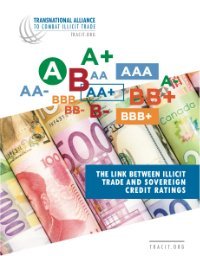
Illicit Trade and Sovereign Credit Ratings

By Transnational Alliance to Combat Illicit Trade (TRACIT),

In light of the strong and widespread impacts of illicit trade on countries’ economic output and performance, a new report from the Transnational Alliance to Combat Illicit Trade (TRACIT) investigates whether a correlation can be established between individual countries’ creditworthiness and their vulnerability to illicit trade. The report compares the credit ratings attributed by S&P Global, Fitch Group and Moody's and the scores attributed by the Global Illicit Trade Environment Index, and finds that countries that are poorly equipped to tackle illicit trade also suffer from poor credit worthiness. Illicit trade has a direct negative impact on the very economic, social, and institutional risk factors that credit rating agencies evaluate to determine countries’ ability to honor their debt. The corruption, crime, human trafficking, money laundering, and environmental degradation connected with illicit trade all combine to weaken a country’s economic, financial and institutional stability that underpin its credit ratings. Correcting the regulatory environment and economic circumstances that enable illicit trade can improve the environment upon which a country’s credit ratings are based. Governments should prioritize and increase efforts to combat illicit trade, and the underlying conditions that facilitate it, because of the severe repercussions it has on society, the economy, and development, and because it is in their own financial interest to do so.

NY: TRACIT 2021. 18p.

download
Organised crime, corruption and the movement of people across borders in the new enlarged EU: A case study of Estonia, Finland and the UK

By Jon Spencer, Rose Broad, Kauko Aromaa et. al.

This report was completed some time ago but for reasons beyond our control its publication has been delayed until now. The issue of the illegal movement of people retains its topicality and continues to be equally relevant as it was at the time of the project fieldwork. For example, recently, HEUNI has completed a further report on the FLEX project (Trafficking for Forced Labour and Labour Exploitation in Finland, Poland and Estonia, HEUNI Publication No. 68), and the report on trafficking for sexual exploitation published by The Swedish Council for Crime Prevention (Brå), accompanied by a Finnish country report published as HEUNI report No. 62 also indicate the importance of this area of research. The research reported on here was innovative as it included law enforcement practitioners and authority representatives in a constant dialogue with researchers. The aim was that this would allow for discussion of the data as it was gathered throughout the project. The intention was that data collection and interpretation formed a permanently iterative, self-correcting process and to some extent this was achieved. It was also an aim that the Expert Groups created for the project would continue once the research phase was completed in order to maximise the sharing of information and to sustain a dialogue between different professional groups. This aim proved to be over optimistic as there were too many problems caused by information sharing. It would seem that without external pressure and support, such formal cross-authority forms of co-operation do not survive spontaneously. The same could be observed in the context of the FLEX project. Our conclusion is that should such “horizontal” groups be created they will only continue if there is a budget and a responsible coordinating body established on a permanent basis. If not, the sustainability of such co-operative relationships is low.

Helsinki: European Institute for Crime Prevention and Control (HEUNI), 2011. 110p.

download
International Approaches to Rape

Edited by Nicole Westmarland and Geetanjali Gangoli.

“The book gives an overview of the socio-legal and political approaches taken in relation to rape across nine countries worldwide. It is written at a time in which many governments have begun to take rape more seriously than in the past and have started to implement wide-ranging reforms.This is therefore an ideal time to describe what that range of reforms has been, and to assess the degree to which they have been successful.”

Policy Press (2011) 249 pages.

download
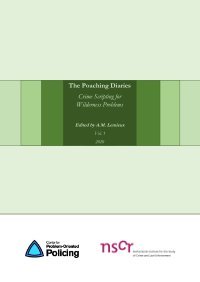
The Poaching Diaries: Crime Scripting for Wilderness Problems

Edited by A.M. Lemieux.

The Poaching Diaries is an edited collection of contributions on wildlife crime prevention and wilderness problems. It is an outlet for practitioners, policy makers, and academics to tell stories that facilitate problem-solving.

The aim of The Poaching Diaries is to present ideas that help governments and civil society diversify their approach to wildlife protection to achieve lasting impacts. The focus of this volume is crime scripting, a useful process for unpacking problems and designing clever solutions. Crime scripts are generated by developing detailed, step-by-step accounts of very specific crimes, in the specific contexts and environments where they take place. These scripts capture the full process of committing a crime, including steps taken before and after the criminal act itself. This is useful for identifying weak points in the chain of events to focus prevention strategies. For example, a subway pickpocketing event is part of a larger process, in which the offender has many decisions to make and actions to complete; one of these actions could be loitering on platforms to find victims. Looking at this stage in the crime script, a disruption strategy might focus on limiting access to subway stations for individuals without a valid ticket. This would make it harder, or at least more expensive, for pickpockets to work and therefore a less attractive environment for crime.

Phoenix, AZ: Center for Problem-Oriented Policing, Arizona State University, 2020. 126[p.

download
A Chapter on Street Nuisances

Babbage, the polymath and father of the modern computer, having designed in 1822 a Difference engine” that could mechanically compute mathematical tables of many kinds, couldn’t stand street noise, so he wrote a chapter on it. Our guess is that noise pollution has become much worse than in his day.

download