Open Access Free Library
CRIME+CRIMINOLOGY.jpeg

CRIME

Violent-Non-Violent-Cyber-Global-Organized-Environmental-Policing-Crime Prevention-Victimization

Posts in social sciences
The Crime Drop in America. Rev. ed.

By Alfred Blumstein and Joel Wallman

Violent crime in America shot up sharply in the mid-1980s and continued to climb until 1991, after which something unprecedented occurred. The crime level declined to a level not seen since the 1960s. This revised edition of The Crime Drop in America focuses first on the dramatic drop in crime rates in America in the 1990s, and then, in a new epilogue, on the patterns since 2000. The separate chapters written by distinguished experts cover the many factors affecting crime rates: policing, incarceration, drug markets, gun control, economics, and demographics. Detailed analyses emphasize the mutual effects of changes in crack markets, a major focus of youth violence, and the drop in rates of violence following decline in demand for crack. The contrasts between the crime-drop period of the 1990s and the period since 2000 are explored in the new epilogue, which also reviews major new developments in thinking about the causes and control of crime.

Cambridge, UK; New York: Cambridge University Press, 2006. 375p.

Peddling Poison: The Tobacco Industry and Kids

By Clete Snell

The social acceptance of tobacco use obscures the fact that it is the single greatest preventable cause of death in the U.S., and approximately 80% of those who use tobacco products began using them before the age of 18. Indeed, tobacco companies in the past routinely targeted youth in their marketing and advertising, hoping to hook kids young and keep them with their original brand. Snell explores the tobacco industry's campaign to attract youth smokers and provides an overview of the FDA's investigation of the tobacco industry and how those investigations revealed the industry's deceptions and their specific intent to target youths….As a result of the Master Settlement with the tobacco industry, many states have developed comprehensive programs that have resulted in a substantial decline in youth tobacco use. While national efforts at tobacco regulation have largely failed, local tobacco control efforts have mostly been successful. Snell shows that the future of youth tobacco policy depends on the continued funding of tobacco prevention programs at the state and local level and illustrates that there is considerable evidence that the tobacco industry is shifting its marketing approach to minority populations and developing nations.

Westport, CT: Greenwood Press, 2005. 188p.

Cannabis Regulation: Lessons from the illicit tobacco trade

By Benoit Gomis

Since 2013, a number of countries and local jurisdictions around the world have legalised and regulated their cannabis supply chains for non-medical use. Lawmakers, regulators, researchers, and advocates continue to design, enact, implement and revise regulatory frameworks for medical and recreational cannabis. And yet lessons from regulating other psychoactive substances, including tobacco products, are not always fully considered. The experience of the illicit tobacco trade is particularly relevant for cannabis regulation. … The global tobacco market is heavily concentrated. China, Brazil, and India accounted for 63% of all tobacco leaf cultivation in 2019 as part of a global cigarette market dominated by a small number of companies.6 China National Tobacco Corporation (CNTC) accounted for 43.9% of global cigarette retail volume in 2019 – the large majority of it is destined for domestic consumption, though the company has been developing a global expansion strategy. Beyond CNTC, Philip Morris International (PMI) (13.4% of global retail volume in 2019), British American Tobacco (BAT) (12.7%), Japan Tobacco International (JTI) (9.1%) and Imperial Brands (4.2%) accounted for 70% of the rest of the world’s market share in 2019. In contrast, cannabis can be grown indoors and therefore almost anywhere across the world. The illicit cannabis market has been characterised by a high number of small-scale growers, including for personal consumption and local distribution.

International Drug Policy Consortium, 2021. 23p.

COVID-19 and the Drug Supply Chain: from production and trafficking to use

By The United Nations Office on Drugs and Crime, Research and Trend Analysis Branch

The COVID-19 crisis is taking its toll on the global economy, public health and our way of life. The virus has now infected more than 3.6 million people worldwide, killed 250,000 and led Governments to take drastic measures to limit the spread of coronavirus disease 2019. Roughly half of the global population is living under mobility restrictions, international border crossings have been closed and economic activity has declined drastically, as many countries have opted for the closure of nonessential businesses. Drug trafficking relies heavily on legal trade to camouflage its activities and on individuals being able to distribute drugs to consumers. The measures implemented by Governments to counter the COVID19 pandemic have thus inevitably affected all aspects of the illegal drug markets, from the production and trafficking of drugs to their consumption. Having said that, the impact of those measures varies both in terms of the different business models used in the distribution of each type of drug and the approaches used by different countries to address the pandemic. These range from the closure of international border crossings, while allowing domestic travel, to moderate-to-strict shelter-in-place orders, or a complete lockdown of all activities, including suspension of essential services other than for emergencies. The impact on actual drug production may vary greatly depending on the substance and the geographical location of its production.

Vienna: UNODC Research and Trend Analysis Branch, 2020. 45p.

The Good Fight: Variations in Explanations of the Tactical Choices Made by Activists Who Confront Organized White Supremacists

By Stanislav Vysotsky

This dissertation seeks to understand the tactical differences between two groups of anti-racist activists who confront white supremacists. I dub these activists non-militant and militant anti-racists based on their tactical preferences. Non-militant anti-racists engage in what are understood to be conventional and demonstrative tactics. While militants are also likely to engage in similar tactics, their tactical repertoire also includes confrontational and violent approaches. I am particularly interested in how the two groups of activists explain the differences in their tactical choices; and therefore, posit that each group will use ideological explanations and perceptions of threat to explain their tactical choices. Using a snowball sampling methodology, I developed a sample of 24 anti-racist activists. These activists were given a quantitative survey in order to establish their tactical preference. The survey consisted of an original index developed to establish the militancy of the respondent. Survey results yielded a bi-modal distribution of scores that suggests a distinct difference in tactical preferences among anti-racist activists and confirms the categorization of activists into non-militant and militant categories. Additionally, interviews were conducted with all of the participants in order to 1) validate the results of the quantitative measure of militancy, 2) establish ideological orientation and test whether it had an influence of discussion of tactical preference, and 3) gauge the level of threat perceived and its influence on tactical preference. The results of the survey and interview data indicate distinct differences in tactical preferences between non-militants and militants.. The interview data demonstrate a clear difference in how non-militants and militants explain their tactical preferences. Non-militants adhered to a liberal ideology, but did not make explicit reference to their ideological position to explain their tactical preferences. I posit that this is a result of hegemonic dominance of liberalism.

Boston, MA: Northeastern University, 2009. 237p.

Hate Crimes: Criminal Law and Identity Politics

By James B. Jacobs and Kimberly Potter

In the early 1980s, a new category of crime appeared in the criminal law lexicon. In response to concerted advocacy-group lobbying, Congress and many state legislatures passed a wave of "hate crime" laws requiring the collection of statistics on, and enhancing the punishment for, crimes motivated by certain prejudices. This book places the evolution of the hate crime concept in socio-legal perspective. James B. Jacobs and Kimberly Potter adopt a skeptical if not critical stance, maintaining that legal definitions of hate crime are riddled with ambiguity and subjectivity. The book contends that hate crime as a socio-legal category represents the elaboration of an identity politics now manifesting itself in many areas of the law. But the attempt to apply the anti-discrimination paradigm to criminal law generates problems and anomalies. For one thing, members of minority groups are frequently hate crime perpetrators. Moreover, the underlying conduct prohibited by hate crime law is already subject to criminal punishment. Jacobs and Potter question whether hate crimes are worse or more serious than similar crimes attributable to other anti-social motivations. Advancing a provocative argument in clear and persuasive terms, Jacobs and Potter show how the recriminalization of hate crime has little (if any) value with respect to law enforcement or criminal justice. Indeed, enforcement of such laws may exacerbate intergroup tensions rather than eradicate prejudice.

Oxford, UK: Oxford University Press, 1998. 224p.

A Pound of Flesh: The Criminalization of Private Debt

By Jennifer Turner

In the first-ever report on the extent and impact of cooperation between courts and the private debt collection industry nationwide, the American Civil Liberties Union found courts in 26 states and Puerto Rico in which judges issued arrest warrants for alleged debtors at the request of private debt collectors.

This practice violates the many state and federal laws as well as international human rights standards that prohibit the jailing of debtors. It worsens their financial struggles by subjecting them to court appearances, arrest warrants that appear on background checks, and jail time that interfere with their wages, their jobs, their ability to find housing, and more.

An estimated one in three adults in the United States has a debt that has been turned over to a private collection company, according to the Urban Institute. More than 6,000 of these companies operate in the U.S. At the bidding of the private debt collection industry, courts issue tens of thousands of arrest warrants every year when people don’t appear in court to deal with unpaid civil debt judgments.

New York: The American Civil Liberties Union (ACLU), 2018. 97p.

Histories Of Transnational Crime

Edited by Gerben Bruinsma

In the past two decades, the study of transnational crime has developed from a subset of the study of organized crime to its own recognized field of study, covering distinct societal threats and requiring a particular approach. This volume provides examples of transnational crime, and places them in a broad historical context, which has so far been missing from this field of study. The contributions to this comprehensive volume explore the causes and historical precursors of six main types of transnational crime: piracy, human smuggling, arms trafficking, drug trafficking, art and antique trafficking and corporate crime. The historical contributions demonstrate that transnational crime is not a novel phenomenon of recent globalization and that, beyond organized crime groups, powerful individuals, governments and business corporations have been heavily involved.

New York: Springer, 2015. 201p.

The Enemy Within: Homicide and Control in Eastern Finland in the Final Years of Swedish Rule 1748-1808

By Anu Koskivirta—

"This work explores the quantitative and qualitative development of homicide in eastern Finland in the second half of the eighteenth century and the early years of the nineteenth. The area studied comprised northern Savo and northern Karelia in eastern Finland. At that time, these were completely agricultural regions on the periphery of the kingdom of Sweden. Indeed the majority of the population still got their living from burn-beating agriculture. The analysis of homicide there reveals characteristics that were exceptional by Western European standards: the large proportion of premeditated homicides (murders) and those within the family is more reminiscent of modern cities in the West than of a pre-modern rural society. However, there also existed some archaic forms of Western crime there. Most of the homicides within the family were killings of brothers or brothers-in law, connected with the family structure (the extended family) that prevailed in the region. This study uses case analysis to explore the causes for the increase in both familial homicide and murder in the area. One of the explanatory factors that is dealt with is the interaction between the faltering penal practice that then existed and the increase in certain types of homicide.

Helsinki: Finnish Literature Society / SKS, 2003. 217p.

Torture, Humiliate, Kill: Inside the Bosnian Serb Camp System

By Hikmet Karčić

Half a century after the Holocaust, on European soil, Bosnian Serbs orchestrated a system of concentration camps where they subjected their Bosniak Muslim and Bosnian Croat neighbors to torture, abuse, and killing. Foreign journalists exposed the horrors of the camps in the summer of 1992, sparking worldwide outrage. This exposure, however, did not stop the mass atrocities. Hikmet Karčić shows that the use of camps and detention facilities has been a ubiquitous practice in countless wars and genocides in order to achieve the wartime objectives of perpetrators. Although camps have been used for different strategic purposes, their essential functions are always the same: to inflict torture and lasting trauma on the victims. Torture, Humiliate, Kill develops the author’s collective traumatization theory, which contends that the concentration camps set up by the Bosnian Serb authorities had the primary purpose of inflicting collective trauma on the non-Serb population of Bosnia and Herzegovina. This collective traumatization consisted of excessive use of torture, sexual abuse, humiliation, and killing. The physical and psychological suffering imposed by these methods were seen as a quick and efficient means to establish the Serb “living space.” Karčić argues that this trauma was deliberately intended to deter non-Serbs from ever returning to their pre-war homes. The book centers on multiple examples of experiences at concentration camps in four towns operated by Bosnian Serbs during the war: Prijedor, Bijeljina, Višegrad, and Bileća. Chosen according to their political and geographical position, Karčić demonstrates that these camps were used as tools for the ethno-religious genocidal campaign against non-Serbs. Torture, Humiliate, Kill is a thorough and definitive resource for understanding the function and operation of camps during the Bosnian genocide.

Ann Arbor: University of Michigan Press, 277p.

Environmental Crime in the Amazon Basin: a Typology for Research, Policy and Action

By Adriana Abdenur, Brodie Ferguson, Ilona Szabo de Carvalho, Melina Risso and Robert Muggah

According to the world’s top scientific experts, deforestation and degradation are up 25 percent in the first six months compared to last year. More forests are being cleared in 2020 than at any point in the past 15 years.

Although spectacular levels of illegal burning have occupied global headlines, a host of other less visible but equally significant environmental crimes are being committed throughout the Amazon basin every day. Such crimes not only impact biodiversity and the global climate, but are virtually always associated with social ills ranging from corruption to slavery and violence.

A new paper from the Igarape Institute – Environmental Crime in the Amazon Basin: a Typology for Research, Policy and Action – introduces a typology to help better understand the scope and scale of the problem and its extensive social and environmental impacts. To date, one of the principal barriers to better policing of the Amazon is the confusion and ambiguity of what is, and is not, a crime. Different countries apply different interpretations which can frustrate investigations and the enforcement of existing laws. The new paper is designed to provide greater clarity to policy makers, law enforcement agencies, civil society actors, and companies committed to curbing environmental crime.

Rio de Janeiro - RJ - Brasil, Igarapé Institute, 2020. 29p.

The Ecosystem of Environmental Crime in the Amazon: an analysis of illicit rainforest economies in Brazil

By Laura Trajber Waisbich, Melina Risso, Terine Husek and Lycia Brasil

Researchers analyzed data from 369 the Federal Police (PF) operations carried out between 2016 and 2021

Environmental crimes are rarely committed isolated from other offenses. Amazon deforestation is not only largely illegal but also driven by a diverse array of offenders through markets contaminated with crimes that despoil the environment, such as illegal logging, illegal mining (especially gold), land grabbing and unsustainable farming. There are a wide array of violations, from environmental, to tax evasion and interpersonal violence from assault to homicide.

The document provides an overview of this biome of Amazon crimes drawn from a detailed analysis of 369 Brazilian Federal Police operations carried out between 2016 and 2021. The police operations found that organized crime was behind half of environmental crimes they investigated, while illegal possession of firearms, ammunition and explosives turned up in almost one in five police operations

The analysis also highlights another strategic failing: lack of data, institutional weaknesses and insufficient political will. All are vital to holding violators accountable for their actions, most critically when the crimes include stealing public lands for illegal farming and ranching – an important driver of illegal deforestation.

Rio de Janeiro - RJ - Brasil, Igarapé Institute, 2022. 41p.

A Shallow Flood: The Diffusion of Heroin in Eastern and Southern Africa

By Jason Eligh

The flow of heroin from Asian production points to the coastal shores of eastern and southern Africa is not new. Whereas the first heroin transit routes in the region in the 1970s relied heavily on maritime transport to enter the continent, a number of transport modes and urban centres of the interior have increasingly become important features in the current movement of heroin in this region. Interior transit hubs and networks have developed around air transport nodes that use regular regional and international connections to ship heroin. As regional air routes proliferated and became more efficient, their utility and value for the heroin trade increased as well. Heroin is also consolidated and shipped over a frequently shifting network of overland routes, moving it deeper into the African interior in a south-westerly direction across the continent.

Consequently, a shallow flood of heroin has gradually seeped across the region, and this has had a significant impact on the many secondary towns found along the continent’s transcontinental road networks. These places, in turn, have spawned their own small local heroin markets, and become waypoints in rendering sustainable the now chronic, metered progression of heroin’s resolute geographic diffusion across the region.

Geneva: Global Initiative Against Transnational Organized Crime, 2020. 100p.

Neighborhood Crime and Travel Behavior: An Investigation of the Influence of Neighborhood Crime Rates on Mode Choice – Phase II

By Christopher E. Ferrell, Shishir Mathur, Justin Meek and Matthew Piven

There are considerable environmental and public health benefits if people choose to walk, bicycle, or ride transit, instead of drive. However, little work has been done on the effects of neighborhood crimes on mode choice. Instinctively, we understand that the threats posed by possible criminal activity in one’s neighborhood can play a major role in the decision to drive, take transit, walk or ride a bicycle, but so far little empirical evidence supports this notion, let alone guides public infrastructure investments, land use planning, or the allocation of police services. This report--describing Phase 2 of a research study conducted for the Mineta Transportation Institute on crime and travel behavior--finds that high crime neighborhoods tend to discourage residents from walking or riding a bicycle. When comparing a high crime to a lower crime neighborhood the odds of walking over choosing auto decrease by 17.25 percent for work trips and 61 percent for non-work trips. For transit access to work trips, the odds of choosing walk/bike to a transit station over auto decrease by 48.1 percent. Transit trips, on the other hand, are affected by neighborhood crime levels in a similar way to auto trips, wherein high crime neighborhoods appear to encourage transit mode choice.

San Jose, CA: Mineta Transportation Institute, 2012. 104p.

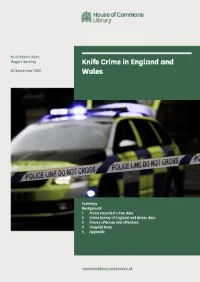
Knife crime England Wales

By Grahame Allen and Megan Harding

“Knife” crime, a crime involving an object with a blade or sharp instrument, is a persistent concern and disproportionately impacts the young and disadvantaged. Various remedies have been tried over the years. The Library Briefing Paper Knives and Offensive Weapons (SN00330) discusses the legislation which governs the carrying (possession) and sale of knives and other offensive weapons.

London: House of Commons Library, 2021. 37p.

Online Victimization: A Report on the Nation's Youth

By David Finkelhor; Kimberly J. Mitchell and Janis Wolak

In its fiscal year 1999 Appropriations Bill, the U.S. Congress directed the National Center for Missing and Exploited Children to undertake the first national survey on the risks faced by children on the Internet, focusing on unwanted sexual solicitations and pornography; in fulfilling this mandate, this report examines the problem and provides a base-line understanding of the risks in order to help policymakers, law enforcement, and families better understand the risks and respond effectively. The survey found that a large fraction of youth were encountering offensive experiences on the Internet, and the offenses and offenders were even more diverse than previously thought. Although most sexual solicitations failed, their quantity was alarming. The primary vulnerable population is teenagers…. social scientists should cooperate with Internet technologists to explore various social and technological strategies for reducing offensive and illegal behavior on the Internet. Further, laws are needed to help ensure offensive acts that are illegal in other contexts will also be illegal on the Internet

Alexandria, VA: National Center for Missing and Exploited Children, 2020. 63p.

Turning the Tide Against Online Child Sexual Abuse

By Michael Skidmore, Beth Aitkenhead and Rick Muir

The internet has enabled the production and consumption of Child Sexual Abuse Material (CSAM) on an industrial scale. It has also created new opportunities for adults to sexually abuse and exploit children. The volume of online child sexual abuse offences is now so great that it has simply overwhelmed the ability of law enforcement agencies, internationally, to respond. However, there is nothing pre-determined about this situation. Public policy can make a difference. This report looks at what can be done to help “turn the tide” on online Child Sexual Abuse (CSA). It does this by first describing the scale and nature of online CSA, second, assessing the ability of the police and law enforcement to investigate these crimes, third, by examining the service provided to victims of online CSA and, finally by looking at what more can be done to prevent online CSA in the first place.

London: The Police Foundation UK, 2022. 95p.

Increasing the Efficacy of Investigations of Online Child Sexual Exploitation: Report to Congress

By Brian Neil Levine

Nothing in history has transformed the character and practice of child sexual exploitation more than the internet. Individuals who commit child sex crimes use internet services, social networks, and mobile apps to meet minors and each other in ways they cannot in person and to groom victims by normalizing abusive sexual acts. Many of those who commit child sex crimes deceive, coerce, and sexually extort child victims with threats that too often are realized. Individuals who commit child sex crimes use the internet to arrange in-person meetings for hands-on abuse, and they use it to remotely coerce young children to selfproduce sexual and sadistic acts. Whether the abuse is hands-on or remote, the images or videos in which an individual captures their rape of a child are referred to as child sexual abuse materials (CSAM). An ever-growing set of online services are misused daily for the upload and immediate distribution of CSAM, supporting worldwide sharing. The harms to victims of child sexual abuse and exploitation are lifelong.

Bribery and Corruption: Navigating the Global Risks

By Brian Loughman and Richard Sibery

As businesses continue to expand globally into new and emerging markets, bribery and corruption risks have increased exponentially. Bribery and Corruption offers a comprehensive look at this growing problem, and at the Foreign Corrupt Practices Act (FCPA) and other international anti-bribery and corruption conventions. Presenting hypothetical examples of situations companies will face, along with practical solutions, the book offers detailed global guidance on a region and country-specific basis.

The FCPA prohibits US companies and their subsidiaries from bribing foreign officials, either directly or indirectly through intermediaries, for the purpose of obtaining or retaining business. It also requires companies to keep accurate records of all business transactions and maintain an effective system of internal accounting controls. Internationally, the Organization of Economic Cooperation and Development's (OECD's) anti-bribery convention has been adopted by 38 countries and creates legally binding standards related to bribery of foreign public officials.

Hoboken, NJ: Wiley, 2012. 417p.

Ransomware. Defending Against Digital Extortion

By Allan Liska and Timothy Gallo

The biggest online threat to businesses and consumers today is ransomware, a category of malware that can encrypt your computer files until you pay a ransom to unlock them. With this practical book, you'll learn how easily ransomware can infect your system and what steps you can take to stop the attack before it sets foot in your network. Security experts Allan Liska and Timothy Gallo explain how the success of these attacks has spawned not only several variants of ransomware, but also a litany of ever-changing ways they're delivered to targets. You'll learn pragmatic methods for responding quickly to a ransomware attack, as well as how to protect yourself from becoming infected in the first place"

Sebastopol, CA: O'Reilly Media, 2017. 174p.