Open Access Publisher and Free Library
Fiction+Mediajpg.jpg

FICTION and MEDIA

CRIME AND MEDIA — TWO PEAS IN A POD

Posts tagged Australian history
Dr. NIKOLA - The Complete Saga: Volume 2


by Guy Boothby (Author), Graeme Newman (Editor), Colin Heston (Introduction)

. When the enigmatic Dr. Nikola first stepped onto the literary stage in 1895, clutching his sinister black cat Apollyon and weaving schemes that stretched from the back alleys of Shanghai to the hidden monasteries of Tibet, he didn't just capture the Victorian imagination—illegally or otherwise, he colonized it.
These volumes bring together, for the first time in a single definitive collection, the complete saga of Dr. Nikola: A Bid for Fortune, Dr. Nikola, The Lust of Hate, Dr. Nikola’s Experiment, and Farewell, Nikola. To read them in succession is to witness the birth of the modern "super-villain" and to appreciate the unique, rugged perspective Boothby brought to the crowded field of late-Victorian sensation fiction.
Born in Adelaide in 1867, Guy Newell Boothby was the son of a prominent South Australian parliamentarian. While he eventually found fame in the drawing rooms of London, his formative years were spent in the wide-open, often unforgiving landscapes of the Australian colonies.
In the 1890s, the literary world was reeling from "Sherlock-mania." While Sir Arthur Conan Doyle gave the world the ultimate champion of logic, Boothby gave it the ultimate agent of chaos. Dr. Nikola is not merely a criminal; he is a polymath, an occultist, and a man of immense physical and intellectual magnetism.
Across these five novels, we see Nikola evolve:
Volume 1:
A Bid for Fortune (1895): We are introduced to the Doctor through the eyes of Richard Hattasall. Here, Nikola is a vengeful shadow, a man whose "vendetta" drives a globe-trotting chase.
Dr. Nikola (1896): Arguably the centerpiece of the series, Boothby takes us into the forbidden heart of Tibet. It remains one of the finest examples of the "Lost World" genre, enriched by Stanley L. Wood’s iconic illustrations.
The Lust of Hate (1898): A darker, more psychological turn where Nikola manipulates a broken man’s desire for revenge.
Volume 2
Dr. Nikola’s Experiment (1899): Here, Boothby touches on the "mad scientist" tropes that would later define 20th-century sci-fi, as Nikola attempts to conquer death itself.
Farewell, Nikola (1901): The swan song of the character, providing a sense of closure to a man who lived his life in the liminal space between genius and madness.
Guy Boothby died tragically young at the age of 37, leaving behind a staggering 53 novels written in just over a decade. For years, his work languished in the shadows of more "academic" Victorian literature. However, as these works have entered the public domain, a new generation of readers—and editors—has rediscovered the sheer, unadulterated joy of his storytelling.
Boothby’s Dr. Nikola remains a vital link in the evolution of popular fiction. Without Nikola, would we have Sax Rohmer’s Fu Manchu? Would we have the sophisticated antagonists of James Bond? Probably not. By centering this edition on Boothby’s Australian roots, we acknowledge that the "King of Sensation" wasn't just a product of London’s Fleet Street, but a traveler of the world who brought the wild energy of the Antipodes to the heart of the Empire. This collection aims to preserve the thrill of the original serialization while providing the context necessary for a modern reader. As you follow the Doctor through the mist-shrouded streets of London and the sun-bleached ports of the Pacific, remember that you are in the hands of a master who knew those ports firsthand.
Welcome to the world of Dr. Nikola. Tread carefully—Apollyon is watching!

Read-Me.Org Inc. New York-Philadelphia-Australia. 2026. 292p.

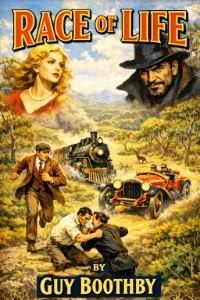
The Race of Life

By Guy Boothby. Introduction by Colin Heston.

In the unforgiving expanse of the Australian outback, where the line between fortune and ruin is as thin as a shadow on the sand, the race for survival is never-ending. Guy Boothby’s pulse-pounding tale follows the odyssey of a man driven by ambition and haunted by the specters of his past, thrust into a world where the elements are as treacherous as the men who inhabit them. From the sweat-soaked cattle runs of the bush to the high-stakes tension of the burgeoning colonial cities, this is a story of grit, reinvention, and the relentless pursuit of a legacy.

As the old world’s certainties crumble in the face of a wild, new frontier, the struggle for dominance becomes a trial of the soul. In a landscape that promises everything to the bold and nothing to the weak, can a man outrun his history, or will the "race of life" ultimately claim him? Boothby, the master of Edwardian adventure, delivers a visceral masterwork of high drama and rugged suspense that captures the raw, beating heart of a continent in the making.

Read-Me.Org Inc. New York-Philadelphia-Australia. 2026. 209p.

Adventures Of An Outlaw: Abridged, simplified and readable

By Colin Heston (Author), James Tucker (Author), Ralph Rashleigh (Contributor)

This compelling narrative offers a vivid portrayal of the convict experience in early colonial Australia. The book, first published in 1929, is attributed to James Tucker, who wrote under the pseudonym Ralph Rashleigh. This introduction by Colin Heston aims to provide an overview of the book’s themes, historical context, and its significance in Australian literature. The story is set during a tumultuous period in Australian history when the continent was used as a penal colony by the British Empire. From 1788 to 1868, over 160,000 convicts were transported to Australia, fundamentally shaping the social and cultural landscape of the emerging nation. “Adventures of an Outlaw” provides a firsthand account of this era, detailing the harsh realities faced by convicts and the brutal conditions of the penal system. James Tucker, the presumed author, was himself a convict transported to Australia for forgery. His experiences and observations lend authenticity to the narrative, making it a valuable historical document. The book offers insights into the daily lives of convicts, their interactions with authorities, and their struggles for survival and dignity in an unforgiving environment. This abridged edition simplifies the narrative and corrects the many quaint spellings and expressions while keeping the essential facts and challenging experiences that challenged Rasjleigh's resilience and determination to find freedom.

First published in 1929 by Jonathan Cape and Harrison Smith1. The memoir, attributed to the pseudonym Ralph Rashleigh, is actually the work of James Rosenberg Tucker. This abridged edition Read-Me.Org Inc. 2025. 105p.