Open Access Free Library
Fiction+Mediajpg.jpg

FICTION and MEDIA

CRIME AND MEDIA — TWO PEAS IN A POD

Posts in historical fiction
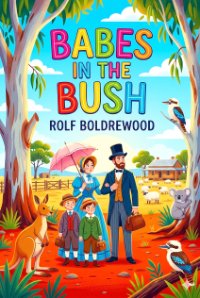
BABES IN THE BUSH

By Ronf Boldrewood

Imagine, if you will, the jarring transition of a family trading the velvet curtains and manicured gardens of an English manor for the sun-scorched, eucalyptus-scented vastness of the Australian interior. This is the heart of Rolf Boldrewood’s 1900 novel, Babes in the Bush, a sprawling narrative that serves as both a romantic adventure and a gritty survival manual for the Victorian era. While Boldrewood is often immortalized for the bushranging exploits of Captain Starlight in Robbery Under Arms, this particular work offers a more domestic, yet no less perilous, look at the "squatting" life—the high-stakes gamble of pastoral farming in the 19th-century colonies.

The story centers on the Effinghams, an aristocratic family whose financial foundation has crumbled beneath them in England. Facing the social death sentence of genteel poverty, they choose a path of radical reinvention: migrating to New South Wales to rebuild their dynasty. The title itself is a clever literary allusion to the old English folk tale "Babes in the Wood," but here, the "woods" are the unforgiving Australian scrub, and the "babes" are sophisticated adults and their children who are utterly illiterate in the language of the frontier. They are innocents abroad, armed with nothing but their British pluck and a very expensive, very impractical education.

What makes this introduction to colonial life so compelling is the man behind the pen. Rolf Boldrewood was the pseudonym for Thomas Alexander Browne, a man who didn't just write about the bush—he lived it. Having served as a police magistrate and a "squatter" (a settler who occupied large tracts of Crown land for grazing), Browne understood the soul-crushing weight of a three-year drought and the chaotic adrenaline of a cattle muster. His prose is thick with the authority of someone who has actually tasted the dust. When he describes the logistical nightmare of moving thousands of sheep across a dry plain or the specific architecture of a bark-roofed homestead, he isn't guessing; he’s reporting from the front lines of history.

However, it would be a disservice to the modern reader to ignore the specific "Victorian lens" through which this story is told. Boldrewood was a product of his time, and his writing is steeped in the ideology of Empire. The Australian landscape is frequently portrayed as a wild, "untamed" canvas waiting for the brush of British civilization to give it meaning. You will find a fascinating, if sometimes uncomfortable, tension between the family's desire to maintain English social hierarchies and the rugged, egalitarian reality of the Australian bush where a man’s worth is measured by his ability to track a stray bull rather than his family crest.

The novel also provides a window into the complex social ecosystem of the frontier. It isn't just the Effinghams vs. Nature; it is a world populated by "currency lads" (Australian-born whites), hardworking immigrants, and the Indigenous people whose land was being transformed. While Boldrewood’s depictions of Indigenous Australians are undeniably colonial and reflect the prejudices of the 1900s, they offer a stark, honest look at the mindset that drove the pastoral expansion. It is a story of resilience and adaptability, showing how the harshness of the Australian sun slowly bakes away the "Englishness" of the characters, leaving behind something harder, leaner, and distinctly Australian.

As you step into the world of the Effinghams, expect a narrative that moves with the slow, deliberate pace of a bullock team. It is a book of grand landscapes, sudden dangers, and the quiet triumph of building a home where none existed before. It remains a cornerstone of Australian colonial literature because it captures that pivotal moment when the Old World collided with the New, and the "Babes" either learned to walk the bush or were swallowed by it.

Read-Me.Org Inc. New York-Philadelphia-Australia. 2026. 353p.

A Colonial Reformer

By Rolf Boldrewood

A Colonial Reformer delves deep into the life of an unsung hero of colonial America. Through meticulous research and insightful analysis, this book brings to light the struggles and triumphs of a visionary figure who challenged the status quo and paved the way for change. Readers will be captivated by the story of a man ahead of his time, whose unwavering dedication to reform reshaped the course of history. A compelling narrative that sheds light on a forgotten chapter of America's past, A Colonial Reformer is a must-read for anyone interested in the untold stories of courage and perseverance.

Macmillan and Company, 1891, 518 pages

A Modern Buccaneer Vol. 3

BY Rolf Boldrewood

A Modern Buccaneer Vol. 3 continues the thrilling adventures of Captain Lucas Black and his intrepid crew as they navigate the treacherous waters of the Caribbean in search of lost treasure and high-seas intrigue. In this latest installment, Captain Black faces his greatest challenge yet as he squares off against a formidable rival and uncovers long-buried secrets that threaten to upend everything he holds dear. With pulse-pounding action, unexpected twists, and a cast of colorful characters, this captivating tale of piracy, betrayal, and redemption will keep readers on the edge of their seats until the very last page. Join Captain Black on his daring quest in A Modern Buccaneer Vol. 3 and set sail for adventure like never before.

Macmillan and Company, 1894, 298 pages

A Modern Buccaneer Vol. 2

BY ROLF BOLDREWOOD

Step into a thrilling world of high-seas adventure and daring exploits with "A Modern Buccaneer Vol. 2." In this riveting sequel, Captain Morgan embarks on a new series of treacherous voyages, facing formidable foes and unexpected challenges at every turn. As alliances are tested and secrets are revealed, readers will be swept away on a pulse-pounding journey filled with twists and turns. With vivid storytelling and vibrant characters, this book is a must-read for fans of action-packed tales of the sea. Join Captain Morgan on another epic escapade in "A Modern Buccaneer Vol. 2."

Macmillan, 1895, 245 pages

A Modern Buccaneer Vol.1.

By Rolf Boldrewood

"A Modern Buccaneer Vol.1" invites readers on an exhilarating voyage across the high seas of the 21st century. This captivating novel follows the daring exploits of Captain James Reynolds, a charismatic and enigmatic figure who navigates the complex waters of modern-day piracy. From heart-pounding heists to unexpected alliances, readers will be swept away by the thrilling adventures of Captain Reynolds and his crew as they challenge the conventions of traditional piracy in a contemporary setting. With its blend of action, intrigue, and unexpected twists, "A Modern Buccaneer Vol.1" is a must-read for fans of swashbuckling tales and high-stakes adventure."

Macmillan, 1894, 247 pages

Hitler's Niece

USED BOOK. MAY CONTAIN MARK-UP

By Ron Hansen

"Scrupulously researched. Hansen's informed interpretation of events makes convincing, if melancholy, reading." -Boston Sunday Globe

"A novel that reads like history." -Austin American-Statesman,

"A carefully crafted and distinctly macabre work of fiction." -Village Voice

"Hansen has written a convincing novel that is provocative, disturbing, and illuminating." -Raleigh News & Observer

"Hansen is a fearless storyteller. . .. [He] creates a savagely human portrait of Hitler. . .. [Hitler's Niece] reads, like all good books, as a vehicle for the writer's obsession--an intelligent, haunting, an‹ oddly devotional exploration of the unimaginable Hitler in love. -BookForum

NY. Perennial. 1999. 321p.

Claudius the god and his wife Messalina

USED BOOK. MAY CONTAIN MARK-IP

By Robert Graves

“The troublesome reign of Tiberius Claudius Caesar, emperor of the Romans (born 10 b.c., died a.d. 54), as described by himself; also his murder at the hands of the notorious agrippin a (mother of the emperor nero) and his subsequent deification, as described by others.”

NY. Vintage Random House. 1962. 584p.

The Agony and the Ecstasy: A Biographical Novel of Michelangelo

USED BOOK. MAY CONTAIN MARK-UP

By Irving Stone

FROM THE COVER: “Set in the days of the deadly Borgias, the warring popes and the mighty Medicis, this is the truly great novel of Michelangelo, his lifelong friendships, his passionate loves and his unquenchable genius. ….

"Irving Stone has painted the portrait of a supreme craftsman, one of the most versatile artists of all time, and he has also laid before us a cyclorama of one of the world's most astounding ages." New York Times

NY. Fontana books. 1970. 786p.

Jefferson: A Novel

USED BOOK. MAY CONTAIN MARK-UP

By Max Byrd

FROM THE COVER: “It is 1784, and Jefferson, the newly appointed American ambassador to the court of Louis XVI and Marie-Antoinette, has just arrived in Paris-a city adrift in intrigue, upheaval, and temptation that will challenge his principles, incite his passions, and change Thomas Jefferson forever.... Through the eyes of his impressionable young secretary, William Short, we watch as the future president builds his dream of an America with fellow patriots John Adams and Ben Franklin, and as he struggles between political ambition and an unexpected crisis of the heart with a woman who has the power to destroy him. And we discover-behind the face the complex Virginian shows the world -an enigmatic statesman who fights for individual liberty even as he keeps slaves, who champions free will even as he denies it to his daughters, and who holds men to the highest standards of honor-even as he embarks on a shadowy double life of his own.”

"A Novel To Be Admired And Enjoyed,The Best Fictionalized Life Of Jefferson Yet!' -Jack McLaughlin,

NY. Bantam. 1994. 470p.

Susan Pulls The Strings

USED BOOK. MAY CONTAIN MARK-UP

By Jane Shaw

FROM THE COVER FLAP: “It was Imposible for Susan, when she knew someone was needing help, not to do something about it. This incurable habit of hers led her into m any awkward situations when she was staying over Christmas with her cousins, the Carmichaels. Charlotte, Midge and Bill all assured her that they would really prefer her t o stop trying to put everything right, but Susan persisted, and proved, in an exciting climax, that her interference wasmore than justified. Jane Shaw's lively sense of humour makes this a very engaging tale; from Susan herself to the " Plum * and Chang the cat, the characters are real, and your interest in them will be kept and held from the first to the last page…”

London. Children’s Press. 1950. 188p.

Schoolgirl Reporter

USED BOOK. MAY CONTAIN MARK-UP

By Constance M. White

From the cover: “With a father who is a well. known newspaper man and an elder sister a junior reporter, it is hardly surprising that Laurel Chester considers that she had definitely inherited the "Chester nose for news" Andno sooner has she decided to edit the Fourth Form magazine, than things begin to happen which exer- cise all her ingenuity. To begin with, there is the empty man- s i o n next door. Why does nobody live there and why does it intrigue Laurel so much? And what are the activities of the strange old man in the long black cloak? As for the mistress, Miss James, her behaviour, to say the least of it, is distinctly odd. Other events complicate Laurel's detective work even further ….”

London. Hutchinson Co. 1950s. 235p.

Wolf Hall: A Novel

USED BOOK. MAY CONTAIN MARK-UP

By Hilary Mantel

FROM CHAPTER 1:

“So now get up."

Felled, dazed, silent, he has fallen; knocked full length on the cobbles of the yard. His head turns sideways; his eyes are turned toward the gate, as if someone might arrive to help him out. One blow, properly placed, could i kill him now. Blood from the gash on his head--which was his father's first effort is trickling across his face. Add to this, his left eye is blinded; but if he squints sideways, with his right eye he can see that the stitching of his father's boot is unraveling. The twine has sprung clear of the leather, and a hard knot in it has caught his eyebrow and opened another cut.”

NY. Henry Holt and Company. 2009. 548p.

The Lost Stradivarius

By John Meade Falkner

Edited with an Introduction by Edward Wilson who notes: “The detailed apparatus to this edition has been demanded not only by Time, which has altered not just the senses of words but a whole cultural hinterland beyond a modern reader's recognition, but by Falkner himself, who delighted in sowing his novel with literary and antiquarian allusions. Indeed, a character, Mr Gaskell, in The Lost Stradivarius itself, when reading an eighteenth-century diary in pursuit of highly sensational matter cannot resist telling us that "the minute details given were often of high antiquarian interest'“

London. Oxford University Press. 1954. (1895). USED BOOK. CONTAINS MARK-UP.

The Song Of Achilles

By Madeline Miller

FROM USA TODAY: “"It takes a truly gifted writer to make a song this old feel this beauti- fully new. What's startling about this sharply written, cleverly reimagined, enormously promising debut novel from Madeline Miller is how fresh and moving her take on the tale is--how she has managed to bring Achilles and his companion Patroclus to life in our time without removing them from their own."

NY. Harper Collins. 2012. 426p. USED BOOK. CONTAINS MARK-UP

The First Man of Rome

By Colleen McCullough

FROM THE COVER: “The publication thirteen years ago of Birds was a landmark event, a remarkable achievement now surpassed by a novel in which storytelling and scholarship combine to bring to life one of history's most important epochs. The First Man in Rome sweeps the reader into an irresistibly vivid world of political intrigue, danger, wars, assassinations, devas- tating upheaval, intricately passionate family alliances and rivalries - and undeniable reality. It is New Year's Day of 110 B.C., and two of the latest in a long line of noble Roman mediocrities are assuming the coveted mantle of consul. But among those watching are two very different men, men whose vision, ruthlessness, and courage will force shattering change upon the Roman Republic, strug- gling to cope with mushrooming territorial possessions and the growing resentment of the Italians it treats as third-class citizens. One of these two men is Marius, a wealthy rustic barred by his low birth from grasping his prophesied destiny, to become the First Man in Rome- he who stands above all his peers through sheer excellence. The second is (continued on back flap)…..”

NY. William Morrow and Company, Inc. 1960. 897p. USED BOOK CONTAINS MARK-UP

The Other Queen

By Phillippa Gregory

London. Harper Collins. 2009. 491p.

"The Other Queen" is a historical fiction novel by Philippa Gregory, published in 2008. The book is set in 16th century England and Scotland, and tells the story of Mary, Queen of Scots, who is imprisoned by her cousin Queen Elizabeth I of England.

The novel is told from the perspective of three women: Mary, Queen of Scots; Elizabeth Talbot, Countess of Shrewsbury; and Georgiana, Duchess of Bedford. Elizabeth Talbot is charged with the care of Mary during her imprisonment and becomes her confidante, while Georgiana is a friend of Elizabeth I who becomes involved in the political intrigues surrounding Mary's imprisonment.

"The Other Queen" is a richly detailed and meticulously researched work of historical fiction that offers a compelling glimpse into the lives of the powerful women who shaped 16th century England and Scotland. Gregory's prose is vivid and engaging, and her characters are complex and nuanced, with their own desires, fears, and motivations.

The Queen's Fool

By Phillippa Gregory

NY. Touchstone. 2004. 512p.

"The Queen's Fool" is a historical fiction novel by Philippa Gregory, first published in 2003. The book is set in England in the 16th century, during the reigns of King Henry VIII and Queen Mary I, and tells the story of a young girl named Hannah Green who becomes a servant in the royal court.

Hannah is a gifted "fool," a type of entertainer who uses jokes and acrobatics to amuse the court. She catches the eye of Queen Mary, who takes her under her wing and makes her a trusted confidante. But as Hannah gets caught up in the political machinations of the court, she must navigate dangerous alliances and protect herself from those who would do her harm.

"The Queen's Fool" is a well-researched and engaging work of historical fiction that offers a window into the complex and turbulent world of Tudor England. Gregory's prose is vivid and evocative, and her characters are richly drawn and memorable. The book offers a fresh perspective on well-known historical figures, such as King Henry VIII and Queen Mary I, and provides a compelling glimpse into the lives of the ordinary people who served them.

Silas Marner. The Lifted Veil. Brother Jacob.

By George Eliot III

Silas Marner is George Eliot's (1819-1880) short novel of 1861, in which the protagonist is obliged to leave his small religious community after being falsely accused of theft. He settles in Raveloe, where he works diligently as a weaver for 15 years and manages to accumulate and hoard a substantial amount of gold.
“The Lifted Veil” concerns themes of fate, extrasensory perception, the mystery of life and life after death. Eliot's interest in these themes stemmed partly from her own struggles with religious faith, as she was an extremely devout Christian as a child and young adult who later renounced Christianity completely. “Brother Jacob'“raises issues of perennial concern to George Eliot as an author who was also a woman. In particular, this fabular tale about a hapless confectioner and his imbecilic broth- er exposes the pitfalls in women's relationship(s) to cultural authority, 'the strange bright fruits of knowledge' (Woolf 160). As a fable whose hero is distinguished by fraudulence and guile, 'Brother Jacob' reflects its author's attitude towards plagiarists and other impostors with pre- tensions to authorship. Even as Marian Evans disguised herself as George Eliot, the 'silly lady novelist' of her day is disguised in the story's protagonist, David Faux.

London. Oxford University Press. 1861., 1859, 1860. 318p.

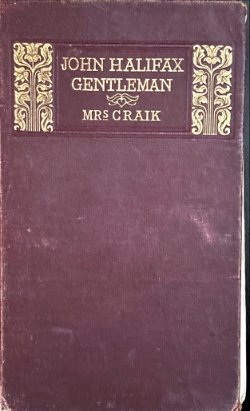
John Halifax, Gentleman

By Mrs. Craik.

The action is centred on the town of Tewkesbury, scarcely disguised by the fictional name Norton Bury, in Gloucestershire. The story is narrated by Phineas, a friend of the central character. John Halifax is an orphan, determined to make his way in the world through honest hard work. He is taken in by a tanner, Abel Fletcher, who is a Quaker, and thus meets Phineas, who is Abel's son. John eventually achieves success in business and love, and becomes a wealthy man. (Wikipedia)

London: Ward, Lock and Co. 1856. 449p.