


By Konrad Buczkowski, Paulina Wiktorska
This book presents a synthesis of selected trends in the dynamics and structure of crime in Poland over the past 30 years, in the context of ongoing social transformations in the wider region. The book explores
the impact of the deep systemic transformation of the late 1980s and early 1990s on the phenomenon of crime, its structure and dynamics, and the policy of its control in the following decades. It also examines the impact of changes resulting from the dynamic development of Polish society in the 21st century in the context of global changes towards the emergence of a new form of collective life, a mobile information society based on modern technologies. The focus is primarily on those deviant behaviours that can most obviously be linked to social changes, primarily political, economic, legal, and technological. The work examines disclosed crime figures available in official statistics. It also looks to the future considering the global societal changes caused by the outbreak of the COVID-19 pandemic. Based on preliminary observations made in selected
countries, the authors describe associated changes in criminal behaviour and identify some pivotal developments that may influence future trends. The book will be of interest to academics and researchers working in the areas of criminal law, criminology, sociology and criminal policy.
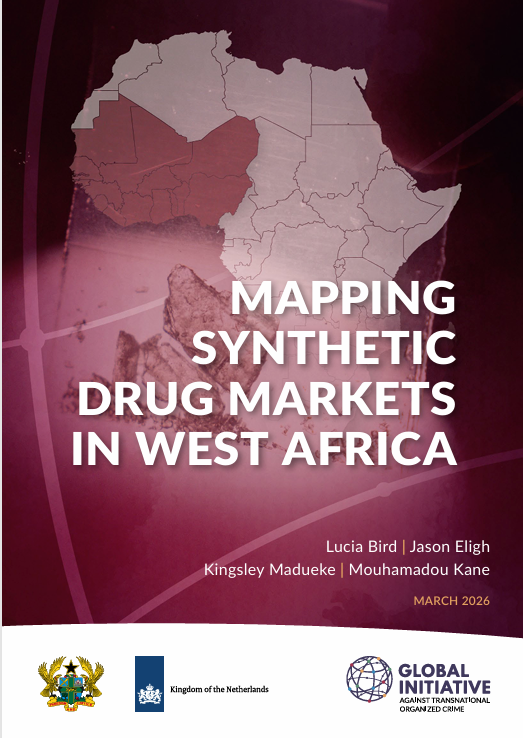
By Lucia Bird | Jason Eligh, Kingsley Madueke | Mouhamadou Kane
The proliferation of synthetic drugs across West Africa potentially represents one of the most urgent and complex public health and security challenges facing the region. In recent years, the illicit drug landscape has been fundamentally reshaped, moving away from traditional plant-based substances controlled by hierarchical criminal networks towards a fragmented, decentralized market for man-made psychoactive compounds. The harms driven by the synthetic drug market – overdoses, chronic health conditions, severe mental health conditions, community fragmentation – are escalating. Consumption, and consequences, are concentrated in the youth: in the worst-affected countries this poses a serious threat to future stability and economic development. The effects of synthetic drugs in parts of West Africa have become so severe that since 2024 two countries have declared states of emergency – an unprecedented response previously reserved for deadly epidemics and pandemics.1 This report examines the emergence and rapid expansion of this synthetic drug economy in West Africa, detailing how factors such as low barriers to entry, the convenience and anonymity afforded by the proliferation of online platforms and technology, and the minimal capital required for production have enabled a diverse array of new criminal actors to enter the trade. The subsequent influx of substances such as synthetic cannabinoids, nitazenes and other novel compounds of unknown composition, and the expansion of pre-existing synthetic drug markets such as methamphetamine, present a multifaceted threat that is rapidly outpacing the response capacity of regional governments. The breadth and depth of synthetic substance presence globally has grown enormously over the past decade. Increasingly, synthetic substances are being detected in local illicit drug markets that have no prior record of their presence, often being identified as contaminants of, or unknown substitutes for, other more traditional substances. Expanding use of synthetic opioids, particularly tramadol, tramadol derivatives (most prominently tapentadol) and nitazenes in West Africa, is a particularly alarming trend within this growing illicit drug marketplace. These substances, some vital to public health institutions for pain relief and palliative care purposes, have been responsible for a significant increase in drug-related morbidity and mortality worldwide. Their potency and availability pose unprecedented challenges to public health systems and law enforcement agencies alike.
The sheer diversity of substances being synthesized, the inability of existing surveillance systems to effectively identify many of them, and the challenge of interdicting and mitigating their harms significantly impairs the ability of health and security services to respond. Further, the intersection of synthetic drug markets with other illicit activities further complicates efforts to address these challenges effectively. Organized criminal networks leverage the profits generated from synthetic drug production, trafficking and distribution to fund their criminal operations and purchase protection, driving corruption. The report explores the mechanisms driving this rapid expansion in synthetic drug markets in West Africa, analyzing the critical roles of digital technology and globalized supply chains. It looks at how internet penetration across the region has facilitated growth in the online purchase of precursor chemicals and finished products, often from suppliers in Asia and Europe, which are smuggled into the region through difficult-to-monitor channels such as postal and courier services. The report discusses the profound economic incentives that make the synthetic drug trade so attractive, functioning as a ‘bridge’ market that allows new entrants to accumulate capital rapidly. By examining case studies and discussing market trends, the report illustrates how these dynamics have allowed synthetic drugs to capture a growing share of the retail market with alarming speed, potentially leading to devastating social and public health consequences.
Geneva: Global Initiative Against Transnational Organized Crime. 2026. 47p.
By D.J. Summers
in the past five years, Colorado’s largest cities have had very different experiences of crime.
Colorado’s violent and property crime rates rose sharply in the early 2020s, prompting varying responses from leaders at state and local levels. Some have been more successful than others, according to the most recently available Colorado Bureau of Investigation data.
CSI analyzed the violent and property crime trends of Colorado’s ten largest cities: Denver, Colorado Springs, Aurora, Fort Collins, Lakewood, Thornton, Arvada, Westminster, Pueblo, and Centennial. These ten cities represent just under half the state’s total population, with a combined population of roughly 2.3 million residents. CSI analyzed the average violent and property crime rates per 100,000 people through the first two quarters of each year between 2016 and 2025. Pueblo’s police data is not current and could not be included in the analysis.
Property and violent crime cost the state $27 billion in economic losses in 2022 between the tangible and intangible effects of reported and unreported crime. It is imperative that public leaders continually examine and understand which policies best address crime rates.
Key Findings
Denver’s violent crime rate is the highest among Colorado’s largest cities, with 235 violent crimes per 100,000 people.
Aurora’s is second highest, with 203 violent crimes per 100,000 people.
Aurora’s violent crime has remained beneath Denver’s for three years, breaking the trend of the late 2010s and early 2020s in which Aurora’s rates were higher.
Only Colorado Springs saw an increase in the violent crime rate between 2022 and 2025.
Among the largest cities, Aurora saw the sharpest decrease in violent crime rate.
Aurora saw the second highest decrease in violent crime rate, with a 36% decrease.
Denver has the highest property crime rate of Colorado’s largest cities, with 1,122 property crimes per 100,000 people.
Lakewood has the second highest rate, with 1,099 per 100,000 people.
Aurora and Centennial had the sharpest decreases in property crime rate since 2021, at 56%, 49%, and 44%, respectively.
By Marilyn FREEMAN
Cross-border parental child abductions in the EU are governed by The 1980 Hague Convention on the Civil Aspects of International Child Abduction and (except for Denmark) the Brussels II-ter Regulation. Countries outside of the EU may or may not be Contracting States to ‘the Convention’, but will not be bound by Brussels II-ter. Research has found that the often negative, long-lasting impact of abduction may continue throughout the lifecycle of those who have been abducted. It may also affect future generations of society. This means that every effort to deter abduction should be made. Where that is not possible, the 1980 Hague Child Abduction Convention should be nurtured to support its application in contemporary society. Specialist mediation should be encouraged in relation to international child abduction generally, and specifically in relation to Third Countries which are not Contracting States to ‘the Convention’. This study was commissioned by the European Parliament’s Policy Department for Citizens’ Rights and Constitutional Affairs at the request of the JURI Committee.
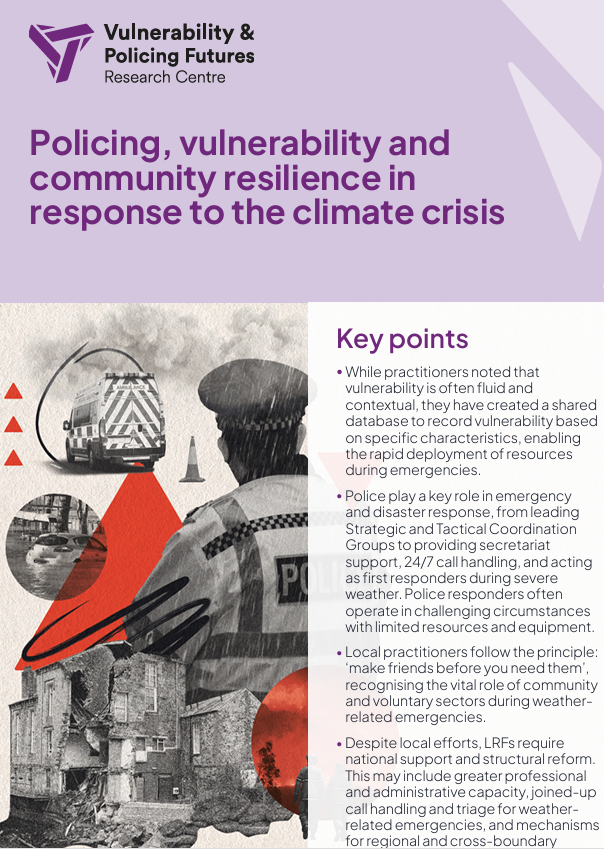
By Ali Malik
The increasing frequency and severity of extreme weather events in the UK, such as storms, flooding, heatwaves, and severe cold spells, recognised as consequences of the climate crisis, have placed significant operational and organisational pressures on police, emergency responders and local authorities. This research adopts an in-depth qualitative case study design and a temporal analogues approach, which draws on past experiences and events to develop an understanding of the present and inform future learning. Doing this provides insights into the role of the police and Local Resilience Forums (LRFs) in preparing for and responding to extreme weather eventsThe findings highlight that LRFs are essential for locally led emergency planning. However, due to resource constraints, these partnerships often rely on relational capital, negotiated agreement and goodwill. Decisive leadership, situational awareness, experience from past events and routine work were also described as key factors for effective emergency response. LRFs cannot mitigate the impacts of the climate crisis without national support. Local preparedness depends on safe homes, green spaces, reliable transport networks and affordable clean energy. The research also points to the need for greater professional, analytical, and specialist support for LRFs, along with targeted funding to resource localised efforts for preparedness, recovery, and long-term climate adaptation.
By William Downs
Police misconduct is behaviour by a police officer that falls below the standards of professional behaviour for the police.
Cases of police misconduct can arise from concerns raised by police officers or staff, or following incidents where members of the public have been harmed by the actions of the police.
What are the laws on police misconduct?
Legislation specifies how allegations of police misconduct should be handled, though the framework is complex. In short, most allegations of police misconduct are handled in line with rules set out in the Police Act 1996 and Police (Conduct) Regulations 2020. This legislation is designed to support the police in maintaining a disciplined force. The Home Office provides statutory guidance on implementing this legislation.
London: UK Parliament, House of Commons Library, 2025. 23p.