Open Access Publisher and Free Library
CRIME+CRIMINOLOGY.jpeg

CRIME

Violent-Non-Violent-Cyber-Global-Organized-Environmental-Policing-Crime Prevention-Victimization

Posts tagged drug possession
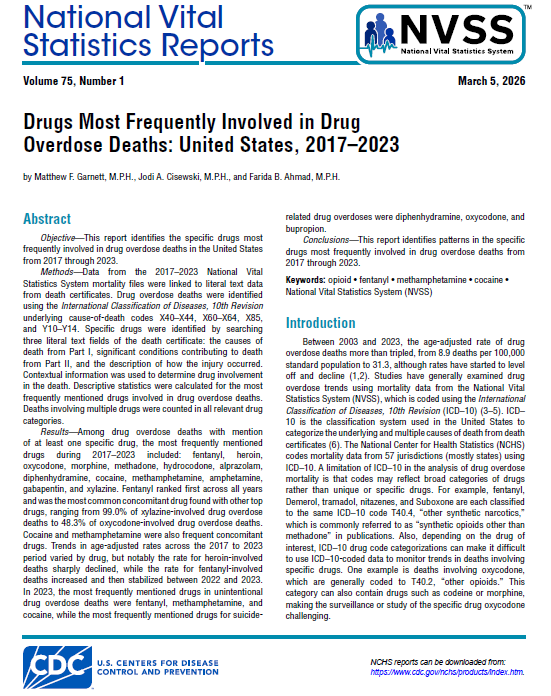
Drugs Most Frequently Involved in Drug Overdose Deaths: United States, 2017–2023

By Matthew F. Garnett, Jodi A. Cisewski, Farida B. Ahmad

Objective:

This report identifies the specific drugs most frequently involved in drug overdose deaths in the United States from 2017 through 2023.

Methods:

Data from the 2017–2023 National Vital Statistics System mortality files were linked to literal text data from death certificates. Drug overdose deaths were identified using the International Classification of Diseases, 10th Revision underlying cause-of-death codes X40–X44, X60–X64, X85, and Y10–Y14. Specific drugs were identified by searching three literal text fields of the death certificate: the causes of death from Part I, significant conditions contributing to death from Part II, and the description of how the injury occurred. Contextual information was used to determine drug involvement in the death. Descriptive statistics were calculated for the most frequently mentioned drugs involved in drug overdose deaths. Deaths involving multiple drugs were counted in all relevant drug categories.

Results:

Among drug overdose deaths with mention of at least one specific drug, the most frequently mentioned drugs during 2017–2023 included: fentanyl, heroin, oxycodone, morphine, methadone, hydrocodone, alprazolam, diphenhydramine, cocaine, methamphetamine, amphetamine, gabapentin, and xylazine. Fentanyl ranked first across all years and was the most common concomitant drug found with other top drugs, ranging from 99.0% of xylazine-involved drug overdose deaths to 48.3% of oxycodone-involved drug overdose deaths. Cocaine and methamphetamine were also frequent concomitant drugs. Trends in age-adjusted rates across the 2017 to 2023 period varied by drug, but notably the rate for heroin-involved deaths sharply declined, while the rate for fentanyl-involved deaths increased and then stabilized between 2022 and 2023. In 2023, the most frequently mentioned drugs in unintentional drug overdose deaths were fentanyl, methamphetamine, and cocaine, while the most frequently mentioned drugs for suicide-related drug overdoses were diphenhydramine, oxycodone, and bupropion.

Conclusions:

This report identifies patterns in the specific drugs most frequently involved in drug overdose deaths from 2017 through 2023.National Vital Statistics Reports; CDC National Center for Health Statistics; 2026.

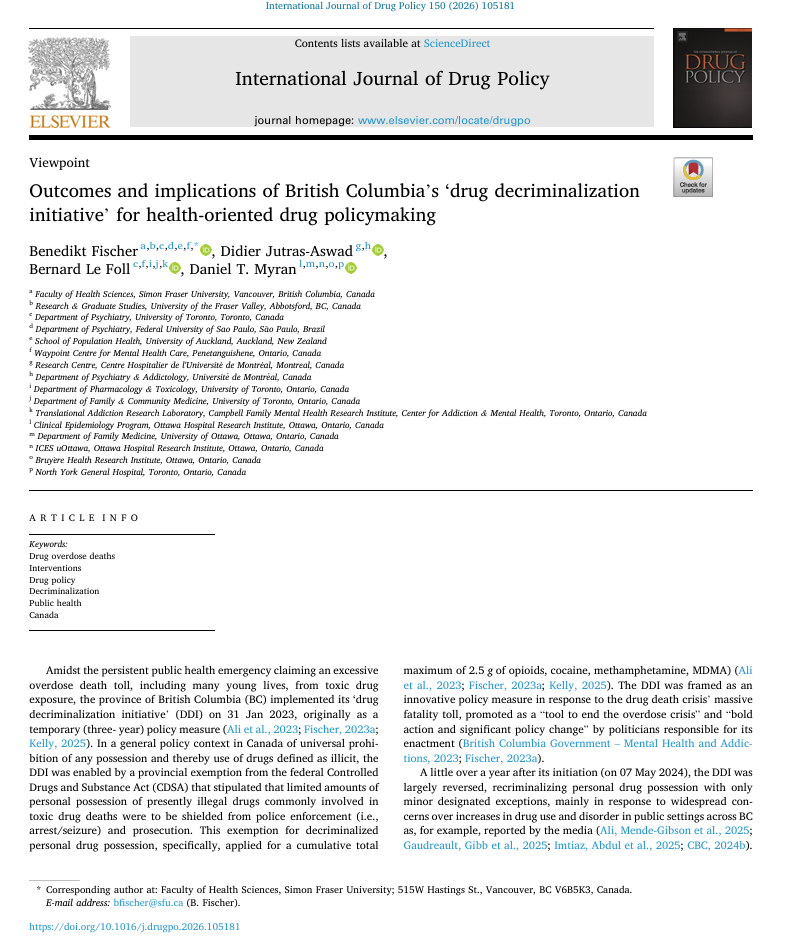
Outcomes and implications of British Columbia’s ‘drug decriminalization initiative’ for health-oriented drug policymaking

By lBenedikt Fischer,  Didier Jutras-Aswad, Bernard Le Foll, Daniel T. Myra

Highlights

The province of British Columbia (Canada) temporarily implemented a decriminalization initiative for personal drug possession/use (2023–2024) in contexts of a toxic drug death crisis.

  1. The decriminalization initiative was a priori promoted as a “tool to end the overdose crisis” and widely expected to reduce adverse health outcomes from toxic drug use.

  2. Emerging evaluation data indicate that the drug decriminalization initiative was not associated with population-level changes in drug use-related mortality (e.g., overdose deaths) or morbidity (e.g., hospitalizations).

  3. Drug use decriminalization remains an essential step to align prohibition-based drug policy frameworks with public health and human rights principles, but must be approached realistically and designed sensibly.

  4. To tangibly address toxic drug use-related harms, expanded measures are required that are effectively capable of preventing and reducing PWUDs’ exposure to and use of toxic drugs
    International Journal of Drug Policy

Volume 150, April 2026, 105181

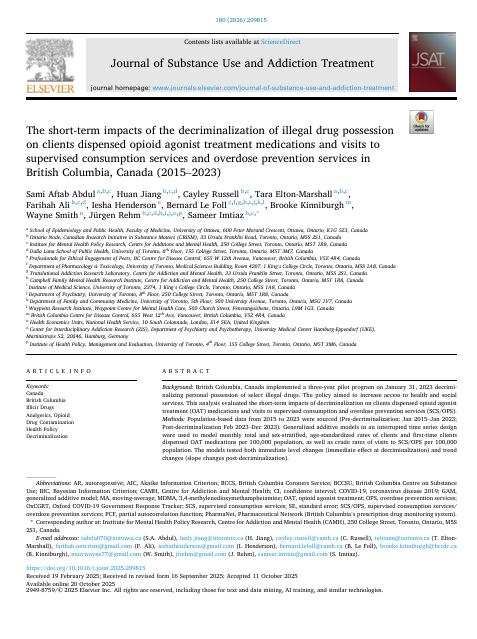
The Consequences of Legalizing Recreational Marijuana: Evidence from Colorado and Washington

By Ty Miller

In December of 2012, Washington and Colorado implemented the legalization of possession and use of marijuana for recreational purposes. Following this, January of 2014, Colorado opened the first recreational marijuana dispensaries in the United States. Although the debate about recreational marijuana has been fought in the public and academic spheres, we have limited empirical data as to the effect of these policies. With this, arguments in regard to whether marijuana should be legalized in the United States have far outpaced reliable scientific research. As more states, and potentially the federal government, begin to vote on whether to legalize, reliable research will be necessary. Sociology provides possible theoretical justifications for both sides of the recreational marijuana debate. However, there is still relatively little research on the effects of legalization in the United States. The current project analyzes changes in measures of excessive drinking, crime, DUI-related fatalities, and DUI arrests in Washington and Colorado following legalization of recreational marijuana. Each set of analyses are carried out in two parts. First, I examine the effects of legalizing possession and use in 2013. Second, I examine the effects of opening recreational dispensaries in Colorado in 2014. These separate analyses are utilized to uncover any shock-effects that might be inherently tied to legalization of possession and use or the opening of recreational dispensaries. Results indicate that, in most of the analyses, there are no significant effects of either part of legalization on the outcome variables of interest. The lone significant effect is that policing of DUI appears to increase following the legalization of possession and use in Washington and Colorado in 2013. The implications of these findings for both sociological theory and policy-making are discussed in the concluding chapter

West Lafayette, IN: Purdue University, 2018. 282p.

Drug Paraphernalia Laws Undermine Harm Reduction: To Reduce Overdoses and Disease, States Should Emulate Alaska

By Jeffrey A. Singer and Sophia Heimow 

  Every state except Alaska has laws that criminalize the possession and/or sale of paraphernalia for the consumption of illicit drugs. State-level drug paraphernalia laws prevent people who use those drugs from accessing the means to reduce the risk of infection or overdose. This makes nonmedical drug use even more dangerous because the laws often prevent access to clean needles and syringes along with products to test drugs for deadly contaminants. These laws are meant to discourage illicit drug use. Instead, they produce avoidable disease and death. Drug prohibition puts peaceful, voluntary drug users at risk of losing their liberty and often their lives. Paraphernalia laws similarly increase the risk that users will lose their lives. Some states have amended their laws to permit harmreduction programs and tools. For example, many states allow syringe services programs (also called SSPs or “needle exchange programs”) to operate within narrowly defined parameters. The goal of drug paraphernalia policy should be to save lives by reducing the risks of overdose and disease. This means removing government barriers to obtaining and distributing clean syringes and drug testing equipment. Because Alaska leaves residents free to purchase syringes and other paraphernalia in any quantity, anyone can operate an SSP and implement other harm-reduction measures. States should follow Alaska’s lead by repealing their drug paraphernalia laws so that programs aimed at reducing overdoses and disease can proliferate and succeed.

Washington, DC: Cato Institute, 2022. 24p.