
Open Access Publisher and Free Library
CRIME+CRIMINOLOGY.jpeg

CRIME

Violent-Non-Violent-Cyber-Global-Organized-Environmental-Policing-Crime Prevention-Victimization

Posts tagged illegal activities
The Evolution of Threat Networks in Latin America

By Phil Williams and Sandra Quincoses

The economic and political environments in Latin America have been advantageous for local, regional, and transnational threat networks. Specifically, technology, increased international trade and economic interdependence, heightened interest in natural resources for profit, synthetic drug production, economic disparities, corruption, impunity, and unstable political conditions have led to a complex web of opportunities that requires new, progressive ways to address criminal activities. The creativity of threat networks along with their entrepreneurial strategies have resulted in increasing power and influence. Despite efforts by the United States and some governments in Latin America to combat these networks, the everchanging global environment has worked in their favor. Indeed, some countries in Central and South America are in danger of transforming into what Jorge Chabat described as “criminally possessed states.” Furthermore, gangs in Central America, especially in Honduras where MS-13 has become more closely linked to drug trafficking, have reduced local extortion, become more aware of their nascent political power and have even engaged in rudimentary social welfare provision.
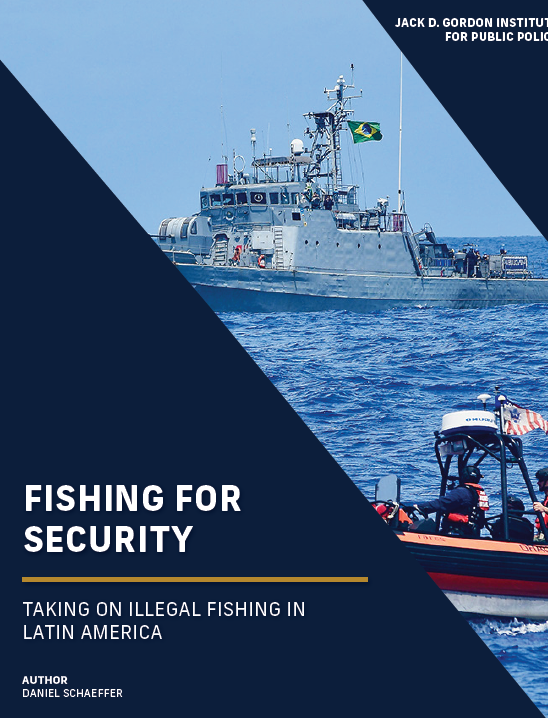
Fishing For Security. Taking on Illegal Fishing in Latin America

By Daniel Schaeffer


Often viewed through a myopic lens as an environmental issue or one relegated to fisheries authorities, illegal, unreported, and unregulated (IUU) fishing affects all coastal nations in the Western Hemisphere and has national security implications on the United States. A regional problem requires a regional solution and greater cooperation across agencies, private industry, and governments. Actions to address IUU fishing in Latin America have the potential to achieve greater aims of maritime security in the region. The report will frame the problem of IUU fishing by first highlighting its overall impacts globally and regionally. Food security, employment, national revenue, and other illicit activities are discussed. The report concludes with recommendations for interagency and regional coordination.


Miami:2021. 


Harnessing Artificial Intelligence to Address Organised Environmental Crime in Africa

By Romi Sigsworth 

Artificial intelligence (AI) offers innovative solutions for addressing a range of illegal activities that impact Africa’s environment. This report explores how AI is being used in Africa to provide intelligence on organised environmental crime, craft tools to assess its impact, and develop methods to detect and prevent environmental criminal activities. It discusses the challenges and opportunities AI poses for policing environmental crime in Africa, and proposes recommendations that would allow AI-powered policing to make a real difference on the continent. Recommendations • African governments and organisations should invest in gathering large, local data sets to allow AI models to produce appropriate and relevant solutions. • Investments in digital and communication infrastructure need to be made across Africa to improve and expand access to and affordability of AI solutions. • Police forces across Africa should include technology and AI skills capacity building into their basic and professional development training curricula. • Guardrails should be established through legislation to protect data, ensure privacy where necessary, and regulate the use of AI. • Public-private partnerships must be strengthened for law enforcement agencies across Africa to receive the technology and training they need to effectively embed AI tools into their methodologies to combat environmental (and other) organised crime

Enact Africa 2024. 28p.

To racketeer among neighbors: spatial features of criminal collaboration in the American Mafia

By Clio Andris, Daniel Della Posta, Brittany N. Freelin, Xi Zhu, Bradley Hinger, Hanzhou Chen

The American Mafia is a network of criminals engaged in drug trafficking, violence and other illegal activities. Here, we analyze a historical spatial social network (SSN) of 680 Mafia members found in a 1960 investigatory dossier compiled by the U.S. Federal Bureau of Narcotics. The dossier includes connections between members who were ‘known criminal associates’ and members are geolocated to a known home address across 15 major U.S. cities.

Under an overarching narrative of identifying the network’s proclivities toward security (dispersion) or efficiency (ease of coordination), we pose four research questions related to criminal organizations, power and coordination strategies. We find that the Mafia network is distributed as a portfolio of nearby and distant ties with significant spatial clustering among the Mafia family units.

The methods used here differ from former methods that analyze the point pattern locations of individuals and the social network of individuals separately. The research techniques used here contribute to the body of non-planar network analysis methods in GIScience and can be generalized to other types of spatially-embedded social networks.

International Journal of Geographical Information Science Volume 35, 2021 - Issue 12: Spatial Social Networks in GIScience