Open Access Publisher and Free Library
CRIME+CRIMINOLOGY.jpeg

CRIME

Violent-Non-Violent-Cyber-Global-Organized-Environmental-Policing-Crime Prevention-Victimization

Posts in Social Sciences
The Ivory Dynasty: A report on the soaring demand for elephant and mammoth ivory in southern China.

By Esmond Martin and Lucy Vigne

China is the largest importer by weight of illegal ivory in the world (Milliken, et al. 2009). In response the government of China took steps to reduce this illegal ivory trade in 2004 by introducing an official identification card for each ivory item sold in registered shops. China was then approved by CITES to buy tusks from the southern African ivory auctions in 2008; Chinese traders bought 62 tonnes. In January 2011 we surveyed ivory factories and retail outlets in Guangzhou, the largest city in southern China and an important ivory centre, and in Fuzhou, a city famous for carving. According to a factory owner in Fuzhou, in 2010 he paid on average USD 455/kg for government-owned 1-5kg tusks with a range of USD 303- 530/kg. Similarly, privately-owned raw ivory in 2010 was USD 750/ kg, according to various sources. Siberian mammoth high quality tusks were around USD 400/kg in 2010 wholesale in China.

London: Elephant Family, The Aspinall Foundation and C Woking, Surrey Woking, Surrey olumbus Zoo and Aquarium, 2011. 20p.

Operation Dragon: Revealing new evidence on the scale of corruption and trafficking in the turtle and tortoise trade

By Wildlife Justice Commission

The report ‘Operation Dragon: Revealing new evidence on the scale of corruption and trafficking in the turtle and tortoise trade’ describes in detail the results of the Operation and how the intelligence and evidence gathered by the Wildlife Justice Commission investigators provided an in-depth understanding of individual roles and network dynamics, enabling law enforcement agencies to target the most prolific criminals in a time-critical manner.

New York: WJC, 2018. 46p.

Strengthening legal frameworks for licit and illicit trade in wildlife and forest products: Lessons from the natural resource management, trade regulation and criminal justice sectors

By United Nations Environment Programme

The publication takes stock and gives a ‘gap analysis’ of the current status of institutions and legal frameworks relating to the regulation of licit trade, and the prevention, detection and penalization of illicit trade, in wildlife and forest products. It also highlights useful components of existing instruments and possible issues with the content of those instruments, which could benefit from future attention by the executive, legislative and judicial branches of national governments.

Nairobi: UNEP, 2018. 73p.

Disruptive Endeavors: Ethical guidance for civil society organizations monitoring and responding to online trafficking in endangered species

By Alastair MacBeathbn

The world’s most popular social media platforms, e-commerce sites, and specialist forums consistently host advertisements for the sale of endangered species or products made from their parts. These private platforms bear almost no legal liabilities for hosting such content or facilitating this trade, and as a result, their responses have been weak and inadequate. This also complicates the response from law enforcement. Without a clear legal basis to act and being overwhelmed by and ill-equipped to counter online crime in general, wildlife crime is usually low on police forces’ priority lists. This lack of prioritization ultimately stems from governments who refuse to acknowledge the urgency of tackling threats to biodiversity or to address the challenges posed by weak responses to cybercrime. Faced with almost complete impunity for illegal wildlife traders online, civil society actors, including non-governmental organizations (NGOs), conservation organizations, and citizen investigators are stepping into the gap: monitoring, reporting, running complex – sometimes clandestine – investigations and even engaging in confrontations to disrupt these illegal markets. But unlike law enforcement, journalists and academics, civil society actors have no universally accepted professional ethical standards or regulations to guide their investigative conduct. This community tool is aimed at supporting civil society actors in responding to this critical ethical dilemma: How should they balance ethical imperatives to respond to wildlife crime without contravening user privacy, accepted norms related to mass data collection or a platform’s terms of service? It also intends to provide an overview of the ethical issues involved in civil society organizations’ collection of data, investigation into the illegal online trade in wildlife and possible interventions.

Geneva: Global Initiative Against Transnational Organized Crime, 2022. 36p.

Disrupting Abalone Harms: Illicit flows of H. midae from South Africa to East Asia

By Kimon de Greef amd Simone Haysom

Abalone, a variety of marine snail, is valued as a high-status delicacy in East Asia, primarily in China. For more than 30 years, a species of abalone found only in South African waters – Haliotis midae, known locally as perlemoen – has been subjected to massive levels of poaching, driving the evolution of a lucrative and violent criminal economy. This report maps out the profound harms associated with this trade, ranging from resource collapse to corruption, turf wars and the erosion of state institutions. Despite decades of anti-poaching efforts, illegal harvesting is currently at its highest-ever levels, with record prices for abalone, myriad groups competing for profits — from Cape gangsters to Somali smugglers — and few realistic prospects for bringing the trade under control. Faced with these facts, a radical shift to the current state response is needed. Although reports exist of poaching in other countries such as Australia and the US, South Africa has been the global hotspot for abalone poaching since the 1990s. Abalone is harvested by divers, dried in South Africa and smuggled over the border to other southern African states, where it is laundered into licit trade routes and is shipped, primarily, to Hong Kong (the hub of the global abalone trade), from where it enters East Asian consumer markets.

Geneva: Global Initiative Against Transnational Organized Crime, 2022. 62p.

Policing the Trafficking of Wildlife: Is there anything to learn from law enforcement responses to drug and firearms trafficking?

By John M. Sellar

The “tipping point” on wildlife crime is fast approaching: the extinction of key species and irreparable damage to the environment are both imminent possibilities in the near future. Growing demand for wildlife products in key markets has triggered a professionalization and aggression in poaching which is unparalleled. Armed with advanced weaponry, surveillance equipment and facilitated by extensive corruption, the criminal market in wildlife crime is now one of the most significant illicit markets in the world. Key species such as the rhino are being slaughtered at record levels. Lesser known animals are traded at a scale that is almost incomprehensible. This is no longer just a criminal act: it is warfare. The law enforcement community, at national and international levels, has long been engaged in what are described as ‘wars’ against narcotic and firearm trafficking. These two forms of criminality share many of the same features as those of wildlife trafficking, particularly as all three involve: the harvesting or acquisition of material or products in one State; usually require illicit export from the same State; the subsequent clandestine movement of the material or products across further national borders (regularly many borders and also intercontinentally); illicit import to the State of destination; and final delivery to customers and consumers.

Geneva: Global Initiative against Transnational Organized Crime, 2014. 46p.

What’s Driving the Wildlife Trade? A Review of Expert Opinion on Economic and Social Drivers of the Wildlife Trade and Trade Control Efforts in Cambodia, Indonesia, Lao PDR, and Vietnam

By TRAFFIC

The trade in wildlife living in the forests and other natural habitats in East and Southeast Asia is of great importance and concern. While we continue to prepare and implement many conservation-related projects across the region, we are aware that unsustainable wildlife trade, much of it illegal, undermines the best attempts by governments and NGOs to secure viable populations of many species. The abundance of many wild species in the forests and other ecosystems is now just a shadow of what it was - and could be - to the detriment of those who have relied on those species in a sustainable manner for livelihoods, including in times of food insecurity. In 2005, we launched the report Going, Going, Gone? The Illegal Trade in Wildlife in East and Southeast Asia, which described the nature and scale of the trade, including through case studies. It described the markets, including illegal markets, for wildlife. However, in our discussions on how to move forward in tackling the problems identified in the report, we became aware that there was limited understanding of the economic and social drivers of these markets. This information is needed to determine the actions most likely to succeed given the wide range of market contexts within which the illegal wildlife trade operates in the region. This report is intended to help address this information gap. It was supported financially by the World Bank-Netherlands Partnership Program and prepared by TRAFFIC, in collaboration with staff from the IUCN Asia Ecosystems and Livelihoods Group and Species Programme and The World Bank. We believe this to be an important contribution to the effort to generate information about the economic and social factors influencing illegal and unsustainable wildlife trade in Southeast Asia. It is our sincere hope that this information will result in more effective policies, programs and projects aimed to address the illegal and unsustainable trade in wildlife in the region.

Cambridge, UK: TRAFFIC: Washington, DC: World Bank, 2008. 120p.

Justice for Forests : Improving Criminal Justice Efforts to Combat Illegal Logging

By Goncalves, Marilyne Pereira; Panjer, Melissa; Greenberg, Theodore S.; Magrath, William B

Every two seconds, across the world, an area of forest the size of a football field is clear-cut by illegal loggers. In some countries, up to 90 percent of all the logging taking place is illegal. Estimates suggest that this criminal activity generates approximately US$10-15 billion annually worldwide funds that are unregulated, untaxed, and often remain in the hands of organized criminal gangs. Thus far, domestic and international efforts to curb forest crimes have focused on preventative actions, but they have had little or no significant impact. While prevention is an essential part of enforcement efforts to tackle illegal logging, it has not halted the rapid disappearance of the world's old-growth trees. New ideas and strategies are needed to preserve what is left of forests. This paper suggests that current practice be combined with a more targeted, punitive approach, through more effective use of the criminal justice system. It argues that the criminal justice system should form an integral part of any balanced and organized strategy for fighting forest crime. This strategy should include initiatives to enhance the efficiency of criminal justice in combating illegal logging that is, the investigation, prosecution, and conviction of cases, as well as the confiscation of the proceeds of criminal activity. These initiatives should be deployed in parallel with preventive programs, and the two approaches should complement and reinforce each other. The criminal justice system has been used in the fight against illegal logging, but only in very sporadic instances and in limited and ineffective ways. Moreover, in those few cases, it has tended to target low-level criminals whose involvement in illegal logging is due to poverty. As such, it has created no real deterrent and has encouraged skeptics to further discount the relevance of criminal justice methods. The objective of this paper is to inform policy makers and forestry and law enforcement actors how they can use the criminal justice system in fighting illegal logging. It seeks to mobilize them to take action and address the various criminal acts involved in illegal logging operations. The paper puts forward practical suggestions that can be implemented to achieve a tangible improvement in this fight. Rather than focusing on a single element of the criminal justice system, it provides a broad overview of the topic. Future papers may provide an opportunity to flesh out further detail.

Washington, DC: World Bank, 2012. 60p.

Illegal Logging, Fishing, and Wildlife Trade : The Costs and How to Combat it

By World Bank

This paper has two goals - to motivate policy makers in developed and emerging economies to pay more attention to illegal logging, fishing, and wildlife trade, and to provide a road map to address the root causes of the illegal activities. Illegal wildlife trade directly causes declines in species population, resulting in the deterioration of ecosystem functions. Illegal activities involve trade of species threatened with extinction, including many keystone species. It also covers a range of mammals, such as pangolins (considered the world’s most trafficked mammal), and wood products such as rosewood, and marine mammals such as the vaquita found in the Sea of Cortez in Mexico. For all practical purposes, combating illegal logging, fishing, and wildlife trade is a governance issue that first and foremost requires high-level political commitment at the national and international levels. The financial action task force (FATF) recommendations (FATF 2012-19) provide a framework for a risk-based, peer-reviewed system of mutual evaluations for compliance with global standards on money laundering and terrorist financing. The national risk assessment tools can be expanded to also address illegal logging, fishing, and wildlife trade and other natural resources crimes.

Washington, DC: World Bank, 2019. 70p.

Money Laundering and the Illegal Wildlife Trade

By Financial Action Task Force

The illegal wildlife trade (IWT) is a major transnational organised crime, which generates billions of criminal proceeds each year. IWT fuels corruption, threatens biodiversity, and can have a significant negative impact on public health and the economy. To move, hide and launder their proceeds1 , wildlife traffickers exploit weaknesses in the financial and non-financial sectors, enabling further wildlife crimes and damaging financial integrity. Despite this, jurisdictions2 rarely investigate the financial trail left by this crime. 2. The Financial Action Task Force (FATF), as the global standard setter on antimoney laundering (AML), countering the financing of terrorism (CFT) and countering proliferation financing (CPF), is concerned about the lack of focus on the financial aspects of this crime, and has conducted this study to support jurisdictions to combat related money laundering. The FATF Standards (i.e. 40 Recommendations) provide a useful framework for jurisdictions to address these threats by strengthening their national laws, policies, and co-operation at the domestic and international level. 3. This is the FATF’s first global report on IWT. It builds on previous studies by two of the FATF-Style Regional Bodies (FSRBs), work by other international bodies and recent initiatives by the private sector. This study by the FATF makes a unique contribution by assessing the money laundering (ML) aspects of wildlife crimes, and by demonstrating how jurisdictions should apply the FATF standards to combat IWT. The findings in this report are based on inputs from around 50 jurisdictions across the FATF Global Network, as well as expertise from the private sector and civil society. This study highlights that jurisdictions should view the proceeds generated by IWT as a global threat, rather than as a problem only for those jurisdictions where wildlife is illegally harvested, transited, or sold. In particular, criminals are frequently misusing the legitimate wildlife trade, as well as other import-export type businesses, as a front to move and hide illegal proceeds from wildlife crimes. They also rely regularly on corruption, complex fraud and tax evasion. Another key theme of this study is the growing role of online marketplaces and mobile and social media-based payments to facilitate movement of proceeds from wildlife crimes. These trends highlight the increasing importance of a coordinated response from public authorities, the private sector and civil society to identify and disrupt financial flows from IWT.

Paris: Financial Action Task Force (FATF)., 2020. 72p.

Demand Under the Ban: China Ivory Consumption Research 2020

By Wander Meijer, Dr. Daniel Bergin, Timothy Cheng, Crystal Yang, and Dr. Eugene Kritski .

The large-scale consumption of wildlife parts, products, and derivatives across the globe is increasingly being recognized as a driving factor toward substantial declines in populations for many species. Mainland China (hereafter referred to as ‘China’ in this report) is thought to be one of the largest markets, leading conservation professionals to explore the potential for targeted advocacy, social marketing, and multi-media campaigns to deliver real and rapid impact in reducing this demand. WWF have implemented several behavior change interventions in recent years to reduce demand for illegal wildlife products like ivory, pangolin scales, rhino horn, and tiger bones. Consumers including outbound tourists, persistent buyers, collectors, businessmen, and traditional medicine users have been targeted in those behavior change interventions. Within this context, a “game-changing” ban on commercial processing and trade in elephant ivory was implemented by the State Council, China’s Cabinet on 31 December 2017. TRAFFIC and WWF commissioned GlobeScan before the ban became effective in 2017 to conduct the largest-ever ivory consumer research in China. This research seeks to discover the nature of ivory consumption in 15 major cities in China, to understand consumers’ perception toward the ivory ban, and to assess effective messaging and mechanisms for demand reduction based on a pre- and a post-ban surveys, conducted in September – October 2017 (pre-ban), May – June 2018 (post-ban), May – July 2019 (post-ban) and October 2020 - January 2021 (postban). The research will also serve as the foundation of WWF’s future behavior change strategies and interventions.

Beijing, China: World Wildlife Fund, 2021. 119p.

The India-Myanmar Borderlands: Guns, Blankets and Bird Flu

By Jabin T. Jacob

The India-Myanmar border regions form a forgotten frontier in the Indian and global imagination. India’s frontiers to the west (Pakistan), to the north (Tibet/China) and to the south (Sri Lanka and the Indian Ocean) have always received greater attention. Today, however, the region representing the conjunction of India, China and Myanmar is returning to the centre of attention for a number of reasons both old and new. Violence (‘Guns’) has been endemic in the region since communities and peoples were rent asunder by the imposition and policing of officially demarcated borders between India and Myanmar. Yet, trade (‘Blankets’) – both formal and informal – has managed to carry on. What has added to the importance of the region in the eyes of the national capitals, is the increasing severity of transnational challenges such as drug-trafficking and the spread of diseases (‘Bird Flu’). Together, these three factors have kept both a regional identity as well as specific community identities alive. This paper is an attempt to examine the region-building properties of these factors.

Cahiers de SPIRIT, 2010. 27p,

Nations Hospitable To Organized Crime And Terrorism

By LaVerle Berry. et al.

This report assesses conditions that contribute to or are potentially hospitable to transnational criminal activity and terrorist activity in selected regions of the world during the period 1999-2002. Although the focus of the report is on transnational activity, domestic criminal activity is recognized as a key foundation for transnational crime, especially as the forces of globalization intensify. The report has been arranged geographically into the following major headings: Africa, the former Soviet Union and Eastern Europe, South Asia, Southeast Asia, Western Europe, and the Western Hemisphere. Within the geographical headings, the report addresses individual countries with particularly salient conditions. Cases such as the Triborder Area (TBA) of South America and East and West Africa, where conditions largely overlap national borders, have been treated as regions rather than by imposing an artificial delineation by country. The bibliography has been divided into the same geographical headings as the text. The major sources for this report are recent periodical reports from Western and regional sources, Internet sites offering credible recent information, selected recent monographs, and personal communications with regional experts. Treatment of individual countries varies according to the extent and seriousness of conditions under study. Thus some countries in a region are not discussed, and others are discussed only from the perspective of one or two pertinent activities or conditions. Because they border the United States, Canada and Mexico have received especially extensive treatment.

Washington, DC: Federal Research Division, Library of Congress, 2003. 260p.

Formal Employment and Organized Crime: Regression Discontinuity Evidence from Colombia

By Gaurav Khanna, Carlos Medina, Anant Nyshadham and Jorge Tamayo

Canonical models of criminal behavior highlight the importance of economic incentives and employment opportunities in determining participation in crime (Becker, 1968). Yet, deriving causal corroborating evidence from individual-level variation in employment incentives has proven challenging. We link rich administrative micro-data on socioeconomic measures of individuals with the universe of criminal arrests in Medellin over a decade. We test whether increasing the relative costs to formal-sector employment led to more crime. We exploit exogenous variation in formal employment around a socioeconomic score cutoff, below which individuals receive generous health benefits if not formally employed. Our regression discontinuity estimates show that this popular policy induced a fall in formal-sector employment and a corresponding spike in organized crime. This relationship is stronger in neighborhoods with more opportunities for organized crime. There are no effects on less economically motivated crimes.

Boston, MA: Harvard Business School, 2019. 57p.

Capitalism, Slavery, and the Legacy of Cesare Beccaria

By Sophus A. Reinert

The Milanese Marquis Cesare Beccaria (1738-1794) dedicated his life first to theorizing a more just and equal society grounded in individual rights, anchored in secular political economy rather than in religious dogma, then to realizing this bold vision through decades of administrative and regulatory work for the Milanese state. His project was not merely to reform the criminal system of the Old Regime but to challenge the very inequalities—legal, economic, educational, and so on—which drove crime to begin with.2 During his lifetime, however, his fame as a “friend of humanity” derived mostly from his impassioned pleas against torture and capital punishment, though on the basis of his temperament and his ideas it would also be easy to count him as part of what, for the later eighteenth century, the late Yves Bénot dubbed the “internationale abolitionniste.”3 This is, in large parts, also how he is remembered, but not only. It is of course a truism that ideas can have ironic, even sarcastic afterlives, but there is nonetheless something slightly perverse about Beccaria’s treatment in parts of American historiography.4 I have previously highlighted how his paternity has been claimed for both libertarian atheism and Catholic social democracy, but his name now appears ever more frequently in contemporary debates over “gun rights,” the “carceral state” and the rise of “racial capitalism.”5 We often hear of the “centrality of penal slavery” in Beccaria’s thought, for example, to the point where he repeatedly has been given the rather unenviable title of “father of prison slavery” and “father of penal servitude.”6 Some of these commentators are generous enough to admit that Beccaria can “be credited with voicing some humanitarian concerns,”

Boston, MA: Harvard Business School, 2021. 49p.

Lost at Sea: The urgent need to tackle marine litter

By Environmental Investigation Agency

Lost at Sea, calls on governments, industry, retailers, and consumers to help end the appalling damage that plastic waste inflicts on marine environments.

The report details how global plastics production has grown from five million tons per year in the 1960s to 299 million tons in 2013. It is found in our clothes, computers, and cars and has now found its way to our oceans, leaving no area uncontaminated. Plastics are ingested by seabirds and other marine life, concentrated in Arctic Sea ice, and are accumulating in deep sea sediments where microplastics are now more numerous than in surface waters. An estimated 80 percent of marine litterl originates from terrestrial waste sources, but can vary depending on geographical area.

This report outlines some of the impacts on marine creatures, with recommended actions to reduce the rising tide of plastic waste entering the oceans.

London: Environmental Investigation Agency, 2015. 12 p.

The Nexus of Illegal Gold Mining Supply Chains Lessons from Latin America ,

By Verité

In-depth research carried out by Verité has found that Latin American countries export reputational risks for major companies with gold in their supply chains. The Global Initiative Against Transnational Organized Crime, with which Verité has been closely collaborating, recently released an in-depth report thoroughly documenting the close link between illegal gold mining and organized crime, which fuels violence, environmental damage, corruption, money Verité publications include a research report focusing on illegal gold mining in Colombia and a white paper with detailed recommendations for companies and other stakeholders to ensure that illegally mined gold does not enter into company supply chains and the vaults of central banks. research carried out by Verité in Peru in 2012-2013 and in Colombia in 2015, and desk research carried out across the Latin American region.

Amherst, MA: Verité , 2016. 17p.

Commodity Booms, Conflict, and Organized Crime: Logics of Violence in Indonesia's Oil Palm Plantation Economy

By Paul D. Kenny, Rashesh Shrestha, and Edward Aspinall

This paper examines the relationships between agrarian commodity booms and the incidence of group conflict and criminality in the context of Indonesia’s expanding oil palm sector. It theorizes that commodity boom violence takes two main forms: low level but organized criminal violence involved in the extortion of “rents” produced by a given commodity extraction and production process (extortion); and violent competition among a range of groups, including “mafias”, youth gangs, landholders, and commercial producers for control of these rents (competition). Extortion and competition violence are associated with distinct temporal distributions consistent with our theory. Criminality–especially theft–is higher in villages with established and productive oil palm plantations (extortion), whereas villages undergoing planation expansion have a higher incidence of group conflict (competition). Dynamic analyses utilizing panel data at the sub-district level support our causal interpretation, as the relationship between the area under oil palm cultivation and resource conflict (competition) changes over time and with prevailing commodity prices. Our results are robust to the use of instrumental variable analysis to account for the potential endogeneity of plantation expansion. Our theorized mechanism is given further support by a targeted primary survey of 1,920 respondents in oil palm producing and non-producing villages, which shows that villages experience different rates of extortion and competition violence depending both on if, and when, oil palm production commenced.

Canberra: Australian National University, 2020. 77p.

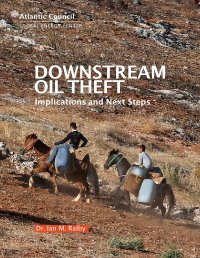
Downstream Oil Theft: Implications and Next Steps

By Ian M. Ralby

On January 13, 2017, the Atlantic Council launched a major study on downstream oil theft at its inaugural Global Energy Forum in Abu Dhabi, United Arab Emirates. The present analysis draws on that launch event to examine the implications of the Downstream Oil Theft: Global Modalities, Trends, and Remedies report findings, and to suggest tangible next steps in both further investigating this global scourge and beginning to confront it effectively. The panel, moderated by Ambassador Richard Morningstar, the Atlantic Council Global Energy Center’s chairman, included the lead author of the report, Dr. Ian Ralby, a nonresident senior fellow of the center and chief executive officer (CEO) of I.R. Consilium; Éric Besson, former minister of industry, energy, and digital economy for the Republic of France; Dr. John Gannon, former Central Intelligence Agency deputy director for intelligence and chairman of the US National Intelligence Council; and Kola Karim, CEO of Shoreline Energy, an oil company in Nigeria. Though the panelists’ comments form a starting point for this analysis, they do not constitute the sole basis for this report. The implications of the study are extensive and point to a wide range of challenges, but six areas stand out as encompassing the most significant consequences of illicit downstream hydrocarbons activity: 1. The Energy Industry 2. Security, Terrorism, and Law Enforcement 3. The Environment 4. Finance and Economics 5. Politics and Policy 6. International Relations The present analysis focuses on the implications of the study for these six areas

Washington, DC: Atlantic Council, 2017. 15p.

Countering global oil theft: responses and solutions \by Etienne

By Etienne Romson

This second of two papers on global oil theft discusses ways to reduce oil theft, misappropriation, and fraud. At US$133 billion per year, oil is the largest stolen natural resource globally, while fuel is the most smuggled natural resource. Oil theft equates to 5–7 per cent of the global market for crude oil and petroleum fuels. It is so engrained in the energy supply chain that thefts are priced in by traders and tolerated by many shipping companies as petty theft. Oil theft and related insecurity have substantial negative economic effects on developing countries, whether they produce oil or not. In 2012, non-oil-producing Benin saw a 28 per cent drop in taxable income after a spate of oil tanker hijacking incidents in the Gulf of Guinea in 2011. In Nigeria, the oil capacity shut-in and amount of oil deferred is more than twice the amount estimated as stolen, with a US$20 billion annual loss in petroleum profit tax—63 per cent of total government tax revenue in 2019. Organized oil crime syndicates are often transnational and conduct theft and fraud professionally, exploiting gaps in jurisdiction and adapting their practices when law enforcement becomes more effective. They evolve from ship piracy to stealing tanker cargoes to kidnapping tanker crews; from physical ransom of assets to digital hijacking via ransomware. The proceeds of oil theft often finance other organized crime, and it triggers violence against the community and in crime-on-crime activities. Twelve commonalities in oil theft and fraud have been identified that can direct international solutions, in three target areas: stolen oil volumes, stolen oil transport, and stolen oil money. Prosecution for acts of bribery offers opportunities for action: transport of or payment for illegal oil could constitute a bribe under the US Foreign Corrupt Practice Act if government officials were involved in the transaction or shipment. Bribe charges could be raised for paid ‘services’ that facilitate oil theft (through action or non-action).

Helsinki: UNU-WIDER , 2022. 65p.