Open Access Publisher and Free Library
CRIME+CRIMINOLOGY.jpeg

CRIME

Violent-Non-Violent-Cyber-Global-Organized-Environmental-Policing-Crime Prevention-Victimization

Posts in Social Sciences
Militarised Responses to Transnational Organised Crime: The War on Crime

Edited by Tuesday Reitano, Sasha Jesperson and Lucia Bird Ruiz-Benitez de Lugo

This edited volume examines the use of militarised responses to different forms of criminal activity, discussing the outcomes and unintended consequences. Politicians and policymakers frequently use militarised responses to look tough on crime. The deployment of armies, navies, military assets and militarised approaches can send a powerful message, but have produced mixed results. While they generate the perception that governments are actively engaged on issues of concern to the public, and in some cases have resulted in notable successes, on the downside they have frequently also increased the loss of life, exacerbated the humanitarian consequences of a particular crime and entrenched divides between security and state institutions and the criminal proponents, narrowing the possibilities for future negotiated solutions. By focusing on four different areas of criminality – wildlife crime, piracy, migration and drug trafficking – the book allows context and evidence-based conclusions to be drawn on the strategic value and commonality of responses and their outcomes.

Cham: Springer International Publishing, 2017. 353p

Drugs, Gangs and Vigilantes: How to tackle the new breeds of Mexican armed violence

By Gema Santamaria

This report analyzes the objectives, structures and impact of armed non-state actors in Mexico, focusing on drug-trafficking organizations, street gangs and self-defense forces. The author also examines the pitfalls and lessons learned from the country's past and present strategies to deal with these actors. Finally, she provides an alternative approach to tackling these groups, which suggests the Mexican state should 1) recognize the hybrid character of these groups and prioritize the fight against corruption; 2) focus on protecting affected communities and not on dismantling criminal organizations; 3) work at the local level and focus on the most affected areas; 4) prevent the forced recruitment of youth and immigrants by organized crime; and 5) promote a culture of legality in state institutions and communities.

Oslo: Norwegian Peacebuilding Resource Centre (NOREF), 2014. 9p.

Environmental Criminology and Crime Analysis

Edited by Richard Wortley and Lorraine Mazerolle

Environmental criminology is a generic label that covers a range of overlapping perspectives. At the core, the various strands of environmental criminology are bound by a common focus on the role that the immediate environment plays in the performance of crime, and a conviction that careful analyses of these environmental influences are the key to the effective investigation, control and prevention of crime. Environmental Crime and Crime Analysis brings together for the first time the key contributions to environmental criminology to comprehensively define the field and synthesize the concepts and ideas surrounding environmental criminology. The chapters are written by leading theorists and practitioners in the field. Each chapter will analyze one of the twelve major elements of environmental criminology and crime analysis.

Cullompton, UK: Willan Publishing, 2011. 320p.

Re-examining The Crime Drop

By Stephen Farrell

The crime drop is one of the most important puzzles in contemporary criminology: since the early-1990s many countries appear to exhibit a pronounced decline in crime rates. While there have been many studies on the topic, this book argues that the current crime drop literature relies too heavily on a single methodological approach, and in turn, provides a new method for examining the falling rates of crime, based on ideas from political science and comparative historical social science. Farrall’s original new research forwards an understanding of trends in crime and responses to them by questioning the received theoretical assumptions. The book therefore encourages a ‘deepening’ in the nature of the sorts of studies which have been undertaken so far.

Cham: Palgrave Macmillan, 2017. 116p.

Tobacco Wars: Inside The Spy Games and Dirty Tricks of Southern Africa’s Cigarette Trade

By Johann van Loggerenberg

Warning. Smoking kills. It also corrupts law-enforcement officials and eviscerates state institutions. It devours politicians, professionals, business people and ordinary workers in the chase for big bucks and the battle for a slice of an ever-shrinking cigarette market. Join one of South Africa’s former tax sleuths Johann van Loggerenberg in a wild ride through the double-dealing world of tobacco’s colourful characters and ruthless corporates. Meet the femme fatales, mavericks, mercenaries and grandmasters, and learn how the crime-busting unit led by Van Loggerenberg at SARS and its ‘Project Honey Badger’ became a victim of a war between industry players and a high-stakes political game driven by state capture. This is the tale of a few good men and women who dared to try to hold to account a billion-dollar international industry rife with private spy networks, tax evasion, collusion and corruption – ultimately at great cost to themselves and South Africa.

Cape Town, South Africa: Tafelberg 2019. 272p.

Illegal Pathways to Illegal Profits: The Big Cigarette Companies and International Smuggling

By E. LeGresley and E. Lindblom

Each year approximately 400 billion cigarettes, or one-third of all legally exported cigarettes, end up illegally smuggled across international borders. Cigarettes are the world’s most widely smuggled legal consumer product. Cigarette smuggling hurts the world’s nations by evading otherwise applicable duty fees and taxes. Even worse, it increases the number of smokers by providing a less-expensive supply of cigarettes, especially for the young and the poor. National efforts to restrict access to cigarettes by children can be undermined by the availability of cheap contraband cigarettes. In addition, cigarette smuggling that steals away public revenues leaves less funding available for public health efforts. At the same time, it reduces available revenues for health care and law enforcement. The major international cigarette companies say that the solution for the world’s governments is to reduce cigarette taxes and duty fees to reduce the incentives to smuggle. But an enormous, growing body of evidence shows that the major cigarette companies, themselves, have knowingly fostered and have consciously supported cigarette smuggling. In doing so, they have been able to penetrate otherwise closed markets, to increase the sales of their brands by making them available at lower prices, and to provide an argument against high or increased levels of cigarette taxes or import duties

Washington, DC: Campaign for Tobacco-Free Kids, 2002. 54p.

Protocol to Eliminate Illicit Trade in Tobacco Products

By The World Health Organization

The Protocol to Eliminate Illicit Trade in Tobacco Products is the first protocol to the WHO Framework Convention on Tobacco Control (WHO FCTC), and a new international treaty in its own right. It was adopted by consensus on 12 November 2012 at the fifth session of the Conference of the Parties (COP) to the WHO FCTC (Seoul, Republic of Korea, 12–17 November 2012). The Protocol builds upon and complements Article 15 of the WHO FCTC, which addresses means of countering illicit trade in tobacco products, a key aspect of a comprehensive tobacco control policy. The Protocol was developed in response to the growing international illicit trade in tobacco products, which poses a serious threat to public health. Illicit trade increases the accessibility and affordability of tobacco products, thus fuelling the tobacco epidemic and undermining tobacco control policies. It also causes substantial losses in government revenues, and at the same time contributes to the funding of transnational criminal activities. The objective of the Protocol is the elimination of all forms of illicit trade in tobacco products, in accordance with the terms of Article 15 of the WHO FCTC.

Geneva: WHO, 2013. 68p.

Assessment of COVID-19 pandemic impact on illicit medication in East Africa

By ENACT

Weak medical regulations and the lack of regulatory autonomy poses challenges in efforts to address organised criminality in the sector. The COVID-19 global pandemic has had profound social, economic and geo-political impact across the globe. In East Africa, countries have attempted to face this issue in the context of resource challenged national healthcare systems. Organised crime groups (OCGs) however have sought to exploit the vulnerabilities in society, which have developed following fundamental changes in population behaviours as a result of fear and often misinformation concerning the pandemic. Challenges in regulatory authority autonomy combined with widespread adoption in East African of misinformation on COVID-19 create an ideal operating environment for OCGs. This has encouraged OCGs to move into the illicit medications market over other forms of crime. A COVID-19 related hysteria has maximised profits for organised crime in this field, whilst enabling relatively risk free activity for criminals. This activity has included increased importations of counterfeit and substandard medications from Asia as well as the acquisition of powerful painkillers to sell on the black market.

ENACT Africa, 2020. 25p.

The Globalization of Hate: Internationalizing Hate Crime?

Edited by Jennifer Schweppe and Mark Austin Walters

The Globalisation of Hate: Internationalising Hate Crime? is the first book to examine the impact of globalisation on our understanding of hate speech and hate crime. Bringing together internationally acclaimed scholars with researchers, policy makers and practitioners from across the world, it critically scrutinises the concept of hate crime as a global phenomenon, seeking to examine whether hate crime can, or should, be conceptualised within an international framework and, if so, how this might be achieved. …. The final part of the book concludes with an examination of the different ways in which hate speech and hate crime is being combatted globally. International law, internet regulation and the use of restorative practices are evaluated as methods of addressing hate-based conflict, with the discussions drawn from existing frameworks as well as exploring normative standards for future international efforts. Taken together, these innovative and insightful contributions offer a timely investigation into the effects of hate crime, offering an interdisciplinary approach to tackling what is now a global issue.

New York: Oxford University Press, 2016. 340p.

Organized Crime Groups: A systematic review of individual-level risk factors related to recruitment

Francesco Calderoni,Tommaso Comunale,Gian Maria Campedelli,Martina Marchesi,Deborah Manzi and Niccolò Frualdo

There is relatively strong evidence that being male and having committed prior criminal activity and violence are associated with future organised crime recruitment. There is weak evidence that prior sanctions, social relations with organised crime-involved subjects and a troubled family environment are associated with recruitment. This systematic review examines what individual-level risk factors are associated with recruitment into organised crime. Despite the increase of policies addressing organised crime activities, little is known about recruitment. Existing knowledge is fragmented and comprises different types of organised criminal groups.Recruitment refers to the different processes leading individuals to stable involvement in organised criminal groups, including mafia, drug trafficking organisations, adult gangs and outlawed motorcycle gangs. This systematic review excludes youth (street) gangs, prison gangs and terrorist groups.

Oslo, Norway: Campbell Collaborative, 2022. 68p.

Climate Change and Crime in Cities

By Robert Muggah

Climate change is already disrupting cities around the world. Continued greenhouse gas emissions and warming are intensifying heat islands, contributing to water shortages, rising seas, increasing flood-related risks and worsening pollution. With over two thirds of the population expected to live in cities by 2030, the effects are consequential. Large and fast-growing cities in Asia, Africa and the Americas are likely to be hit hardest by more frequent and intense disasters. Coastal cities across North America and Western Europe are likewise on the front-line.

Climate change is influencing all aspects of city life, from labor markets and food security to migration patterns and economic productivity. One critical, if under-examined, way climate change is affecting cities is in relation to crime and victimization. To be sure, the debate about the relationships between climate and security – and in particular the influence of global warming on conflict onset, duration and intensity – has heated-up over the past decade, there is less attention devoted to how climate change stands to influence criminal violence in cities around the world.

Evidence suggests that dramatic climate change will generate a substantial increase in crime in many cities – and especially more vulnerable neighborhoods. In this paper, Robert Muggah, Igarapé Institute co-founder and Research and Innovation Director analyses studies and theories about the link climate-crime and present strategies and preventive measures to avoid violence while protecting the most vulnerable.

Rio de Janeiro - RJ - Brasil, Igarapé Institute, 2021. 13p.

Guidance Note on Combating Environmental Crime: Lessons from fighting illegal gold mining in the Amazon Basin

By The Igarapé Institute and INTERPOL

The Igarapé Institute, in a partnership with INTERPOL, releases the “Guidance note on combating environmental crime: lessons from fighting illegal gold mining in the Amazon Basin”. The publication offers practical guidance for law enforcement, criminal justice and environmental protection authorities to better understand the scope and scale of the challenge. It is designed for national and subnational environmental investigators, police officers and public prosecutors at the forefront of efforts to dismantle environmental crimes in the Amazon.

The guidance note reviews policy and operational strategies meant to prevent, control and reduce illegal small-scale gold mining in the Amazon – with a focus on Brazil, Colombia and Peru. The note offers a catalogue of 12 measures already in place in the three countries that can be valuable for law enforcement, criminal justice and environmental protection authorities to learn from each other, cooperate and coordinate activities within and across countries.

Rio de Janeiro - RJ - Brasil, Igarapé Institute, 2021. 41p.

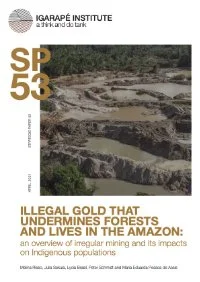
Illegal Gold that Undermines Forests and Lives in the Amazon: an overview of irregular mining and its impacts on Indigenous populations

By Melina Risso, Julia Sekula, Lycia Brasil, Peter Schmidt and Maria Eduarda Pessoa de Assis

In the past 20 years, the price of gold has increased from US$400 to US$1861.50 per ounce, driven by rising demand in China and India. Gold is time and capital-intensive to produce, which is why this rise in demand has driven an attendant demand for illegal gold mining — an industry that is estimated to yield globally between US$12 and US$28 billion annually.2 The Brazilian Amazon is rife with illegal gold mining operations, with 321 identified points of illegal, active and inactive mines arranged in the 9 states that comprise the Brazilian Amazon Basin.3 This has had a direct impact on deforestation rates and health hazards of local indigenous populations. Deforestation across the Amazon grew 25% in the first half of 2020 according to INPE (Brazil’s National Institute for Space Research). The contribution of mining activity to deforestation rates as a whole has increased from 4% in 2017 to 23% in indigenous territories in data recorded up to June 10, 2020.4 Deforestation has been concentrated in indigenous territories where, between 2018 and 2019, environmental degradation by mining increased 107%. This devastation has a price — according to Brazil’s Federal Public Prosecutors Office, 1kg of gold represents roughly R$1.7m in environmental damages, culminating in an environmental cost roughly 10 times greater than the current price of gold.

Rio de Janeiro - RJ - Brasil, Igarapé Institute, 2021. 50p.

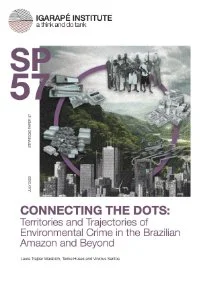
Connecting the Dots: Territories and Trajectories of Environmental Crime in the Brazilian Amazon and Beyond

By Laura Trajber Waisbich, Terine Husek and Vinicius Santos

The ecosystem of environmental crime in the Amazon is largely to blame for the current levels of deforestation and degradation of the biggest tropical forest on the planet. Several illegal economic activities, representing the main drivers of destruction in the river basin, take a heavy toll on the forest and its inhabitants. Based on an analysis of the spatial distribution of the Federal Police operations to fight environmental crime in the Legal Amazon between 2016 and 2021, this study highlights the hotspots for a range of illicit forest-based economic activities in the region, while also showing how other locations within and outside the Brazilian Amazon form part of a broader nexus of environmental crime. The study reviewed more than 300 Federal Police operations and identified 846 territories that make up the ecosystem of environmental crime in the Amazon. These territories are located in 262 municipalities, both in the Legal Amazon and beyond its borders. Of the cities mapped, 75% are located in the Legal Amazon, 22% are in other regions of Brazil and 3% are in neighboring countries. These territories are where environmental and associated crimes converge to fuel illegal deforestation, illegal logging, public land grabbing (known as grilagem, in Portuguese), agriculture and livestock rife with environmental illegalities and illegal mining.

Rio de Janeiro, Brazil: Igarape, 2022. 58p.

Exploring Drug Supply, Associated Violence and Exploitation of Vulnerable Groups in Denmark

By Thomas Friis Søgaard Marie Højlund Bræmer Michael Mulbjerg Pedersen

This report provides an analysis of current drug supply models and the related violence and exploitation of vulnerable groups in Denmark. Recent years have seen a growth in criminals’ exploitation of vulnerable groups for drug-related crimes. This development appears to be driven by several structural factors, including increased drug market competition and a proliferation of more labour-intensive supply models. Based on the findings of this study, we identify some priorities for future research to understand the impact of digital developments in retail-level drug distribution on vulnerable individuals and to inform responses to reduce criminal exploitation.

Lisbon: European Monitoring Centre for Drugs and Drug Addiction (EMCDDA), 2021. 55p.

European Drug Report 2022: Trends and Developments

By European Monitoring Centre on Drugs and Drug Addiction (EMCDDA)

Our overall assessment is that drug availability and use remain at high levels across the European Union, although considerable differences exist between countries. Approximately 83.4 million or 29 % of adults (aged 15–64) in the European Union are estimated to have ever used an illicit drug, with more males (50.5 million) than females (33.0 million) reporting use. Cannabis remains the most widely consumed substance, with over 22 million European adults reporting its use in the last year. Stimulants are the second most commonly reported category. It is estimated that in the last year 3.5 million adults consumed cocaine, 2.6 million MDMA and 2 million amphetamines.

Lisbon: EMCDDA: 2022. 60p.

From the Maskani to the Mayor: The political economy of heroin markets in East and Southern Africa

By Simone Haysom

The heroin economy has shaped the growth of coastal villages, border towns and megacities across East and Southern Africa.

The trafficking of heroin is a crucial component of urban politics and development in East and Southern Africa. The heroin economy has shaped the growth of small coastal villages, border towns and megacities along the Southern Route – a network moving Afghan drugs south across the Indian Ocean and onward through Tanzania, Kenya and Mozambique to South Africa. Rapid and dysfunctional urbanisation, the migration of low-skilled youth throughout the region, unemployment and the inability of local governments to cope with service delivery needs have contributed to the spread of the drug, building fortunes for a few ‘big fish’ and promoting corruption among police and politicians.

ENACT (Africa) 2020. 60p..

Hiding in Plain Sight: Heroin's Stealthy Takeover of South Africa

By Simone Haysom

The heroin route that crosses South Africa has created a regional heroin economy, with severe social and political repercussions. Heroin use has developed in both major cities and small towns – an important shift in local drug markets that is taking a toll on thousands of people. This policy brief sheds light on the domestic heroin economy, analyses its implications and proposes responses to its drivers and consequences. An effective response will need to consider political factors and must be regionally coordinated. Market dynamics and harm-reduction approaches should also be included. The most sustainable strategies address root causes, disrupt markets and tackle corruption.

ENACT (Africa) 2019. 12p.

The Heroin Coast: A political economy along the estern African seaboard

By Simone Haysom, Peter Gastrow and Mark Shaw

This report examines the characteristics of the heroin trade off the East African coast and highlights the criminal governance systems that facilitate drug trafficking along these routes.

In recent years, the volume of heroin shipped from Afghanistan along a network of maritime routes in East and southern Africa appears to have increased considerably. Most of this heroin is destined for Western markets, but there is a spin-off trade for local consumption. An integrated regional criminal market has developed, both shaping and shaped by political developments in the region. Africa is now experiencing the sharpest increase in heroin use worldwide and a spectrum of criminal networks and political elites in East and southern Africa are substantially enmeshed in the trade. This report focuses on the characteristics of the heroin trade in the region and how it has become embedded in the societies along this route. It also highlights the features of the criminal governance systems that facilitate drug trafficking along this coastal route.

ENACT (Africa), 2018. 54p.

Fending off Fentanyl and Hunting Down Heroin: Controlling opioid supply from Mexico

By Vanda Felbab-Brown

This paper explores policy options for responding to the supply of heroin and synthetic opioids from Mexico to the United States. Forced eradication of opium poppy has been the dominant response to illicit crop cultivation in Mexico for decades. Forced eradication appears to deliver fast results in suppressing poppy cultivation, but the suppression is not sustainable even in the short term. Farmers find a variety of ways to adapt and replant after eradication. Moreover, eradication undermines public safety and rule of law efforts in Mexico, both of high interest to the United States….Unless security and rule of law in Mexico significantly improve, the licensing of opium poppy in Mexico for medical purposes is unlikely to reduce the supply of heroin to the United States. Mexico faces multiple feasibility obstacles for getting international approval for licensing its poppy cultivation for medical purposes, including, currently, the inability to prevent opium diversion to illegal supply and lack of existing demand for its medical opioids. In seeking to establish such demand, Mexico should avoid setting off its own version of medical opioid addiction.

Washington, DC: The Brookings Institution,2020. 28p.