Open Access Publisher and Free Library
CRIME+CRIMINOLOGY.jpeg

CRIME

Violent-Non-Violent-Cyber-Global-Organized-Environmental-Policing-Crime Prevention-Victimization

Posts in Violence & Oppression
Carnival of Crime

By Mark Twain.

The Facts Concerning The Recent Carnival Of Crime In Connecticut. “Straightway the door opened, and a shriveled, shabby dwarf entered. He was not more than two feet high. He seemed to be about forty years old. Every feature and every inch of him was a trifle out of shape; and so, while one could not put his finger upon any particular part and say, “This is a conspicuous deformity,” the spectator perceived that this little person was a deformity as a whole—a vague, general, evenly blended, nicely adjusted deformity. There was a fox-like cunning in the face and the sharp little eyes, and also alertness and malice. And yet, this vile bit of human rubbish seemed to bear a sort of remote and ill-defined resemblance to me! “

Atlantic Monthly June (1876) 17 pages.

download
The Story of Crime

By Hargrave Lee Adam.

From the Cradle to the Grave. “Some years ago I set myself the task of studying crime and prison life in all its phases. Not merely to accept hearsay evidence, but to see and hear with my own eyes and ears all that was significant on the subject that I could. Therefore, whereever anything was to be learned concerning crime I there prosecuted and observed for my inquiries myself what transpired.”

London: T. Werner Laurie, 346p.

download
Unseen Victims

By Inka Lilja, Elina Kervinen, Anni Lietonen, Natalia Ollus, Minna Viuhko, Anniina Jokinen.

The HEUNI report "Unseen Victims" presents the manifestations and consequences of gender-based violence and the challenges in assisting victims of violence in the migration context. With this report we aim to increase the understanding of policymakers on the structural challenges asylum-seeking and refugee women who have experienced gender-based violence face.

Helsinki: European Institute for Crime Prevention and Control (HEUNI), 2020. 100p.

download
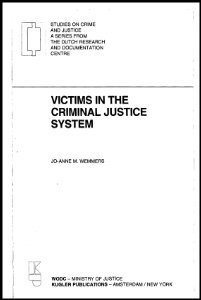
Victims in the criminal justice system: A study into the treatment of victims and its effects on their attitudes and behaviour

Edited by J.A. Wemmers.

In the last fifteen to twenty years, criminal justice policy-makers and government in the Netherlands have begun to realize that victims of crime are often seriously affected by their experience and that reactions by criminal justice authorities are not always supportive. This realization was in part stimulated by the women's movement which drew attention to violence against women and the position of these victims in the criminal justice system. Other developments which have contributed to the increased attention for victims of crime include the rise in the registered crime rate which was at its peak during the seventies and early eighties. Also in the early seventies, the victim survey was introduced. It revealed that the registered crime statistics are incomplete and that only a fraction of crimes are brought to the attention of authorities. At the same time, police were finding it increasingly difficult to solve the crimes which were brought to their attention and the clearance rate began to drop. Authorities realized that they can only do their work if victims are prepared to report crime to them and that their willingness to report crimes is in part dependent on the quality of the relationship between citizens and the justice system.

The Hague: WODC, Ministry of Justice ; Amsterdam : Kugler Publications. 1996. 252p.

download
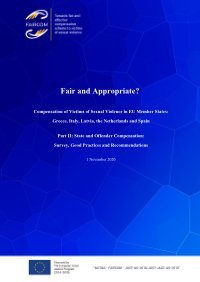
Fair and Appropriate? Compensation of Victims of Sexual Violence in EU Member States: Part II

By N Elbers; A Akkermans; H Soleto Muñoz; Fiodorova; A Grané; J Maria Tamarit; L Arantegui; P Patrizi; GL Lepri; E Lodi; D Chirico; I Lāce; L Vaivode; J Dilba; A Brekasi; N Zoidou Saripapa; N Spetsidis.

The second eBook of the FAIRCOM Project, available as download on this page, presents the results of an investigative study on State Compensation and Offender Compensation in the current five partner countries: Greece, Italy, Latvia, the Netherlands and Spain. It identifies good practices and offers recommendations.

The last 20 years, victims of crime have received increased attention in the criminal trial process. Various EU legislation, in specific the Victims’ Rights Directive 2012/29/EU,1 has established important victims’ rights, such as the right to receive information, respectful treatment, legal support, victim support and compensation. Most EU member states have implemented the legislation and the position of victims has clearly been strengthened. Now that victims of crime are in the spotlight, it is a good opportunity to also focus on specific vulnerable groups of victims in criminal law: victims of sexual crimes. Victims of sexual crimes require special attention for several reasons. Firstly, the scale in which sexual violence occurs is significant: according to a report of the European Agency for Fundamental Rights (FRA), it is estimated that 3.7 million women in the EU are subjected to sexual violence every year. 2 In total 11% of women have experienced some form of sexual violence since they were 15 years old. 5% of women have been raped since the age of 15. 3 The FRA did not include sexual violence to men. What is known about men is that 10% of victims of violent sexual crimes are men, the majority (90%) of the victims are women. 4 Of the perpetrators, 99% are men, 1% are women. 5 Secondly, victims of sexual crimes need support in their search for justice. Only 14% of victims of sexual violence report their offense to the police.6 Sexual crimes are often associated with shame and stigma and often mentioned in relation to secondary victimisation. About 25% of victims of sexual crimes do not dare to report the crime because of shame and 12% does not report because they think they will not be believed. Victims of physical violence also do not report because of shame or not being believed but the percentages are much lower, respectively 8% and 2%.7 Of the victims of sexual crimes who report to the police, about 46% are not satisfied with the treatment received by the police.

Amsterdam: Free University of Amsterdam, 2020. 94p.

download
Challenge Of Crime In A Free Society

By the President’s Commission of Law Enforcement and Administration of Justice.

“This report is about crime in America — about those who commit it, about those who are its victims, and about what can be done to reduce it….The existence of crime, the talk about crime, the reports of crime, and the fear of crime have eroded the basic quality of life of many Americans.” From the Summary.

Harrow and Heston Classic reprint. (1967) 342 pages.

download
Criminals of Chicago

By Prince Emmanuel of Jerusalem.

“ History shows that hanging did not prevent petit larceny. So we have abandoned the policy of frightfulness in punishment and cannot revert to it even though it still has some few supporters. And yet we feel that the theory of punishment being deterrent is philosophically sound. …The first news from the Laboratory revealed the prevalence of feeble-mindedness among delinquents. “

Rosburgh Publishing (1921) 247 pages.

download
Criminal Intelligence

By Carl Murchison.

“This material is offered for the special consideration of lawyers, psychologists, siociologists, social workers, and all those who have to do with the formulation of criminal law, the treatment of criminals, and the molding of public opinion concerning the enemies of organized society…”

A Read-Me.Org Classic Reprint (1926) 483 pages.

download
Crimes Against Criminals

By Robert J. Ingersoll.

In addition to these, nations have relied on confiscation and degradation, on maimings, whippings, brandings, and exposures to public ridicule and contempt. Connected with the court of justice was the chamber of torture. The ingenuity of man was exhausted in that would surely the construction the most reach of instruments sensitive nerve. All this was in the interest protection of virtue, and done of civilization — for the states. the well-being of how Curiously enough, the fact is that, no matter severe the punishments were, the crimes increased.

download

NY. Farrell (1892) 49 pages.

Mob Rule

By Ida Well-Barnett.

“Immediately after the awful barbarism which disgraced the State of Georgia in April of last year, during which time more than a dozen colored people were put to death with unspeakable barbarity, I published a full report showing that Sam Hose, who was burned to death during that time, never committed a criminal assault, and that he killed his employer in self- defense.”

Harrow and Heston Classic Reprint (1892) 63 pages.

download
The Complete Celebrated Crimes

By Alexander Dumas.

“The Crimes were published in Paris, in 1839-40, in eight volumes, comprising eighteen titles…. The success of the original work was instantaneous. Dumas laughingly said that he thought he had exhausted the subject of famous crimes, until he became deluged with letters from every province in France, supplying him with material upon other deeds of violence! The subjects which he has chosen, however, are of both historic and dramatic importance.

Harrow and Heston Classic Reprint. (1910) 1,565 pages.

download
Giant clam shells, ivory, and organised crime: Analysis of a potential new nexus.

By Jenny Feltham and Luciana Capdepon

Giant clams are a traditional source of subsistence protein for coastal communities across Asia and Pacific regions. In recent decades, however, giant clams have been subject to poaching and commercial harvesting. Now viewed as high-value luxury food item, giant clams are also in demand in the international aquarium trade, and their shells are sought after for the ornamental carving industry. The Wildlife Justice Commission is concerned that giant clam shells are being used as a substitute for elephant ivory. Since China’s 2017 ban on the domestic elephant ivory trade, giant clam shells are an increasingly popular ivory alternative. These factors are likely to have contributed to the overexploitation and rapid decline of giant clam populations throughout many of their natural habitats. This not only puts increased pressure on the vulnerable giant clam, but also perpetuates demand for “premium” ivory products, sustaining the threat to elephant populations in the wild. Giant clams may not be as immediately charismatic as, say, elephants or rhinos, but they play a valuable role in maintaining healthy coral and oceans. Preventing biodiversity loss and preserving ocean eco-systems are crucial in the fight against catastrophic climate change.

The Hague: Wildlife Justice Commission, 2021. 41p.

download
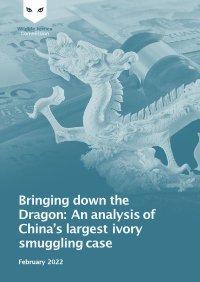
Bringing Down the Dragon: An analysis of China’s largest ivory smuggling case

By Jenny Feltham and Hendelene Prinsloo.

Bringing down the Dragon: An analysis of China’s largest ivory smuggling case, provides an in-depth case study of the inner workings of a wildlife crime syndicate and how Chinese authorities took it down by targeting the key facilitators and following the money. It also highlights how complex trafficking is and offers useful insights for law enforcement. The Chen organised crime group was a successful organised crime network, the kingpins, the untouchables. For several years they trafficked huge quantities of ivory by flying under the radar and eluding authorities through their corrupt connections. That all changed in late 2018 when Chen Chenzong, son of the Big Boss Chen Jiancheng, was arrested whilst dining out at a restaurant in China. Chinese authorities caught onto the network and the key players. They targeted the corrupt facilitators, in this instance a corrupt Customs Officer. Then followed the money, eventually seizing the assets of the Chen organised crime group. By December 2020, 17 members of the group had been convicted for their roles in trafficking 20.22 tonnes of ivory – equivalent to approximately 2000 elephants – from Nigeria to China. This case is a blueprint for law enforcement agencies investigating transnational organised wildlife crime.

The Hague: Wildlife Justice Commission, 2022. 56p.

download
Convergence of wildlife crime with other forms of organised crime

By Jenny Feltham.

Through its own investigations and intelligence analysis, the Wildlife Justice Commission has also collected evidence of criminal networks that are dealing in wildlife alongside other illicit commodities. This report aims to present some of these examples, along with information collected from open sources, to contribute to the knowledge base on this issue. It sets out 12 case studies that illustrate a range of converging crime types and typologies that have transpired in different regions of the world to increase the understanding of how these intersections can occur on the ground. The case studies include six cases involving the trafficking of terrestrial wild animals, three cases involving fisheries crimes, and three cases involving timber crimes (although they are collectively referred to as wildlife crime throughout the report). The cases demonstrate that criminal groups may have a range of motivations to diversify their activities and engage in wildlife or other types of crime Convergence can occur opportunistically on an adhoc basis, as a complete “career shift” in response to changing conditions, or as part of a diversification strategy to increase profits across a range of illicit commodities. It can also occur transactionally when criminal groups in different markets exchange goods or services with each other or could be embedded to such an extent that the crimes are inextricably linked.

The Hague: Wildlife Justice Commission, 2021. 53p.

download
Child sexual abuse in the digital era : Rethinking legal frameworks and transnational law enforcement collaboration

By S.K. Witting.

With access to and usage of it increasing dramatically over the past 20 years, the Internet has become an emerging realm for human interaction. With children constituting one-third of Internet users worldwide, this realm offers endless opportunities to learn, connect, and interact. At the same time, the Internet facilitates child sexual abuse on a large scale – through the production, dissemination, and accessing of child sexual abuse material.This study aims to critically analyse emerging aspects of the international and national regulation, investigation and prosecution of online child sexual abuse material from a child-rights and rule-of-law-based approach. It investigates emerging aspects of substantive and procedural law which have been little explored in the past, zooming in on complex constitutional aspects by applying a comparative legal analysis approach with a strong focus on the Global South as well as interdisciplinary legal research.In order to solve these complex legal issues, the answer lies in the identification and subsequent navigation of a variety of dichotomies that govern the discourse on online child sexual abuse material. The international and national regulation, investigation and prosecution of emerging aspects of online child sexual abuse material hence require constant identification, reflection and calibration of competing discourses, with a view to developing a cyber-specific yet victim-sensitive response that upholds the rule of law and takes a child-centred approach.

Leiden: Leiden University, 2020. 158p.

download
Understanding the Effects of Violent Video Games on Violent Crime

By Benjamin Engelstätter, A. Scott Cunningham, and Michael R. Ward.

Most psychological studies report a positive relationship between violent video game play and aggression. In line with that researchers and policy makers alike understand playing violent video games as contributing factors to increased aggression in teenagers and young adults including, perhaps, high school shootings. However, laboratory studies are unable to account for either the possible selection of relatively violent people into playing violent video games or foregone aggressive effects of alternative activities video game playing may substitute for. Specifically, psychological laboratory experiments cannot address the time use effects of video games which tend to incapacitate gamers from violent activity, e. g. crimes, by drawing them into extended gameplay. Accordingly, laboratory studies may be poor predictors of the net effects of violent video games on society, thus potentially overstating the importance of video game induced aggression. We argue that as both a behavioral tendency toward aggression and incapacitation from aggression are consequences of playing violent video games, the policy relevance of violent video game regulation depends critically on the degree to which one outweighs the other. We empirically investigate how video games could affect crime using four years of weekly data from the US by matching four different data sources. The number of violent and nonviolent crime incidents each week we obtain from the National Incident Based Reporting System (NIBRS). Our measure for video game play is derived from VGChartz which report the unit sales of the top 50 video games across the US each week. To determine the violent content of each game, we collect information from the Entertainment Software Rating Board (ESRB). This nonprofit body rates the appropriateness of games and provides detailed content descriptions for each game including the degree of violence. To control for unobserved factors that might influence both crime rates and video game play like, e. g., bad weather such as rain or heavy snow, we focus only on changes in game sales associated with differences in game quality as measured by Gamespot, a professional video game rating board (instrumental variable approach). Our results indicate two opposing effects. They suggest the behavioral effects in line with the psychological studies. If not for the incapacitation effect, violent video games would be associated with more violent crimes. However, the results also support a voluntary incapacitation effect in which playing either violent or non-violent games decrease crimes. Sales of either violent or non-violent games are associated with decreased violent and non-violent crime. The incapacitation effect dominates the behavioral effect such that, overall, violent video games lead to decreases in violent crime.

Mannheim: ZEW – Leibniz Centre for European Economic Research, 2011. 47p.

download
The Internet Effects on Sex Crime and Murder – Evidence from the Broadband Internet

By André Nolte.

This paper studies the effects of the introduction of a new mass medium on criminal activity in Germany. The paper asks the question of whether highspeed internet leads to higher/lower sex crime offences and murder. I use unique German data on criminal offences and broadband internet measured at the municipality level to shed light on the question. In order to address endogeneity in broadband internet availability, I follow Falck et al. (2014) and exploit technical peculiarities at the regional level that determine the roll-out of high-speed internet. In contrast to findings for Norway (Bhuller et al., 2013), this paper documents a substitution effect of internet and child sex abuse and no effect on rape incidences. The effects on murder increase under the instrumental variable approach however remain insignificant. Overall, the estimated net effects might stem from indirect effects related to differences in reporting crime, a matching effect, and a direct effect of higher and more intensive exposure to extreme and violent media consumption. After investigating the potential channel, I do find some evidence in favor of a reporting effect suggesting that the direct consumption effect is even stronger. Further investigation of the development of illegal pornographic material suggests that the direct consumption channel does play a significant role in explaining the substitution effect.

Mannheim: ZEW - Leibniz Centre for European Economic Research, 2017. 60p.

download
Development and Validation of Scientific Indicators of the Relationship Between Criminality, Social Cohesion and Economic Performance

By Horst Entorf and Hannes Spengler

According to the European Parliament, unemployment, social disintegration, the lack of an integrative policy, and the worsening of urban services and living conditions cause frustration and despair, especially among economically and socially disadvantaged groups, and constitute unfavourable conditions that might lead to delinquent behaviour. Furthermore increasing poverty and inequality are supposed to be crime-enhancing factors. Based on this view, the European Commission has put out to tender a research project titled "Development and validation of scientific indicators of the relationship between criminality, social cohesion and economic performance" which has been executed by ZEW during the period 1/12/1998 - 29/2/2000. The present publication provides the results obtained from this project. The study intends to contribute to a better understanding of the interactions between criminality, economic performance and social cohesion. We try to achieve this aim by evaluating the existing economic and criminological research (with a special focus on quantitative research) and by carrying out own empirical investigations on the basis of a panel consisting of national time series from the 15 EU member states, an international cross-section of nations and an unique set of regional panel data originating from eight EU member states. Our empirical results about causes of crime reveal the crime reducing potential of intact family values. A smaller number of divorces and earlier marriage significantly reduce delinquency. By the same token, less efficient child care as a consequence of lacking family cohesion might explain the crime enhancing effects found for increasing female labour force participation rates. Further evidence supporting the interdependence of crime and the labour market show up in significant parameter estimates for indicators of unemployment, fixed-term contracts and part-time working. Furthermore, we find that higher wealth is associated with higher property crime rates and more drug-related offences, and that in turn drug offences foster the incidence of property crime.

Mannheim: ZEW- Leibniz Centre for European Economic Research, 2000. 213p.

download
The Sussex Hate Crime Project: final report

By Jennifer Paterson, Mark A Walters, Rupert Brown, and Harriet Fearn.

This report summarises the findings from a five year research project, the Sussex Hate Crime Project, funded by the Leverhulme Trust. The aim was to examine the indirect impacts of hate crimes – how hate attacks on members of a community affect the thoughts, emotions and behaviours of other members of that community. The project focused on hate crimes targeted against LGB&T and Muslim communities and used a variety of different research methods, including questionnaire surveys, individual interviews and social psychological experiments.

Sussex, UK: University of Sussex, 2018. 54p.

download