Open Access Publisher and Free Library
CRIME+CRIMINOLOGY.jpeg

CRIME

Violent-Non-Violent-Cyber-Global-Organized-Environmental-Policing-Crime Prevention-Victimization

Posts in Violence & Oppression
Information Manipulation and Organized Crime: Examining the Nexus

By Tena Prelec

Information manipulation has been a growing concern in recent years, particularly in relation to the disinformation tactics employed by authoritarian regimes. However, the role of non-state actors, such as organized crime (OC) groups, in information manipulation has been largely overlooked. This research aims to fill this gap by examining the various ways in which OC groups manipulate information to achieve their objectives and those of actors connected to them. Drawing on Nicholas Barnes’ concept of ‘political criminality’ (2017), this study examines the varying degrees of proximity between criminal actors and the state, which is essential in exploring the complex interplay between OC and information manipulation. Empirical data was collected from several geographies, with a particular focus on Eastern Europe and the post-Soviet space, including Ukraine, Russia, Moldova (Transnistria), and Albania. The research highlights several dimensions of interest, including: the changing opportunities that technology gives to OC groups to shape facts and narratives; media ownership by organised crime groups and criminal actors; and the ways in which this interplay is situated within the global political economy of offshore finance – including the wider networks of enablers these actors rely on. By shedding light on these aspects, the research seeks to contribute to a more comprehensive understanding of the threat posed by the misuse of information, situates it within the literatures on non-state actors and transnational kleptocracy, and puts forward a framework for analysis that can be tested in future work.

Birmingham, UK: SOC ACE Research Paper 22. University of Birmingham 2023. 44p,

El Salvador’s (Perpetual) State of Emergency: How Bukele’s Government Overpowered Gangs

By Alex Papadovassilakis, et al

El Salvador’s gangs are in disarray.

For decades, the Mara Salvatrucha (MS13) and two factions of the 18th Street (Barrio 18) dominated the small Central American nation’s criminal landscape. The gangs embedded themselves in poor communities, terrorizing urban dwellers with extortion and murders. Successive governments tried and failed to dismantle the gangs with aggressive security policies, known as mano dura (iron fist).

In March 2022, the government of El Salvador President Nayib Bukele enacted a state of emergency (régimen de excepción) in response to a brutal gang massacre that left 87 dead. Buoyed by emergency powers, security forces tore through the gangs, arresting tens of thousands of suspected gang members and collaborators. Those who escaped arrest went underground or into exile. In a flash, the MS13 and Barrio 18 all but vanished from the streets of El Salvador.

But though battered and bruised, a surprising number of gang members remain at large. The country’s prisons, once incubators for the gangs, have never been so full.

This six-part investigation looks at how the Bukele government’s crackdown succeeded in overpowering the MS13 and Barrio 18. We assess what remains of the gangs in El Salvador, and contemplate whether these structures could one day return or mutate.

Washington, DC; Medellin, Columbia: InSight Crime, 2023.56p.

The Moskitia: The Honduran Jungle Drowning in Cocaine

By: Bryan Avelar, Juan José Martínez

Moskitia is dying. And it is organized crime that is killing it.

First came the drugs, as traffickers turned the region’s coasts and forests into a cocaine corridor. Then came the traffickers themselves, financing invaders that are clear-cutting thousands of hectares of forest and fencing off vast tracts of land with barbed wire and armed guards.

The region’s Indigenous Miskito people have been left trapped in desperate poverty, and are caught between the traffickers and an indifferent state. But some are now preparing to fight back.

Washington, DC, Columbia: InSight Crime, 2023. 64p..

South Africa Illicit Copper Economy

By Jenni Irish-Qhobosheane

Our new report focuses on the pervasive issue of copper theft in South Africa. This socio-economic challenge has severe consequences on the country's already strained infrastructure, affecting the capacity and operations of state-owned entities and municipalities.

Our 2022 South Africa Strategic Organized Crime Risk Assessment revealed that the nation's critical infrastructure is 'at a tipping point after years of chronic mismanagement and rampant theft,' noting the role of copper theft as an exacerbating factor. In light of this alarming situation, our latest report delves into the repercussions of copper theft on South Africa's infrastructure and its links to organized crime networks.

This comprehensive study examines the value chain and market dynamics for stolen copper, a familiar yet often overlooked area where criminal enterprises have become deeply entrenched. With a focus on solutions, the report outlines measures taken to combat copper theft and explores possible future strategies for addressing this growing concern.

Geneva, SWIT: Global Initiative Against Transnational Organized Crime, 2023. 60p.

2023 West Africa Organised Crime Resilience Framework: Assessing threats and resilience - Foundational report

By Lyes Tagziria and Lucia Bird Ruiz Benitez de Lugo

West Africa is one of the world’s most vibrant and diverse regions; home to over 400 million people, around 1 200 languages and many different religious and ethnic identities. The region’s economic growth since the turn of the century has been impressive, resulting in a significant reduction in absolute levels of poverty. Nevertheless, with rampant insecurity at the hands of violent extremists, armed groups and criminal bandits, political instability, limited economic opportunities for the region’s burgeoning youth population and the worsening impact of climate change, West Africa faces many complex challenges.

With over 20 000 conflict fatalities across the region in 2022 alone, violence in West Africa, especially in the Sahel region, is at unprecedented levels. According to the ACLED Conflict Severity Index, three countries in West Africa – Mali, Burkina Faso and Nigeria – have extreme or high levels of conflict. Illicit economies play an important role in sustaining instability across the region.

The security and well-being of citizens across the ECOWAS region is affected not only by violent conflict, but by myriad, interwoven factors from economic prosperity to political representation, justice and security, social cohesion, freedom and much more. In this context the concept of human security, as opposed to the narrower concept of state security, has increasingly become the focus of policymakers across West Africa.

As set out in the ECOWAS Country Risk and Vulnerability Assessments (CRVAs), ‘the human security framework provides a holistic approach to understanding different threats that affect individuals’ lives, whether this is through conflict, health, food, environment, or other social, political or economic factors’.

A key component of this human-centric approach to security, focused on reducing harm to the people of West Africa, is prevention. This requires comprehensive, accurate and timely data on existing and future threats and is therefore one of the main rationales behind the work of the ECOWAS Commission, through both the Early Warning Directorate and the ENACT Organized Crime Index. While the objectives of the index are manifold, its principal aim is to build an evidence base to underpin responses to organized crime.

The 2021 ENACT Organized Crime Index identified the West Africa region as having the second-highest level of criminality on the African continent, with human trafficking, drugs and the illicit trade in non-renewable resources forming the most prevalent criminal markets. The region placed in second once again in the latest iteration of the index, the 2023 Global Organized Crime Index.

In 2023, West Africa overtook Southern Africa as the region with the highest resilience score on the continent, pointing to comparatively high levels of resilience even in areas affected by significant criminal markets. The index highlighted legislative frameworks, civil society actors and the region’s international collaboration in the fight against organized crime as relative regional strengths. Overall levels of resilience, however, both objectively and within the global context, are weak.

The index’s findings provides a statistical underpinning for the relationship between illicit markets, security and stability, demonstrating a strong negative correlation between criminality and peacefulness. In other words, the less peaceful a country, the more likely it is to be afflicted by high levels of organized crime. In other words, the less peaceful a country, the more likely it is to be afflicted by high levels of organized crime. Responding to illicit economies which pose a threat to these goals must be a central element of programming. In line with this, the Organized Crime Resilience Framework (OCRF) examines the major organized-crime threats facing the West African region, as identified by the index and the CRVAs published by the ECOWAS Early Warning Directorate.

While the index is devoted to organized crime, the CRVAs focus on conflict and human security more broadly. Drawing on both these datasets engenders a conflict-sensitive and human-security-focused assessment of organized crime in West Africa, encompassing threats and vulnerabilities, as well as potential sources of resilience.

Geneva, SWIT: Global Initiative Against International Organized Crime, Ecowas Commission, 2023.

Conflict, Governance and Organized Crime: Complex Challenges for UN Stabilization Operations

By Marina Caparini

This SIPRI Report examines how organized crime is intertwined with armed conflict and hybrid governance systems in three states that currently host United Nations stabilization missions. It surveys the conflict/crime/governance nexus in the Central African Republic (CAR), the Democratic Republic of the Congo (DRC), and Mali, and how UN stabilization missions, in particular the UN Police, have engaged with the challenge of organized crime.

The report argues that improving how UN stabilization interventions engage with organized crime will require a frank assessment of the significance of organized crime in systems of governance and patronage, of the role of organized crime as a driver and enabler of armed conflict by non-state armed groups, and of the involvement of state-embedded actors in illicit markets. The complex links between conflict and governance actors and organized crime in the settings examined raise fundamental questions about the assumptions underlying peace operations. The report concludes with a set of recommendations on how to move to more realistic analyses and bases for peace operations.

Solna: Stockholm International Peace Research Institute, 2022. 57p.

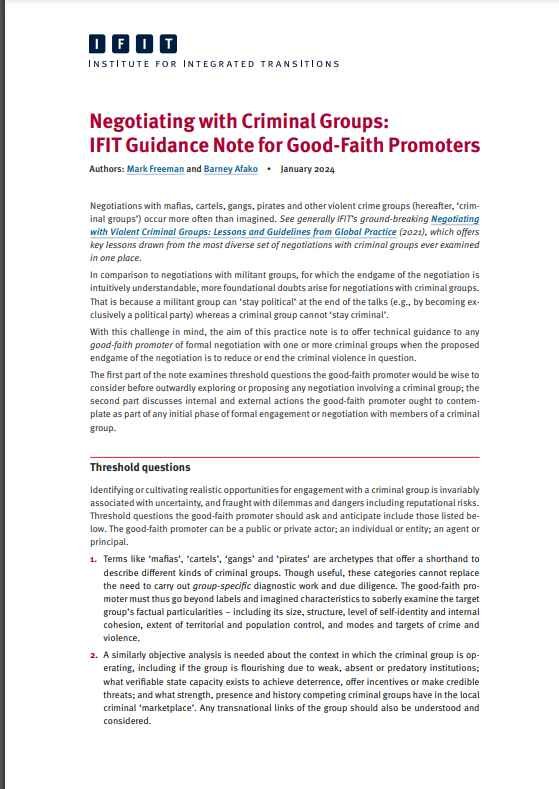
Negotiating with Criminal Groups: IFIT Guidance Note for Good-Faith Promoters

By Mark Freeman and Barney Afako

Co-authored by Mark Freeman and Barney Afako, the publication offers simplified technical guidance directed to any good-faith promoter of formal negotiation with one or more violent criminal groups when the proposed endgame of the negotiation is to reduce or end the criminal violence in question. In doing so, the paper draws on key ideas developed in IFIT’s ground-breaking report, Negotiating with Violent Criminal Groups: Lessons and Guidelines from Global Practice (Freeman & Velbab-Brown, 2021), which covers the most diverse set of negotiations with criminal groups ever examined in one place.

The first part of Freeman and Afako's practice note examines threshold questions a good-faith promoter would be wise to consider before outwardly exploring or proposing any negotiation involving a criminal group; the second part discusses internal and external actions a good-faith promoter ought to contemplate as part of any initial phase of formal engagement or negotiation with members of a criminal group.

Barcelona: Institute for Integrated Transitions (IFIT) , 2024. 3p.

Understanding the Role of Women in Organized Crime

By The Organization for Security and Co-operation in Europe

This report offers empirical evidence and case studies from across the OSCE area on how women are recruited into organized crime groups, their roles within them, and how and why they exit these groups. It demonstrates that the role of women in organized crime is nuanced. Evidence shows that while women are often exploited and victimized by organized crime groups, they can also be important actors. Yet persistent gender stereotypes mean that women’s agency in organized crime is often not recognized by criminal justice practitioners. Failing to recognize women’s agency in organized crime impedes the understanding in participating States of the complexity of the organized crime landscape, and hampers their ability to combat transnational organized crime or support women to leave organized crime groups.

Vienna: OSCE, 2023. 72p.

Non-Fatal Shooting Crosswalk Study: FINAL REPORT

By Alaina De Biasi Edmund F. McGarrell Scott E. Wolfe

Historically, crime in the United States has been measured by the Uniform Crime Reporting (UCR) system administered by the Federal Bureau of Investigation (FBI). In this system, local, county, state, Tribal and federal law enforcement agencies submit summary crime data on incidents and arrests to the UCR system. Crime patterns and trends can then be analyzed and tracked at local, state, and national levels. 

United States, Michigan Justice Statistics Center, School of Criminal Justice, Michigan State University. 2023. 33pg
What the data says about gun deaths in the U.S.

By John Gramlich

More Americans died of gun-related injuries in 2020 than in any other year on record, according to recently published statistics from the Centers for Disease Control and Prevention (CDC). That included a record number of gun murders, as well as a nearrecord number of gun suicides. Despite the increase in such fatalities, the rate of gun deaths – a statistic that accounts for the nation’s growing population – remains below the levels of earlier years.

United States, Pew Research Center. 2022. 7pg.

Racial Isolation, School Police, and the “School-To-Prison Pipeline”: An Empirical Perspective on the Enduring Salience of “Tipping Points”

By Michael Heise

Two broad trends inform public K-12 education’s current trajectory. One involves persisting (and recently increasing) school racial isolation which helps account for an array of costs borne by students, schools, and communities. A second trend, involving a dramatically increasing police presence in schools, is evidenced by a rising school resource officer (“SRO/police”) presence in schools. Increases in the magnitude of a school’s SRO/police presence correspond with increases in the school’s propensity to engage law enforcement agencies in student disciplinary matters which, in turn, help fuel a growing school-to-prison pipeline problem. While these two broad trends propel two distinct research literatures, these research literatures do not meaningfully engage with one another. Empirical research is largely silent on the degree to which, if at all, variation in a school’s racial isolation level influences how its SRO/police presence interacts with the school’s propensity to report student discipline issues to law enforcement agencies. This Article examines whether variation in school racial isolation levels informs whether a school’s SRO/police presence influences the school’s law enforcement reporting rates. Results from this study imply that any such influence is confined to schools where non-white student enrollment ranges from 11% to 50%. The research literature on tipping points provides one helpful interpretative lens to better understand why this specific school racial isolation band systematically differs from others when it comes to SRO/police presence’s influence on a school’s propensity to report student discipline matters to law enforcement agencies.

Buffalo Law Review Vol. 71, No. 2 (2023)

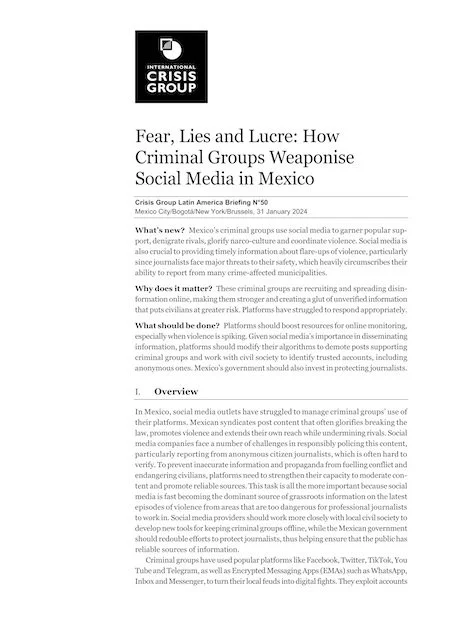
Fear, Lies and Lucre: How Criminal Groups Weaponise Social Media in Mexico

By International Crisis Group

What’s new? Mexico’s criminal groups use social media to garner popular support, denigrate rivals, glorify narco-culture and coordinate violence. Social media is also crucial for providing timely information about flare-ups of violence, particularly since journalists face major threats to their safety, which heavily circumscribes their ability to report from many crime-affected municipalities.

Why does it matter? These criminal groups are recruiting and spreading disinformation online, making them stronger and creating a glut of unverified information that puts civilians at greater risk. Platforms have struggled to respond appropriately.

What should be done? Platforms should boost resources for online monitoring, especially when violence is spiking. Given social media’s importance in disseminating information, platforms should modify their algorithms to demote posts supporting criminal groups and work with civil society to identify trusted accounts, including anonymous ones. Mexico’s government should also invest in protecting journalists.

Brussels: Crisis Group, 2024

 Hybrid Interpersonal Violence in Latin America: Patterns and Causes   

By Abigail Weitzman, Mónica Caudillo, and Eldad J. Levy

In this review, we argue that to understand patterns and causes of violence in contemporary Latin America, we must explicitly consider when violence takes on interpersonal qualities. We begin by reviewing prominent definitions and measurements of interpersonal violence. We then detail the proliferation of interlocking sources of regional insecurity, including gender-based violence, gangs, narcotrafficking, vigilantism, and political corruption. Throughout this description, we highlight when and how each source of insecurity can become interpersonal. Next, we outline mutually reinforcing macro and micro conditions underlying interpersonal violence in its many hybrid forms. To conclude, we call for more multifaceted conceptualizations of interpersonal violence that embrace the complexities of Latin American security situations and discuss the opportunities and challenges that lie ahead in this area.

Annual Review of Criminology, Volume 7, Page 163 - 186

The Sixty-Year Trajectory of Homicide Clearance Rates: Toward a Better Understanding of the Great Decline

By Philip J. Cook and Ashley Mancik

In 1962, the FBI reported a national homicide clearance rate of 93%. That rate dropped 29 points by 1994. This Great Decline has been studied and accepted as a real phenomenon but remains mysterious, as does the period of relative stability that followed. The decline was shared across regions and all city sizes but differed greatly among categories defined by victim race and weapon type. Gun homicides with Black victims accounted for most of the decline. We review the evidence on several possible explanations for the national decline, including those pertaining to case mix, investigation resources, and citizen cooperation. Our preferred explanation includes an upward trend in the standard for arrest, with strong evidence that although clearance-by-arrest rates declined, the likelihood of conviction and prison sentence actually increased. That result has obvious implications for the history of policing practice and for the validity of the usual clearance rate as a police performance measure.

Annual Review of Criminology, Volume 7, Page 59 - 83

Global Study on Homicide 2023

By The United Nations Office on Drugs and Crime, Research and Trend Analysis Branch

Preventing and reducing homicide means sparing hundreds of thousands of lives lost to violence every year. To do that, we must understand the complex and highly diverse range of threats and phenomena that drive and intersect with such lethal violence – from interpersonal dynamics to organized crime and rule of law to climate change, poverty and inequality to demographics, and much more – and how they differ across national and regional contexts. This Global Study on Homicide is an effort to reveal and delve into the facts behind the violence, to try and identify notable trends and to inform policies and solutions. The Study shows that 2021 was an exceptionally lethal year, with an estimated 458,000 intentional homicides worldwide, averaging 52 killings every hour. The global homicide rate was at 5.8 for every 100,000 persons, a number that sadly reflects little progress in reducing lethal violence worldwide since the launch of the 2030 Agenda for Sustainable Development in 2015. The biggest share of the victims were killed with firearms, which accounted for 47 per cent of homicides committed with a known mechanism worldwide. That number rises to 75 per cent in the Americas, which has the highest homicide rate in the world, and where organized crime is responsible for at least half of all homicides. In different parts of the world, organized crime can lead to spikes in homicide, particularly as criminal groups compete for control. Organized crime has also had an impact on homicide rates in Europe. While the regional homicide rate has decreased over the last six years, there are signs of increased lethal violence connected to organized crime in various countries of the continent. Such organized crime-related killing – and all homicidal violence, in all parts of the world – is far more likely to be committed by, and against, men. Men account for 81 per cent of the victims of intentional homicide globally, and around 90 per cent of the suspects. Women, on the other hand, are more likely to be killed because of their gender, and more likely to lose their lives to violence at home. Women account for the victims in 54 per cent of killings in the home, and 66 per cent of intimate partner killings. Many people are also killed because of what they do, including human rights defenders, humanitarian workers, journalists, and environmental activists. The current global situation, characterized by growing conflicts and rule of law challenges, is fuelling such sociopolitical homicides, which in many cases happen with impunity. Given the broad and diverse factors driving lethal violence around the world, effective responses to homicide must cover a wide spectrum of context-specific interventions. Some interventions will be designed to reduce genderbased violence against women and girls, others will be geared towards reducing organized crime and gang violence, and others still may focus on firearm laws and regulations, vocational training to at-risk demographics, or mental health interventions. But all responses must share common threads, namely the need to be based on evidence, the need to prioritize prevention and address root causes, and the need to invest significantly. Investing in homicide prevention and responses is of particular priority in Africa, which this Global Study projects to be the most at-risk region over the coming decades, in large part due to its younger population, economic inequality levels, climate vulnerability, and weaker response capabilities. This study also highlights the significant limitations in the information available across regions, and the need to invest in better data collection. It is highly important to understand the types of homicide in any given context, whether family-related, gang-related, or any of the other identified typologies, yet more than a third of all detected homicides are classified as “unknown”. Similarly, four out of every ten killings of women and girls do not have information on the victim-perpetrator relationship, despite the prevalence of intimate partner killings against women and girls.

Vienna/New York: United Nations Office on Drugs and Crime; Research and Trend Analysis Branch, 2023. 155pp; December 2023

Envy, Poison, and Death: Women on Trial in Classical Athens

By: Esther Eidinow

At the heart of this book are some trials conducted in Athens in the fourth century BCE. In each case, the charges involved a combination of supernatural activities, including potion-brewing and cult activity; the defendants were all women. Because of the brevity of the ancient sources, and their lack of agreement, the precise charges are unclear; the reasons for taking these women to court, even condemning some of them to die, remain mysterious. This book takes the complexity and confusion of the evidence not as a riddle to be solved, but as revealing multiple social dynamics. It explores the changing factors—material, ideological, and psychological—that may have provoked these events. It focuses in particular on the dual role of envy (phthonos) and gossip as processes by which communities identified people and activities that were dangerous, and examines how and why those local, even individual, dynamics may have come to shape official civic decisions during a time of perceived hardship. At first sight so puzzling, these trials come to provide a vivid glimpse of the sociopolitical environment of Athens during the early to mid-fourth century BCE, including responses to changes in women’s status and behaviour, and attitudes to particular supernatural/religious activities within the city. This study reveals some of the characters, events, and local social processes that shaped an emergent concept of magic: it suggests that the legal boundary of acceptable behaviour was shifting, not only within the legal arena, but also with the active involvement of society beyond the courts.

Oxford, UK: Oxford University Press, 2015. 434p.

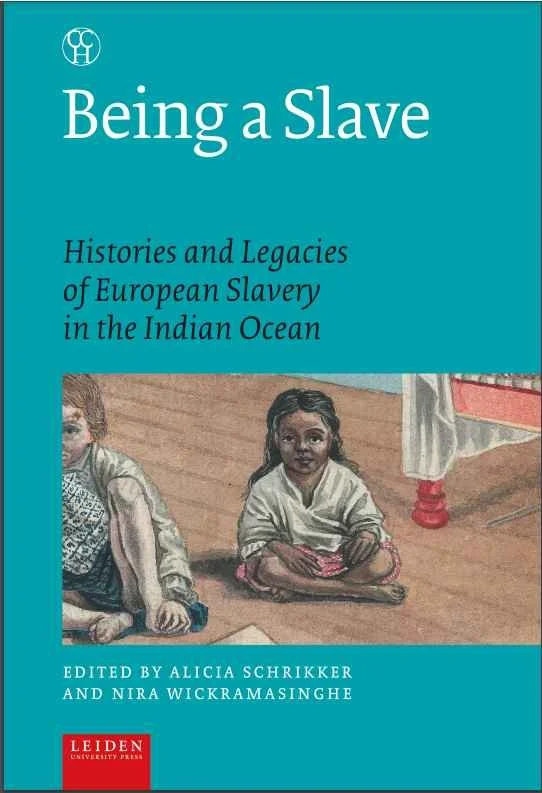
Being a Slave: Histories and Legacies of European Slavery in the Indian Ocean

By: Nira Wickramasinghe and Alicia Schrikker

"Being a Slave brings together scholars and writers who try to come to terms with the histories and legacies of European slavery in the Indian Ocean. This volume discusses a variety of qualitative data on the experience of being a slave in order to recover ordinary lives and, crucially, to place this experience in its Asian local context. Building on the rich scholarship on the slave trade, this volume offers a unique perspective that embraces the origin and afterlife of enslavement as well as the imaginaries and representations of slaves rather than the trade in slaves itself. From Cape to Batavia, slavery is understood as a diffuse practice. This approach helps unearth 18th and 19th century experiences of being a slave in the Indian Ocean world, but also sheds light on continuities in bondage into the present. Contributors face an often hostile archive to extract traces of the lived experience of slavery in court records, petitions or private letters. They also listen to local voices by prying unexplored primary sources such as oral histories, memories and objects."

[Leiden] : Leiden University Press, [2020]

The Genocidal Gaze: From German Southwest Africa to the Third Reich

By Elizabeth R. Baer

The first genocide of the twentieth century, though not well known, was committed by Germans between 1904–1907 in the country we know today as Namibia, where they exterminated hundreds of Herero and Nama people and subjected the surviving indigenous men, women, and children to forced labor. The perception of Africans as subhuman—lacking any kind of civilization, history, or meaningful religion—and the resulting justification for the violence against them is what author Elizabeth R. Baer refers to as the “genocidal gaze,” an attitude that was later perpetuated by the Nazis. In The Genocidal Gaze: From German Southwest Africa to the Third Reich, Baer uses the metaphor of the gaze to trace linkages between the genocide of the Herero and Nama and that of the victims of the Holocaust. Significantly, Baer also considers the African gaze of resistance returned by the indigenous people and their leaders upon the German imperialists.

Detroit, MI: Wayne State University Press, 2017.

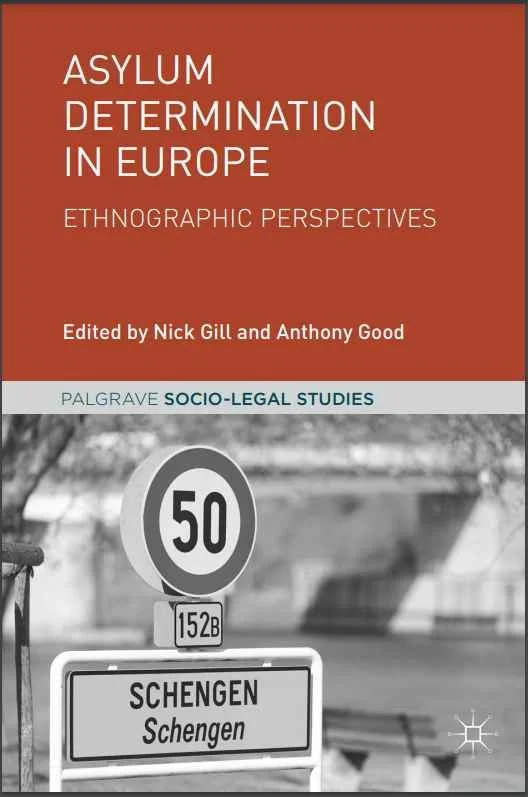
Asylum Determination in Europe: Ethnographic Perspectives

Edited by Nick Gill and Anthony Good

Drawing on new research material from ten European countries, Asylum Determination in Europe: Ethnographic Perspectives brings together a range of detailed accounts of the legal and bureaucratic processes by which asylum claims are decided. The book includes a legal overview of European asylum determination procedures, followed by sections on the diverse actors involved, the means by which they communicate, and the ways in which they make life-and-death decisions on a daily basis. It offers a contextually rich account that moves beyond doctrinal law to uncover the gaps and variances between formal policy and legislation, and law as actually practiced. The contributors employ a variety of disciplinary perspectives – sociological, anthropological, geographical, and linguistic – but are united in their use of an ethnographic methodological approach. Through this lens, the book captures the confusion, improvisation, inconsistency, complexity, and emotional turmoil inherent to the process of claiming asylum in Europe.

Basingstoke, UK: Palgrave Macmillan, 2019. 346p.

Genocide and Mass Violence in Asia : An Introductory Reader

Edited by Frank Jacob

The series Genocide and Mass Violence in the Age of Extremes wants to provide an interdisciplinary forum for research on mass violence and genocide during the "short" 20th century. It will highlight the role of state and non-state actors, the perspectives of perpetrators, victims, and bystanders, and put violent events of the Age of Extremes in a larger political, social, and most important, cultural context. Anthologies and monographs will provide academic and non-academic readers with a deep insight into and a better understanding for the reasons, the acts, and the consequences or mass violence and genocide from a global perspective. The late Nobel Peace Prize laureate and former General Secretary of the UN Kofi Annan (1938–2018) emphasized in his Nobel Lecture in 2001 that the “crime of all crimes” often begins with a single murder. This violent act does not only physically destroy a human being, but, as French philosopher Michel Foucault (1926–1984) highlighted, power relations are established and new mechanisms of power are eventually installed or fortified within a society.2 The 20th century in particular witnessed countless attempts to restructure such power relations and, as a whole, the years between the First World War and the end of the Cold War, i.e. the period Eric Hobsbawm (1917–2012) called the “Age of Extremes,”3 were perhaps, as Kofi Annan correctly further remarked, “the deadliest in human history, devastated by innumerable conflicts, untold suffering, and unimaginable crimes.”4 The century was determined by imperial wars, two World Wars, the Cold War, and new wars at its end.5 These were often accompanied by forms of mass violence, i.e. mass killings or genocides.6 German historian Christian Gerlach consequently speaks of “extremely violent societies” that determined the course of this “Age of Extremes.” Gerlach describes these “extremely violent societies” as formations where various population groups become victims of massive physical violence, in which, acting together with organs of the state, diverse social groups participate for a multitude of reasons. Simply put, the occurrence and the thrust of mass violence depends on broad and diverse support, but this is based on a variety of motives and interests that cause violence to spread in different directions and varying intensities and forms

Berlin ; Boston : De Gruyter Oldenbourg, 2019, 220p.