Open Access Publisher and Free Library
CRIME+CRIMINOLOGY.jpeg

CRIME

Violent-Non-Violent-Cyber-Global-Organized-Environmental-Policing-Crime Prevention-Victimization

Posts in justice
Reducing Drug Use, Reducing Reoffending Are programmes for problem drug-using offenders in the UK supported by the evidence?

By The UK Drug Policy Commission

Over the past ten years, UK drug strategies have increasingly focused on providing treatment and support services for drug-dependent offenders – who commit a disproportionate number of acquisitive crimes (e.g. shoplifting and burglary) – as a way of reducing overall crime levels. This criminal justice focus has been reinforced in the recent 2008 UK drug strategy (new Welsh and Scottish drug strategies are also being developed). The UK Drug Policy Commission (UKDPC) has analysed the evidence for the effectiveness of these initiatives for reducing drug use and reoffending and of the wider impact of this more prominent criminal justice approach. To inform our analysis we commissioned an independent review of the published evidence from leading researchers at the Institute for Criminal Policy Research (ICPR), King’s College London. We also listened to policy experts, local commissioners, drug workers and current and ex-drug users.

London: The UK Drug Policy Commission (UKDPC), 2008. 80p.

download
A Fresh Approach to Drugs: the final report of the UK Drug Policy Commission

By The UK Drug Policy Commission

In this report, UKDPC proposes a radical rethink of how we structure our response to drug problems. It analyses the evidence for how policies and interventions could be improved, with recommendations for policymakers and practitioners to address the new and established challenges associated with drug use.

London: The UK Drug Policy Commission, 2012.173p.

download
Scarface Al and the Crime Crusaders: Chicago's Private War Against Capone

By Dennis Earl Hoffman

According to the Elliot Ness myth, which has been widely disseminated through books, television shows, and movies, Ness and the Untouchables defeated Al Capone by marshaling superior firepower. In Scarface Al and the Crime Crusaders, Dennis Hoffman presents a fresh new perspective on the downfall of Al Capone. To debunk the Eliot Ness myth, he shows how a handful of private citizens brought Capone to justice by outsmarting him rather than by outgunning him.

Drawing on previously untapped sources, Hoffman dissects what he terms a “private war” against Capone. He traces the behind-the-scenes work of a few prominent Chicago businessmen from their successful lobbying of presidents Coolidge and Hoover on behalf of federal intervention to the trial, sentencing, and punishment of Al Capone. Hoffman also reconstructs in detail a number of privately sponsored citizen initiatives directed at stopping Capone. These private ventures included prosecuting the gangsters responsible for election crimes; establishing a crime lab to assist in gangbusting; underwriting the costs of the investigation of the Jake Lingle murder; stigmatizing Capone; and protecting the star witnesses for the prosecution in Al Capone’s income tax evasion case.

Hoffman suggests that as American society continues to be threatened by illegal drugs, gangs, and widespread violence, it is important to remember that the organized crime and political corruption of Prohibition-era Chicago were checked through the efforts of private citizens.

Carbondale, IL: Southern Illinois University Press, 1993. 205p.

download
Gang Violence as Organized Violence: Investigating the Implications for the Women, Peace, and Security Index

By Mariana Viollaz and Jeni Klugman

In this note, we experiment with potential improvements on the measurement of violence in the Women, Peace, and Security (WPS) Index to better reflect the reality on the ground in countries experiencing high levels of gang violence. First, we propose an extension to the measure of conflict from the Uppsala Conflict Data Program—currently the most comprehensive measure of organized violence—by including a more accurate number of deaths associated with gang violence alongside “battle deaths.” We show what difference this would make to WPS Index rankings for a set of four Central American countries and Mexico.

Washington, DC: Georgetown Institute for Women, Peace and Security, 2018. 12p.

download
Organized Crime in Central America: The Northern Triangle

Edited by Cynthia J. Arnson and Eric L. Olson

In early May 2011, dozens of gunmen entered a farm in Guatemala’s Petén region, murdering and decapitating 27 people. Guatemalan authorities as well as speculation in the press have blamed the Zetas, a violent Mexican drug trafficking cartel increasingly active in Guatemala and other parts of Central America . Whether a vengeance killing following the murder of a presumed drug lord, or a struggle amongst the Zetas and Mexico’s Sinaloa cartel for the control of territory and smuggling routes, the massacre underscores the vulnerability of the civilian population in unsecured border areas between Mexico and Guatemala, where narcotics and human trafficking flourish. In response, the government of President Álvaro Colom declared a state of siege similar to the one declared from December 2010-February 2011 in the department of Alta Verapaz. This incident and others like it underscore the serious threat to democratic governance, human rights, and the rule of law posed by organized crime in Central America. The international community has begun to address the burgeoning crisis and commit significant resources to the fight against crime and violence; indeed, not since the Central American wars of the 1980s-1980s has the region commanded so much attention in the international arena. To better understand the nature, origins, and evolution of organized crime in Central America, and thereby contribute to the efforts of policymakers and civil society to address it, the Latin American Program commissioned a series of case studies that looked at the countries of the so-called Northern Triangle—El Salvador, Guatemala, and Honduras— and at the broader regional context affecting national dynamics. Our interest was to understand more fully how organized crime has evolved in Central America, and to examine the links between organized crime and traffickers in Central America, Mexico and Colombia. What role does Central America play in the supply chain for illegal goods between the Andes and the United States, and how have trafficking organizations from these areas related to one another over time? The growing presence and activities of organized crime groups in Central America has worsened an already alarming crisis of citizen security. In mid- 2010, the Inter-American Commission on Human Rights reported that Latin America had the highest levels of youth violence in the world . UN figures indicate that the rate of youth homicide in Latin America is more than double that of Africa, and 36 times the rate of developed countries . An oft-referenced study by the United Nations Development Program (UNDP) noted in 2009 that the seven countries of Central America—Belize, Costa Rica, El Salvador, Guatemala, Honduras, Nicaragua, and Panama—register the highest levels of non-political violence in the world; this observation has been echoed in statements by the U.S. Department of Defense . The situation is most acute in the countries of the Northern Triangle6 . In El Salvador alone, sixty-eight percent of homicide victims are between the ages of fifteen and thirty-four, and nine out of ten victims are male7 . Countries such as Costa Rica, Nicaragua, and Belize are also witnessing rising rates of insecurity associated with the increased presence of organized crime.

Washington, DC: Woodrow Wilson International Center for Scholars, Latin American Program, 2011. 254p.


download
Drug Violence in Mexico Data and Analysis Through 2015

By Kimberly Heinle, Octavio Rodríguez Ferreira, and David A. Shirk

This is one of a series of special reports that have been published on a semi-annual by Justice in Mexico since 2010, each of which examines issues related to crime and violence, judicial sector reform, and human rights in Mexico. The Drug Violence in Mexico report series examines patterns of crime and violence attributable to organized crime, and particularly drug trafficking organizations in Mexico. This report was authored by Kimberly Heinle, Octavio Rodríguez Ferreira, and David A. Shirk, and builds on the work of past reports in this series. The report was formally released on April 10, 2014 and was made possible by the generous support of The John D. and Catherine T. MacArthur Foundation. This report does not represent the views or opinions of the University of San Diego or Justice in Mexico’s sponsoring organizations.

San Diego: Justice in Mexico, University of San Diego, 2016. 58p.

download
Countering the Evolving Drug Trade in the Americas

By Celina Realuyo

The illicit drug trade in the Americas has been evolving and expanding from plant-based narcotics like cocaine, heroin and marijuana to potent synthetic substances like fentanyl and methamphetamine. Since the 1980’s, the U.S. war on drugs focused on countering cocaine trafficking that made the Colombian and Mexican cartels immensely wealthy and powerful. Over the past decade, U.S. narcotic consumption has shifted significantly from cocaine to opioids and methamphetamine, resulting in an unprecedented opioid epidemic with 72,037 drug overdose deaths recorded in 2017 according to the Centers for Disease Control and Prevention. Meanwhile, Mexican cartels are increasingly trafficking opioids and synthetics to respond to market changes in the U.S. The atomization of large cartels and increased competition to dominate trafficking routes resulted in record levels of violence in Mexico with 29,111 homicides registered in 2018. The October 17, 2019 failed Mexican government operation to capture one of El Chapo Guzman’s sons demonstrated how the Sinaloa cartel outgunned Mexican security forces and terrorized the city of Culiacan for hours. This paper will examine the evolving drug trade across the Americas from plant-based to synthetic drugs, the role of the Darknet as a force multiplier for the narcotics market, and U.S. and Mexican national and international efforts to address the dynamic drug trade and associated violence. Narcotics trafficking continues to be the most lucrative illicit activity in the world and is increasingly adapting and leveraging cyberspace. Drug demand changes are impacting the U.S. and Mexican security in different but equally concerning ways. As cocaine production in Colombia reaches its highest levels in history consumption in the U.S. is falling. As a result, cocaine traffickers are seeking new markets as far as Asia and Europe. Meanwhile, heroin use in the U.S. has spread across suburban and rural communities and socioeconomic classes with over 90% of heroin in the U.S. originating from Mexico. Potent synthetic opioids like fentanyl have become more prevalent and popular in the U.S. resulting in the tragic opioid crisis. Mexican cartels are increasingly involved in heroin, fentanyl and methamphetamine trafficking into the U.S. and becoming more formidable. The U.S. and Mexico need to better understand this shift in narcotics demand and the corresponding modifications in the production, marketing, distribution and consumption aspects of drug trafficking. As narcotic offerings diversify and the Internet plays a more critical role in drug trafficking, these changes are affecting public health and security in the U.S. and Mexico. Both governments must strive to design timely responses to reduce demand, increase treatment, and improve supply reduction strategies through increased interagency and international cooperation as narcotics trafficking has increasingly adapted to new trends and enforcement efforts.

Washington, DC: Wilson Center, Mexico Institute, 2020. 16p.

download
Authorized to Steal: Organized Crime Networks Launder Illegal Timber from the Peruvian Amazon

By Rolando Navarro Gómez

Authorized to Steal: Organized Crime Networks Launder Illegal Timber from the Peruvian Amazon reveals the extent to which public officials systematically enable criminal networks to illegally harvest timber in Peru. It identifies by name 34 Peruvian government officials who have been complicit in laundering timber from harvest to sale. In addition, it elaborates the administrative, civil, and criminal penalties officials could face for their role in enabling illegal logging and explores how the failure to enforce these penalties allows the continued proliferation of illegal practices in Peru’s logging sector.

Washington, DC: Center for International Criminal Law, 2019. 54p.

download
Combating Wildlife Crime in Nigeria: An analysis of the Criminal Justice Legislative Framework

By Shamini Jayanathan

This report, commissioned by the Environmental Investigation Agency UK (EIA) in partnership with Africa Nature Investors Foundation (ANI) and supported by the U.S. Department of State, Bureau of International Narcotics and Law Enforcement Affairs (INL), is the first of its kind to undertake an in-depth legislative analysis of the federal wildlife-related laws of Nigeria alongside those of six states identified as key for addressing wildlife crime in Nigeria, namely Adamawa, Kano, Lagos, Rivers, Cross River and Taraba States. It builds on recommendations made by the EIA in its report of 2018 regarding Nigeria’s progress on its National Ivory Action Plan (NIAP) which included the need to conduct an assessment under the auspices of the International Consortium for Combatting Wildlife Crime (ICCWC). This report’s focus on legislation will complement such an effort that will in due course be undertaken by the UN Office on Drugs and Crime (UNODC).

Nigeria: Africa Nature Investors Foundation; London:Environmental Investigation Agency (UK), 2021. 36p.

download
Out of Africa: How West and Central Africa have become the epicentre of ivory and pangolin scale trafficking to Asia

By Environmental Investigation Agency (EIA)

The coronavirus pandemic of 2020 saw the world come to a virtual standstill, with global lockdowns disrupting or halting transport and trade routes and travel. The hopes that illegal wildlife trade activities would also be disrupted or halted were largely misplaced – as millions of people worldwide adapted and started working from home, so too did the traffickers. Over the past decade, we have seen a shift of focus as organised criminal networks involved in illegal wildlife trafficking from the continent of Africa to markets in East and South-East Asia have further turned their attention from East and Southern Africa to West and Central Africa, moving their operations to both source and export increasing quantities of illegal wildlife. Based on ongoing EIA investigations, this report presents a brief analysis of these two regions and provides an overview of the ongoing activities of the networks operating in them. Through engagement with illegal traffickers and traders operating out of Nigeria and beyond, details and documents shared with investigators reveal how they exploit the existing status quo of the region, which has a wealth of natural resources but is faced with a number of challenges – pockets of civil unrest, high levels of poverty and weak rule of law, all underpinned by corruption.

London; Washington, DC: EIA, 2020. 27p.

download
Taking Off: Wildlife Trafficking in the Latin America and Caribbean Region

By Bridget Connelly and Henry Peyronnin

Wildlife trafficking in the air sector in Latin America and the Caribbean (also known as the LAC region) is a serious and significant problem. As in other regions, the confluence of habitat destruction, economic polarization, and convenient availability of international travel has facilitated wildlife trafficking at a national, regional, and international level. The consequences for wildlife populations have been dire – against the backdrop of a 94% drop in regional animal population sizes between 1970 and 2020, the C4ADS Air Seizure Database shows that seizures of animal products along air routes increased steadily until 2019.

The LAC region poses particular concern for two reasons. First, it is one of the principal remaining repositories of biological and species diversity in the world. Increasing wildlife trafficking will continue to degrade this essential environment. Second, the LAC region is the home to many of the world’s most capable and violent trafficking organizations, which raises the risk that wildlife trafficking will empower organizations seeking to impose more direct harms on humans.

Washington, DC: USAID Reducing Opportunities for Unlawful Transport of Endangered Species (ROUTES). 2021. 16p.

download
The Ecosystem of Illegal Gold Mining

By Livia Wagner

Criminal groups quickly recognized that controlling large swaths of land and illicit and legitimate enterprises linked to illegal gold mining in the Peruvian Amazon enabled them to generate larger profit margins with fewer risks due to the lack of a government law enforcement presence. Gold constitutes an ideal medium for criminal groups to launder proceeds obtained from other illegal activities. Compared to other natural resources and illicit goods, gold is valuable by volume. Also, COVID-19 is not only having an impact on the global economy and surging unemployment. It is driving gold prices to historical record highs since 2012, leading to an influx of illegal miners to unlicensed mining sites where they invade protected indigenous lands, stripping swaths of forest bare, poisoning rivers with mercury, and laundering illegal gold through mineral shops. The nexus between illegal mining and other organized crime complicates the design of strategies to address this problem effectively. Specifically, intersections with human trafficking and forced labor, migrant smuggling, and the drug trade have been identified. However, the form and degree can vary significantly.

Miami: Florida International University, The Jack D. Gordon Institute for Public Policy, 2021. 27p.

download
Organized Crime and Illegally Mined Gold in Latin America

By Livia Wagner

Throughout history, man has venerated gold. Gold was the first of the three gifts of the Magi to Jesus. For much of the 19th and 20th centuries, the values of world currencies were fixed in terms of gold (the Gold Standard). Olympic athletes vie for gold medals and the best footballer in the world is awarded the Ballon d’Or. An extremely well behaved child is ‘as good as gold’ and a generous person has ‘a heart of gold’.

It is only natural to think positively about gold, just as it is equally natural to think negatively about drugs. But, as the Global Initiative proves in its latest research report: “Organised Crime and Illegally Mined Gold in Latin America”, illegally mined gold is now more important to organized crime in some countries of Latin America than narcotics:

In Peru and Colombia – the largest cocaine producers in the world – the value of illegal gold exports now exceeds the value of cocaine exports.

Illegal mining is the easiest and most profitable way to launder money in the history of Colombian drug trafficking.

Geneva, SWIT: Global Initiative against Transnational Organized Crime, 2016. 100p.

download
Corruption, Informality, and Power: Explaining the limits to institutional approaches for tackling illegal logging in Peru

By Camila Gianella, Maritza Paredes and Lorena Figueroa

Policies and strategies implemented to combat illegal logging in Peru appear to have had limited success. Addressing corruption in the forest sector requires an understanding of the role of political and informal power arrangements that shape individual and collective behaviours. Forest governance outcomes can only be strengthened by considering the networks, actors, powers, and interests that interact with wider conditions.

Bergen, Norway: Chr. Michelsen Institute, 2021. 25p.

download
Vietnam's Footprint in Africa: An analysis of the role of Vietnamese criminal groups in wildlife trafficking

By The Environmental Investigation Agency (EIA)

For a decade, Vietnam has been repeatedly highlighted for its role in the international illegal wildlife trade, so it is encouraging to see the recent efforts taken by the Government to address its involvement; it is to be congratulated for the measures it has taken and the successes it has had domestically. Yet despite these efforts to tackle illegal wildlife trade in country, Vietnam’s reputation is tarnished by the fact that it is the primary destination for illegal wildlife products sourced from across Africa and shipped by criminal networks directly or indirectly to meet the demand in Vietnam and beyond. These networks are accelerating the decline of Africa’s biodiversity and are exacerbating corruption and weak rule of law in many source and transit countries in the continent.

London; Washington, DC: EIA, 2021. 32p.

download
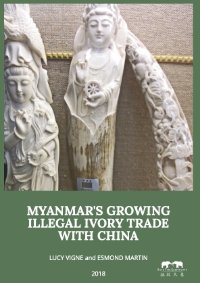
Myanmar's Growing Illegal Ivory Trade with China

By Lucy Vigne and Esmond Martin

The report ‘Myanmar’s Growing Illegal Ivory Trade with China’ released today (subs: October 2, 2018) shows that one town in particular, Mong La - a frontier town in the notorious Golden Triangle on the border of China - has experienced a ‘prolific growth’ in ivory trading. The number of new ivory items seen for sale in the town grew by 63% in three years, and now accounts for over a third of the ivory seen in the country.

The report by ivory trade specialists Lucy Vigne and Esmond Martin recounts how Chinese visitors smuggle worked ivory from Mong La back home with little concern about getting caught. This ivory has often come up the Mekong River into the lawless eastern periphery of Myanmar where it is for sale in both retail and bulk. The wholesale price for African raw ivory in late 2017 in the Golden Triangle region has remained stable at about USD 770 to USD 800 per kg since late 2015.

Myanmar has the largest captive, or ‘domestic’, elephant population in the world with over 5,000 individuals. Traders there say that the internal ivory trade is legal for trimmed domestic elephant tusk tips and from licensed animals that have died, and operate accordingly. (Trading in the tusks of the remaining wild elephants in Myanmar – numbering perhaps 2,000 – is acknowledged to be illegal). The ivory from captive elephants is used for local carving and retail sale especially in Mandalay and Yangon. Their tusks are also sold wholesale in Mandalay to Chinese traders, who smuggle them across the China border in contravention of the existing international ivory trade ban.

Traders reported that 90% of buyers were Chinese wishing to smuggle the ivory home, as also found by the same authors in market surveys in Hong Kong (2015) and Laos (2017). In Vietnam (2016) this was estimated to be 75%.

Nairobi, Kenya: Save the Elephants, 2018. 92p.

download
Runway to Extinction: Wildlife Trafficking in the Air Transport Sector

By Mary Utermohlen

"This report highlights the widespread, pervasive nature of wildlife trafficking by air, with each major world region impacted. Our analysis shows that traffickers of all types exploit the same vulnerabilities within airports, often using the same trafficking methods to circumvent law enforcement and airport authorities. Furthermore, seizure data shows that many wildlife trafficking networks rely on the same smuggling methods over time, suggesting that a thorough understanding of airport-specific or country-specific trafficking patterns could be instrumental in reducing the air transport system's vulnerability to trafficking," said the report’s author Mary Utermohlen, Program Director at C4ADS.

In addition to contributing to the extinction of endangered species, threatening local livelihoods, and undermining regional and global security, illegal wildlife trade is a risk factor for the spread of zoonotic diseases. According to the Center for Disease Control, three out of every four new or emerging infectious diseases originate in animals. Many of the species seized in air transport—including live birds, live reptiles and mammals—are high-risk carriers of zoonotic diseases and may end up in illegal or unregulated markets around the world.

Godalming, UK: Traffic, 2022. 12p.

download
The Roots of Environmental Crime in the Peruvian Amazon

By InSight Crime

Peru’s 70 million hectares of Amazon forest are being razed at an alarming rate. This investigation reveals the range of culprits behind the devastation: from illegal gold miners who leave behind pools of poisonous mercury, to poor locals coopted into harvesting valuable trees, to a complex web of front companies, agribusiness subsidiaries, corrupt officials and criminal groups that prosper from the Amazon’s destruction.

Conducted with the Igarapé Institute – a Brazil-based think tank devoted to development, security and climate issues – the six-part series also unravels the crucial links in the chain of specific environmental crimes contributing to forest loss, including illegal logging, illicit gold mining, coca cultivation, wildlife trafficking and the usurping of lands for cattle farms and booming agricultural industries.

Peru’s Amazon, which covers nearly half of the Andean country, is rich in biodiversity and critical to the capture of carbon, which mitigates global warming. Political instability and corruption, however, have made protecting it much more difficult. Meanwhile, demand from international markets for wood, gold and other forest products increases the threat to Indigenous communities, animal habitats and protected reserves.

Washington, DC: InSight Crime; IGARAPÉ INSTITUTE , 2022. 61p.

download
Shell Shocked: Japan's Role In The Illegal Tortoise Shell Trade

By Tomomi Kitade, Masayuki Sakamoto, Chris Madden Hof

Japan customs records reported 564 kg of hawksbill tortoiseshell seized in 71 incidents between 2000 and 2019, representing some 530 Hawksbill Turtles. Over half was seized between 2015 and 2019 alone. The Hawksbill Turtle is listed as “Critically Endangered” in the IUCN Red List. In recent years, the major source region appears to have shifted from Southeast Asia to the Caribbean. The report highlights the current marine turtle trade situation in Japan, including the trends in illegal commodity imports —hawksbill tortoiseshell, in particular—and an analysis of manufacturers’ stockpiles, domestic regulations, and online trade.

Tokyo: World Wildlife Fund for Japan, 2021. 16p.

download
Wildlife Trafficking in Brazil.

By Sandra Charity and Juliana Machado Ferreira

Brazil is home to 60% of the Amazon biome and holds the planet’s largest biodiversity treasure trove, with over 13% of the world’s animal and plant life. Turtles, fish, jaguars, frogs, insects, primates, songbirds, and parrots are among a long list of wildlife in Brazil that is illegally targeted for domestic and international trade. According to the report’s analysis of trafficking in the Amazon region, river turtles, ornamental fish, fish for consumption, and wild meat appeared most frequently in seizure open data between 2012–2019.

Cambridge, UK: TRAFFIC, 2020. 140p.

download