Open Access Publisher and Free Library
CRIME+CRIMINOLOGY.jpeg

CRIME

Violent-Non-Violent-Cyber-Global-Organized-Environmental-Policing-Crime Prevention-Victimization

Opioids: Treating an Illness, Ending a War

By Nazgol Ghandnoosh and Casey Anderson

More people died from opioid-related deaths in 2015 than in any previous year. This record number quadrupled the level of such deaths in 1999. Unlike the heroin and crack crises of the past, the current opioid emergency has disproportionately affected white Americans—poor and rural, but also middle class or affluent and suburban. This association has boosted support for preventative and treatment-based policy solutions. But the pace of the response has been slow, critical components of the solution—such as health insurance coverage expansion and improved access to medication assisted treatment—face resistance, and there are growing efforts to revamp the failed and costly War on Drugs.

This report examines the sources of the opioid crisis, surveys health and justice policy responses at the federal and state levels, and draws on lessons from past drug crises to provide guidance on how to proceed.

Washington, DC: The Sentencing Project, 2017. 35p.

download
A Better City for All: A Partnership Approach to Address public Substance Missuse and Perceived Anti-social Behaviour in Dublin City Centre

By The Strategic Response Group (SRG)

The Strategic Response Group (SRG)is a partnership set up to address public substance misuse and perceived anti-social behaviour in Dublin city centre. This report - Report of the Strategic Response Group to build sustainable street-level drug services and address related public nuisance - acknowledges that for historical reasons there is a clustering of drug treatment and homelessness services in or adjacent to the inner city. While these services play a major role in the provision of effective treatment to problematic drug users, the report recommends that there should be greater access to prompt provision of treatment options nationally and that people should be treated and accommodated in the most appropriate setting for their circumstances and provided with support services as close to their home as possible.

The report takes a holistic approach to address the issues of the city centre. The group have set out their recommendations in the short, media and long term and under the headings of treatment, rehabilitation, homelessness, policing responses, planning and urban design, legislation and regulation and implementation.

Dublin: The Strategic Response Group, 2012. 24p.

download
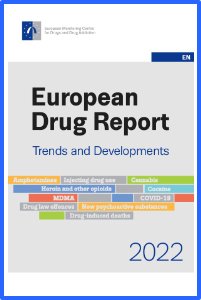
European Drug Report 2022: Trends and developments

By European Monitoring Centre on Drugs and Drug Addiction (EMCDDA)

Our overall assessment is that drug availability and use remain at high levels across the European Union, although considerable differences exist between countries. Approximately 83.4 million or 29 % of adults (aged 15–64) in the European Union are estimated to have ever used an illicit drug, with more males (50.5 million) than females (33.0 million) reporting use. Cannabis remains the most widely consumed substance, with over 22 million European adults reporting its use in the last year. Stimulants are the second most commonly reported category. It is estimated that in the last year 3.5 million adults consumed cocaine, 2.6 million MDMA and 2 million amphetamines.

Around 1 million Europeans used heroin or another illicit opioid in the last year. Although the prevalence of use is lower for opioid use than for other drugs, opioids still account for the greatest share of harms attributed to illicit drug use. This is illustrated by the presence of opioids, often in combination with other substances, which was found in around three quarters of fatal overdoses reported in the European Union for 2020. It is important to note that most of those with drug problems will be using a range of substances. We are also seeing considerably more complexity in drug consumption patterns, with medicinal products, non-controlled new psychoactive substances and substances such as ketamine and GBL/GHB now associated with drug problems in some countries or among some groups. This complexity is reflected in an increasing recognition that drug use is linked with, or complicates how we respond to, a wide range of today’s most pressing health and social issues. Among these issues are mental health problems and self-harm, homelessness, youth criminality and the exploitation of vulnerable individuals and communities.

Lisbon: EMCDDA, 2022. 60p.

download
Loosening Drug Prohibition’s Lethal Grip on the Americas: The U.S. finally embraces harm reduction but the drug war still rages

By John Walsh

More than half a century after the advent of a global drug prohibition regime and the launch of the U.S. “war on drugs,” the results have been disastrous for Latin America and the Caribbean, and for the United States itself. Even worse, prohibition’s consequences are exacerbating other grave problems—corruption and organized crime, violence perpetrated with impunity, forest loss and climate change, and displacement and migration—making solutions to these challenges even more difficult to achieve. The Biden administration’s historic embrace of harm reduction represents an enormous, lifesaving advance for U.S. drug policy. But even with harm reduction services, moves to decriminalize drug possession, and shifts underway to legally regulate recreational cannabis, the brunt of drug prohibition remains intact and the drug war rages on in the Americas. The principal victims of government repression in the name of drug control and of the predations of organized crime have always been and continue to be the most impoverished and marginalized communities…. Regulatory models must prioritize the interests and inclusion of those communities most harmed by the punitive enforcement of drug prohibition. Such regulatory frameworks will be far better suited than prohibition to protecting human rights and promoting health, gender and racial equality, security and environmental sustainability.

Washington, DC: WOLA, 2022. 28p.

download
After the War on Drugs: Blueprint for Regulation

By Stephen Rolles

Global drug policy is rooted in a laudable urge to address the very real harms that non-medical psychoactive drugs can create. Such concerns have driven a prohibitionist global agenda: an agenda that gives clear and direct moral authority to those who support it, while casting those who are against it as ethically and politically irresponsible. However, such binary thinking can be problematic. By defining the most stringent prohibition as the most moral position, it makes nuanced consideration of the impacts of prohibition difficult. In particular, it makes it very difficult to look at and learn from the impacts and achievements of prohibition. Historic attempts to do so have foundered on a sense that analysing prohibition means questioning prohibition, and that questioning prohibition is in itself an immoral act—one that allies the questioner with the well known infamies of the world’s illegal drug trade. Ironically, supporting the status quo perpetuates that trade, and the harms that it creates.

It is not the purpose of this report to revisit these various findings; they are freely and easily available elsewhere. Rather, we seek to reconsider the management of illicit drugs in the light of the experience that they represent and embody. Using that experience, we will set out a blueprint for non-medical drug management policies that will minimise the harms that such drug use creates, both on a personal and on a societal level. In short, our goal is to define a set of practical and effective risk and harm management and reduction policies. Such policies will represent a clear and positive step towards the positive outcomes that prohibition has tried, and failed, to achieve. A strictly prohibitionist stance would understand them to be immoral, because they call for the legally regulated production and availability of many currently proscribed drugs. Transform’s position is, in fact, driven by an ethics of effectiveness, and as such represent an attempt to re-frame the global harm management debate in exclusively practical terms

London: Transform Drug Policy Foundation, 2009. 232p.

download
A Rapid Assessment Research (RAR) of Drug and Alcohol Related Public Nuisance in Dublin City Centre

By Marie Claire Van Hout and Tim Bingham

This research aimed to assemble an evidence base around perceived anti-social behaviour associated with the provision of drug treatment in Dublin’s city centre, upon which to build a strategic response incorporating short/medium/long term goals and actions within the area. It will be used to guide discussions on how to reduce visibility of drug related public nuisance, improve public perceptions of safety in the area and provide comprehensive, safe, effective and appropriate treatment services within a series of short, medium and long-term strategies.

Dublin:Strategic Response Group, 2012. 187p.

download
Tackling Drug Markets and Distribution Networks in the UK : A review of the recent literature

By Tim McSweeney, Paul J. Turnbull, and Mike Hough

This summary sets out the main findings from a review of the recent literature on strategies to tackle illicit drug markets and distribution networks in the UK. The report was commissioned by the UK Drug Policy Commission and has been prepared by the Institute for Criminal Policy Research, School of Law, King’s College London. The main literature searches for this review were conducted during late September 2007 using a number of search terms and bibliographic data sources. In drawing together the evidence for this review we aimed to answer four broad questions: • What is the nature and extent of the problem? • What are current UK responses? • What are effective strategies for dealing with these issues? • Where are the gaps in our knowledge and understanding? This review restricted itself to domestic measures for tackling the drugs trade. As well as production control (e.g. assisting the Afghan government to implement its National Drug Control Strategy), there are a range of measures as part of the current drug strategy that are aimed at tackling drug markets and distribution networks within the UK’s borders.

London: The UK Drug policy Commission, 2008. 90p.

download
Reducing Drug Use, Reducing Reoffending Are programmes for problem drug-using offenders in the UK supported by the evidence?

By The UK Drug Policy Commission

Over the past ten years, UK drug strategies have increasingly focused on providing treatment and support services for drug-dependent offenders – who commit a disproportionate number of acquisitive crimes (e.g. shoplifting and burglary) – as a way of reducing overall crime levels. This criminal justice focus has been reinforced in the recent 2008 UK drug strategy (new Welsh and Scottish drug strategies are also being developed). The UK Drug Policy Commission (UKDPC) has analysed the evidence for the effectiveness of these initiatives for reducing drug use and reoffending and of the wider impact of this more prominent criminal justice approach. To inform our analysis we commissioned an independent review of the published evidence from leading researchers at the Institute for Criminal Policy Research (ICPR), King’s College London. We also listened to policy experts, local commissioners, drug workers and current and ex-drug users.

London: The UK Drug Policy Commission (UKDPC), 2008. 80p.

download
A Fresh Approach to Drugs: the final report of the UK Drug Policy Commission

By The UK Drug Policy Commission

In this report, UKDPC proposes a radical rethink of how we structure our response to drug problems. It analyses the evidence for how policies and interventions could be improved, with recommendations for policymakers and practitioners to address the new and established challenges associated with drug use.

London: The UK Drug Policy Commission, 2012.173p.

download
An Analysis of UK Drug Policy

By Peter Reuter and Alex Stevens

Despite the long-standing political prominence of the problem, relatively coherent strategies and substantial investment, the United Kingdom remains at the top of the European ladder for drug use and drug dependence. This study by Professor Peter Reuter of the University of Maryland, USA, and Alex Stevens of the University of Kent, England, assesses the evidence relating to the UK drug problem and analyses the impact of current policies.

London: The UK Drug Policy Commission, 2007. 108p.

Read/Download

Read-Me.Org
Scarface Al and the Crime Crusaders: Chicago's Private War Against Capone

By Dennis Earl Hoffman

According to the Elliot Ness myth, which has been widely disseminated through books, television shows, and movies, Ness and the Untouchables defeated Al Capone by marshaling superior firepower. In Scarface Al and the Crime Crusaders, Dennis Hoffman presents a fresh new perspective on the downfall of Al Capone. To debunk the Eliot Ness myth, he shows how a handful of private citizens brought Capone to justice by outsmarting him rather than by outgunning him.

Drawing on previously untapped sources, Hoffman dissects what he terms a “private war” against Capone. He traces the behind-the-scenes work of a few prominent Chicago businessmen from their successful lobbying of presidents Coolidge and Hoover on behalf of federal intervention to the trial, sentencing, and punishment of Al Capone. Hoffman also reconstructs in detail a number of privately sponsored citizen initiatives directed at stopping Capone. These private ventures included prosecuting the gangsters responsible for election crimes; establishing a crime lab to assist in gangbusting; underwriting the costs of the investigation of the Jake Lingle murder; stigmatizing Capone; and protecting the star witnesses for the prosecution in Al Capone’s income tax evasion case.

Hoffman suggests that as American society continues to be threatened by illegal drugs, gangs, and widespread violence, it is important to remember that the organized crime and political corruption of Prohibition-era Chicago were checked through the efforts of private citizens.

Carbondale, IL: Southern Illinois University Press, 1993. 205p.

download
Gangster Warlords: Drug Dollars, Killing Fields, and the New Politics of Latin America

By Ioan Grillo

In a ranch south of Texas, the man known as The Executioner dumps five hundred body parts in metal barrels. In Brazil's biggest city, a mysterious prisoner orders hit-men to gun down forty-one police officers and prison guards in two days. In southern Mexico, a meth maker is venerated as a saint while enforcing Old Testament justice on his enemies.

A new kind of criminal kingpin has arisen: part CEO, part terrorist, and part rock star, unleashing guerrilla attacks, strong-arming governments, and taking over much of the world's trade in narcotics, guns, and humans. What they do affects you now--from the gas in your car, to the gold in your jewelry, to the tens of thousands of Latin Americans calling for refugee status in the U.S. Gangster Warlords is the first definitive account of the crime wars now wracking Central and South America and the Caribbean, regions largely abandoned by the U.S. after the Cold War. Author of the critically acclaimed El Narco, Ioan Grillo has covered Latin America since 2001 and gained access to every level of the cartel chain of command in what he calls the new battlefields of the Americas. Moving between militia-controlled ghettos and the halls of top policy-makers, Grillo provides a disturbing new understanding of a war that has spiraled out of control--one that people across the political spectrum need to confront now.

New York: Bloomsbury Press, 2016. 384p.

download
Master Thieves : The Boston Gangsters Who Pulled Off The World's Greatest Art Heist

By Stephen Kurkjian

In a secret meeting in 1981, a low-level Boston thief gave career gangster Ralph Rossetti the tip of a lifetime: the Isabella Stewart Gardner Museum was a big score waiting to happen. Though its collections included priceless artworks by Rembrandt, Vermeer, Degas, and others, its security was cheap, mismanaged, and out of date. And now, it seemed, the whole Boston criminal underworld knew it.

Nearly a decade passed before the Museum museum was finally hit. But when it finally happened, the theft quickly became one of the most infamous art heists in history: thirteen works of art valued at up to $500 million, by some of the most famous artists in the world, were taken. The Boston FBI took control of the investigation, but twenty-five years later the case is still unsolved and the artwork is still missing.

Stephen Kurkjian, one of the top investigative reporters in the country, has been working this case for over nearly twenty years. In Master Thieves, he sheds new light on some of the Gardner’s most abiding mysteries. Why would someone steal these paintings, only to leave them hidden for twenty-five years? And why, if one of the top crime bosses in the city knew about this score in 1981, did the theft happen in 1990? What happened in those intervening years? And what might all this have to do with Boston’s notorious gang wars of the 1980s?

Kurkjian’s reporting is already responsible for some of the biggest breaks in this story, including a meticulous reconstruction of what happened at the Museum museum that fateful night. Now Master Thieves will reveal the identities of those he believes plotted the heist, the motive for the crime, and the details that the FBI has refused to discuss. Taking you on a journey deep into the gangs of Boston, Kurkjian emerges with the most complete and compelling version of this story ever told.

New York: Public Affairs, 2015. 247p.

download
Prohibition Gangsters: The Rise and Fall of a Bad Generation

By Marc Mappen

Master storyteller Marc Mappen applies a generational perspective to the gangsters of the Prohibition era—men born in the quarter century span from 1880 to 1905—who came to power with the Eighteenth Amendment.

Making use of FBI and other government files, trial transcripts, and the latest scholarship, the book provides a lively narrative of shootouts, car chases, courtroom clashes, wire tapping, and rub-outs in the roaring 1920s, the Depression of the 1930s, and beyond. Mappen asserts that Prohibition changed organized crime in America. Although their activities were mercenary and violent, and they often sought to kill one another, the Prohibition generation built partnerships, assigned territories, and negotiated treaties, however short lived. They were able to transform the loosely associated gangs of the pre-Prohibition era into sophisticated, complex syndicates. In doing so, they inspired an enduring icon—the gangster—in American popular culture and demonstrated the nation’s ideals of innovation and initiative.

New Brunswick, NJ: Rutgers University Press, 2013. 279p

download
American Gangsters, Then and Now. An Encyclopedia

By Nate Hendley

American Gangsters, Then and Now: An Encyclopedia ranges from Western outlaws revered as Robin Hoods to the Depression's flamboyant bootleggers and bank robbers to the late 20th century's drug kingpins and "Dapper Dons." It is the first comprehensive resource on the gangster's historical evolution and unshakable grip on the American imagination.American Gangsters, Then and Now tells the stories of a number of famous gangsters and gangs—Jesse James and Billy the Kid, the Black Hand, Al Capone, Sonny Barger and the Hell's Angels, the Mafia, Crips and Bloods, and more. Avoiding sensationalism, the straightforward entries include biographical portraits and historical background for each subject, as well as accounts of infamous robberies, killings, and other events, all well documented with both archival newspapers and extensive research into the files of the FBI. Readers will understand the families, the places, and the times that produced these monumental criminals, as well as the public mindset that often found them sympathetic and heroic.

Santa Barbara, Calif. : ABC-CLIO, 2010. 292p.

download
Young People’s Involvement in Gangs and Guns in Liverpool

By Hannah Smithson, Kris Christmann, Rachel Armitage, Leanne Monchuk, Antony Whitehead and Michelle Rogerson

There has been growing concern among policy makers and the wider public about the continued spate of high profile murders involving firearms, along with a perception that these events are a result of youth gang violence more generally. These incidents have been taking place in major cities across the UK, including Liverpool. This perception of escalating violence among young people, frequently involving weapons, has prompted the government to make confronting what it has termed ‘gun, knife and gang crime’ a priority. However, relatively little information exists on ‘gang’ involvement and ‘gun crime’, who is committing it, for what reasons and what might be the best ways of reducing it. Other commentators have connected gun crime to criminal gangs and a growing ‘gang culture’ as an overarching explanatory variable, nevertheless, important gaps remain in our knowledge about violent crime fuelled by gangs and weapons. This research study draws upon an extensive literature review of the national and international research examining gangs and gun crime, coupled with a series of in-depth interviews with senior practitioners, senior specialist police officers, front line youth workers, and gang and gun involved young people from across Liverpool.

Huddersfield, UK: Applied Criminology Centre, University of Huddersfield, 2009. 122p.

download
Maras and Gangs, Community and Police in Central America

By María Andrea Araya Carvajal; Patricia Soley Alfaro and Jennifer González Zamora

Over the past decade, youth gangs have come to constitute a serious problem for public security in Central America. The situation has generated increasing levels of fear among the general population and has become a theme of great concern also within government circles. This has been the case in particular for the countries located in the region’s northern triangle – El Salvador, Honduras and Guatemala. However, also Nicaragua and Costa Rica have, to some extent, experienced a similar development concerning the growth of violent and criminal youth gangs. While the existence of criminal youth gangs is not at all new in Central America, the systematic use of violence and the brutality shown by the new type of gangs is no doubt unprecedented – something which today is embodied in the very concept of the maras. Although it would be incorrect to make the maras the main culprits for the rapid increase of violence during recent times in Central America, they clearly do represent a major and very real problem which deserves greater attention in order to improve both the security situation for the citizens and future prospects for the region’s youth. History as well as social sciences show that youth delinquency is primarily a group phenomenon refl ecting complex social and economic situations. Consequently, for the design and carrying out of effective and successful action programs profound, specifi c and updated knowledge is required. It is in this context that the Swedish International Development Cooperation Agency (Sida) – with support also from the Central American Bank for Economic Integration (CABEI) – decided to fi nance a regional and multi-disciplinary study on the maras and other violent youth gangs, an applied study with a solid empirical base and characterized by a contextual approach focusing not only on the gangs but bringing into the picture also the neighbours, the local community and the police. The objective of the present publication – which constitutes a condensed version of the study carried out by a team of researchers from the company Demoscopía S.A. – is to facilitate a more comprehensive as well as constructive and action-oriented public discussion, concerning both the need to immediately address the current situation and to develop policies and measures for prevention.

San José, Costa Rica, DEMOSCOPÍA S.A; Stockholm Sweden: Swedish International Development Cooperation Agency, 2008. 166p.

download
Gangs in Honduras

By InSight!Crime and the Asociación para una Sociedad más Justa

In a new report based on extensive field research, InSight Crime and the Asociacion para una Sociedad mas Justa have traced how Honduras’ two largest gangs, the MS13 and the Barrio 18, are evolving, and how their current modus operandi has resulted in staggering levels of violence and extortion.

Washington, DC: InSight Crime, 2018. 43p.

Download
Gang Violence as Organized Violence: Investigating the Implications for the Women, Peace, and Security Index

By Mariana Viollaz and Jeni Klugman

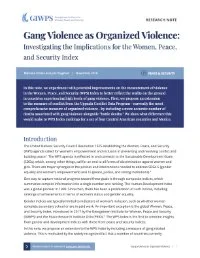
In this note, we experiment with potential improvements on the measurement of violence in the Women, Peace, and Security (WPS) Index to better reflect the reality on the ground in countries experiencing high levels of gang violence. First, we propose an extension to the measure of conflict from the Uppsala Conflict Data Program—currently the most comprehensive measure of organized violence—by including a more accurate number of deaths associated with gang violence alongside “battle deaths.” We show what difference this would make to WPS Index rankings for a set of four Central American countries and Mexico.

Washington, DC: Georgetown Institute for Women, Peace and Security, 2018. 12p.

download
Leaving the Gang: Logging Off and Moving On

By Scott H. Decker and David C. Pyrooz

Why do people leave a group that they have been a member of? What do they do to leave their group? What role, if any, do the use of social media and the Internet play in this process? These are central questions that motivate our interest in desistance. In criminology the focus on desistance has been a part of the life course study of crime. This approach examines involvement in crime across the life span, and pays particular attention to initial involvement in crime during adolescence as well as declines in crime that tend to occur beginning in the early twenties. This latter process is referred to as desistance from crime and tends to occur rather rapidly, usually starting in the late teens. This is typically a period of considerable maturation, marked by the movement from adolescence into adulthood and the increasing involvement in family and the labor market. Social media play an increasingly important role in the lives of adolescents as they transition to adulthood.

Google Ideas, 2011. 21p.

download