
Open Access Free Library
CRIME+CRIMINOLOGY.jpeg

CRIME

Violent-Non-Violent-Cyber-Global-Organized-Environmental-Policing-Crime Prevention-Victimization

Posts tagged true crime
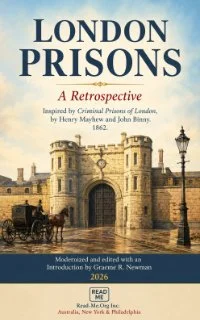
London Prisons: A Retrospective

by Graeme R. Newman

In 1862, Henry Mayhew and John Binny walked into eleven of London's most notorious institutions — Newgate, Millbank, Pentonville, Brixton, the prison hulks at Woolwich, Coldbath Fields, Tothill Fields, Wandsworth, Holloway, the House of Detention at Clerkenwell, and Horsemonger Lane — and wrote down exactly what they saw: the governors, the warders, the chaplains, and the prisoners themselves, in their own words.

This edition brings that record back to life. Each chapter has been fully rewritten in modern prose while preserving every fact, every interview, and every argument the original authors made — from their case against purposeless hard labour to their unflinching accounts of the convict nursery, the condemned cell, and the boy discharged from prison with no one waiting at the gate.

A new introduction and retrospective, written for this edition, follows these institutions into the present: which ones were demolished, which became galleries, cathedrals, and post offices — and which are still open today, cited in current inspection reports for the very same overcrowding and neglect that Victorian reformers were fighting a century and a half ago.

What you'll find inside: • Eleven Victorian prisons, reconstructed room by room, cell by cell • Real testimony from governors, chaplains, and prisoners — first offenders and lifelong professionals alike • A frank, often moving record of Victorian London's poorest and most desperate • A new historical retrospective connecting each institution to its fate today

Part social history, part true crime, part uncomfortable mirror — London Prisons: A Retrospective is a door-by-door tour of a city's conscience, then and now.

Read-Me.Org Inc. New York-Philadelphia-Australia. 2026. p.339.
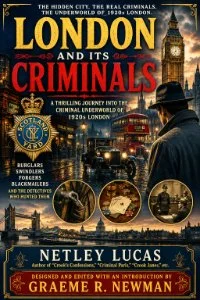
London and Its Criminals: A Portrait of London's Underworld in the 1920s

by Nettly Lucas (Author), Graeme Newman (Introduction)

Step into the hidden London of the 1920s—a city of fashionable hotels and crowded streets, respectable suburbs and shadowy back rooms, Scotland Yard detectives and professional criminals who made deception, burglary, fraud and blackmail their trade.

First published in 1926, London and Its Criminals is Netley Lucas’s remarkable journey through the criminal underworld of interwar London. Rather than simply recounting celebrated crimes, Lucas sets out to describe criminals themselves: how they lived, where they gathered, the methods they used, the slang they spoke, and the elaborate machinery of policing that pursued them.

The result is an extraordinary period portrait of crime and criminal justice.

Lucas takes his readers inside Scotland Yard and its Criminal Record Office, explaining the growing importance of fingerprints, criminal records and systematic detection. From there he ventures into a very different London—the world of professional burglars, pickpockets, confidence tricksters, jewel thieves, forgers, blackmailers and criminal gangs. He introduces his readers to figures he describes as the “Kings” and “Queens” of the Underworld: men and women who move between cheap public houses, prosperous suburban homes, exclusive restaurants and fashionable hotels while living secret criminal lives.

Among the book’s most striking chapters are Lucas’s accounts of “master criminals” and “crooked women.” His characters include expert burglars, ingenious forgers, sophisticated jewel thieves and accomplished confidence tricksters. Some are frightening, some ingenious, some surprisingly ordinary. Again and again Lucas emphasizes the unsettling proximity of the criminal world to respectable society.

Yet London and Its Criminals is more than a gallery of rogues. Lucas was writing at a moment when attitudes toward crime and punishment were beginning to change. He opens the book by discussing the emerging scientific study of crime, criminal psychology, rehabilitation and the limitations of imprisonment—questions that remain central to debates about criminal justice a century later.

Lucas is also an unusually provocative guide. He claims familiarity with criminals themselves and repeatedly describes conversations, meals and encounters with people operating on the wrong side of the law. His London is consequently not the London of official police reports alone. It is a city observed from its restaurants, streets, clubs, pubs, courtrooms and criminal meeting places.

Modern readers should approach some of Lucas’s language, assumptions and sweeping judgments as products of their time. That is also part of the historical importance of the book. It provides a vivid primary-source window into how crime, policing, punishment, class and the urban underworld were represented during the 1920s.

This new Read-Me.Org Classic Reprint presents Lucas’s fascinating account to a new generation of readers, accompanied by a detailed new Introduction by Graeme Newman that places the work in its historical and criminological context.

For readers interested in true crime, criminology, Scotland Yard, policing, criminal history, London history, organized crime and the social history of the 1920s, London and Its Criminals offers a fascinating journey into a vanished—but sometimes surprisingly familiar—criminal world

Read-Me.Org Inc. New York-Philadelphia-Australia. 2026. p.194.

Master Thieves : The Boston Gangsters Who Pulled Off The World's Greatest Art Heist

By Stephen Kurkjian

In a secret meeting in 1981, a low-level Boston thief gave career gangster Ralph Rossetti the tip of a lifetime: the Isabella Stewart Gardner Museum was a big score waiting to happen. Though its collections included priceless artworks by Rembrandt, Vermeer, Degas, and others, its security was cheap, mismanaged, and out of date. And now, it seemed, the whole Boston criminal underworld knew it.

Nearly a decade passed before the Museum museum was finally hit. But when it finally happened, the theft quickly became one of the most infamous art heists in history: thirteen works of art valued at up to $500 million, by some of the most famous artists in the world, were taken. The Boston FBI took control of the investigation, but twenty-five years later the case is still unsolved and the artwork is still missing.

Stephen Kurkjian, one of the top investigative reporters in the country, has been working this case for over nearly twenty years. In Master Thieves, he sheds new light on some of the Gardner’s most abiding mysteries. Why would someone steal these paintings, only to leave them hidden for twenty-five years? And why, if one of the top crime bosses in the city knew about this score in 1981, did the theft happen in 1990? What happened in those intervening years? And what might all this have to do with Boston’s notorious gang wars of the 1980s?

Kurkjian’s reporting is already responsible for some of the biggest breaks in this story, including a meticulous reconstruction of what happened at the Museum museum that fateful night. Now Master Thieves will reveal the identities of those he believes plotted the heist, the motive for the crime, and the details that the FBI has refused to discuss. Taking you on a journey deep into the gangs of Boston, Kurkjian emerges with the most complete and compelling version of this story ever told.

New York: Public Affairs, 2015. 247p.