Open Access Publisher and Free Library
CRIME+CRIMINOLOGY.jpeg

CRIME

Violent-Non-Violent-Cyber-Global-Organized-Environmental-Policing-Crime Prevention-Victimization

The prevalence of intimate partner violence in Australia: a national survey

By Ben Mathews, Kelsey L Hegarty, Harriet L MacMillan, Monica Madzoska, Holly E Erskine, Rosana Pacella, James G Scott, Hannah Thomas, Franziska Meinck, Daryl Higginss

Objectives: To estimate the prevalence in Australia of intimate partner violence, each intimate partner violence type, and multitype intimate partner violence, overall and by gender, age group, and sexual orientation.

Study design: National survey; Composite Abuse Scale (Revised)—Short Form administered in mobile telephone interviews, as a component of the Australian Child Maltreatment Study.

Setting: Australia, 9 April – 11 October 2021. Participants 8503 people aged 16 years or older: 3500 aged 16–24 years and about 1000 each aged 25–34, 35–44, 45–54, 55–64, or 65 years or older.

Main outcome measures: Proportions of participants who had ever been in an intimate partner relationship since the age of 16 years (overall, and by gender, age group, and sexual orientation) who reported ever experiencing intimate partner physical, sexual, or psychological violence.

Results: Survey data were available for 8503 eligible participants (14% of eligible persons contacted), of whom 7022 had been in intimate relationships. The prevalence of experiencing any intimate partner violence was 44.8% (95% confidence interval [CI], 43.3–46.2%); physical violence was reported by 29.1% (95% CI, 27.7–30.4%) of participants, sexual violence by 11.7% (95% CI, 10.8–12.7%), and psychological violence by 41.2% (95% CI, 39.8–42.6%). The prevalence of experiencing intimate partner violence was significantly higher among women (48.4%; 95% CI, 46.3–50.4%) than men (40.4%; 95% CI, 38.3–42.5%); the prevalence of physical, sexual, and psychological violence were also higher for women. The proportion of participants of diverse genders who reported experiencing intimate partner violence was high (62 of 88 participants; 69%; 95% CI, 55–83%). The proportion of non-heterosexual participants who reported experiencing intimate partner violence (70.2%; 95% CI, 65.7–74.7%) was larger than for those of heterosexual orientation (43.1%; 95% CI, 41.6–44.6%). More women (33.7%; 95% CI, 31.7–35.6%) than men (22.7%; 95% CI, 20.9–24.5%) reported multitype intimate partner violence. Larger proportions of participants aged 25–44 years (51.4%; 95% CI, 48.9–53.9%) or 16–24 years (48.4%, 95% CI, 46.1–50.6%) reported experiencing intimate partner violence than of participants aged 45 years or older (39.9%; 95% CI, 37.9–41.9%).

Conclusions: Intimate partner violence is widespread in Australia. Women are significantly more likely than men to experience any intimate partner violence, each type of violence, and multitype intimate partner violence. A comprehensive national prevention policy is needed, and clinicians should be helped with recognising and responding to intimate partner violence.

Medical Journal of AustraliaVolume 222, Issue 9, May 2025, Pages, 423-480

download
Fraud against the Commonwealth 2023–24 

This Statistical Bulletin presents the results from the 2023–24 Fraud Against the Commonwealth census. A similar number of internal fraud investigations were finalised compared with the previous financial year. Fewer external fraud investigations were finalised. Automatic processes were the primary method of detecting internal and external fraud allegations in 2023–24. Program information and program payments were the principal targets of substantiated internal and external fraud allegations respectively. Internal and external fraud losses were lower than the losses reported in 2022–23. Australian Government entities reported greater internal fraud and lower external fraud recoveries in 2023–24 than in the previous financial year

Statistical Bulletin 47

Canberra: Australian Institute of Criminology, 2025. 16p.

download
A Content Analysis of Illicit Tobacco-Related Crimes Reported in Australian Media

Introduction

Australian survey and seizure data suggest a growing illicit tobacco market. As an illicit product, accurately tracking trends in illicit tobacco growing, manufacture, and sales is challenging. We examined trends in Australian illicit tobacco-related crimes using a content analysis of news articles.

Aims and Methods

We analyzed Australian news articles identified in the Factiva database and government press releases describing Australian illicit tobacco-related crimes reported between January 2000 and December 2023. Sources were coded for crime type, location, product type, dollar value of seized products, methods of distribution or storage, agencies involved, and other crimes involved.

Results

We identified 447 crimes reported in 389 sources. The number of illicit tobacco-related crimes reported increased between 2000 and 2023. The most common crimes were possession of illicit tobacco (n = 196/43.7%) and smuggling (n = 187/41.8%), and the most common product type was “illicit cigarettes” (n = 197/44.1%). The most common distribution/storage method reported was via residential premises (n = 98/21.9%). One-hundred and twenty incidents involved other crimes such as financial crimes involving money laundering (n = 59/13.2%). Across all included news articles, the quantity of seized products totaled 827 529 307 cigarette sticks, 76 185 cartons, 668 687 packs, 239 hectares (of land growing tobacco plants), and 2 149 000 plants of illicit tobacco between 2000 and 2023. The median value (worth; AUD) of each seizure was $1 500 000 (range $43 to $67 000 000).

Conclusions

Australian media reporting on illicit tobacco-related crimes increased over the past two decades, particularly since 2018. These findings highlight a need for improved border detection measures, investment in enforcement, and other deterrent activities.

Implications

This media analysis complements trends identified in national survey data that indicate a growing illicit tobacco market in Australia since 2013 with a marked increase since 2018. While survey data suggests that the Australian tobacco tax policy, which has included regular large tax increases since 2010, has decreased consumer demand for tobacco overall, it may have also incentivized criminal networks to supply illicit tobacco products due to it being a “low risk” and “high reward” activity. Controlling the Australian illicit tobacco market should be a policy priority.

Nicotine & Tobacco Research, Volume 27, Issue 6, June 2025, Pages 980–987,

download
The Information Age: Transnational Organized Crime, Networks, and Illicit Markets

By John P. Sullivan

In his landmark trilogy, The Information Age: Economy, Society and Culture, sociologist Manuel Castells argued that networks, information technology, and global economic flows were altering the nature of politics, power, and states. This article examines the network dynamics Castells wrote about in relation to transnational crime and illicit economic markets. The article further explores Castells’s influence on the study of transnational organized crime, illicit networks, and the global illicit economy 

Journal of Strategic Security 16, no. 1 (2023) : 51-71

download
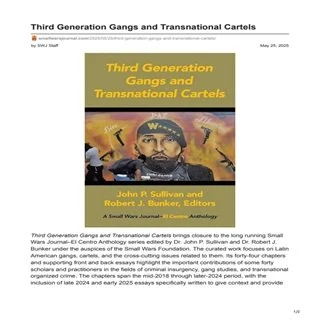
Third Generation Gangs and Transnational Cartels

 Written and edited by Sullivan and Robert J. Bunker

Third Generation Gangs and Transnational Cartels brings closure to the long running Small Wars Journal–El Centro Anthology series edited by Dr. John P. Sullivan and Dr. Robert J. Bunker under the auspices of the Small Wars Foundation. The curated work focuses on Latin American gangs, cartels, and the cross-cutting issues related to them. Its forty-four chapters and supporting front and back essays highlight the important contributions of some forty scholars and practitioners in the fields of criminal insurgency, gang studies, and transnational organized crime. The chapters span the mid-2018 through later-2024 period, with the inclusion of late 2024 and early 2025 essays specifically written to give context and provide analysis related to this work. The anthology benefits from a Foreword provided by Dr. Rashmi Singh, an Afterword offered by Dr. Alexandra Phelan, and a Postscript written by Dr. Mahmut Cengiz.

(A Small Wars Journal–El Centro Anthology). Bloomington: Xlibris, 2025 [ISBN: 979-8369442999, Paperback, 782 Pages]

Download
Changes in Online Illegal Drug Buying during COVID‑19: Assessing Effects due to a Changing Market or Changes in Strain using a Longitudinal Sample Design 

By James Hawdon· Katalin Parti  Thomas Dearden

This research uses longitudinal data to investigate if illegal online drug purchases changed over time during the COVID-19 pandemic, and if these changes were primarily driven by users adjusting to market conditions or by a heightened level of pandemic-induced strain that could drive a greater demand for drugs. Data were collected across four waves between fall 2019 and fall 2021 using an online survey. Data showed an increase in reported online drug purchases across the waves, but the online drug purchases remained consistent for the frst year of the pandemic, but increased by approximately 44% between the fall 2020 and fall 2021 when over 13 percent of the sample admitted to buying illegal drugs online. Strain was also related to buying illegal drugs online as those respondents who made illegal online purchased had an average of 5.2 strain events in the past 12 months compared to only 2.4 events among those who did not report purchasing illegal drugs online. However, the infuence of strain on online purchases remained consistent across time. These results suggest that the increase in online drug purchases was primarily driven by users adapting to changing market conditions rather than the cumulative strains associated with the pandemic producing a greater effect on purchases. Policy implications are also discussed.

  American Journal of Criminal Justice (2022) 47:712–734  

download
Strengthening the Prevention Support System in CDC’s Rape Prevention and Education

By Corinne Meltzer Graffunder, MPH

Through the Rape Prevention and Education (RPE) program, the Center’s for Disease Control and Prevention (CDC) provides funding, translates research findings, provides technical assistance, develops tools and other products, and conducts program monitoring of state health agencies functioning as intermediary organizations within a prevention support system. (Wandersman et al., 2008) The aims of this dissertation were to 1. Create an assessment tool defining the capacities needed to support the implementation of priority, evidence-based sexual assault prevention strategies; 2. Assess select priority needs and capacities of intermediary organizations to support this implementation; and 3. Develop a strategy to enhance the prevention support system capacity of intermediary organizations.

Department of Public Health, Chapel Hill, 2008, 319p.

download
State and Community Responses to Domestic Violence in Sri Lanka

By Kamalini Wijayatilake and Camena Guneratne

The Sri Lanka Report on domestic violence was undertaken by CENWOR for the regional project on Monitoring Progress in the Elimination of Discrimination Against and the Achievement of Equality for women, conducted by the International Women’s Rights Action Watch Asia-Pacific (IWRAW-AP). The purpose of the project was to create a mechanism by which to assess and facilitate the fulfilment of State obligations under the UN Convention on the Elimination of All Forms of Discrimination Against Women and the Beijing Platform for Action. CENWOR as the focal point in Sri Lanka for this project was required to identify a priority area to be monitored based on whether it results in extensive gender disparities. CENWOR identified violence against women as the area it would study, with specific reference to domestic violence. The first activity of the project would be to produce a baseline report on the identified issue as a basis on which to measure the fulfilment of the State’s obligations in the advancement of women’s rights.

Asia Pacific Gender Equality Network (APGEN), Centre for Women’s Research (CENWOR) Colombo, 2002, 105p.

download
UNDERSTANDING AGENCY AND RESISTANCE STRATEGIES (UNARS): Childre’s Experiences of Domestic Violence

Report completed by Jane E. M Callaghan and Joanne H. Alexander

This epot fouses o hildes epeiees of doesti iolee, i failies affeted doesti iolee. Ou epot is oeed ith hildes epeiees i situatios hee the ai perpetrator and victim of violence would be legally defined as two adults in an intimate relationship ot hee the hild is ioled i datig iolee.  Research and professional practice that focuses on children as damaged witnesses to domestic violence tends to describe children as passive and helpless. Our study, based on interviews with more than a hundred children across four European countries, recognises the significant suffering caused to children who experience domestic violence. However, it also tells a parallel story, about the capacity of children who experience domestic violence to cope, to maintain a sense of agency, to be resilient, and to find ways of resisting violence, and build a positive sense of who they are.

UNARS, 2015, 272p.

download
The Role of School for Children who have Relocated because of Domestic Violence and Abuse

By Amy Stanton

There is a scarcity of research that considers the role of school for children who have relocated because of domestic violence and abuse. In spite of this, the impact on school age children is well evidenced and can have severe long- lasting implications for a child in their ecosystem (CAADA, 2014; Sterne & Poole, 2010). This research used qualitative methodology and a social constructionist perspective underpinned by Bronfenbrenner’s bioecological theory to investigate how children 7 – 10 years experienced school when they had relocated because of domestic violence and abuse. Data was collected from five children using vignettes and drawings. Four Deputy Head Teachers, one Inclusion Manager and five Educational Psychologists were interviewed using a semi-structured interview. Thematic Analysis was used to analyse the accounts of children and school professionals. The findings showed children felt under threat in the classroom and playground

UCL Institute of Education

download
RECKLESSNESS AND RAPE

By R.A.Duff*

Both the trial judge and the Court of Appeal seemed to base their view that a mistaken belief in consent must be reasonable if it is to secure an acquittal on evidential principles, not on the substantive principle that one who acts on an unreasonable belief really has the mens rea of rape. That mens rea consists, they agreed, in "the intention to do the prohibited act":" it involves an awareness of the woman's lack of consent, and is in principle negatived by any honest belief in consent. But proof of the fact of non-consensual intercourse creates a presumption that the defendant knew she did not consent, and casts on him the evidential burden of adducing evidence to rebut that presumption. "before any issue as to his state of mind can arise for the jury's consideration".' This burden is not discharged by "a bald assertion of belief for which the accused can indicate no reasonable ground"," but only by evidence of a reasonable belief: if such evidence is adduced, the prosecution must prove either that that belief was not honestly held or that it was not reasonable.

The Liverpool Law Review VoJ. III (2) 119811, 16p.

download
Rape Victims' Attitudes to Rape Myth Acceptance

By Rachel Egan & Janet Clare Wilson

The present study examined victims’ attitudes to rape and rape-reporting behaviour. There were 36 Rape Victims, and approximately half reported their rape to the police (Rape Victim – Report) and half did not report their rape to the police (Rape Victim – Not Report). There were 42 Crime Victims, and approximately half reported the crime to the police (Crime Victim – Report) and half did not (Crime Victim – Not Report). Participants filled out a questionnaire which consisted of six scales: Rape Myth Acceptance, Just World Beliefs, Attitudes towards the Police, Locus of Control, the Pro-Victim scale and the Anti-Rapist scale. The results showed that Rape Victims-Not Report had significantly higher levels of Rape Myth Acceptance and Internal Locus of Control than Rape Victims-Report. However, all rape victims reported similar levels of Just World Beliefs and Attitudes towards the Police. Rape Myth Acceptance was significantly related to Just World Beliefs for crime victims but not for rape victims. Finally, crime victims had higher levels of Internal Locus of Control than rape victims.

Psychiatry, Psychology and Law, Vol. 19, No. 3, June 2012, 345–357

download
Rape, Shame and Pride

By John Braithwaite

A proposition of the theory of reintegrative shaming is that a reason some societies have lower rates of rape is that rape is unthinkable to most men in those societies. This presentation shows how war interrupts the unthinkableness of rape. Bougainville society seems to have had a low level of rape until its war of the 1980s and 1990s. A single rape was one of the important sparks that lit its civil war. It caused perhaps over 5% of the population to lose their lives and perhaps over a third to be displaced from their homes. As in most wars, rape became common in Bougainville. A theory of why war causes epidemics of rape helps criminologists understand rape better. It can also help international relations scholars to see that the bigger problem caused by armed conflict today may be crime rather than battle deaths. Rape in peace and in war is interpreted according to Eliza Ahmed’s theory of shame management and pride management. Ahmed’s work is seen as an important advance in evidence- based criminological theory. A deficiency of reintegrative shaming theory is that it neglects pride as the flip-side of shame as an emotion. Shame displacement may be important to the explanation of rape; yet narcissistic pride may be more important. In war we see more vividly the social dynamics of how shame displacement and narcissistic pride allow both rape and the onset of war itself. Bougainville helps us to ponder how historically sustained, deep and broad restorative justice processes may be part of what is needed to return a society to peace and to low levels of rape.

Address to Stockholm Criminology Symposium, 16 June, 2006, 15p.

download
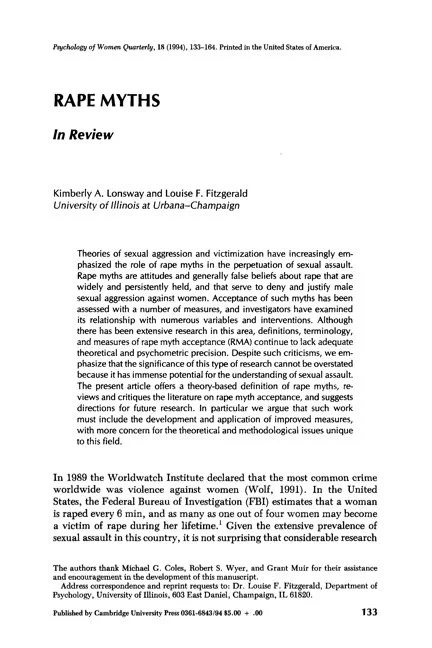
Rape Myths: In Review

By Kimberly A. Lonsway and Louise F. Fitzgerald

Theories of sexual aggression and victimization have increasingly em- phasized the role of rape myths in the perpetuation of sexual assault. Rape myths are attitudes and generally false beliefs about rape that are widely and persistently held, and that serve to deny and justify male sexual aggression against women. Acceptance of such myths has been assessed with a number of measures, and investigators have examined its relationship with numerous variables and interventions. Although there has been extensive research in this area, definitions, terminology, and measures of rape myth acceptance (RMA) continue to lack adequate theoretical and psychometric precision. Despite such criticisms, we em- phasize that the significance of this type of research cannot be overstated because it has immense potential for the understanding of sexual assault. The present article offers a theory-based definition of rape myths, re- views and critiques the literature on rape myth acceptance, and suggests directions for future research. In particular we argue that such work must include the development and application of improved measures, with more concern for the theoretical and methodological issues unique to this field.

Cambridge University Press 0361-6843194, 32p.

download
Meanings of ‘Sex’ and ‘Consent’: The Persistence of Rape Myths in Victorian Rape Law

By Dr Anastasia Powell, Dr Nicola Henry, Dr Asher Flynn and Dr Emma Henderson

Since the 1980s, laws regulating the meaning and interpretation of sexual consent have been substantially reformed across Australian and international jurisdictions. Of particular note in an Australian context are the significant changes to the definition of consent introduced in Victoria in 2006 and 2007, which were primarily informed by the Victorian Law Reform Commission’s review of legislative provisions relating to sexual offences. In this article, we explore the persistence of traditional rape discourses in the courtroom following the 2007 Victorian reforms by examining meanings of ‘sex’ and ‘consent’ in a pilot sample of rape trials. Our analysis suggests that although deeply entrenched societal myths or discourses about rape continue to pervade Victorian courtrooms, there is some evidence of a shift towards a legal focus on the accused’s state of mind, in addition to that of the victim-complainant. This shift, however, is only prominent in cases in which the accused testifies. In light of these preliminary findings, we suggest that further comparative analyses of the qualitative impact of law reform on discursive constructions of ‘sex’ and ‘consent’ in rape trials may provide alternative measures of the impact of rape law reform.

Powell, A., Henry, N., Flynn, A. and Henderson, E. (in press, 2014). ‘Meanings of “Sex” and “Consent”: The Persistence of Rape Myths in Victorian Rape Law’, in Griffith Law Review, (accepted 10 January 2014), 1-38.

download
Male Rape, Masculinities, and Sexualities Understanding, Policing, and Overcoming Male Sexual Victimisation

By ALIRAZA JAVAID

On an unimaginable, uncertain and unpredictable night, I was alone after a night out, floating aimlessly when really I should be getting home, to sleep and to experience the dreaded hangover the next day: but no, something kept me lingering on after the night out fuelled with alcohol and excitement. I was drunk. There was just one thing on my mind and that was finding love; I was still embedded in naivety, even at the age of 20–21, which was how old I was when my selfish offender raped me. When I was lingering on while people on the night out had started to disperse into their own ways, getting taxis to go home alone or with strangers for casual sex, I was looking for something or should I say someone, someone with whom I had previous sex with. Him and I had sex twice before. I wanted to see him again for the third time, as I was thirsty for some more sex. I fancied him. I lusted over him. I wanted to fall in love with him, but he just wanted to penetrate me and then to leave me, like all men. I never gave up trying to fall head over heels for him, though, so I went to see him after the night out; it was not dark as such, the light started to shine. While I was intoxicated, I made my way to his flat. Eventually, he came downstairs to get me after he was sleeping.

Palgrave Macmillan, 2018, 302p.

download
Locating the Processes of Policy Change in the Context of Anti-Rape and Domestic Worker Mobilisations in India

By Shraddha Chigateri, Mubashira Zaidi and Anweshaa Ghosh

This research seeks to address the question of when and why the state in India responds to women’s claims making by foregrounding the mobilisations of women’s groups on two issues: anti-rape laws and domestic work. In particular, it analyses the relationship between women’s claims making and laws and policies, especially focusing on the issues around which mobilisations take place, the processes and strategies of claims making by women’s groups, and the processes through which the changes in laws and policies occur. The research addresses these concerns at both a national level, as well as two subnational levels, Gujarat and Karnataka. It also compares the differences and similarities in mobilisations, structural configurations, actors and coalitions between the two issue areas, and across the levels (national and subnational).

Institute of Social Studies Trust, New Delhi, April 2016, 226p.

download
Victims'/Survivors' Perceptions of South Australia Police Responses to Rape

By Katherine J McLachlan

Women who have been raped rarely report their assaults to police. Researchers have attributed this to a range of reasons, both personal and systemic, including the influence of stereotypes and myths about rape on victims’/survivors’ decision- making. Rape myths often reflect community attitudes, social norms and police responses. For example, victims/survivors may blame themselves and also expect police will blame or disbelieve them. Such expectations (or subsequent experiences) of negative police responses undermine victims’/survivors’ faith in police. Poor or uncertain expectations held by victims/survivors are often borne out in reality, for police responses to rape are typically inconsistent and unpredictable. The potential diversity of responses is reflected in the mixed experiences reported by victims/survivors in my study.

Faculty of Education, Humanities, Law and Theology,, March 2007, 256p.

download
THE CRIME Volume 3.

BY Richard Grelling.. Translated By Alexander Gray. Introduction by Colin Heston.

Richard Grelling’s The Crime (Das Verbrechen), translated into English by Alexander Gray and published in London and New York between 1917 and 1919, is conceived as both a moral successor and completion to his earlier pacifist landmark, J’Accuse!, written between August 1915 and November 1916. In creating this extended work, Grelling sought to underscore the causes of World War I and dissect the self-justifying rhetoric that sustained the conflict long after its outbreak. Volumes I and II lay foundational groundwork, tracing the immediate antecedents of the war: imperialist tendencies within Germany and, on the part of the opposing Entente powers, ostensibly defensive motives followed by trait protectionism.

Never before in the annals of humankind has a crime of such sweeping magnitude been committed—and seldom has its perpetration been met with denial so unashamed. Within the very citadels of reason and culture, a proud civilization unleashed catastrophe under the guise of necessity—only to scramble afterward in self-exculpation. It is in this spirit of moral defiance—standing firm against voices of dissent, even from one’s own kin—that The Crime is offered to you. In the trilogy’s third volume, Grelling moves beyond the origins of war into the heart of wartime rationalization, exposing the “war-aims” that enabled aggression to persist under the cloak of purpose. May this work cast a clear light upon the structures of self-deception that allowed the world’s descent, and may it stir an unyielding clarity in us to recognize—and reject—such patterns again.

Read-Me.Org Inc. New York-Philadelphia-Australia. 2025. 261p.

download
kindle $2.99 -- paperback $9.99
First Taskforce Report: PPPs and Fighting Financial Crime in Ukraine

By Ian Mynot and Oksana Ihnatenko

This report summarises the main findings of the first meeting of the Taskforce on Public–Private Partnership in Fighting Financial Crime in Ukraine

Overview

On 15 November 2024, RUSI’s Centre for Finance and Security and the Center for Financial Integrity (CFI)1 launched a Taskforce on Public–Private Partnership in Fighting Financial Crime in Ukraine. An in-person meeting in Warsaw, held on a non-attributable basis, convened 40 representatives, including those from the public and private sectors in Ukraine, and international experts.

The discussion included two sessions focused on the current state of public–private partnerships (PPPs) in Ukraine and on international experience and recommendations. This report summarises the main findings of each of these sessions.

London: The Royal United Services Institute for Defence and Security Studies. (RUSI) 2025. 15p.

download