Open Access Publisher and Free Library
Fiction+Mediajpg.jpg

FICTION and MEDIA

CRIME AND MEDIA — TWO PEAS IN A POD

Posts in history
The Ordeal Of Richard Feverel

By George Meredith

This book, first published in 1859, is a novel that explores the complexities of human nature and the consequences of rigid educational systems. The story centers around Sir Austin Feverel, who devises a strict educational plan known as "the System" to raise his son, Richard, in isolation from the corrupting influences of society. Despite Sir Austin's efforts, Richard falls in love with Lucy Desborough, a girl of lower social standing, leading to a series of tragic events. The novel delves into themes of love, passion, and the limitations of authoritarian control, offering a critical examination of contemporary attitudes toward education and sexuality.

Meredith's work is notable for its rich psychological analysis and lyrical prose, significantly contributing to Victorian literature. The novel's exploration of the father-son relationship and the impact of societal expectations on individual lives is both poignant and thought-provoking. "The Ordeal of Richard Feverel" was controversial at the time of its publication, with some readers finding its content prurient, leading to its ban by leading lending libraries. Despite this, it has endured as a classic, praised for its depth and literary merit.

First published by Chapman & Hall in a three-volume set. 1859. This edition Read-Me.Org Inc. 2025. 320p.

Life And Death Of Mr Badman

By John Bunyan

This work of Christian fiction was published in 1680. It is structured as a dialogue between two characters, Mr. Wiseman and Mr. Attentive, who discuss Mr. Badman's sinful life and eventual death. The book serves as a moral tale, warning readers about the consequences of a wicked life and the importance of repentance and redemption.

The narrative provides a detailed account of Mr. Badman's life, from his early years of deceit and dishonesty to his ultimate demise. Through the dialogue, Bunyan explores themes of sin, morality, and the afterlife, using Mr. Badman's story as a cautionary example. The book is notable for its realistic portrayal of the consequences of immoral behavior and its emphasis on the need for spiritual awakening.

First Published: 1680 by Nathaniel Ponde. This edition Read-Me.Org Inc. 2025. 174p.

The Mill on the Floss

By George Eliot

e lives of siblings Tom and Maggie Tulliver. Their story unfolds against the backdrop of Dorlcote Mill, their family's ancestral home and livelihood. From childhood to adulthood, Tom and Maggie navigate the complexities of familial duty, societal expectations, and personal aspirations. Maggie Tulliver, with her intelligence, emotional depth, and yearning for a life beyond the provincial confines, emerges as one of literature's most compelling heroines. Her struggles against the rigid gender roles of her time and her passionate quest for self-identity resonate deeply with readers. Tom, her pragmatic and duty-bound brother, often finds himself at odds with Maggie's impulsive nature, creating a dynamic and poignant sibling relationship.

George Eliot's masterful storytelling is evident in her rich character development and psychological insight. She delves into the inner lives of her characters, offering a nuanced portrayal of their motivations and conflicts. The novel's themes of duty, loyalty, and the constraints imposed by society are explored with empathy and realism, making it a powerful critique of the social structures of the time. "The Mill on the Floss" also reflects the broader economic and social changes of the 19th century. The Tulliver family's financial troubles, brought about by Mr. Tulliver's imprudent business decisions, mirror the uncertainties faced by many during the period of industrialization. Eliot's vivid depiction of rural life and the impact of modernization adds depth to the narrative, making it relevant to contemporary readers.

This novel is not just a story of personal and familial struggles but also a meditation on the forces of fate and the resilience of the human spirit. The tragic climax, marked by a devastating flood, underscores the novel's themes of loss, redemption, and the inexorable flow of life. Immerse yourself in "The Mill on the Floss," a literary masterpiece that continues to captivate and inspire readers with its timeless exploration of human nature and society. Whether you're a long-time fan of George Eliot or discovering her work for the first time, this novel promises a rich and rewarding reading experience.

First published on April 4, 1860 by William Blackwood and Sons. This edition by Read-Me.Org Inc. 2025.. 367p.

Middlemarch

By George Eliot

"Middlemarch" by George Eliot is a richly woven tapestry of life in a provincial English town during the early 19th century. The novel delves into the lives, ambitions, and struggles of its diverse cast of characters, exploring themes of marriage, idealism, political reform, and the pursuit of personal fulfillment. At its heart is Dorothea Brooke, an intelligent and idealistic young woman whose aspirations for a meaningful life lead her into a complex marriage with the much older scholar, Edward Casaubon. Alongside Dorothea's story, the novel follows the fortunes of other key figures, such as the ambitious but flawed doctor Tertius Lydgate, the charming and morally ambiguous Will Ladislaw, and the steadfast yet troubled banker, Nicholas Bulstrode. Through its intricate plot and deep psychological insight, "Middlemarch" offers a profound commentary on the social and political issues of the time, while also providing timeless reflections on human nature and relationships.

• "Middlemarch" is celebrated for its intricate narrative and profound exploration of social, political, and personal themes.

• The novel features rich and complex characters, such as Dorothea Brooke and Tertius Lydgate, who reflect societal struggles and limitations.

• Eliot's work provides a detailed social and political commentary on 19th-century England, addressing issues like the Reform Bill of 1832 and the impact of industrialization.

• The themes of personal fulfillment, societal expectations, and moral integrity are timeless and resonate with readers across generations.

• Despite its length and complexity, "Middlemarch" remains relevant for its exploration of social issues, influence on modern writers, and significance in feminist literary criticism.

First published in eight installments between 1871 and 1872 by William Blackwood and Sons. This edition Read-Me.Org Inc. 2025. 690p.

The Case of Mr. Crump: Editied with an Introduction by Graeme R. Newman

Byy Ludwig Lewisohn (Author), Graeme Newman (Editor)

“The Case of Mr. Crump” by Ludwig Lewisohn is a richly detailed narrative that delves into the complex lives of Anne and Herbert Crump. The story spans multiple stages of their lives, exploring themes of love, manipulation, duty, and the pursuit of artistic integrity. Anne’s tumultuous past and manipulative nature clash with Herbert’s aspirations as a young musician, leading to a series of personal and professional struggles. Set against the backdrop of early 20th-century America, the novel portrays Herbert’s journey through marital conflicts, familial obligations, and his relentless quest for success in the music industry. The narrative is marked by intense emotional conflicts, societal pressures, and the enduring impact of past traumas on the characters’ lives. Editing of the book corrects punctuation and spelling errors and improves the overall design and layout of the book, taking care to preserve the author's style. The interior design has been improved to make the book easier to read. The new Introduction offers a detailed overview of the novel and discusses the cultural and historical significance of Lewisohn's work.

Read-Me.Org Inc. 2025.

Daniel Deronda

By George Eliot

Step into the richly woven tapestry of Victorian society with George Eliot's final and most ambitious novel, "Daniel Deronda." Published in 1876, this literary gem explores profound themes of identity, cultural heritage, and moral growth, making it a timeless classic that continues to resonate with readers today.

"Daniel Deronda" masterfully intertwines the lives of two compelling characters: Daniel Deronda and Gwendolen Harleth. Daniel, a compassionate and introspective young man of uncertain parentage, embarks on a journey of self-discovery that leads him to embrace his Jewish heritage. His quest for identity and purpose is both poignant and inspiring, reflecting the universal human search for belonging.

Gwendolen Harleth, on the other hand, is a beautiful but self-centered woman whose life takes a dramatic turn when she marries the cruel and manipulative Henleigh Grandcourt. Her journey from vanity and ambition to moral awakening and redemption is a powerful narrative of personal growth and transformation. Through Gwendolen's struggles, Eliot critiques the societal constraints placed on women and explores the possibilities of moral and personal redemption.

Eliot's writing is renowned for its deep psychological insight and realism, and "Daniel Deronda" is no exception. The novel is rich with symbolism that adds depth to its themes and character development. Water, for instance, symbolizes cleansing and rebirth, particularly in Gwendolen's storyline. Jewelry represents power, control, and submission, while stage performance reflects the theme of appearance versus reality.

"Daniel Deronda" is not just a story of individual journeys; it is also a critique of Victorian society. Eliot highlights the limitations and hypocrisies of societal conventions, particularly those related to gender and class. Her characters frequently struggle against these constraints, seeking to find their own paths and to act according to their moral convictions rather than societal expectations.

As George Eliot's final novel, "Daniel Deronda" represents the culmination of her literary career. Its innovative approach to character development and engagement with cultural and social issues have influenced countless writers and continue to inspire readers. Eliot's emphasis on empathy, integrity, and the importance of understanding individual circumstances offers valuable insights into the complexities of human behavior and ethical decision-making.

First published in 1876. William Blackwood and Sons in London released the book in eight parts from February to September of that year. This novel was the last one Eliot completed and is notable for its exploration of Victorian society and its sympathetic portrayal of Jewish proto-Zionist ideas. 591p.


Adam Bede

By George Eliot

"Adam Bede," written by George Eliot, is a novel set in the rural community of Hayslope in 1799. The story revolves around Adam Bede, a diligent and morally upright carpenter, who is in love with Hetty Sorrel, a beautiful but superficial dairymaid. Hetty, however, is infatuated with Captain Arthur Donnithorne, the charming but irresponsible grandson of the local squire. The novel explores the complexities of their relationships and the repercussions of their actions.

Adam Bede is characterized by his integrity and strong moral principles, while Hetty's beauty and naivety lead her into a tragic situation. Arthur Donnithorne's seduction of Hetty sets off a chain of events that profoundly affect all the characters involved. Dinah Morris, a Methodist preacher and Hetty's cousin, provides spiritual and moral guidance throughout the story.

The novel is notable for its detailed depiction of rural life, rich character development, and exploration of social and ethical issues. George Eliot's writing is praised for its realism and psychological depth, making "Adam Bede" a significant work in Victorian literature. The narrative delves into themes of love, morality, and social change, offering a poignant and insightful look at human nature and society.

Adam Bede was first published in three volumes on 1 February 1859 by William Blackwood and Sons in Edinburgh and London. The novel was an immediate success, going through multiple editions within the first year. A second edition was released in March 1859, followed by a one-volume edition in 1862. The book was published anonymously at first, but George Eliot’s identity was soon revealed, further increasing public interest in the novel. This version was published by Read-Me.Org. 2025. 427p.

BUY ON AMAZON. ALL PROCEEDS GO DIRECTLY TO READ-ME.ORG

Brother Jacob AND Scenes of Clerical Life

by George Eliot

“Brother Jacob” is a satirical short story by George Eliot that follows the ambitions of David Faux, a confectioner who seeks wealth and respectability through deception. His plans are complicated by his intellectually disabled brother, Jacob, whose presence ultimately exposes David’s hypocrisy and selfishness. The story critiques vanity and self-delusion with irony and humor.

“Scenes of Clerical Life” is Eliot’s first published work, a collection of three novellas—”The Sad Fortunes of the Reverend Amos Barton,” “Mr. Gilfil's Love-Story,” and “Janet's Repentance.” Each explores the struggles and moral dilemmas of clergymen and those around them in rural England, highlighting themes of duty, sacrifice, and redemption. These stories offer a compassionate yet realistic portrayal of human nature and the social challenges of the time.

Brother Jacob was first published in 1864 as part of The Cornhill Magazine and later included in a collection with The Lifted Veil in 1878.. Scenes of Clerical Life was originally serialized in Blackwood’s Edinburgh Magazine between January and November 1857. It was later published as a three-volume book in 1858. This collection marked George Eliot’s debut as a fiction writer. This book was published by Read-Me.Org 2025. 346p.

BUY FROM AMAZON. ALL PROCEEDS GO DIRECTLY TO READ-ME.ORG

A Modern Buccaneer Vol.1.

By Rolf Boldrewood

"A Modern Buccaneer Vol.1" invites readers on an exhilarating voyage across the high seas of the 21st century. This captivating novel follows the daring exploits of Captain James Reynolds, a charismatic and enigmatic figure who navigates the complex waters of modern-day piracy. From heart-pounding heists to unexpected alliances, readers will be swept away by the thrilling adventures of Captain Reynolds and his crew as they challenge the conventions of traditional piracy in a contemporary setting. With its blend of action, intrigue, and unexpected twists, "A Modern Buccaneer Vol.1" is a must-read for fans of swashbuckling tales and high-stakes adventure."

Macmillan, 1894, 247 pages

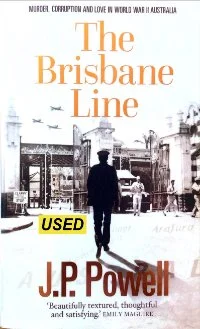
The Brisbane - Line

By J.P. Powell

"The Brisbane Line" by J.P. Powell is a captivating historical fiction novel that delves into the untold story of the controversial defense strategy during World War II. Set in Australia, the novel follows the lives of ordinary individuals caught in extraordinary circumstances as they navigate loyalty, sacrifice, and the blurred lines between right and wrong. Powell masterfully weaves together personal narratives and political intrigue against the backdrop of war-torn landscapes, offering readers a thought-provoking insight into a lesser-known aspect of history. With meticulous research and vivid storytelling, "The Brisbane Line" is a compelling read that sheds light on the complexities of human nature in times of crisis.

Sydney. Brio. 2020. 293p.

Claudius the god and his wife Messalina

USED BOOK. MAY CONTAIN MARK-IP

By Robert Graves

“The troublesome reign of Tiberius Claudius Caesar, emperor of the Romans (born 10 b.c., died a.d. 54), as described by himself; also his murder at the hands of the notorious agrippin a (mother of the emperor nero) and his subsequent deification, as described by others.”

NY. Vintage Random House. 1962. 584p.

The Agony and the Ecstasy: A Biographical Novel of Michelangelo

USED BOOK. MAY CONTAIN MARK-UP

By Irving Stone

FROM THE COVER: “Set in the days of the deadly Borgias, the warring popes and the mighty Medicis, this is the truly great novel of Michelangelo, his lifelong friendships, his passionate loves and his unquenchable genius. ….

"Irving Stone has painted the portrait of a supreme craftsman, one of the most versatile artists of all time, and he has also laid before us a cyclorama of one of the world's most astounding ages." New York Times

NY. Fontana books. 1970. 786p.

I'm a Stranger Here Myself

By Bill Bryson

FROM CHAPTER 1: “In the late summer of 1996, an old journalist friend from London named Simon Kelner called me in New Hampshire, to where I had lately moved after living for twenty-some years in Britain. Simon had recently been made editor of Night& Day magazine, a supplement ofthe Mail on Sunday newspaper, and it was his idea that I should write a weekly column for him on America. At various times over the years Simon had persuaded me to do all kinds of work that I didn't have time to do, but this was way out of the question.

"No," I said. "I can't. I'm sorry. It's just not possible. I've got too much on."

"So can you start next week?"

"Simon, you don't seem tounderstand. I can't do it."

"We thought we'd call it 'Notes from a Big Country.'" "Simon, you'll have to call it 'Big Blank Space in the Magazine' because I cannot do it."

NY. Broadway Books. 1999. 299p.

Jefferson: A Novel

USED BOOK. MAY CONTAIN MARK-UP

By Max Byrd

FROM THE COVER: “It is 1784, and Jefferson, the newly appointed American ambassador to the court of Louis XVI and Marie-Antoinette, has just arrived in Paris-a city adrift in intrigue, upheaval, and temptation that will challenge his principles, incite his passions, and change Thomas Jefferson forever.... Through the eyes of his impressionable young secretary, William Short, we watch as the future president builds his dream of an America with fellow patriots John Adams and Ben Franklin, and as he struggles between political ambition and an unexpected crisis of the heart with a woman who has the power to destroy him. And we discover-behind the face the complex Virginian shows the world -an enigmatic statesman who fights for individual liberty even as he keeps slaves, who champions free will even as he denies it to his daughters, and who holds men to the highest standards of honor-even as he embarks on a shadowy double life of his own.”

"A Novel To Be Admired And Enjoyed,The Best Fictionalized Life Of Jefferson Yet!' -Jack McLaughlin,

NY. Bantam. 1994. 470p.

Round the Camp Fire

USED BOOK. MAY CONTAIN MARK-UP

By E. E. Reynolds

FROM THE PREFACE: “The yarns in this book are all narratives of actual experiences. It is not usually difficult to get the books written by famous explorers, such as Livingstone, and their achievements are also recorded in biographies; but there have been a great many men who have travelled in the lesser known parts of the world without becoming famous. Many of the stories that follow are drawn from the adventures ofsuch minor explorers. One group. of the yarns is about early settlers in the Dominions; these men and women had to endure much hardship while creating new homes, but unfortunately few of themrecorded their experiences.

Oxford University Press. 1953. 160p.

Wolf Hall: A Novel

USED BOOK. MAY CONTAIN MARK-UP

By Hilary Mantel

FROM CHAPTER 1:

“So now get up."

Felled, dazed, silent, he has fallen; knocked full length on the cobbles of the yard. His head turns sideways; his eyes are turned toward the gate, as if someone might arrive to help him out. One blow, properly placed, could i kill him now. Blood from the gash on his head--which was his father's first effort is trickling across his face. Add to this, his left eye is blinded; but if he squints sideways, with his right eye he can see that the stitching of his father's boot is unraveling. The twine has sprung clear of the leather, and a hard knot in it has caught his eyebrow and opened another cut.”

NY. Henry Holt and Company. 2009. 548p.

Spitfire Parade

USED BOOK. MAY CONTAIN MARK-UP

By Captain W. E. Johns

FROPM THE COVER: “While the Battle of Britain is still at its height Squadron Leader Bigglesworth, D.S.O., D.F.C., is appointed to Number 666 Fighter Squadron. He soon finds that his new Com- mand is likely to be something of a handful, for the Squadron has been formed for the special purpose of accommodating a collection of bril- liant but unstable types whose capacities as fighter pilots are in inverse ratio to their amenity to discipline and the normal routine of a station.”

Oxford University Press. 1951. 252p.

The Lost Stradivarius

By John Meade Falkner

Edited with an Introduction by Edward Wilson who notes: “The detailed apparatus to this edition has been demanded not only by Time, which has altered not just the senses of words but a whole cultural hinterland beyond a modern reader's recognition, but by Falkner himself, who delighted in sowing his novel with literary and antiquarian allusions. Indeed, a character, Mr Gaskell, in The Lost Stradivarius itself, when reading an eighteenth-century diary in pursuit of highly sensational matter cannot resist telling us that "the minute details given were often of high antiquarian interest'“

London. Oxford University Press. 1954. (1895). USED BOOK. CONTAINS MARK-UP.

The Song Of Achilles

By Madeline Miller

FROM USA TODAY: “"It takes a truly gifted writer to make a song this old feel this beauti- fully new. What's startling about this sharply written, cleverly reimagined, enormously promising debut novel from Madeline Miller is how fresh and moving her take on the tale is--how she has managed to bring Achilles and his companion Patroclus to life in our time without removing them from their own."

NY. Harper Collins. 2012. 426p. USED BOOK. CONTAINS MARK-UP