Open Access Publisher and Free Library
Fiction+Mediajpg.jpg

FICTION and MEDIA

CRIME AND MEDIA — TWO PEAS IN A POD

Metamorphosis

By Franz Kafka. Translated by David Wyllie

From Wikipedia: Metamorphosis (German: Die Verwandlung) is a novella written by Franz Kafka which was first published in 1915. One of Kafka's best-known works, Metamorphosis tells the story of salesman Gregor Samsa, who wakes one morning to find himself inexplicably transformed into a huge insect (German: ungeheueres Ungeziefer, lit. "monstrousvermin") and subsequently struggles to adjust to this new condition. The novella has been widely discussed among literary critics, with differing interpretations being offered. In popular culture and adaptations of the novella, the insect is commonly depicted as a cockroach.

With a length of about 70 printed pages over three chapters, it is the longest of the stories Kafka considered complete and published during his lifetime. The text was first published in 1915 in the October issue of the journal Die weißen Blätter under the editorship of René Schickele. The first edition in book form appeared in December 1915 in the series Der jüngste Tag, edited by Kurt Wolff.[1]


Leipzig. Kurt Wolff Verlag . 1915. 49p. CONTAINS MARK-UP

Franz Kafka: The Complete Stories

By Franz Kafka. : Willa and Edwin Muir, Tania and James Stern

This is a 1971 collection of all Kafka’s finished works. It contains all the amazing, weird and wonderful unsettling stories from Metamorphisis to In the Penal Colony.From Wikipedia: “In 1912, Kafka wrote Die Verwandlung (The Metamorphosis, or The Transformation),[150] published in 1915 in Leipzig. The story begins with a travelling salesman waking to find himself transformed into an ungeheures Ungeziefer, a monstrous vermin, Ungezieferbeing a general term for unwanted and unclean pests, especially insects. Critics regard the work as one of the seminal works of fiction of the 20th century.[151][152][153] The story "In der Strafkolonie" ("In the Penal Colony"), dealing with an elaborate torture and execution device, was written in October 1914,[82] revised in 1918, and published in Leipzig during October 1919. The story "Ein Hungerkünstler" ("A Hunger Artist"), published in the periodical Die neue Rundschau in 1924, describes a victimized protagonist who experiences a decline in the appreciation of his strange craft of starving himself for extended periods.[154] His last story, "Josefine, die Sängerin oder Das Volk der Mäuse" ("Josephine the Singer, or the Mouse Folk"), also deals with the relationship between an artist and his audience.[155]

NY. Schoken. 1971. 487p. CONTAINS MARK-UP

The Wings of the Dove

By Henry James

From Wikipedia: The Wings of the Dove is a 1902 novel by Henry James. It tells the story of Milly Theale, an American heiress stricken with a serious disease, and her effect on the people around her. Some of these people befriend Milly with honourable motives, while others are more self-interested. Plot summary:

Kate Croy and Merton Densher are two betrothed Londoners who desperately want to marry but have very little money. Kate is constantly put upon by family troubles, and is now living with her domineering aunt, Maud Lowder. Into their world comes Milly Theale, an enormously rich young American woman who had previously met and fallen in love with Densher, although she has never revealed her feelings. Her travelling companion and confidante, Mrs. Stringham, is an old friend of Maud. Kate and Aunt Maud welcome Milly to London, and the American heiress enjoys great social success…….

Washington Square

By Henry James

From Wikipedia: The story of Washington Square by Henry James is told with a nuanced perspective of characters with individual rationalizations and sometimes undisclosed motivations. There is a subtle ambiguity to the internal logic of the participants in the story and none are altogether depicted as outright villainous.

In 1840s New York City, naive, introverted Catherine Sloper lives with her respected physician father, Dr. Austin Sloper, in Washington Square, a then newly established neighborhood near Greenwich Village. After the deaths of his wife and son, Dr. Sloper raises Catherine with his widowed sister, Mrs. Penniman, who is charged with Catherine's education. Although never disclosed directly to Catherine, the Doctor does not hold her personality or appearance in high regard, finding her a cheap substitute for her mother. This evaluation is never challenged in the narrative and Catherine is depicted as a simple, reserved individual……

NY. Harper. 1880. 266p.

The Turn of the Screw

By Henry James

From Wikipedia: The Turn of the Screw is an 1898 horror novella by Henry James which first appeared in serial format in Collier's Weekly (January 27 – April 16, 1898). In October 1898, it was collected in The Two Magics, published by Macmillan in New York City and Heinemannin London. The novella follows a governess who, caring for two children at a remote estate, becomes convinced that the grounds are haunted. The Turn of the Screw is considered a work of both Gothic and horror fiction.

In the century following its publication, critical analysis of the novella underwent several major transformations. Initial reviews regarded it only as a frightening ghost story, but, in the 1930s, some critics suggested that the supernatural elements were figments of the governess' imagination. In the early 1970s, the influence of structuralism resulted in an acknowledgement that the text's ambiguity was its key feature. Later approaches incorporated Marxist and feminist thinking.

  • On Christmas Eve, an unnamed narrator and some of his friends are gathered around a fire. One of them, Douglas, reads a manuscript written by his sister's late governess. The manuscript tells the story of her being hired by a man who has become responsible for his young niece and nephew following the deaths of their parents. He lives mainly in London and has a country house in Bly, Essex. The boy, Miles, is attending a boarding school, while his younger sister, Flora, is living in Bly, where she is cared for by Mrs. Grose, the housekeeper. Flora's uncle, the governess's new employer, is uninterested in raising the children and gives her full charge, explicitly stating that she is not to bother him with communications of any sort. The governess travels to Bly and begins her duties…………

NY.London. Collier Macmillan. 1898. 118p.

The Portrait of a Lady

By Henry James

From Wikipedia: The Portrait of a Lady is a novel by Henry James, first published as a serial in The Atlantic Monthly and Macmillan's Magazine in 1880–81 and then as a book in 1881. It is one of James's most popular novels and is regarded by critics as one of his finest.

The Portrait of a Lady is the story of a spirited young American woman, Isabel Archer, who, "affronting her destiny,"[1] finds it overwhelming. She inherits a large amount of money and subsequently becomes the victim of Machiavellian scheming by two American expatriates. Like many of James's novels, it is set in Europe, mostly England and Italy. Generally regarded as the masterpiece of James's early period,[2] this novel reflects James's continuing interest in the differences between the New World and the Old, often to the detriment of the former. It also treats in a profound way the themes of personal freedom, responsibility, and betrayal.

  • Isabel Archer, from Albany, New York, is invited by her maternal aunt, Lydia Touchett, to visit Lydia's rich husband, Daniel, at his estate near London, following the death of Isabel's father. There, Isabel meets her uncle, her friendly invalid cousin Ralph Touchett, and the Touchetts' robust neighbor, Lord Warburton. Isabel later declines Warburton's sudden proposal of marriage. She also rejects the hand of Caspar Goodwood, the charismatic son and heir of a wealthy Boston mill owner. Although Isabel is drawn to Caspar, her commitment to her independence precludes such a marriage, which she feels would demand the sacrifice of her freedom…….

The Bostonians

By Henry James

The Bostonians is a novel by Henry James, first published as a serial in The Century Magazine in 1885–1886 and then as a book in 1886. This bittersweet tragicomedycentres on an odd triangle of characters: Basil Ransom, a political conservative from Mississippi; Olive Chancellor, Ransom's cousin and a Boston feminist; and Verena Tarrant, a pretty, young protégée of Olive's in the feminist movement. The storyline concerns the struggle between Ransom and Olive for Verena's allegiance and affection, though the novel also includes a wide panorama of political activists, newspaper people, and quirky eccentrics.

  • Henry James originally entered into an agreement with the Boston publisher James R. Osgood & Co. to publish the book in the United States for $4,000. Osgood made a separate agreement with The Century for the magazine to serialize the novel. In May 1885, before the serialization had finished and James had been paid any of the money owed to him, Osgood's firm went bankrupt.[1] James was able to recover part of the lost sum by selling the copyright to Macmillan and Co., which published The Bostonians in a three-volume edition in Britain in February 1886, and in a one-volume edition in the US in May 1886.[1] James was not, however, able to recover any money for the serialization in The Century.[2]

  • Mississippi lawyer and Civil War veteran, Basil Ransom, visits his cousin Olive Chancellor in Boston. She takes him to a political meeting where Verena Tarrant delivers a feminist speech. Ransom, a strong conservative, is annoyed by the speech but fascinated with the speaker. Olive, who never has set eyes on Verena, is equally fascinated. She persuades Verena to leave her parents' house, move in with her and study in preparation for a career in the feminist movement. Meanwhile, Ransom returns to his law practice in New York, which is not doing well. He visits Boston again and walks with Verena through the grounds of Harvard College, including the impressive Civil War Memorial Hall. Verena finds herself attracted to the charismatic Ransom. Basil eventually proposes to Verena, much to Olive's dismay. Olive has arranged for Verena to speak at the Boston Music Hall. Ransom shows up at the hall just before Verena is scheduled to begin her speech. He persuades Verena to elope with him, to the discomfiture of Olive and her fellow-feminists. The final sentence of the novel shows Verena in tears – not to be her last, James assures us.

London. Macmillan . 1886. 419p.

The Uncommercial Traveller

By Charles Dickens

From Wikipedia: “In 1859 Dickens founded a new journal called All the Year Round, and the "Uncommercial Traveller" articles would be among his main contributions. He seems to have chosen the title and persona of the Uncommercial Traveller as a result of a speech he gave on 22 December 1859 to the Commercial Travellers' School in London,[1] in his role as honorary chairman and treasurer. The persona sits well with a writer who liked to travel, not only as a tourist, but also to research and report what he found visiting Europe, America and giving book readings throughout Britain. He did not seem content to rest late in his career when he had attained wealth and comfort and continued travelling locally, walking the streets of London in the mould of the flâneur, a "gentleman stroller of city streets". He often suffered from insomnia and his night-time wanderings gave him an insight into some of the hidden aspects of Victorian London, details of which he also incorporated into his novels.”

London: Chapman & Hall, Ld. New York: Charles Scribner’s Sons. 1905. 370p.

Some Short Christmas Stories

By Charles Dickens

The opening of “A Christman story”. I have been looking on, this evening, at a merry company of children assembled round that pretty German toy, a Christmas Tree.  The tree was planted in the middle of a great round table, and towered high above their heads.  It was brilliantly lighted by a multitude of little tapers; and everywhere sparkled and glittered with bright objects.  There were rosy-cheeked dolls, hiding behind the green leaves; and there were real watches (with movable hands, at least, and an endless capacity of being wound up) dangling from innumerable twigs; there were French-polished tables, chairs, bedsteads, wardrobes, eight-day clocks, and various other articles of domestic furniture (wonderfully made, in tin, at Wolverhampton), perched among the boughs, as if in preparation for some fairy housekeeping; there were jolly, broad-faced little men, much more agreeable in appearance than many real men—and no wonder, for their heads took off, and showed them to be full of sugar-plums; there were fiddles and drums; there were tambourines, books, work-boxes, paint-boxes, sweetmeat-boxes, peep-show boxes, and all kinds of boxes; there were trinkets for the elder girls, far brighter than any grown-up gold and jewels; there were baskets and pincushions in all devices; there were guns, swords, and banners; there were witches standing in enchanted rings of pasteboard, to tell fortunes; there were teetotums, humming-tops, needle-cases, pen-wipers, smelling-bottles, conversation-cards, bouquet-holders; real fruit, made artificially dazzling with gold leaf; imitation apples, pears, and walnuts, crammed with surprises; in short, as a pretty child, before me, delightedly whispered to another pretty child, her bosom friend, “There was everything, and more.”  This motley collection of odd objects, clustering on the tree like magic fruit, and flashing back the bright looks directed towards it from every side—some of the diamond-eyes admiring it were hardly on a level with the table, and a few were languishing in timid wonder on the bosoms of pretty mothers, aunts, and nurses—made a lively realisation of the fancies of childhood; and set me thinking how all the trees that grow and all the things that come into existence on the earth, have their wild adornments at that well-remembered time.

London. Chapman and Hall Christmas Stories edition, Volume 1, 1911. 69p.

Nicholas Nickleby,

By Charles Dickens

From Wikipedia. Nicholas Nickleby, or The Life and Adventures of Nicholas Nickleby, is the third novel by Charles Dickens, originally published as a serial from 1838 to 1839. The character of Nickleby is a young man who must support his mother and sister after his father dies.

London. Chapman and Hall. 1839. 954p.

Our Mutual Friend

By Charles Dickens

From Wikipedia: Our Mutual Friend, written in 1864–1865, is the last novel completed by Charles Dickens and is one of his most sophisticated works, combining savage satire with social analysis. It centres on, in the words of critic J. Hillis Miller, quoting the book's character Bella Wilfer, "money, money, money, and what money can make of life".[1]

Most reviewers in the 1860s continued to praise Dickens's skill as a writer in general, but did not review this novel in detail. Some found the plot both too complex and not well laid out.[2] The Times of London found the first few chapters did not draw the reader into the characters. In the 20th century, however, reviewers began to find much to approve in the later novels of Dickens, including Our Mutual Friend.[3] In the late 20th and early 21st centuries, some reviewers suggested that Dickens was, in fact, experimenting with structure,[4][5] and that the characters considered somewhat flat and not recognized by the contemporary reviewers[6] were meant rather to be true representations of the Victorian working class and the key to understanding the structure of the society depicted by Dickens in the novel.[6][7]

London. Chapman & Hall. 1865. 970p.

Little Dorrit

By Charles Dickens

From Wikipedia: Little Dorrit is a novel by Charles Dickens, originally published in serial form between 1855 and 1857. The story features Amy Dorrit, youngest child of her family, born and raised in the Marshalsea prison for debtors in London. Arthur Clennam encounters her after returning home from a 20-year absence, ready to begin his life anew.

The novel satirises some shortcomings of both government and society, including the institution of debtors' prisons, where debtors were imprisoned, unable to work and yet incarcerated until they had repaid their debts. The prison in this case is the Marshalsea, where Dickens's own father had been imprisoned. Dickens is also critical of the impotent bureaucracy of the British government, in this novel in the form of the fictional "Circumlocution Office". Dickens also satirises the stratification of society that results from the British class system.

Bradbury and Evans. 1857. 995p.

Hard Times

By Charles Dickens

From Wikipedia: “Hard Times: For These Times (commonly known as Hard Times) is the tenth novel by Charles Dickens, first published in 1854. The book surveys English society and satirises the social and economic conditions of the era. Hard Times is unusual in several ways. It is by far the shortest of Dickens's novels, barely a quarter of the length of those written immediately before and after it.[1] Also, unlike all but one of his other novels, Hard Times has neither a preface nor illustrations. Moreover, it is his only novel not to have scenes set in London.[1] Instead the story is set in the fictitious Victorian industrial Coketown, a generic Northern English mill-town, in some ways similar to Manchester, though smaller. Coketown may be partially based on 19th-century Preston. One of Dickens's reasons for writing Hard Times was that sales of his weekly periodical Household Words were low, and it was hoped the novel's publication in instalments would boost circulation – as indeed proved to be the case. Since publication it has received a mixed response from critics.

London. Chapman and Hal. 1905. 304p.

Dombey and Son

By Charles Dickens

From Wikipedia: “The story concerns Paul Dombey, the wealthy owner of the shipping company of the book's title, whose dream is to have a son to continue his business. The book begins when his son is born and Dombey's wife dies shortly after giving birth. Following the advice of Mrs Louisa Chick, his sister, Dombey employs a wet nurse named Mrs Richards (Toodle). Dombey already has a six-year-old daughter Florence, but, bitter at her not having been the desired boy, he neglects her continually. One day, Mrs Richards, Florence, and her maid, Susan Nipper, secretly pay a visit to Mrs Richards' house in Staggs's Gardens so that Mrs Richards can see her children. During this trip, Florence becomes separated from them and is kidnapped for a short time by Good Mrs Brown, before being returned to the streets. She makes her way to Dombey and Son's offices in the City and there is found and brought home by Walter Gay, an employee of Mr Dombey, who first introduces her to his uncle, the navigation instrument maker Solomon Gills, at his shop The Wooden Midshipman. The child, named Paul after his father, is a weak and sickly child….”

London. Bradbury & Evans. 1848.

The Life and Adventures of Martin Chuzzlewit

By Charles Dickens

From Wikipedia: “Like nearly all of Dickens's novels, Martin Chuzzlewit was first published in monthly instalments. Early sales of the monthly parts were lower than those of previous works, so Dickens changed the plot to send the title character to the United States.[3] Dickens had visited America in 1842 in part as a failed attempt to get the US publishers to honour international copyright laws. He satirized the country as a place filled with self-promoting hucksters, eager to sell land sight unseen. In later editions, and in his second visit 24 years later to a much-changed US, he made clear it was satire and not a balanced image of the nation in a speech and then included that speech in all future editions. The main theme of the novel, according to Dickens's preface, is selfishness, portrayed in a satirical fashion using all the members of the Chuzzlewit family. The novel is also notable for two of Dickens's great villains, Seth Pecksniff and Jonas Chuzzlewit. Dickens introduced the first private detective character in this novel.”

The Chimes: A Goblin Story

By Charles Dickens

“…When he came therefore to think of his new story for Christmas time, he resolved to make it a plea for the poor ... He was to try and convert Society, as he had converted Scrooge, by showing that its happiness rested on the same foundations as those of the individual, which are mercy and charity not less than justice…” (Wikipedia)

Chapman and Hall. 1844. 175p.

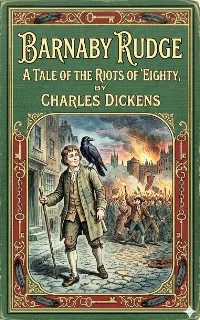
Barnaby Rudge

By Charles Dickens

A Storm is Gathering in the Heart of London.

In the quiet village of Chigwell, a decades-old murder remains unsolved, its shadow hanging over the crumbling Maypole Inn. In the sweltering, narrow streets of London, a different kind of darkness is brewing: a mob looking for a reason to burn.

Barnaby Rudge is a young man of pure heart and fractured mind, accompanied everywhere by his uncanny companion, Grip the Raven. While Barnaby sees the world in flashes of color and song, the men around him see only power. From the manipulative demagogue Lord George Gordon to the vengeful ghosts of Barnaby's own past, the stage is set for a collision that will leave the city in ashes.

As the infamous Gordon Riots of 1780 ignite, private secrets and public madness intertwine. Charles Dickens’s most atmospheric historical novel is a gripping tale of:

  • The "Innocent" caught in the crossfire: A haunting look at how the vulnerable are used by the powerful.

  • Family Legacies: A dark exploration of the sins of the father visited upon the son.

  • The Roar of the Crowd: A terrifyingly modern depiction of how quickly a protest becomes a catastrophe.

"I'm a devil! I'm a devil!" croaks Grip. In a city consumed by fire and fanaticism, he might be the only one telling the truth.

London Chapmwn Hall. 1870. Read-Me.Org Inc. New York-Philadelphia-Australia. 2026. 467p.

The Thief's Journal

From the Cover: In this, his most famous book, Genet charts his progress through Europe and the 1930s in rags, hunger, contempt, fatigue and vice. Spain, Italy, Austria, Czechoslovakia, Poland, Nazi Germany, Belgium . . . everywhere the pattern is the same: bars, dives, flop-houses; robbery, prison and expulsion. This is a voyage of discovery beyond all moral laws; the expression of a philosophy of perverted vice, the working out of an aesthetic of degradation. The cover shows 'Head on Stand' (1947)b y Alberto Giacometti, in the Maeght Collection.

London. Penguin Classics. 1950s? THIS BOOK CONTAINS MARK-UP

My Cousin Rachel

By Daphne Du Maurier

"My Cousin Rachel" is a novel written by Daphne du Maurier, a British author known for her Gothic and romantic suspense novels. The novel was first published in 1951 and is set in 19th-century Cornwall, England.

The story follows the character of Philip Ashley, a young man who is raised by his cousin Ambrose on their estate in Cornwall. When Ambrose travels to Italy for his health and falls in love with their distant cousin Rachel, Philip is initially suspicious of her motives. After Ambrose's sudden death, Philip inherits his estate and becomes increasingly obsessed with Rachel, who comes to visit him in Cornwall.

The novel is a blend of mystery, romance, and psychological drama, as Philip tries to uncover the truth about Rachel's involvement in Ambrose's death and struggles with his conflicting feelings for her.

London. Gollancz. 1951. 221p.

The Aunt's Story

By Patrick White

"The Aunt's Story" is a novel written by Patrick White, an Australian author who was awarded the Nobel Prize in Literature in 1973. It was first published in 1948 and is considered one of White's most significant works.

The novel follows the character of Theodora Goodman, a woman who feels out of place in her conventional middle-class Australian upbringing. She travels to Europe to find a sense of purpose and belonging, but struggles to find her place in the world. The story is told through a series of interconnected vignettes, exploring Theodora's inner thoughts and perceptions of the world around her.

"The Aunt's Story" is noted for its lyrical and poetic writing style, as well as its exploration of themes such as identity, self-discovery, and the search for meaning in life. The novel is also notable for its use of symbolism and metaphor, which are used to explore Theodora's psychological journey.

Mitcham, Austalia. Penguin. 1953