Open Access Free Library
CRIMINAL JUSTICE.jpeg

CRIMINAL JUSTICE

CRIMINAL JUSTICE-CRIMINAL LAW-PROCDEDURE-SENTENCING-COURTS

Posts in Prevention
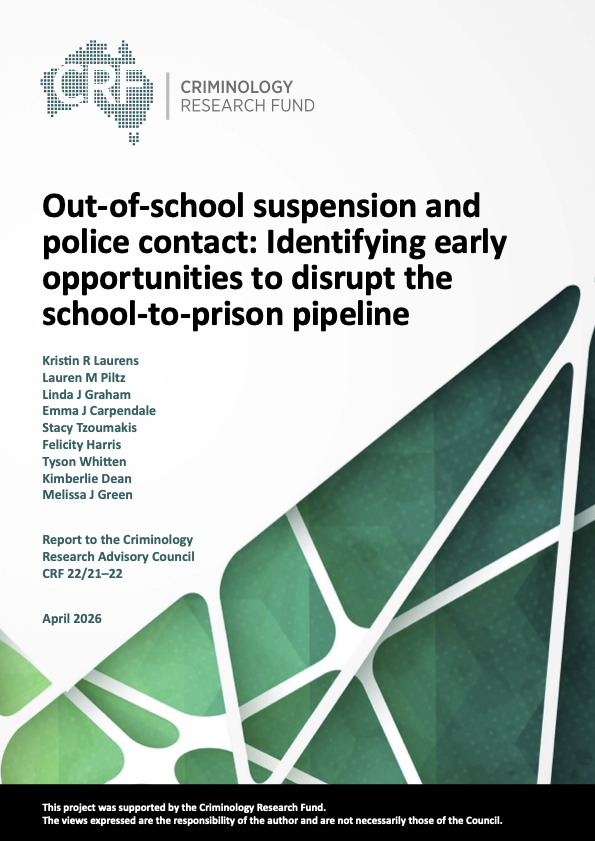
Out-of-school suspension and police contact: Identifying early opportunities to disrupt the school-to-prison pipeline

By Kristin R Laurens, Lauren M Piltz. Linda J Graham, Emma J Carpendale. Stacy Tzoumakis. Felicity Harris.  Tyson Whitten,  Kimberlie Dean,  Melissa J Green

The aim of this study was to examine the association between out-of-school suspension from primary school and early contact with police (by approximately 14 years of age). Using data from the New South Wales Child Development Study, this study determined the prevalence and pattern of suspension (by timing, total number, total days, and reason) and police contact (any, person of interest, victim, and/or witness) among 68,121 children who attended NSW public schools during 2012 to 2015 (Years 3 to 6). Associations between suspension and police contact were analysed using a demographically matched sample that compared all 3,291 suspended children with 6,582 like non-suspended peers. Suspended children had almost quadruple the odds of police contact relative to nonsuspended children after controlling for other factors. Children with more suspensions, and suspensions for more serious reasons, had even greater likelihood of police contact, especially as a person of interest. Findings highlight a need for systemic education and interagency reform to enact effective alternatives to suspension.

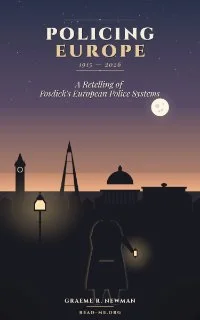
POLICING EUROPE 1915–2026: A Retelling of Fosdick's European Police Systems

by Graeme Newman (Author)

How did Europe police its cities before the First World War, and what can those systems teach us today?

In Policing Europe: A Retelling of Fosdick's Classic, criminologist and policing scholar Graeme R. Newman presents a concise, modernized edition of Raymond B. Fosdick's landmark 1915 study of European policing. Based on nearly two years of firsthand research across England, Scotland, Germany, Austria-Hungary, France, Italy, Holland, and Belgium, Fosdick's original work remains one of the most comprehensive comparative examinations of police systems ever written. [Policing_Europe Word]

Traveling through the great capitals and industrial cities of Europe on the eve of World War I, Fosdick interviewed commissioners, detectives, patrol officers, judges, and government officials to answer questions that remain deeply relevant today:

  • Should policing be controlled locally or by the national government?

  • How much authority should police possess?

  • What creates public trust in law enforcement?

  • How should police leaders be selected and trained?

  • What prevents corruption and abuse of power?

  • Which organizational structures produce effective and accountable policing?

This edition preserves Fosdick's remarkable firsthand observations while updating the language for contemporary readers. It explores the contrasting traditions of British "policing by consent" and Continental state-centered policing, compares police organizations in London, Paris, Berlin, Vienna, Budapest, and Rome, and examines detective methods, recruitment, training, leadership, forensic science, and police integrity. [Policing_Europe Word]

More than a historical document, Policing Europe offers a fascinating window into the origins of many modern debates about public safety, civil liberties, professionalization, surveillance, police accountability, and the relationship between citizens and the state. Written just before a world war transformed Europe forever, it captures a vanished world while illuminating issues that continue to shape policing in the twenty-first century. [Policing_Europe Word]

Ideal for:

  • Students of criminology and criminal justice

  • Police professionals and policymakers

  • Historians of law, government, and public administration

  • Readers interested in comparative policing and European history

  • Anyone seeking a deeper understanding of how modern police systems evolved

A century after its original publication, Fosdick's pioneering study remains essential reading for anyone interested in the enduring challenge of balancing order, authority, liberty, and public trust. [Policing_Europe Word]

Read-Me.Org Inc. New York-Philadelphia-Australia. 2026. p172.

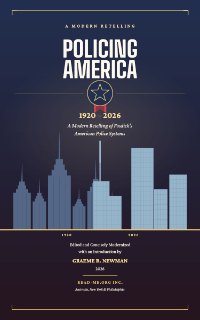
Policing America:1920–2026:: A Modern Retelling of Fosdick's American Police Systems

by Graeme Newman (Author)

In 1920, an investigator toured seventy-two American cities and concluded that the police in every one of them were failing — not from a lack of good men, but from a century of political interference, organizational chaos, and a refusal to let any competent leader keep the job long enough to matter. A hundred years later, the argument still lands.

Raymond B. Fosdick's American Police Systems was one of the most ambitious studies of policing ever produced in the Progressive Era — a firsthand, city-by-city comparison of American departments against the professional, politically insulated forces of London, Paris, and Berlin. Fosdick found American policing outmatched at nearly every turn: murder rates that dwarfed Europe's, police chiefs who rotated out with every election, civil-service rules that protected the incompetent as readily as the honest, and city after city that tore up its own police governance and started over, never once letting a good structure — or a good leader — mature.

This edition brings that argument back, rewritten for a modern reader.

This is not a facsimile reprint. Every chapter has been surveyed against Fosdick's original text — including its extensive footnotes — and rewritten fresh, in modernized prose, at roughly a fifth of the original length. The topic structure, the argument, and the great majority of Fosdick's specific facts, cases, and comparisons survive intact; the discursive, footnote-heavy academic style of 1920 does not. Readers get the substance of a landmark study without the apparatus of a century-old monograph.
A substantial new introduction places Fosdick's argument in conversation with policing today: the persistence of American police fragmentation across eighteen thousand separate agencies, the technology Fosdick could only gesture toward (national fingerprint databases, predictive policing, body-worn cameras), the surprising afterlife of "heterogeneity" as European cities have grown as demographically diverse as the American ones Fosdick once contrasted them against, the diversity of police workforces themselves in the U.S. and U.K. today, and where Fosdick's own instincts do — and don't — anticipate contemporary arguments over the scope and funding of policing.
What's inside:
- All eleven chapters of Fosdick's original argument, modernized and condensed
- A new, extensive introduction connecting the book to policing in 2026
- The original seven city police-organization charts, reproduced as images
- Modern 5x8 trade formatting with a full table of contents
Policing America, 1920-2026 is for readers of policing history, criminal justice students, and anyone following today's debates over police reform who wants to see how far back — and how little changed — those debates actually go.
A Read-Me.Org Modern Adaptation. Modernized and edited, with an introduction, by Graeme R. Newman. Based on the 1920 original by Raymond B. Fosdick.

Read-Me.Org Inc. New York-Philadelphia-Australia. 2026. p111.

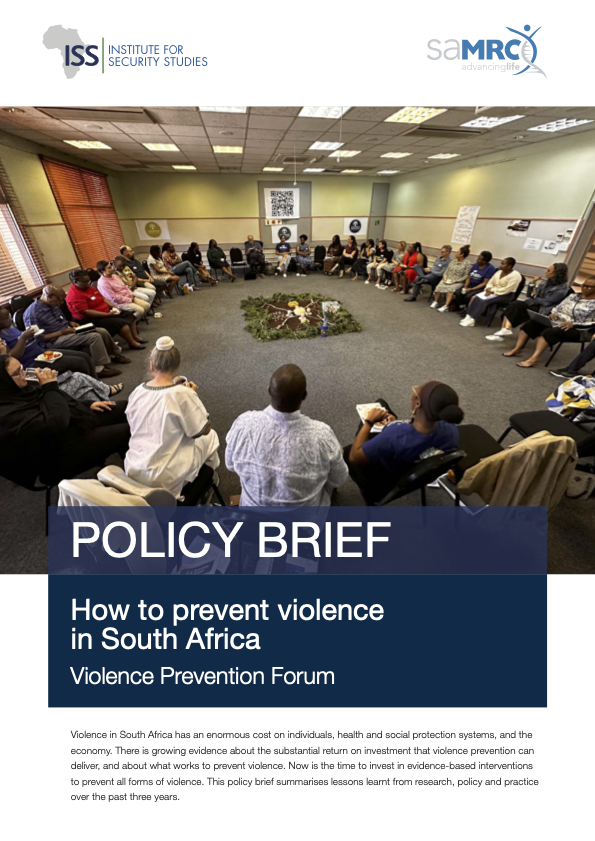
How to prevent violence in South Africa Violence Prevention Forum 

By Senzikile Bengu, Harsha Dayal, Gwen Dereymaeker, et al.

Violence in South Africa has an enormous cost on individuals, health and social protection systems, and the economy. There is growing evidence about the substantial return on investment that violence prevention can deliver, and about what works to prevent violence. Now is the time to invest in evidence-based interventions to prevent all forms of violence. This policy brief summarises lessons learnt from research, policy and practice over the past three years. Key findings Violence costs the economy, companies, and health and social systems. There is evidence for a positive return on investments when violence is prevented. This means it is cheaper to fund effective violence prevention than a criminal justice system, which reacts to violent crime. There is a growing body of research and practicebased knowledge of what works to prevent violence in South Africa. There is a strong association between violence and inequality, unemployment, food insecurity and poverty. Parenting and community-based interventions show significant effects on preventing or reducing intimate partner violence and violence against children. With regard to violence against women: The chances of getting justice for a murdered woman are low and decreasing. Police fail to make arrests despite an intimate partner or family member being involved in more than 70% of cases. Experience of trauma and poor mental health increase the chances of women students in higher education institutions being targeted for sexual violence. Circumstances that lead male students to perpetrate violence include abuse during childhood, and cultural norms equating masculinity with dominance over women. Burnout and exhaustion in frontline workers significantly hamper violence prevention efforts