Open Access Publisher and Free Library
TERRORISM.jpeg

TERRORISM

Terrorism-Domestic-International-Radicalization-War-Weapons-Trafficking-Crime-Mass Shootings

Posts in Social Sciences
Behind the Mask:Uncovering the Extremist Messages of a 3D‑Printed Gun Designer

By The International Centre for the Study of Radicalisation and Political Violence

Within the world of 3D-printed guns, one pseudonymous figure has emerged as a symbol for the cause of universal access to firearms: “JStark1809”. He created the world’s most popular 3D-printed gun and established an influential network of 3D-printed gun designers. Since his death in July 2021, he has been memorialised as a martyr for the right to bear arms. In this report, ICSR Senior Research Fellow Dr Rajan Basra identifies “JStark1809” as Jacob Duygu, a German national born to Kurdish parents who arrived as refugees from Southeast Turkey in the 1990s. Using a combination of authorship attribution techniques, JStark can be identified as the author of over 700 seemingly “anonymous” comments on 4chan’s /pol/ board. He disclosed hitherto unknown details about his life, broader political views, and extremist attitudes.

Chapter one lays out the findings and structure of the report. Chapter two details the open-source methodology used in finding JStark’s digital footprint, including how he was identified as the author of “anonymous” comments. It also summarises JStark’s biographical details.

The subsequent chapters analyse JStark’s life according to three themes: (1) his journey to designing 3D-printed firearms; (2) his political beliefs, including his xenophobic online behaviour and threats of violence as expressed on 4chan’s /pol/; and (3) his life as a self-identified incel, attitudes to misogynistic violence, and his related suicidal ideation. The report concludes with implications for the broader 3D-printed gun movement.

London: ICSR, Department of War Studies, King’s College London, 2023. 52p.

download
Layers of Lies: A First Look at Irish Far-Right Activity on Telegram

By Institute for Strategic Dialogue (ISD)

This report aims to provide a first look into Irish far-right activity on the messaging app, Telegram, where the movement is operating both as identifiable groups and influencers, and anonymously-run channels and groups. The report looks at the activity across 34 such Telegram channels through the lens of a series of case studies where content posted on these channels resulted in real life consequences. Using both quantitative and qualitative methods, the report examines the tactics, language and trends within these channels, providing much-needed detail on the activity of the Irish far-right online. This report was produced in conjunction with TheJournal.ie and its investigative platform Noteworthy.ie as part of their Eyes Right series, examining the growth of far-right ideology on Irish online networks, and its influence on wider public opinion.

Beirut; London; etc.: Institute for Strategic Dialogue (2021). ,30p.

download
The Domestic Extremist Next Door: How Digital Platforms Enable the War Against American Government

By The Digital Citizens Alliance

Digital platforms enabled the disturbing rise of domestic extremism, culminating with the January 6 attack on the U.S. Capitol. Militia groups use social media networks to plan operations, recruit new members and spread anti-democracy propaganda, a new Digital Citizens Alliance (Digital Citizens) and Coalition for a Safer Web (CSW) investigation has found.

Taking a page from Jihadists, these extremist groups operate along the fringes of where platforms such as YouTube, Twitter, Facebook, and Instagram will let them. Federal prosecutors investigating the Capitol riot revealed how militia groups used social media platforms to coordinate and prepare for possible conflict with Antifa. But the joint Digital Citizens / CSW investigation found the use of platforms goes well beyond tactical planning. Militias rely on the platforms to share their beliefs and ideology and recruit new members. The militias get a boost from their ideological simpatico with mis/disinformation groups like QAnon, which provides oxygen that militias use to fan the flames.

The anti-government militia movement first emerged after the 1992 Ruby Ridge standoff, the 1993 Waco siege, and the Oklahoma City Bombing on April 19, 1995. After Oklahoma City, U.S. law enforcement cracked down on domestic terrorism and the militia movement. In 1996, the Southern Poverty Law Center (SPLC) reported 858 militia groups with up to 50,000 active members. The 9/11 terrorist attacks shifted focus to global threats and led to a dormant period for militias. But domestic extremists such as the Proud Boys, the Boogaloo Bois, the Three Percenters, and the Oath Keepers have reinvigorated the movement – aided in large part by digital platforms. In 2020, according to research by The Washington Post, the number of domestic terrorism incidents in the United States had doubled from what it was in 1995. But the joint Digital Citizens / CSW investigation found the use of platforms goes well beyond tactical planning. Militias rely on the platforms to share their beliefs and ideology and recruit new members. The militias get a boost from their ideological simpatico with mis/disinformation groups like QAnon, which provides oxygen that militias use to fan the flames.

The anti-government militia movement first emerged after the 1992 Ruby Ridge standoff, the 1993 Waco siege, and the Oklahoma City Bombing on April 19, 1995. After Oklahoma City, U.S. law enforcement cracked down on domestic terrorism and the militia movement. In 1996, the Southern Poverty Law Center (SPLC) reported 858 militia groups with up to 50,000 active members. The 9/11 terrorist attacks shifted focus to global threats and led to a dormant period for militias. But domestic extremists such as the Proud Boys, the Boogaloo Bois, the Three Percenters, and the Oath Keepers have reinvigorated the movement – aided in large part by digital platforms. In 2020, according to research by The Washington Post, the number of domestic terrorism incidents in the United States had doubled from what it was in 1995.

Washington, DC: Digital Citizens Alliance, 2021. 56p.

download
The Role of Translation in ISIS Propaganda:: International Online Radicalization Methods and Its Effect on Extremism in Indonesia

By Hanny Purnama Sari and Muhammad Syauqillah

This research aims to compile data and information that will contribute to understanding the online radicalization phenomenon through translation. There are many studies on using the internet and propaganda in a terrorism context. However, only a handful studied the correlation between translation and terrorism propaganda, especially in Indonesia. There was little discussion on the role of translation in bridging communication between different nations, cultures, and languages and using it to propagate radical/propaganda narratives worldwide and amplify those messages to its target audience. The research method is descriptive qualitative using primary and secondary data; the sample is taken from the book of Nadharat Fi Al Ijma' Al Qath'i and previous findings and news. This research revealed at least ten roles of translation in the online radicalization phenomenon; among others, translation in the target language can be used to identify the target audience of the propagandist, and many terrorist sympathizers were willing to volunteer to translate the propaganda. However, although the translation is used to leverage the spread of propaganda, it can also assist law enforcement officers in combating terrorist/propaganda narratives. Indonesian law enforcement officers may use translation to counter-terrorism as Indonesia has hundreds of vernacular languages that can be used to 'encrypt' and disseminate their extremist narratives.

International Journal of Science and Society, 4(4), 319-336.

download
Terror Times: The Depth and Breadth of the Islamic State Alternative News Outlet Ecosystem Online

By Moustafa Ayad, Nadeem Khan and Aymenn al-Tamimi

his report highlights the networks, supporters, and the platforms of Islamic State disinformation disseminators, focusing on popular social media platforms as well as encrypted messaging applications. These disinformation networks are creating self-branded media outlets with followers in the tens of thousands, and often with innocuous names like “Global Happenings,” “DRIL” and “Media Center,” to evade moderation and takedowns. These same networks use coded language and a codebook of emojis to spread Islamic State “news” to other networks of supporters, who similarly evade moderation. These ‘alternative news outlets’ are trying to outcompete narratives publicized by government officials as well as independent mainstream media and individual journalists – groups that were also heavily targeted by Islamic State.

London: IDS - Institute for Strategic Dialogue, 2022. 22p.

download
Silencing the guns in cities: urbanisation and arms trafficking in Bamako and Lagos

by Oluwole Ojewale

This study explores the complex relationships between urbanisation and transnational organised crime, focusing on how illicit arms shape urban violence and are leveraged by criminal groups. It maps the nexus between arms trafficking actors and criminal groups operating in other organised markets in urban contexts and proposes interventions that engage with diverse layers of urban governance and stakeholders in the cities. The study focuses on Bamako and Lagos as urban centres in which arms trafficking and urbanisation intersect. Key points l There are multiple drivers and enablers of arms trafficking. l Armoury theft is a major source of illicit weapons and ammunition. l Arms trafficking is highly segmented and spatially concentrated. l Illicit firearms enter cities through various entry points. l Organised crime groups operate across multiple illicit businesses. l Elite support to ethnic militias drives private armament outside of state control. l The centralised governance framework on security forecloses potential collaboration from subnational governments to address urban arms trafficking.

OCWAR-T Research Report 2 . ECOWAS Commission, 2023. 38p,

download
Preventing explosions: taking stock of weapon stockpiles in the ECCAS and SADC regions

By Nelson Alusala

This policy brief reviews the state of physical security and stockpile management (PSSM) in Central and Southern Africa as at 2022. Africa’s most progressive legally binding instruments for controlling small arms and light weapons can be found in these regions. The Economic Community of Central African States (ECCAS) Convention became legal in 2017 and the Southern African Development Community Protocol was revised in 2020. However, compliance with these instruments requires commitment from all stakeholders, including civil society. Key findings ∙ The region’s long-term stability depends on good principles of physical security and stockpile management (PSSM). Until ECCAS members enforce policy and implement steps to improve the PSSM of arms and ammunition in government possession, leakage and diversion to non-state actors will continue undeterred. ∙ Implementation should be next. The Kinshasa Convention, like the Arms Trade Treaty and UN Agenda 2030, are considered some of the latest instruments on disarmament, human security and development. The review of the Southern African Development Community (SADC) Firearms Protocol in 2020 aligned the SADC region with the latest developments, and the African Union (AU) vision for silencing the guns by 2030. ∙ A review of other regional instruments is required. This is vital, especially for the Economic Community of West African States (ECOWAS) Convention on Small Arms and Light Weapons, their Ammunition and other Related Materials, and the Nairobi Protocol for the Prevention, Control and Reduction of Small Arms and Light Weapons in the Great Lakes Region, the Horn of Africa and Bordering States.

ENACT Africa, 2022. 11p.

download
Preventing explosions: taking stock of weapon stockpiles in West Africa and the Sahel

By Nelson Alusala

Without effective security and stockpile management systems, the wave of political instability in the two regions is likely to endure.

This policy brief reviews the state of the physical state of security and stockpile management (PSSM) in West Africa and the Sahel as at 2022. Through desk research and policymaker interviews, it explores key policies and practices. It questions whether governments struggle to maintain their arms and ammunition because they bite off too much, encounter unforeseen consequences that lead to the exposure and diversion of weaponry, or are just negligent. Regardless, loss of life and the destruction of property continue unabated as criminals, violent extremists and other non-state actors take advantage of the armouries’ sub-standard security.

Key findings ∙ The region (West Africa and the Sahel) implemented several PSSM measures from 2011 to 2020; and the African Union (AU) decided in December 2020 to extend the Silencing the Guns initiative until 2030. ∙ Interventions in the region were not harmonised and were short-lived, making their impact difficult to quantify. Most initiatives were programmes and capacity-building training rather than disarmament and/or practical steps to secure the safety and security of national stockpiles. ∙ The movement of people between countries oblivious of borders is a tradition linked to pastoralism and transhumance. However, the corridor proclaimed for this purpose has been subsumed by human settlement, leading to herder-farmer conflicts that have exacerbated the demand for illegal arms. These have put excess pressure on national stockpiles.

ENACT Africa, 2020. 12p,

download
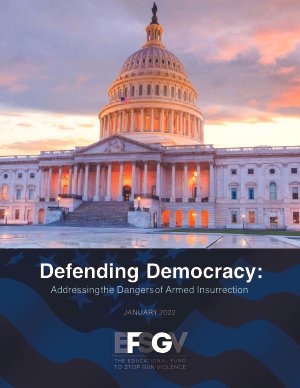
Defending Democracy: Addressing the Dangers of Armed Insurrection

By The Educational Fund to Stop Gun Violence'

The Educational Fund to Stop Gun Violence (ESGV) has issued a report with five policy recommendations that states must implement immediately in order to protect democracy in the face of a growing armed insurrectionist movement. The insurrection at the Capitol last January 6th was the loudest expression of a continuing effort by armed insurrectionists to upend government The report offers new insight and analysis and serves as both an examination and a warning that, if left unaddressed, armed insurrectionism will continut to pose a threat to the country. It also examines the significant overlap between insurrectionist activity and White Supremacism and the deadly combination of guns and hate.

Washington, DC: Educational Fund to Stop Gun Violence, 2022. 31P.

download
A Public Health Crisis Decades in the Making: A Review of 2019 CDC Gun Mortality Data

By The Coalition to Stop Gun Violence

Gun violence is an American public health crisis decades in the making. The latest Centers for Disease Control and Prevention (CDC) data show that 39,707 people, 86% of whom were male, lost their lives to gun violence in 2019. Gun death data are the most reliable type of gun violence data currently available -- but gun deaths are only the tip of the iceberg of gun violence. With this report, it is our mission to share the most accurate and up-to-date data related to gun deaths while we advocate for more and better data related to gun violence in all its forms. Ultimately, we strive to apply these data to create and implement life-saving policies and programs that will end the gun violence epidemic

Washington, DC: Educational Fund to Stop Gun Violence. 2021. 37p.

download
rends and Sources of Crime Guns in California: 2010-2021

By Hannah S Laqueur, Christopher McCort, Colette Smirniotis; Sonia Robinson , Garen J Wintemute 3

Firearm-related interpersonal violence is a leading cause of death and injury in cities across the United States, and understanding the movement of firearms from on-the-books sales to criminal end-user is critical to the formulation of gun violence prevention policy. In this study, we assemble a unique dataset that combines records for over 380,000 crime guns recovered by law enforcement in California (2010–2021), and more than 126,000 guns reported stolen, linked to in-state legal handgun transactions (1996–2021), to describe local and statewide crime gun trends and investigate several potentially important sources of guns to criminals, including privately manufactured firearms (PMFs), theft, and “dirty” dealers. We document a dramatic increase over the decade in firearms recovered. shortly after purchase (7% were recovered within a year in 2010, up to 33% in 2021). This corresponds with a substantial rise in handgun purchasing over the decade, suggesting some fraction of newly and legally acquired firearms are likely diverted from the legal market for criminal use. We document the rapid growth of PMFs over the past 2-3 years and find theft plays some, though possibly diminishing, role as a crime gun source. Finally, we find evidence that some retailers contribute disproportionately to the supply of crime guns, though there appear to be fewer problematic dealers now than there were a decade ago. Overall, our study points to temporal shifts in the dynamics of criminal firearms commerce as well as significant city variation in the channels by which criminals acquire crime guns.

J Urban Health (2023). https://doi.org/10.1007/s11524-023-00741-y

download
U.S, Youth Attitudes on Guns

By The Southern Poverty Law Center (SPLC_

Since 2020, guns have been the leading cause of death in the United States for children and teens. While the proliferation of gun access and gun violence often dominate national, state and local headlines, little has been done to understand the views young people have on these pervasive issues.

To address this gap, Everytown for Gun Safety Support Fund, the Polarization & Extremism Research & Innovation Lab (PERIL) and SPLC came together to study young people’s access to guns, experiences with gun violence, feelings of safety and mental wellbeing, as well as their views on male supremacy, racial resentment and the Second Amendment.

Our U.S. Youth Attitudes on Guns Report provides groundbreaking insights into young people's perceptions, fears and proximity to guns and gun violence. This nationally representative survey of 4,156 Americans aged 14 to 30 and qualitative focus groups lay bare the ubiquity of guns and gun violence in the lives of young Americans.

Montgomery, AL: SPLC, 2023.

download
Motorbikes and Armed Groups in the Sahel: Anatomy of a regional market

By Eleanor Beavor

This report examines how motorbikes are drivers of both stability and instability in the Sahel region of West Africa. Specifically, it examines how variants of motorbike crime contribute to destabilization at a local economic level and in the broader Sahelian conflict. In that regard, the practices of both motorbike theft and motorbike trafficking are examined. The involvement of the Sahel’s armed groups in trafficking is closely explored, and it is argued that motorbike trafficking is critical to the operations and mobility of Jama’at Nasr al-Islam wal Muslimin (JNIM) and Islamic State Sahel (IS Sahel). It is difficult to overstate the importance of motorbikes to the daily life of residents of the Sahel region.1 Motorbikes are an essential means of transport in both urban and rural settings in these three countries, and the lynchpin of many local economies. This is because they represent the cheapest, and often most reliable, means of transport for citizens who cannot or do not want to rely on public transport, or who cannot afford a car. They have very often replaced donkey carts, camels or bicycles as forms of transport, and have become a staple in business and family life in the Sahel.

Geneva, SWIT: Global Initiative Against Transnational Organized Crime , 2023. 37p.

download
The Social Life of Anti-Terrorism Laws: The War on Terror and and the Classifications of the "Dangerous Others"

Edited by Julia M. Eckert

This book addresses two developments in the conceptualisation of citizenship that arise from the »war on terror«, namely the re-culturalisation of membership in a polity and the re-moralisation of access to rights. Taking an anthropological perspective, it traces the ways in which the trans-nationalisation of the »war on terror« has affected notions of »the dangerous other« in different political and social contexts, asking what changes in the ideas of the state and of the nation have been promoted by the emerging culture of security, and how these changes affect practices of citizenship and societal group relations.

\Bielefeld, Transcript Verlag, 2008. 197p.

download
Trends and Disparities in Firearm Deaths Among Children

By Bailey K. Roberts, Colleen P. Nofi, Emma Cornell, Sandeep Kapoor, MD, MS-HPPL,b,c,d,e Laura Harrison, MPH,c,d Chethan Sathya

BACKGROUND AND OBJECTIVES: In 2020, firearm injuries became the leading cause of death among US abstract children and adolescents. This study aimed to evaluate new 2021 data on US pediatric firearm deaths and disparities to understand trends compared with previous years. METHODS: Centers for Disease Control and Prevention Wide-ranging Online Data for Epidemiologic Research was queried for firearm mortalities in children/adolescents from 2018 to 2021. Absolute mortality, death rates, and characteristics were reported. Death rates were defined per 100 000 persons in that population per year. Death rates across states were illustrated via geographic heat maps, and correlations with state poverty levels were calculated. RESULTS: In 2021, firearms continued to be the leading cause of death among US children. From 2018 to 2021, there was a 41.6% increase in the firearm death rate. In 2021, among children who died by firearms, 84.8% were male, 49.9% were Black, 82.6% were aged 15 to 19 years, and 64.3% died by homicide. Black children accounted for 67.3% of firearm homicides, with a death rate increase of 1.8 from 2020 to 2021. White children accounted for 78.4% of firearm suicides. From 2020 to 2021, the suicide rate increased among Black and white children, yet decreased among American Indian or Alaskan Native children. Geographically, there were worsening clusters of firearm death rates in Southern states and increasing rates in Midwestern states from 2018 to 2021. Across the United States, higher poverty levels correlated with higher firearm death rates (R 5 0.76, P < .001).

Pediatrics, August 21, 2023.

download
The Thin Blue Line in Schools: New Evidence on school-Based Policing across the U.S.

by Lucy C. Sorensen, Montserrat Avila-Acosta, John Engberg, Shawn D. Bushway

U.S. public school students increasingly attend schools with sworn law enforcement officers present. Yet little is known about how these school resource officers (SROs) affect school environments or student outcomes. Our study uses a fuzzy regression discontinuity (RD) design with national school-level data from 2014 to 2018 to estimate the impacts of SRO placement. We construct this discontinuity based on the application scores for federal school-based policing grants of linked police agencies. We find that SROs effectively reduce some forms of violence in schools, but do not prevent gun-related incidents. We also find that SROs intensify the use of suspension, expulsion, police referral, and arrest of students. These increases in disciplinary and police actions are consistently largest for Black students, male students, and students with disabilities.''

download
K-12 School Shootings in Context: New Findings from The American School Shooting Study (TASSS)

By Brent R. Klein,

Joshua D. Freilich and

Steven M. Chermak

The American School Shooting Study (TASSS) is an ongoing mixedmethod project funded by the National Institute of Justice to catalog US school shootings. It has amassed data based on open sources and other public materials dating back to 1990. This brief presents new insights from TASSS, diving deeper into the database’s potential to examine the locations, timing, and student involvement of youth-perpetrated gun violence.

Although statistically rare, fatal and nonfatal shootings in the United States at elementary, middle, and secondary schools remain important crime problems with significant public policy implications. Indeed, the impact of such violence exceeds the devastating fatalities and immense sorrow that survivors, families, and communities experience. Even one gunshot fired at a school can subject numerous individuals to the traumas of gun violence.1 Recent polls indicate that school shootings can also sway broader public views on crime, including attitudes toward violence reduction.2 As a result, school shootings have become a focal point of US politics, sparking crucial debates on the most effective strategies for preventing and responding to gun violence, both inside and outside K-12 schools.

Albany, NY: Rockefeller Institute of Government, 2023. 21p.

download
Mass shootings, fatality thresholds and defining by numbers: Political and social consequences

By Sarah Watson

Mass sho are otingsone example of a focusing event that has particular significance for firearms legislation. Mass shootings shock, disturb and provoke enormous and controversial debate, often causing significant public and media resonance, becoming the subject of intense discussion politically. At times providing an impetus for legislative amendments, often in distinct ways that routine gun violence does not. If certain events highlight the need for reform, policy change becomes more likely. Cases with the lowest number of victims are likely to generate the least amount of attention and are most likely to be missed in data collection, rendering them the least noteworthy, least important in terms of lethality and social and political consequence. Various problems come to the attention of people in and around government, necessitating an understanding of why such problems occupy officials’ attention and appear to be more ‘deserved>

Criminology & Criminal JusticeOnlineFirst, July 19, 2022

download
Firearms and Lynching

By Michael D. Makowsky and Patrick L. Warren

We assess firearms as a means of Black self-defense in the Jim Crow South. We infer firearm access by race and place by measuring the fraction of suicides committed with a firearm. Corroborating anecdotal accounts and historical claims, state bans on pistols and increases in White law enforcement personnel served as mechanisms to disarm the Black community, while having no comparable effect on White firearms. The interaction of these mechanisms with changing national market prices for firearms provides us with a credible identification strategy for Black firearm access. Rates of Black lynching decreased with greater Black firearm access.

Prepublication paper, 2022. 35p

download
The Spirit of Gun Laws

By Josh Levine

The firearms debate in the United States often pits public health against freedom. This false dichotomy implies that gun laws, even wise ones, inherently erode individual liberty. Indeed, this appeal to liberty finds fertile ground in the United States, where many Americans intuitively reject any incursion on their freedom. Yet this one-sided conception of liberty is, at best, incomplete: while the government can certainly encroach on our freedom, so too can our fellow citizens.

A historically grounded conception of liberty in the United States includes the sense of security that fosters self-expression without fear of arbitrary constraint. That is, when citizens feel safe, they can properly exercise their will. But this tranquility doesn't exist naturally. To achieve it, the government must exercise a monopoly of force and ensure that citizens do not fear other citizens. Only then can people act and express themselves without fear of reprisal.

Yet when civilians openly wield their guns in public, they impose an arbitrary constraint on others that represses others' ability to exercise their will. Armed goers change the risk calculations for their fellow citizens—often forcing them to avoid areas where guns are present or arm themselves in self-defense. As this Note discusses, each of these options begets a compounding harm to our liberty. And the resulting proliferation of civilian defensive arms in the United States—the modern arms race—does not represent peace, only détente.

By this understanding, open carrying itself subverts liberty, and its regulation upholds it. Although an individual's arms may constitute a productive solution to his own fear, the externalities on others are substantial. The state must prevent these costs to the liberty of others by regulating those wielding firearms in public spaces.

18 Duke Journal of Constitutional Law & Public Policy Sidebar–265 (Arlington, VA: National Policing Institute 2022.

download