Open Access Publisher and Free Library
TERRORISM.jpeg

TERRORISM

Terrorism-Domestic-International-Radicalization-War-Weapons-Trafficking-Crime-Mass Shootings

Posts in Social Sciences
Reclaiming Asabiya to Counter Extremism and Foster Unity

By Noor Huda Ismail

The concept of asabiyya – group solidarity – originally articulated by Ibn Khaldun, has been hijacked by extremist groups in Southeast Asia to create division and promote radical ideologies. Reclaiming asabiya is crucial, redefining it as a tool for social cohesion and unity by drawing on cultural values that foster mutual respect and collective responsibility. Regional cooperation and digital counter-narratives are essential in countering extremism and fostering long-term peace in the region.

S. Rajaratnam School of International Studies, NTU Singapore, 2025. 4p.

Download
Relief from Abuse Case Processing and Firearm Relinquishment 

By:Robin Joy and Monica Weeber

Domestic violence is a national and Vermont public health crisis. The Vermont Department of Health estimates that up to 16% of adult Vermonters have experienced either fear, control, or violence at the hands of an intimate partner. In Vermont, a victim may seek a Relief from Abuse Order (RFA) in the Family Division of Superior Court. As part of the process, the victim may also request that a defendant relinquish their firearms. This study examines general case processing statistics for RFAs, how often firearm relinquishment is requested, and if granted, who is the designated holder of the weapons. The report also documents the processes related to serving orders and storing and returning weapons. Methods Researchers worked with the Vermont Judiciary to create an extract of RFA cases to answer quantitative questions. They also conducted interviews with court personnel, police officers, and licensed firearms dealers. Findings • Bennington County has the highest rate of disposed RFA dockets per 1,000 of the population. Chittenden County has the lowest. • Seventy percent of denied temporary orders are not pursued to final orders. • Fifty-eight percent of all requested temporary orders are granted. • Most RFAs (59%) are between parties who are current or former household members. • Women are overrepresented as plaintiffs (74%) as compared to the general population. Men are overrepresented as defendants (75.8%). • The Judiciary does not record in the case management system whether a request to relinquish was made by the plaintiff. • The rate of relinquishment orders mirrors the estimated firearm ownership rates. • Essex and Orange Counties had the highest rate of firearm relinquishment orders. • Bennington and Rutland Counties has the lowest rate of firearm relinquishment orders. • Temporary RFAs with a relinquishment order are more likely to continue to a final hearing. Recommendations This is the first report on RFA and firearm relinquishment data in Vermont and the first report outlining the relinquishment and storage process. Based on the information CRG has developed suggestions for practice, policy, and further research 

Montpelier, VT: Crime Research Group, 2024. 22p.

download
Disinformation and Cognitive Warfare

By Alana Ford

An examination of the threat of disinformation and cognitive warfare in the Indo-Pacific, the brief unpacks how these tactics are reshaping national security and undermining democratic institutions. Drawing on global examples, it highlights the implications for regional stability and democratic resilience.

The briefing paper outlines Australia’s multipronged approach, including legislative reforms, international partnerships, and public education efforts, offering practical insights to counter these evolving security threats and safeguard democratic values across the Indo-Pacific.

Key messages

Disinformation and cognitive warfare are evolving security threats that undermine democratic institutions, polarise societies, and manipulate public trust at a global scale.

The digital revolution has amplified the speed, precision, and scale of disinformation campaigns.

Russia’s invasion of Ukraine demonstrates how cognitive warfare is deployed to legitimize unlawful acts of aggression and manipulate international narratives.

Democracies in the Indo-Pacific, including Australia, face heightened risks of disinformation and cognitive warfare due to their open information environments and the region’s complex geopolitical dynamics.

Effective countermeasures require coordinated domestic and international efforts, leveraging regulation and multilateral partnerships like AUKUS and the Quad.

Australia: Perth USAsia Centre, 2025.

Download
Options for Enhancing Operational Instruments in the Area of Firearms Trafficking. Final Report of Project ECOFIT.

By Mancuso Marina and Manzi Deborah

Project ECOFIT – Options for EnhanCing Operational instruments in the area of FIrearms Trafficking (www.transcrime. it/ecofit/) is a research project co-funded by the European Union’s Internal Security Fund – Police (ISFP-2018-AG-OCFIRE). Project ECOFIT aims to enhance operational cooperation between Law Enforcement Agencies (LEAs) in the fight against firearms trafficking across the 27 EU Member States (MSs) and seven non-EU SELEC MSs (Albania, Bosnia and Herzegovina, Moldova, Montenegro, North Macedonia, Serbia and Turkey). It analyses five operational

instruments that have been selected as indicators of international cooperation, namely: mechanisms for data collection, mechanisms for data sharing, National Firearms Focal Points (NFPs), joint criminal investigations and controlled delivery procedures. Based on the findings of the Project, it provides recommendations for the EU and guidelines for LEAs concerning how to better put into action these instruments and how to more effectively reduce, prevent and tackle illicit trafficking of firearms offences. In order to achieve its objectives, Project ECOFIT conducts five impact assessments (one for each of the operational instruments included in the analysis). The methodology utilises the Better Regulation “Toolbox” of the European Commission (European Commission 2017). Besides the definition of the problem addressed by Project ECOFIT and the methodology.

mproving the intelligence picture (collection and exchange of systematic and harmonised information between LEAs, knowledge on modi operandi, tactics, new trends, etc.); • Intensifying the pressure on criminal markets (fully operational NFPs, joint actions, etc.). The five operational instruments are strongly interrelated, as also stressed by EMPACT Firearms: having fully staffed and operational NFPs will enhance both data collection and data sharing procedures as well as facilitating the standardisation of practices amongst countries.

Milano: Transcrime – Università Cattolica del Sacro Cuore. 2021. 154p.

download
Firearm-related Gender-based Violence in the European Union

By Giovanna Maletta

Some European Union (EU) member states—as well as the EU, through Eurostat—collect and publish useful and gender-disaggregated information about violent crimes, intentional homicides, or domestic violence. In addition

to using different methodologies and definitions, however, available data does not always include information on the weapons used in the commission of such crimes, the relationship between victim and perpetrator, or the context in which the violence has occurred.

Available data collected at the international, regional, and national level does not allow for a comprehensive picture of the trends and dynamics of gender-based violence (GBV), including firearm violence, within the EU.

The EU is working to establish a common understanding of GBV at the EU level and among its member states, and to detail minimum standards for the criminalization of GBV against women and domestic violence—thus providing the opportunity to address the use of firearms to facilitate and commit GBV across the EU. These regulatory initiatives also have the potential to improve the availability of relevant information by promoting the collection of comparable data and the development of harmonized practices in collecting and reporting this information, which in turn will allow states to better monitor and adapt measures being taken to tackle GBV.

These EU initiatives could benefit from establishing linkages with the existing EU framework for the control of the production, trade, and possession of firearms.

KEY FINDINGS • Some European Union (EU) member states—as well as the EU, through Eurostat— collect and publish useful and gender-disaggregated information about violent crimes, intentional homicides, or domestic violence. In addition to using different methodologies and definitions, however, available data does not always include

information on the weapons used in the commission of such crimes, the relationship between victim and perpetrator, or the context in which the violence has occurred. • Available data collected at the international, regional, and national level does not allow for a comprehensive picture of the trends and dynamics of gender-based violence (GBV), including firearm violence, within the EU. • The EU is working to establish a common understanding of GBV at the EU level and among its member states, and to detail minimum standards for the criminalization of GBV against women and domestic violence—thus providing the opportunity to address the use of firearms to facilitate and commit GBV across the EU. These regulatory initiatives also have the potential to improve the availability of relevant information by promoting the collection of comparable data and the development of harmonized practices in collecting and reporting this information, which in turn will allow states to better monitor

and adapt measures being taken to tackle GBV. • These EU initiatives could benefit from establishing linkages with the existing EU framework for the control of the production, trade, and possession of firearms.

Brussels: Flemish Institute for Peace, 28p.

download
Risk and Protective Factors Associated With Support of Violent Radicalization: Variations by Geographic Location

By Heidi Ellis , Alisa B. Miller , Georgios Sideridis , Rochelle Frounfelker , Diana Miconi , Saida Abdi , Farah Aw-Osman and Cecile Rousseau

Objectives: We examine the association between perceived discrimination, mental health, social support, and support for violent radicalization (VR) in young adults from three locations across two countries: Montréal and Toronto, Canada, and Boston, United States. A secondary goal is to test the moderating role of location. Methods: A total of 791 young adults between the ages of 18 and 30, drawn from the Somali Youth longitudinal study and a Canada-based study of college students, participated in the study. We used multivariate linear regression to assess the association between scores on the Radical Intentions Scale (RIS) with demographic characteristics, anxiety, depression, social support, and discrimination. Results: In the full sample, discrimination, age, and gender were associated with RIS scores. When we examined moderation effects by location, RIS scores were associated with depression only in Montréal, and with social support (negatively) and discrimination in Toronto. None of the variables were significant in Boston. Conclusion: These findings suggest that an understanding of risk and protective factors for support of VR may be context-dependent. Further research should take into consideration local/regional differences

International Journal of Public Health published: 29 March 2021, 10 p.

download
Cognitive and Behavioral Radicalization: A Systematic Review of the Putative Risk and Protective Factors

By Michael Wolfowicz, Yael Litmanovitz, David Weisburd, and Badi Hasisi

Abstract Background: Two of the most central questions in radicalization research are, (1)why do some individuals radicalize when most of those from the same groups or exposed to similar conditions do not? and (2) why do radicalized individuals turn to radical violence while the majority remain inert? It has been suggested that the answer to both questions lie in the cumulative and interactive effects of a range of risk factors. While risk assessment and counter‐radicalization take a risk‐protectivefactor approach, there is widespread debate as to what these factors are and which are most important.Objectives: This review has two primary objectives.1) To identify what the putative risk and protective factors for different radica-lization outcomes are, without any predeterminations.2) To synthesize the evidence and identify the relative magnitude of the effects of different factors.The review's secondary objectives are to:1) Identify consistencies in the estimates of factors across different radicalizationoutcomes.2) Identify whether any significant heterogeneity exists within factors between(a) geographic regions, and (b) strains of radicalizing ideologies.Search Methods: Over 20 databases were searched for both published and gray literature. In order to provide a more comprehensive review, supplementary sear-ches were conducted in two German and one Dutch database. Reference harvesting was conducted from previous reviews and contact was made with leading researchers to identify and acquire missing or unpublished studies.Selection Criteria: The review included observational studies assessing the out-comes of radical attitudes, intentions, and/or radical behaviors in OECD countries and which provided sufficient data to calculate effect sizes for individual‐level risk and protective factors.Data Collection and Analysis: One‐hundred and twenty‐seven studies, containing 206 samples met the inclusion criteria and provided 1302 effect sizes pertaining to over 100 different factors. Random effects meta‐analyses were carried out for each factor, and meta‐regression and moderator analysis were used to explore differ-ences across studies.Results: Studies were primarily cross‐sectional, with samples representing 20 OECD countries. Most studies examined no specific radicalizing ideology, while others focussed on specific ideologies (e.g., Islamist, right‐wing, and left‐wing ideologies). The studies generally demonstrated low risk of bias and utilized validated or widely acceptable measures for both indicators and outcomes.With some exceptions, sociodemographic factors tend to have the smallest estimates, with larger estimates for experiential and attitudinal factors, followed by traditional criminogenic and psychological factors.Authors' Conclusions: While sociodemographic factors are the most commonly examined factors (selective availability), they also tend to have the smallest es-timates. So too, attitudinal and even experiential factors, do not have effect sizes of the magnitude that could lead to significant reductions in risk through tar-geting by interventions. Conversely, traditional criminogenic factors, as well as psychological factors tend to display the largest estimates. These findings suggest the need to broaden the scope of factors considered in both risk assessment and intervention, and this review provides much needed evidence for guiding the selection of factors

Campbell Systematic Reviews: Volume 17, Issue 3 September 2021, 90 p.

download
30 Years of Trends in Terrorist and Extremist Games

By Emily Thompson and Galen Lamphere-Englund

Violent extremist, terrorist, and targeted hate actors have been actively exploiting video games to propagandise, recruit and fundraise for more than 30 years. This report presents an analysis of that history using a unique dataset, the Extremist and Terrorist Games Database (ETGD), developed by the authors. It contains 155 reviewed entries of standalone games, modifications for existing games (mods) and browser‑based games dating from 1982 to 2024. The titles analysed appear across the ideological spectrum: far right (101 titles), jihadist (24), far left (1) and other forms of extremism and targeted hate (29), including school‑massacre ideation (12). They span platforms ranging from simple standalone games for Atari in the 1980s to sophisticated mods for some of today’s most popular games. The number of titles has increased year on year – in line with global conflict and extremist ideological trends, and revealing a continued push by malicious actors to exploit gaming. Meanwhile, the means of distribution have shifted from violent extremist organisations and marketplaces – such as white supremacist, neo‑Nazi and jihadist organisations – to distributed repositories of extremist games hosted on internet archives, Ethereum‑hosted file‑sharing, Telegram and with subtly coded titles on mainstream platforms like Steam. While most of the titles in the ETGD are available for free, several that have been sold (often at symbolic prices like $14.88 or $17.76) appear to have generated revenue for groups ranging from Hezbollah to the National Alliance, an American neo‑Nazi group. Through new analysis of Steam data, we also show that a small number of extremist and targeted hate titles have generated almost an estimated $600,000 in revenue for small publishers on the platform. Far from being a comprehensive analysis of the ETGD, we intend this preliminary launch report to form a basis for future research of the dataset and a framework for continued contributions to the ETGD from Extremism and Gaming Research Network (EGRN) members. Above all, we seek to contribute to sensible policymaking to prevent violent extremism that situates games as part of a wider contested and exploited information space, which deserves far more attention from those working towards peaceful ends.

Complete recommendations are provided in the conclusion section of this report, but include the following: 1. Prohibit and prevent violent extremist exploitation: Gaming platforms should explicitly prohibit violent extremist and terrorist behaviours and content. Leadership exists here from Twitch, Discord, Microsoft/Xbox and the affiliated Activision‑Blizzard. a. Audio and video platforms, such as Spotify, Apple Music and YouTube should seek to identify extremist gaming content currently available under misleading titles and tags. b. Flag and remove extremist titles across platforms: Hashing and preventing outlinking to ETGD games and links should be a priority across platforms. 2. Improve reporting mechanisms: Platforms must improve reporting mechanisms to make it easier for players to report violative content found in games and in‑game conduct. 3. Understand and take down distributed repositories: Larger repositories of extremist gaming content readily available on the surface web accelerate user exposure. 4. Collaborate across sectors: Addressing the spread of extremist games requires a collaborative effort between tech companies, government agencies and civil society organisations. 5. Educate across sectors: Programmes supporting educators and frontline community moderators should be developed. 6. Support research and innovation: Including cross‑sector initiatives like the Global Network on Extremism and Technology (GNET) and EGRN, which produced this database. 7. Enhance regulatory frameworks: Governments should update regulatory frameworks applying to digital platforms, recognising the nuances of gaming platforms and complying with human rights. 8. Encourage positive community engagement: Thoughtful, well designed community guidelines, moderation policies and reporting mechanisms can support community‑building.

London: The Global Network on Extremism and Technology (GNET). 2024. 40p.

download
COVID-19 and Child Sex Trafficking: Qualitative Insights on the Effect of the Pandemic on Victimization and Service Provision

By Jennifer E. O’Brien ; Lisa M. Jones; Kimberly J. Mitchell; and Gina Zwerling Kahn

Objectives: Child sex trafficking (CST) is the involvement of minors in the commercial exchange of sex for goods, services, drugs, or money. The COVID-19 pandemic negatively affected many risk factors associated with CST victimization and the availability of CST services. We examined service providers’ perspectives on how the pandemic affected trajectories of CST victimization among young people in the United States. Methods: We collected qualitative data from 80 law enforcement professionals and service providers working with young people affected by CST from 11 US cities. Semistructured interviews lasted approximately 1 hour and were digitally recorded, transcribed verbatim, and coded via a grounded theory approach. Results: We found 3 overarching themes related to the pandemic’s effect on CST victimization trajectories: grooming, perpetration, and service provision. Participants described how increased online activity may have increased the risk of CST, even among children without traditional risk factors. However, technology also facilitated young people’s agency in seeking help and receiving services. In addition, participants reported increases in virtual service provision that facilitated access to, and availability of, CST services more generally. Conclusions: Technology use among young people increased during the pandemic, leading to increases in the risks of experiencing technology-facilitated CST. Technology use among young people who experience CST victimization—and how it may differ from young people more generally—is underexplored and may provide insights into prevention and treatment. Collectively, results highlight the need for epidemiologic research to help identify how global and national events affect trajectories of victimization among young people

Public Health Reports 1–7 , 2024, 7p.

Download
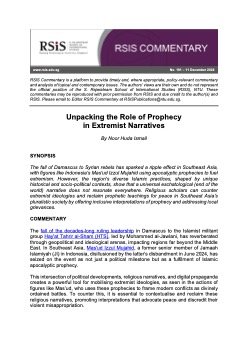
Unpacking the Role of Prophecy in Extremist Narratives

By Noor Huda Ismail

The fall of Damascus to Syrian rebels has sparked a ripple effect in Southeast Asia, with figures like Indonesia’s Mas'ud Izzul Mujahid using apocalyptic prophecies to fuel extremism. However, the region's diverse Islamic practices, shaped by unique historical and socio-political contexts, show that a universal eschatological (end of the world) narrative does not resonate everywhere. Religious scholars can counter extremist ideologies and reclaim prophetic teachings for peace in Southeast Asia’s pluralistic society by offering inclusive interpretations of prophecy and addressing local grievances.

Singapore: S. Rajaratnam School of International Studies (RSIS), 2024. 4p.

download
Exposure to and Sharing of Fringe or Radical Content Online

By Timothy Cubitt and Anthony Morgan

Using a large, national survey of online Australians, we measured unintentional and intentional exposure to fringe or radical content and groups online.

Two in five respondents (40.6%) reported being exposed to material they described as fringe, unorthodox or radical. One-quarter of these respondents (23.2%) accessed the content intentionally. One-third (29.9%) said the content they had seen depicted violence.

Fringe or radical content was often accessed through messages, discussions and posts online. Mainstream social media and messaging platforms were the platforms most frequently used to share fringe or radical content. Being a member of a group promoting fringe or radical content was associated with increased sharing of that content with other internet users.

Efforts to restrict access to radical content and groups online, especially on mainstream platforms, may help reduce intentional and unintentional exposure to and sharing of that content.

Canberra: Australian Institute of Criminology. 2024. 17p.

Download
Domestic Terrorism: How the US Legal System is Falling Short

By Camden Carmichael, Brooke Buxton, Seamus Hughes, and Clara Braun

Despite a rapid increase in domestic terrorism investigations in the United States, the threat that domestic terrorism poses to the homeland remains unclear. This is due to a lack of a comprehensive domestic terrorism legal framework that fully encompasses the variety of ideological groups present in the US. Using a sample of twenty-six QAnon and eighteen incel cases that have been federally prosecuted, our team examined how the US prosecutorial system utilises non-terrorism-related charges in addressing domestic violent extremism (DVE) cases. We propose a more inclusive DVE legal framework that expands the categorisation of VE ideologies, identifies specific DVE charges, and requires the engagement of the prosecutorial and probationary offices. By recognising Misogyny Motivated Violent Extremists (MMVEs) and Conspiracy Theory Motivated Violent Extremists (CTMVEs) as their own threat categories, it would allow researchers and practitioners to gain a deeper understanding of how pervasive the threat posed by these ideologies is.

The Hague: The International Centre for Counter-Terrorism (ICCT) , 2024. 21p.

download
After Action Report Washington Navy Yard September 16, 2013 Internal Review Of The Metropolitan Police Department Washington, D.C.

Metropolitan Police Department, Washington D.C.

On the morning of Monday, September 16, 2013, Aaron Alexis entered Building 197 at the Washington Navy Yard, where he served as an independent contractor, and carried out the most deadly workplace mass shooting in the Nation’s Capital in recent memory.

Over the course of 69 minutes, Alexis terrorized thousands of employees of Naval Sea Systems Command, firing indiscriminately from a shotgun he had legally purchased two days earlier and a handgun he had taken from a security guard after mortally wounding the guard. He would also get into multiple shooting engagements with responding law enforcement officers, seriously injuring a Metropolitan Police Department (MPD) officer. In his final confrontation with police, Alexis ambushed and fired upon another MPD officer. Fortunately, the officer was saved by his protective vest and was able to return fire, killing Alexis and ending his rampage. When it was over, Alexis had shot and killed twelve people and injured several others.

*****

In the aftermath of the incident, the members of MPD first and foremost want to remember and honor the twelve people who lost their lives. Twelve people went to work that Monday, but did not return home to their loved ones. It is truly a senseless tragedy beyond comprehension, and there are no words adequate enough to express our condolences. Our thoughts remain with the victims’ families and friends.

Metropolitan Police Department, Washington D.C. 2014.. 84p.

download
Suffering at the Margins: Applying Disability Critical Race Studies to Human Trafficking in the United States

By Rachel Rein

This Note explores human trafficking in the United States through Disability Critical Race Studies (DisCrit). First, the Note offers background on trafficking and applicable federal law. The Note shows that not only does trafficking disable people, but that people with preexisting disabilities are especially at risk for trafficking. Next, the Note indicates that trafficking law follows a Law-and-Order framework that retraumatizes marginalized survivors. Then, the Note introduces DisCrit and justifies its use for anti-trafficking advocacy. Finally, the Note applies DisCrit. By looking at trafficking law through DisCrit, it becomes clear that trafficking law must work with—not against—survivors to end human suffering.

42 Colum. J. Gender & L. 183 (2022).

download
In the Wrong Place at the Wrong Time: The Impact of Mass Shooting Exposure on Mental Health 

By Michele Ubaldi Matteo Picchio 

We study the effect of mass shooting exposure on individuals’ mental health by using the Panel Study of Income Dynamics. Our identification strategy relies on the quasi-randomness of mass shootings in a staggered difference-in-differences design. We compare changes in mental health outcomes of individuals living in affected cities with changes in matched individuals living in non-proximal and not-affected cities. We find that mass shootings have a substantial adverse impact on mental health, which persists for up to six years. This impact is not statistically significant for Black individuals, whereas it is slightly more pronounced among women and older cohorts

Bonn, Garmany:  IZA – Institute of Labor Economics  2024. 45p.

download
Caribbean Firearms: Agencies Have Anti-Trafficking Efforts in Place, But State Could Better Assess Activitiesx

By Chelsa L. Kenney

Some Caribbean nations, such as Haiti, Jamaica, and Trinidad and Tobago, have high rates of violence, including homicide. In 2021, Caribbean countries accounted for six of the world’s 10 highest national murder rates, according to the United Nations Office on Drugs and Crime. The United Nations and other organizations monitoring firearms trafficking have reported that a high percentage of the firearms used in these crimes have been trafficked from the U.S. GAO was asked to report on U.S. efforts to counter firearms trafficking to Caribbean nations. This report examines (1) what data and reporting show about the trafficking and use of firearms in Caribbean countries; (2) U.S. agencies’ efforts to disrupt firearms trafficking in these countries; and (3) agency efforts to track results of key efforts to combat firearms trafficking from the U.S. to the Caribbean. GAO reviewed federal firearms recovery and trace data, and other related U.S. agency data, analysis, and program information for fiscal years 2018 through 2022, the most recent available at the time of our review. GAO interviewed U.S. and Caribbean officials through in-person site visits in the Bahamas and Trinidad and Tobago, and through video conferences with Barbados, Dominican Republic, Haiti, and Jamaica. GAO selected these countries based on geographic diversity, the percentage of recovered firearms that were of U.S. origin, and U.S. agency efforts in country to combat firearms trafficking. What GAO Recommends GAO is recommending that State update the CBSI’s Results Framework to establish firearms trafficking specific indicators. State concurred.  

Washington, DC:  United States Government Accountability Office, 2024. 55p.

download
Gun Studies and the Politics of Evidence 

By Jennifer Carlson  

This review is about scholarly contributions to a hotly debated issue—gun policy. Teasing apart the politics of evidence within gun politics, it examines both how research agendas shape gun policy and politics as well as how gun policy and politics shape research agendas. To do so, the article maps out two waves of gun research, Gun Studies 1.0 and Gun Studies 2.0. Gun Studies 1.0 emphasizes scientific evidence as a foundation for generating consensus about public policy, and it includes criminological studies aimed at addressing guns as criminogenic tools, public health work aimed at addressing guns as public health problems, and jurisprudential scholarship aimed at adjudicating guns as legal objects. Reviewing how these approaches incited popular debates and public policies that, in turn, shaped subsequent conditions of gun scholarship, the article then turns to Gun Studies 2.0. Instead of taking evidence as self-evident, this body of scholarship tends to prioritize the meaning-making processes that make meaningful—or not— evidence surrounding gun policy. Accordingly, Gun Studies 2.0 unravels the political and cultural conditions of the contemporary US gun debate and broadens inquiries into gun harm and gun security. In addition to discussing areas for future study, this study concludes by encouraging gun researchers to attend to the politics of evidence as they mobilize scholarship not just to inform the gun debate but also to transform it

Annu. Rev. Law Soc. Sci. 2020. 16:183–202 

download
Migration, Culture Conflict, Crime and Terrorism

May Contain Mark-Ups

Edited by Joshua D. Freilich and Rob T. Guerette

The book“Migration, Culture Conflict, Crime and Terrorism,”edited by Joshua D. Freilichand Rob T. Guerette, is part of the Advances in Criminology series. It explores the complex interactions between migration, cultural conflicts, crime, and terrorism through a collection of scholarly works. Published by Ashgate in 2006, the book is divided into four parts, each addressing different aspects of these issues.

Part I: Migration, Religion, Culture, and Terrorism

1.Terrorism Rediscovered: Hans-Heiner Kühne examines the political motivations behind terrorism, emphasizing the need to distinguish between acts of war and criminal acts.

2.Culture or Conflict?: Roland Eckert discusses how conflicts generate collective identities and the role of migration in these conflicts.

3.The 21st-Century Kulturkampf: Shlomo Giora Shoham provides a historical and cultural analysis of the clash between fundamentalist Islam and Western culture,advocating for dialogue and mutual respect.

4.Post-9/11 Legislative Changes: Joshua D. Freilich, Matthew R. Opesso, and Graeme R. Newman compare the legislative and policy changes in the UnitedStates, Canada, and Australia following the 9/11 attacks, focusing on operations abroad, detainment of alleged terrorists, border security, and internal measures.

Ashgate Publishing, Ltd., 2006, 235 pages

READ
Terrorism: A Global Perspective

May Contain Mark-Ups

Edited by Mustafa Ozguler, Ph.D., Ali Ozdogan, Ph.D., Ekrem Mus, Halim Iltas, & A. Sait Yayla, Ph.D.

The book“Terrorism: A Global Perspective,”edited by Mustafa Ozguler, Ali Ozdogan, A. SaitYayla, Ekrem Mus, and Halim Iltas, is a comprehensive compilation of presentations from the 2nd Istanbul Conference on Democracy and Global Security held in June 2007. The book is divided into three parts:“Terrorism: A Global Problem,” “Terrorism and CivilSociety,”and“Issues in Terrorism.”Each section addresses different aspects of terrorismand global security, ranging from the global and local dimensions of terrorism, the role of civil society in counter-terrorism efforts, to specific issues such as the use of biometrics incounter-terrorism and the financing of terrorist organizations through cigarette smuggling.The book emphasizes the importance of international cooperation, understanding local factors, and addressing core issues to effectively combat terrorism and enhance global security.Key topics include the framing of terrorist threats by different countries, the impact of globalization on terrorism, the fundamental causes of terrorism such as social injustice and political conflicts, and the role of media in counter-terrorism. The book also exploresthe psychological profiles of suicide bombers, the evolution of right-wing violence in Japan,and the strategic use of small-scale terrorist attacks. Additionally, it proposes new community protection initiatives, such as “Building Terrorism Resistant Communities,”to enhance local resilience against terrorism. Overall, the book provides a multifaceted analysis of terrorism, combining theoretical insights with practical recommendations for policymakers, law enforcement, and civil society

The Turkish Institute for Security and Democracy, 2009, 357 pages

READ
God's Assassins: State Terrorism in Argentina in the 1970s

May Contain Mark-Ups

By Patricia Marchak

"God’s Assassins: State Terrorism in Argentina in the 1970s"by PatriciaMarchak, in collaboration with William Marchak, delves into the harrowing period of state terrorism in Argentina from 1976 to 1983[^1^][1]. During this time, an estimated 30,000 people disappeared under the military junta, with many being tortured and murdered[^2^][2]. The book provides a comprehensive analysis through interviews with a diverse range of participants, including military officers, priests, survivors, and journalists. These personal accounts, combined with historical documents and media reports,offer a multifaceted view of the causes and processes of state terrorism in Argentina.The narrative is structured to interweave historical context with personal stories, revealing the complex and often contradictory nature of the period.The book explores the roles of various institutions, such as the Catholic Church and the military, and their involvement in the repression. It also addresses the broader social and political dynamics, including the influence of Peronism, unionism, and guerrilla movements. Through these detailed interviews and analyses, Marchak uncovers the deep-seated ideologies and motivations behind the brutal regime, providing a nuanced understanding of this dark chapter in Argentine history.

McGill-Queen's Press, 1999, 393 pages

READ