

Open Access Free Library
CRIME+CRIMINOLOGY.jpeg

CRIME

Violent-Non-Violent-Cyber-Global-Organized-Environmental-Policing-Crime Prevention-Victimization

Posts in Property Crime
CRIMINOLOGY: A Read-Me.Org Modernized-Classic

By. Albert Morris. Modernized with a new introduction and discussion questions by Graeme R. Newman

Criminals are not born. They are made.

In this classic American textbook, first published in 1934 and revised in 1938, Albert Morris of Boston University set out to show how. He treated crime as a problem of human behavior, not of laws and punishments. He follows the offender’s life from beginning to end: the home and the street corner, the gang and the restless years of adolescence, the hardening of a criminal habit, and on through the police, the courts, probation, the jail, the prison, and parole.

Morris was clear-eyed, humane, and often witty, and many of his ideas were well ahead of their time:

  • He warned that most criminals never see the inside of a prison, so studies of convicts tell us little about criminals in general.

  • He exposed the “criminals of the upperworld,” respectable businessmen and politicians the law rarely touches, years before “white-collar crime” became a familiar phrase.

  • He argued that the causes of crime work differently at different ages, an early version of today’s life-course criminology.

  • He gave an unsparing account of the county jail, the chain gang, and the convict-lease system.

  • He traced the history of punishment from the gallows and the prison hulks to the rival Pennsylvania and Auburn prison systems.

  • He examined the first statistical tables for predicting success on parole, the forerunners of today’s risk-assessment tools.

This Read-Me.Org Modernized-Classic edition abridges the 1938 text to about seventy percent of its length and updates the language for today’s readers, while keeping Morris’s own voice. Historical charts are kept, and a new Introduction and Review and Discussion Questions by Graeme R. Newman place the book in the history of criminology.

It is suited to students of criminology, criminal justice, sociology, and the history of corrections, and to anyone curious about how Americans have tried to understand and control crime.

Read-Me.Org Inc. New York-Philadelphia-Australia. 2026. p.338.
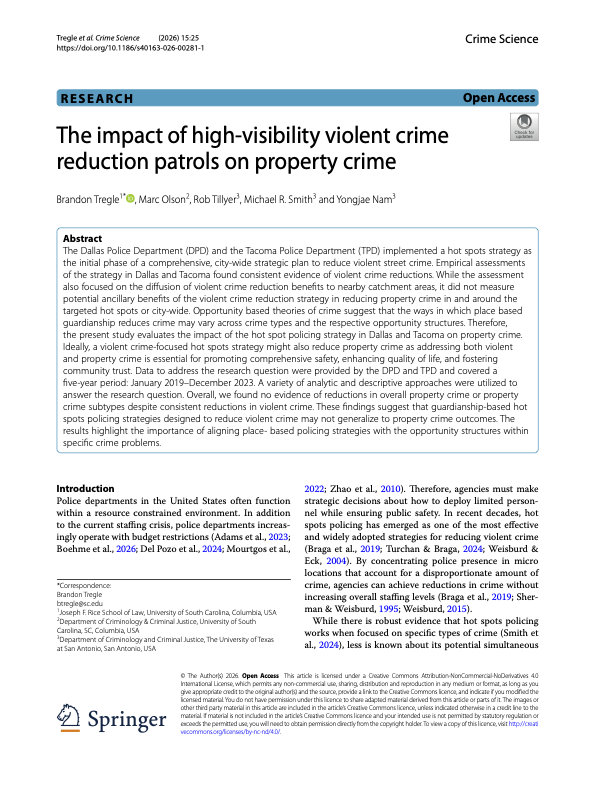
The impact of high-visibility violent crime reduction patrols on property crime

By Brandon Tregle, Marc Olson, Rob Tillyer, Michael R. Smith & Yongjae Nam

The Dallas Police Department (DPD) and the Tacoma Police Department (TPD) implemented a hot spots strategy as the initial phase of a comprehensive, city-wide strategic plan to reduce violent street crime. Empirical assessments of the strategy in Dallas and Tacoma found consistent evidence of violent crime reductions. While the assessment also focused on the diffusion of violent crime reduction benefits to nearby catchment areas, it did not measure potential ancillary benefits of the violent crime reduction strategy in reducing property crime in and around the targeted hot spots or city-wide. Opportunity based theories of crime suggest that the ways in which place based guardianship reduces crime may vary across crime types and the respective opportunity structures. Therefore, the present study evaluates the impact of the hot spot policing strategy in Dallas and Tacoma on property crime. Ideally, a violent crime-focused hot spots strategy might also reduce property crime as addressing both violent and property crime is essential for promoting comprehensive safety, enhancing quality of life, and fostering community trust. Data to address the research question were provided by the DPD and TPD and covered a five-year period: January 2019–December 2023. A variety of analytic and descriptive approaches were utilized to answer the research question. Overall, we found no evidence of reductions in overall property crime or property crime subtypes despite consistent
reductions in violent crime. These findings suggest that guardianship-based hot spots policing strategies designed to reduce violent crime may not generalize to property crime outcomes. The results highlight the importance of aligning place- based policing strategies with the opportunity structures within specific crime
problems.