Open Access Free Library
CRIME+CRIMINOLOGY.jpeg

CRIME

Violent-Non-Violent-Cyber-Global-Organized-Environmental-Policing-Crime Prevention-Victimization

Posts in Social Inequality
London Prisons: A Retrospective

by Graeme R. Newman

In 1862, Henry Mayhew and John Binny walked into eleven of London's most notorious institutions — Newgate, Millbank, Pentonville, Brixton, the prison hulks at Woolwich, Coldbath Fields, Tothill Fields, Wandsworth, Holloway, the House of Detention at Clerkenwell, and Horsemonger Lane — and wrote down exactly what they saw: the governors, the warders, the chaplains, and the prisoners themselves, in their own words.

This edition brings that record back to life. Each chapter has been fully rewritten in modern prose while preserving every fact, every interview, and every argument the original authors made — from their case against purposeless hard labour to their unflinching accounts of the convict nursery, the condemned cell, and the boy discharged from prison with no one waiting at the gate.

A new introduction and retrospective, written for this edition, follows these institutions into the present: which ones were demolished, which became galleries, cathedrals, and post offices — and which are still open today, cited in current inspection reports for the very same overcrowding and neglect that Victorian reformers were fighting a century and a half ago.

What you'll find inside: • Eleven Victorian prisons, reconstructed room by room, cell by cell • Real testimony from governors, chaplains, and prisoners — first offenders and lifelong professionals alike • A frank, often moving record of Victorian London's poorest and most desperate • A new historical retrospective connecting each institution to its fate today

Part social history, part true crime, part uncomfortable mirror — London Prisons: A Retrospective is a door-by-door tour of a city's conscience, then and now.

Read-Me.Org Inc. New York-Philadelphia-Australia. 2026. p.339.

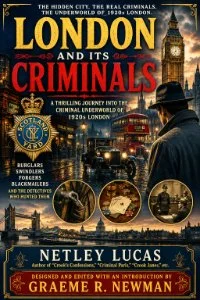
London and Its Criminals: A Portrait of London's Underworld in the 1920s

by Nettly Lucas (Author), Graeme Newman (Introduction)

Step into the hidden London of the 1920s—a city of fashionable hotels and crowded streets, respectable suburbs and shadowy back rooms, Scotland Yard detectives and professional criminals who made deception, burglary, fraud and blackmail their trade.

First published in 1926, London and Its Criminals is Netley Lucas’s remarkable journey through the criminal underworld of interwar London. Rather than simply recounting celebrated crimes, Lucas sets out to describe criminals themselves: how they lived, where they gathered, the methods they used, the slang they spoke, and the elaborate machinery of policing that pursued them.

The result is an extraordinary period portrait of crime and criminal justice.

Lucas takes his readers inside Scotland Yard and its Criminal Record Office, explaining the growing importance of fingerprints, criminal records and systematic detection. From there he ventures into a very different London—the world of professional burglars, pickpockets, confidence tricksters, jewel thieves, forgers, blackmailers and criminal gangs. He introduces his readers to figures he describes as the “Kings” and “Queens” of the Underworld: men and women who move between cheap public houses, prosperous suburban homes, exclusive restaurants and fashionable hotels while living secret criminal lives.

Among the book’s most striking chapters are Lucas’s accounts of “master criminals” and “crooked women.” His characters include expert burglars, ingenious forgers, sophisticated jewel thieves and accomplished confidence tricksters. Some are frightening, some ingenious, some surprisingly ordinary. Again and again Lucas emphasizes the unsettling proximity of the criminal world to respectable society.

Yet London and Its Criminals is more than a gallery of rogues. Lucas was writing at a moment when attitudes toward crime and punishment were beginning to change. He opens the book by discussing the emerging scientific study of crime, criminal psychology, rehabilitation and the limitations of imprisonment—questions that remain central to debates about criminal justice a century later.

Lucas is also an unusually provocative guide. He claims familiarity with criminals themselves and repeatedly describes conversations, meals and encounters with people operating on the wrong side of the law. His London is consequently not the London of official police reports alone. It is a city observed from its restaurants, streets, clubs, pubs, courtrooms and criminal meeting places.

Modern readers should approach some of Lucas’s language, assumptions and sweeping judgments as products of their time. That is also part of the historical importance of the book. It provides a vivid primary-source window into how crime, policing, punishment, class and the urban underworld were represented during the 1920s.

This new Read-Me.Org Classic Reprint presents Lucas’s fascinating account to a new generation of readers, accompanied by a detailed new Introduction by Graeme Newman that places the work in its historical and criminological context.

For readers interested in true crime, criminology, Scotland Yard, policing, criminal history, London history, organized crime and the social history of the 1920s, London and Its Criminals offers a fascinating journey into a vanished—but sometimes surprisingly familiar—criminal world

Read-Me.Org Inc. New York-Philadelphia-Australia. 2026. p.194.

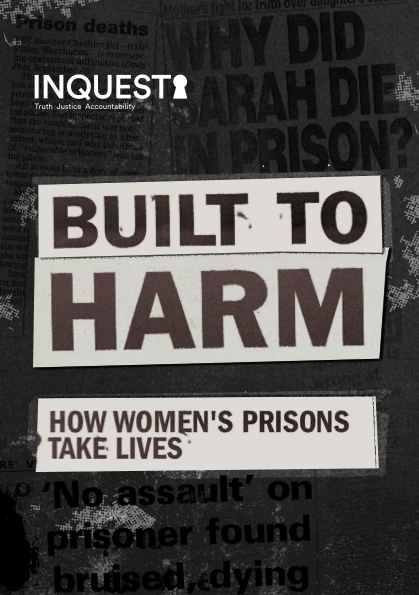
Built to Harm: How Women's Prisons Take Lives

By Jessica Pandian

Through foregrounding the circumstances of seven deaths in women’s prisons and highlighting issues which have persisted for decades, this report provides further evidence that the women’s prison estate is – and for decades has been – incapable of adequate reform. An analysis of the deaths reveals the key thematic issues, which fall under three categories: 1. not believing prisoners in crisis and at risk, 2. failings in prison processes, and 3. imprisonment as the default to social inequality. Lastly, the report provides a statistical analysis of deaths and self-harm in women’s prison from 2018 - 2024If we do not address the current prison crisis and reflect on its harmful impact, it is inevitable that more people will be exposed to the harms of the prison environment and die. This report is a blunt reminder to the Government to act now by committing to dismantle the women’s estate and halt all prison building.
This report exposes the successive failures of reforms, strategies and frameworks introduced in the policy around women’s prisons in England and Wales since the launch of the Ministry of Justice’s Female Offender Strategy in 2018.1 The strategy’s intended purpose was to improve lived conditions in women’s prisons and reduce the women’s prison population. 2018 also marks the year in which INQUEST published 'Still Dying on the Inside', 2 the third INQUEST publication providing unique insight into deaths in women’s prisons.

Abnormal Man : Volume 1 --Digest of Literature

By Arthur MacDonald. Introduction by Graeme R. Newman

What does it mean to be “abnormal”? Who decides? And how have these judgments shaped modern science, education, and criminal justice?

First published in 1893, Arthur MacDonald’s Abnormal Man is one of the earliest American attempts to systematically study human difference through the emerging tools of psychology, anthropology, and criminology. Drawing on international research—from European criminal anthropology to American child-study movements—MacDonald sought to classify the physical, mental, and moral traits considered “aberrant” in his era. His work reflects the hopes and anxieties of a society confronting rapid industrialization, immigration, social change, and new scientific approaches to crime and mental health.

To the modern reader, Abnormal Man reveals both the ambition and the pitfalls of nineteenth-century science. Its pages contain pioneering observations about child development, deviance, and social responsibility, alongside early theories—now discredited—about heredity, physiognomy, and race. What emerges is a vivid and sometimes unsettling portrait of a culture striving to understand human variation without the benefit of modern psychology or ethical safeguards.

This new Read-Me.org edition presents Abnormal Man as both a historical artifact and a gateway to critical reflection. It illustrates how scientific thought evolves, how cultural bias can shape research, and how early debates about abnormality laid the groundwork for contemporary approaches to mental health, special education, criminology, and social policy.

A foundational text at the crossroads of science and society, Abnormal Man invites readers to explore the origins of modern debates about deviance, diversity, and the boundaries of the “normal.”

Read-Me.Org Inc. New York-Philadelphia-Australia. 2025. p.193.

The political economy of illicit drug crops: forum introduction

By Frances Thomson, Patrick Meehan & Jonathan Goodhand (02 Apr 2024):

his article and the forum it introduces examine illicit drug crop (IDC) economies from agrarian perspectives. Examining IDCs as a group implies analysing how prohibition distinguishes them from other (licit) crops. We identify seven mechanisms through which prohibition shapes the agrarian political economy of IDCs and explore how these mechanisms and their effects generate distinctive patterns of development and political action amongst ‘illicit peasantries’. We also examine connections between illicit and licit crops, including how licit crop crises and illicit crop booms intertwine. We argue that IDC economies provide a bulwark for smallholders but are by no means peasant idylls.

The Journal of Peasant Studies. 2024. 39p.

Breaking the Devil's Pact: The Battle to Free the Teamsters from the Mob

By  James B. Jacobs and Kerry T. Cooperman

In 1988, Manhattan U.S. Attorney Rudy Giuliani brought a massive civil racketeering suit against the leadership of the International Brotherhood of Teamsters (IBT), at the time possibly the most corrupt union in the world. The lawsuit charged that the mafia had operated the IBT as a racketeering enterprise for decades, systematically violating the rights of members and furthering the interests of organized crime. On the eve of trial, the parties settled the case, and twenty years later, the trustees are still on the job.

Breaking the Devil’s Pact is an in-depth study of the U.S. v. IBT, beginning with Giuliani’s lawsuit and the politics surrounding it, and continuing with an incisive analysis of the controversial nature of the ongoing trusteeship. James B. Jacobs and Kerry T. Cooperman address the larger question of the limits of legal reform in the American labor movement and the appropriate level of government involvement.

New York; London: NYU Press, 2011. 320p.

Illicit Financial Flows in the Mekong

By Kristina Amerhauser

Illicit financial flows (IFFs) are a serious concern in the Mekong region, which includes Cambodia, Lao People’s Democratic Republic (PDR), Myanmar, Thailand and Vietnam. Facilitated by state-embedded actors, each year vast amounts of illicit proceeds are generated, moved and laundered across the region and beyond in offshore tax havens. This distorts the local economies; deprives the state of income needed for health, education and infrastructure; and deepens inequality. This paper is part of a comparative research project that tests and applies the ‘IFFs pyramid’, a new framework of analysis of IFFs proposed by Reitano (2022), in the context of the Mekong region. Based on a review of secondary literature, it provides an overview of financial flows, trade flows and informality – the three main means by which IFFs are enabled, moved and held according to the ‘IFFs pyramid’ – and discusses how IFFs manifest across the Mekong. It finds that: • There is widespread evidence that each flow is significant in the Mekong and that flows converge and intersect. Nevertheless, current responses to IFFs almost entirely focus on the formal financial system. • Porous borders and strong trade relationships, including with neighbouring China, offer abundant and diverse opportunities for trade-based money laundering (TBML). Lack of capacity to identify misclassified goods and low cross-border collaboration are key impediments to its response. • There are a large number of special economic zones (SEZs), some of which are treated as ‘lawless zones’ where national governments have no authority. This creates widespread opportunities for value to be extracted, under-reported and comingled with legitimate flows. They have also been linked to other illicit markets, such as drug trafficking, the illegal wildlife trade (IWT), human trafficking and financial crimes, and provide the space to generate and launder illicit proceeds in a multitude of ways. • The big informal economy, coupled with the large number of people who remain outside the formal financial system, limits the efficiency of regulatory and oversight instruments. • Political will to tackle IFFs in the Mekong appears to be limited, in large part due to the involvement of Chinese actors. In fact, some actors in charge of the response to IFFs seem to have created loopholes to their own benefit. State-embedded actors are part of the problem, both as a source of IFFs as well as by further enabling them. This research shows that the IFFs pyramid proposed by Reitano (2022) is a helpful tool for organising information related to IFFs in the Mekong and for improving understanding of the major negative impact and harms that IFFs exert on societies and economies of the region  

SOC ACE Research Paper No. 30. University of Birmingham. 2023, 32pg