
Open Access Free Library
CRIME+CRIMINOLOGY.jpeg

CRIME

Violent-Non-Violent-Cyber-Global-Organized-Environmental-Policing-Crime Prevention-Victimization

Posts tagged criminology research
CRIMINOLOGY: A Read-Me.Org Modernized-Classic

By. Albert Morris. Modernized with a new introduction and discussion questions by Graeme R. Newman

Criminals are not born. They are made.

In this classic American textbook, first published in 1934 and revised in 1938, Albert Morris of Boston University set out to show how. He treated crime as a problem of human behavior, not of laws and punishments. He follows the offender’s life from beginning to end: the home and the street corner, the gang and the restless years of adolescence, the hardening of a criminal habit, and on through the police, the courts, probation, the jail, the prison, and parole.

Morris was clear-eyed, humane, and often witty, and many of his ideas were well ahead of their time:

  • He warned that most criminals never see the inside of a prison, so studies of convicts tell us little about criminals in general.

  • He exposed the “criminals of the upperworld,” respectable businessmen and politicians the law rarely touches, years before “white-collar crime” became a familiar phrase.

  • He argued that the causes of crime work differently at different ages, an early version of today’s life-course criminology.

  • He gave an unsparing account of the county jail, the chain gang, and the convict-lease system.

  • He traced the history of punishment from the gallows and the prison hulks to the rival Pennsylvania and Auburn prison systems.

  • He examined the first statistical tables for predicting success on parole, the forerunners of today’s risk-assessment tools.

This Read-Me.Org Modernized-Classic edition abridges the 1938 text to about seventy percent of its length and updates the language for today’s readers, while keeping Morris’s own voice. Historical charts are kept, and a new Introduction and Review and Discussion Questions by Graeme R. Newman place the book in the history of criminology.

It is suited to students of criminology, criminal justice, sociology, and the history of corrections, and to anyone curious about how Americans have tried to understand and control crime.

Read-Me.Org Inc. New York-Philadelphia-Australia. 2026. p.338.

"Another case of Ruthless Robbery…" Violence, Crime and the Local Press in a provincial City of Greece

Dr. Stratos Georgoulas

This paper͛s hypothesis is that the press, through the presentation of criminal incidents, transmits an evaluative knowledge determining this way, desirable objectives and propagating for canonistic types of behaviour. The daily knowledge as a constitutive element of the daily reality is a condition of interaction between the members of a society. In that sense, the local press that transmits this daily knowledge constitutes a dominant structuring factor of this reality.

The research which is based on content analysis of newspaper articles of the whole local press of Mytilene (the capital of the prefecture of Lesbos in Greece) published between January March 2004 and additional interviews from journalists aims to illustrate the following:

a. The concept of criminality is being constructed both qualitatively and quantitatively through local press and not vice versa.

b. The local press evaluates negatively illegal behaviours, positively the austerisation of social control, while in most cases it cancels any relevance with the social frame of criminality.

c. The local press with the dramatic narrations that uses it causes fear of victimisation.

d. The journalists transmit evaluative knowledge in an attempt to cover the lack of knowledge of real criminological data.

International Journal of Academic Research in Business and Social Sciences November 2013, Vol. 3, No. 11 ISSN: 2222-6990.

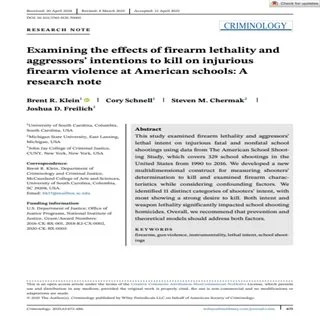
Examining the Effects of Firearm Lethality and Aggressors’ Intentions to Kill on Injurious Firearm Violence at American Schools: A research note

By Brent R. Klein,  Cory Schnell,  Steven M. Chermak,  Joshua D. Freilich

This study examined firearm lethality and lethal intent on injurious fatal and nonfatal school shootings using data from The American School Shooting Study, which covers 329 school shootings in the United States from 1990 to 2016. We developed a new multidimensional construct for measuring determination to kill and examined firearm characteristics while considering confounding factors. We identified 11 distinct categories of shooters’ intent, with most showing a strong desire to kill. Both intent and weapon lethality significantly impacted school shooting homicides. Overall, we recommend that prevention and theoretical models should address both factors.

Criminology. 2025;63:673–686.