Open Access Publisher and Free Library
CRIME+CRIMINOLOGY.jpeg

CRIME

Violent-Non-Violent-Cyber-Global-Organized-Environmental-Policing-Crime Prevention-Victimization

Posts tagged Public opinion
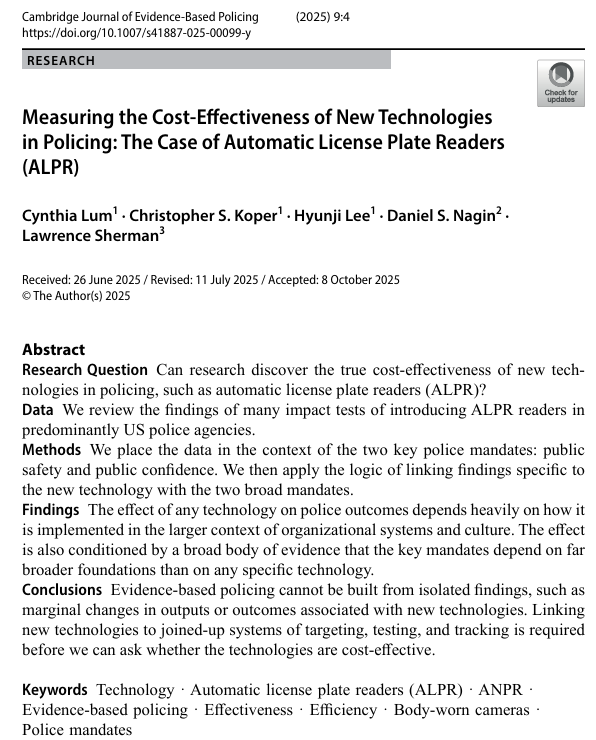
Measuring the Cost-Effectiveness of New Technologies in Policing: The Case of Automatic License Plate Readers (ALPR)

By Cynthia Lum, Christopher S. Koper, Hyunji Lee, Daniel S. Nagin, Lawrence Sherman

Research Question Can research discover the true cost-effectiveness of new technologies in policing, such as automatic license plate readers (ALPR)? Data We review the findings of many impact tests of introducing ALPR readers in predominantly US police agencies. Methods We place the data in the context of the two key police mandates: public safety and public confidence. We then apply the logic of linking findings specific to the new technology with the two broad mandates. Findings The effect of any technology on police outcomes depends heavily on how it is implemented in the larger context of organizational systems and culture. The effect is also conditioned by a broad body of evidence that the key mandates depend on far broader foundations than on any specific technology. Conclusions Evidence-based policing cannot be built from isolated findings, such as marginal changes in outputs or outcomes associated with new technologies. Linking new technologies to joined-up systems of targeting, testing, and tracking is required before we can ask whether the technologies are cost-effective.

Cambridge Journal of Evidence-Based Policing (2025)

The role of UK policing in economic growth

By Crest Advisory with RSM UK Consulting

Economic growth is the number one mission of the Government in the UK, seeking to restore stability, increase investment and reform the economy to improve productivity, prosperity, and living standards. This commitment has been made in the context of a sustained period of economic stagnation, throughout which there has been an ongoing conversation as to whether the right levers are being pulled to achieve economic growth. The Office of the Chief Scientific Adviser for the National Police Chiefs’ Council (NPCC) commissioned us to understand the role of policing as a lever - our research seeks to collate existing evidence as well as identify where there are opportunities to develop this evidence in the future. This research also falls within the wider discussion on police funding, police productivity and police reform which is particularly relevant given that the Home Office will be looking to find savings ahead of this year’s spending review as an unprotected government department, ongoing debate about the police funding formula and growing financial pressures on police forces. Science and technology has a significant role to play in police efficiency and effectiveness, but also growth. The NPCC’s Science and Technology Strategy sets a clear ambition for policing “to deliver the most science and technology led police service in the world”. Often, our understanding of policing impact is focused on implementation and public safety outcomes, but economic outcomes have the potential to shift the narrative in terms of how we define an effective and efficient police response. Our work, in partnership with RSM UK Consulting, has sought to understand the evidence between policing and economic outcomes, from which we have produced a logic model to understand these relationships (a logic model conceptualises the links between activities and key outcomes). While we have not been able to estimate the scale of impact of UK policing on economic growth, we hope this logic model can act as a framework for partners to use to further develop the evidence base around the impact of policing on economic outcomes, specifically designing evaluations with these outcomes in mind. In time, this evidence may begin to change how we understand the positive impact of policing on individuals, businesses and communities in England and Wales - with the potential for positive economic outcomes influencing future decisions on funding allocations and commitments to specific policing initiatives and operational interventions. Furthermore, growth could sit alongside efficiency and effectiveness as key metrics for success in policing.

London: Crest Advisory, 2025. 69p.

AI in Policing: international lessons and domestic solutions

By Justice

1. Artificial intelligence (“AI”) is rapidly reshaping public services, and policing is no exception. The pace of innovation, the scale of private sector investment, and the UK Government’s explicit ambition to “mainline AI into the veins of the nation” mean that AI deployment in policing is not a distant prospect but an accelerating reality. This brings significant opportunities: enhanced investigative capability, faster processing of digital evidence, improved risk assessment, and the potential to intervene earlier to prevent harm. Yet it also carries profound risks for human rights, the rule of law, and public trust. The police occupy a uniquely powerful position in our democratic society; integrating AI into that environment without the right safeguards risks entrenching discrimination, undermining lawful decision making, and eroding communities’ confidence in policing2. This report asks a central question: what must be in place for AI in policing to be trustworthy, value for money, effective in achieving policing goals, and compliant with human rights and the fair administration of justice? To answer this, JUSTICE carried out international research, examined domestic developments, and convened stakeholders across policing, government, civil society, regulators, academia, and industry. Across this work, five lessons emerged, each of which signals not only what must be done, but the urgency of acting now while the UK remains at a crossroads.

London: Justice, 2025. 62p.