Open Access Publisher and Free Library
CRIME+CRIMINOLOGY.jpeg

CRIME

Violent-Non-Violent-Cyber-Global-Organized-Environmental-Policing-Crime Prevention-Victimization

Posts tagged organization
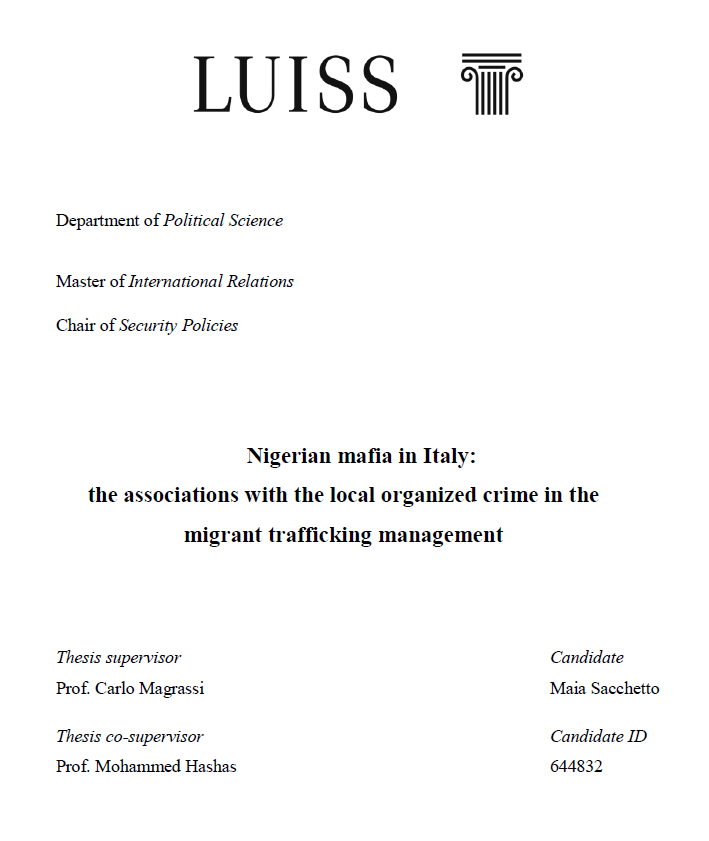
  Nigerian mafia in Italy: the associations with the local organized crime in the migrant trafficking management

By  Maia Sacchetto

  Premising that there are more flexible forms of Nigerian crime, such as small and scattered groups not in connection with each other that operate mainly as drug dealers of small districts in the suburbs of northern Italy, this research focuses on the most structured forms of criminal organizations, those directly descended from the cultist circles born in Nigeria in the '60s and resulted in real mafia associations already in the motherland and then extended throughout Europe. The choice of this theme and this very specific category of Nigerian organized crime is based on the belief that well-structured and organized groups are more dangerous and difficult to counter for three reasons basically: the first is that it is rarer for associates to decide to betray the group to favor information to the police or intelligence. This is because of the closer ties between group members (and in this case this element takes on an even more incisive relevance since the subject is an ethnically based organized mafia in which ethniccultural ties provide the basis for interaction between associates), but also and especially because of the coercive and intimidating forces between members of mafia associations towards the ones prone to cheat on the group; the second is developed from the assumption that a more sophisticated internal structure of the association also corresponds to more elaborate modus operandi and operational strategies that allow prosecutors of illicit activities to camouflage or hide the proceeds of illicit activities; the third reason is closely related to the first and second and consists in the fact that mafia associations that are highly organized and capable of taking advantage of substantial material resources are also more likely to act in a capillary, widespread, large-scale and sprawling manner to the point of infiltrating the legal economy. As will be described in the first chapter of this research, the Black Mafia originated in Nigeria as a protest movement against constituted power and composed mainly of members of Nigeria's leading universities. Over time it expanded, heightened the violence of its manifestations, and began to move out of the realm of mere ideological rebellion by directly affecting public institutions. In a short time, the cults turned into full-fledged clans and began to act in Nigeria as the Italian mafia acts in Italy, intimidating political and economic opponents who would stand between their illicit activities and the achievement of their goals: the accumulation of wealth and power. From the outset, these associations are thus characterized by a high degree of pervasiveness in the political, social and economic structure of their country, as well as multifacetedness by dealing with a massive and varied range of illicit activities, including support in the arms trafficking of terrorist groups such as Boko Haram. With the conclusion of the Cold War, the tearing down of the Berlin Wall and restrictions in the mobility of people, and the emergence of the new globalized and interconnected world, the Black Mafia, which had already shown a remarkable predisposition to expand and sprawl, crossed its national borders. Following a progressive evolution, it has developed into a form of transnational organized crime which according to the UNODC represents the main threat to the security and political and economic stability of states (UNODC, 2006)1 . Undergoing continuous metamorphosis and adapting immediately to the changing needs of the market and globalization, it has then become increasingly sophisticated and pervasive (UNODC, 2018)2 . Out of sheer opportunism, it started allying itself with other forms of crime in order to strengthen its organization and to extend to more and more operators: drug traffickers, arms traffickers, human traffickers, up to encompassing operators that act daily in a regime of legality, all in order to increase their revenues 

Digest of Cyber Organized Crime

By United Nations Office on Drugs and Crime (UNODC)

The present case digest contains an analysis of cases of cyber organized crime. The digest is global in scope and attempts, to the extent possible, to ensure an equitable representation of cases from different geographical regions and legal systems. On the basis of more than 100 cases from more than 20 jurisdictions, observations are made about the ways in which cyber organized crime is identified in case law and how this illicit activity is investigated, prosecuted and adjudicated across jurisdictions. The case digest examines the structure and organization of cyber organized criminal groups, tools used by perpetrators of cyber organized crime, types of cyber organized crime and procedural issues relating to the investigation, prosecution and adjudication of cyber organized crime cases. The case digest contains summaries of relevant judicial proceedings concerning cyber organized crime, organized according to theme. The ultimate goals of the digest are to identify cases involving cyber organized crime and the manner in which such crime has been investigated, prosecuted and adjudicated in different areas of the world. The digest concludes by identifying challenges to investigating, prosecuting and adjudicating cases involving cyber organized crime, as well as the lessons learned for criminal justice professionals, including some of the challenging aspects of criminal justice responses to such crime.

Vienna: UNODC, 2021.144p.

Deep-Rooted Interests: Licensing Illicit Logging in Guinea-Bissau

By Lucia Bird and A. Gomes

The widespread devastation of Guinea-Bissau’s forests – a process coordinated by the military – was curtailed in April 2015 by the imposition of a five-year moratorium on logging exports. Now, the current government looks set to lift the ban – raising widespread concerns of a resurgence in illicit logging.

Drivers for lifting the moratorium may be linked to the powerful interests at play in the sector, both within Guinea-Bissau’s elite and those of the Chinese business community, which have long-standing links to the logging business in the country. These interests, and particularly those of Prime Minister Nuno Gomes Nabiam, were highlighted by a significant seizure of illicit logs by the Judicial Police in November 2020.

Geneva: Global Initiative Against Transnational Organized Crime. 2021, 17p.